Showing posts with label Sketch. Show all posts

Saturday, June 1, 2013

Globular Cluster Messier 14

For amateur astronomers, spring may be galaxy observing season, yet summer provides the opportunity to observe most of the globular clusters that inhabit the outer halo of our galaxy.  Globular clusters are to me, the most beautiful objects to observe through a telescope as they are tight swarms of stars- containing well over 100,000 stars (and some many more!) all within an apparent diameter of a few arc-minutes.  Many folks describe them as diamonds spilled on black velvet and that description is apt.  At left is an image I took of the large globular cluster M 22 in Sagittarius last summer with my Canon T2i through my TEC 140.  (It is a single exposure, not multiple exposures integrated)

These clusters are tightly bound by gravity which gives them a general spherical shape and a higher density of stars toward the center.  There are upwards of 150 known globular clusters in our Milky Way galaxy. While they contain some of the oldest stars in the Universe, the origin and role of globular clusters in the evolution of galaxies remains unclear and this is an area of active research.   Astronomers who study galactic evolution have been able to detect globular clusters in most of the galaxies they have studied, and some galaxies contain extraordinary numbers. For instance, the great Andromeda Galaxy has more than 500, and the giant elliptical galaxy M 87 in Virgo contains approximately 13,000!  (See this post for my observation of the jet emanating from the center of M 87).

Last night I was out observing and spent quite a bit of time observing globular clusters in the constellation of Ophiuchus.  There are 20 reasonably bright globular clusters in this constellation, most if not all of which should be visible in my 140mm refractor under reasonably dark skies.  Among these globulars are 7 Messier objects, from M 107 which is the dimmest of the Messier globular clusters to the majestic clusters M 10 and M 12.  After observing these, as well as M 62, M 9 and M 19, I slewed the telescope to M 14 and was surprised at what I saw.

I have observed all of the Messier objects at some point years ago, yet  I am not sure that I have returned to this cluster since that time.  The cluster, discovered by Messier in 1764, lies in a remote area of the constellation and at first glance the cluster is unimpressive.  It is difficult to resolve many stars and appears more nebulous than cluster like...which is probably why it did not stick in my memory as a great visual target.  More experienced now than I was those years ago, I began to wonder why this cluster appeared so large and reasonably bright in my telescope yet resolution of the stars was so difficult.  A little reference checking and I learned that this globular contains several hundred thousand stars and has an absolute luminosity about 400,000 times that of our own sun!  This cluster is about 30,000 light years away, and as it turns out, the light from the cluster is obscured by an extensive amount of dust in our galaxy.  Below is my sketch from last night of M 14 at a magnification of 163x.


The cluster has a brighter central region with a fainter outer halo and it is difficult to resolve member stars (the sketch is generous in this regard).  The cluster has a grainy appearance and with averted vision it does seem that some faint stars come and go.  The cluster is approximately magnitude 7.6 and has an apparent diameter of 11 arc minutes.  Again, with a cluster this large and bright one would expect to resolve stars.   Often, it is not simply the aesthetics of objects in the eyepiece that make an observation interesting; it is knowing what it is that one is looking at.  In this case, one of the most impressive facts about this cluster is that it has a diameter of approximately 110 light years.  Our galaxy is approximately 100,000 light years across, so it would take only 1000 of these clusters to span the galaxy.  that may not sound impressive until one considers that our galaxy has between 200 and 300 billion stars...


Sunday, May 12, 2013

Mothers Day Sun

Happy Mother's Day to all the moms out there, especially the ones for whom I am about to prepare brunch: My favorite super saucy spouse - Beth; and of course our own Mom's Lynne and Wanda.

I awoke this morning much earlier than the family and set up my Stellarvue 90mm refractor to observe the Sun in white light. Seeing was quite good with only a gentle breeze and numerous spots.  I brewed some coffee, grabbed my pencil and clipboard and headed out to make a sketch of the Mothers Day Sun...and much to my surprise in the 15 minutes I was inside the gentle breeze had become 10-15 mph gusts!  Needless to say, this made sketching difficult.  Below is my sketch completed at 1500 UT (8:00 Am MST).


At the time of my sketch, the Sun was at an altitude of 31 degrees and an azimuth of 87 degrees.  We are in Carrington rotation 2136, and the Official NOAA sunspot number for today is 145.

Sunday, March 17, 2013

Solar Stellarvue 90T

A couple years ago I owned a very nice 90mm triplet refractor from Stellarvue, which I had sold to pay for some other astronomy gear.  Recently, after trying other small aperture scopes, I decided that I wanted to purchase another one of these fine refractors.  At 90mm, the scope is a terrific size to take anywhere, and also has a bit more light gathering than the 80mm telescopes that dominate the small scope market. Additionally I wanted a telescope to use for white light solar observing that would compliment my Lunt 60mm HA without creating balance headaches when used simultaneously.  As it happened, Stellarvue had on their website a used SV 90T, with a carbon fiber tube and a very nice feathertouch focuser.  While one pays a slight premium buying used from Stellarvue as opposed to a private individual, Stellarvue does warranty their used telescopes for two years, just as they do with a new instrument.  To sweeten the deal, they also included a very nice, new soft-sided case with room for much more than just the telescope.  After a few days deliberation, I contacted Stellarvue and ordered the telescope.  It arrived in less than 48 hours, along with wind, dust and scattered clouds...typical with a new telescope, and quite frustrating after a week of clear steady night time skies that define the desert southwest!

While I have not yet had a chance to really shake down the telescope at night (other than point it at a few bright targets like Jupiter and the moon last night) I did have an extensive solar session with it this morning.  All in all, it provides exactly the view of the Sun I was expecting- sharp and detailed when used with my Lunt Solar Systems Herschel Prism.  I am fortunate to have a TEC 140 and compared to that telescope, the SV 90T definitely shows slight color on the limb of the Sun.  There is a very thin blue-green ring along the limb of the Sun, regardless of eyepiece used.  It is not in any way obtrusive and had I not been looking specifically for this color, I may not have noticed it.

Below is a sketch I made of the Sun, completed at 1631 UT 3.17.2013.  Although hard to note in my scan of my sketch, the 90T revealed very fine detail in spot regions, brighter facula surrounding regions near the limb, as well as hinting at granulaton in moments of very steady seeing.


So far, I am quite pleased with this small refractor.  It is light weight and delivers all the detail I expected given the 90mm aperture.  Below you can see my initial attempt at piggybacking my Lunt 60mm HA solar telescope on the SV90T.  It is likely not my final piggyback solution, but it was an exceptional experience being able to go back and forth between images.  Together, these telescopes and required accessories weigh  less than 20 lbs, and likely closer to 15.


Saturday, January 5, 2013

Comet 2012 K5 (Linear)

Comets are engaging objects to observe, particularly as the come through the inner solar system nearer the Earth and Sun. They can be quite rewarding to the observer who, following them from night to night, will see subtle changes in brightness and shape along with the occasional outbursts and dramatic changes. I enjoy reading the blog of Carl Hergenrother, The Transient Sky, as he regularly observes comets as part of his professional and personal work as an astronomer. In December and again this month Carl wrote about comet 2012 K5 (Linear) noting that 2012 K5 "is a long-period comet discovered by the LINEAR near-Earth asteroid survey program on May 25, 2012. At the time the comet was around magnitude 17-18. Though it passed through perihelion on Nov. 28 at a distance of 1.14 AU, the comet reached its brightest last month as it rapidly approached Earth. Close approach occurred at the very end of December at a distance of 0.29 AU (27 million miles or 44 million km).  Recent visual observations place the comet around magnitude ~8.6 at the end of December. Since the comet is now moving away from the Earth and Sun this month, it should rapidly fade to magnitude ~11.4 by the end of the month. The comet is now an evening object as it moves from Auriga through Taurus into Eridanus."

Last night was the clearest night we have had in about a week at the observatory, and I took advantage of the moonless sky to take a look at this outbound comet while it is still bright enough to appreciate. Using the Minor Planet Ephemeris and Comet Service I generated coordinates for the comet and directed the telescope to the specified location. (Note that this comet is moving rather quickly to the southwest, at a rate of 11.38 arcseconds per minute last night, so it is important that if you plan to observe this comet that you generate ephemerides for very close to the time you will be observing.) Currently, the comet is in Taurus and during the time of my observation was approximately .326 AU from Earth, which is about 2.7 light minutes.  The comet was immediately visible in an 8mm eyepiece (122X) using my TEC 140mm refractor. Below is my sketch of the comet from approximately 0440 UT on the 5th of January.

I have a difficult time estimating the brightness of diffuse objects, yet I would suspect that the comet is somewhere between magnitude 10 and 10.5. The nucleus is somewhat condensed and the coma fades quickly. There did appear to be a brighter section of a tail stretching out to the northeast, as I tried to capture in the sketch. This "brighter" ray was best seen with averted vision, but was not a difficult feature to note.

While I enjoy the conveniences of using the internet to generate precise coordinates as well as a "go-to" mount, if you are the type that enjoys the hunt, there is a detailed .pdf finder chart here that shows the comets path through late January. Whichever method you prefer, I encourage you to observe this interloper while you can!

Tuesday, January 1, 2013

Lost Pleiad Blog - 3 years and counting!

Happy New Year!  Today is a day of celebration at the Lost Pleiad Observatory.  Not only is it the New Year, but it is the third birthday of this blog, and Beth and I are happily celebrating our 17th wedding anniversary!  (No wonder I can hardly remember watching the Rose Bowl over the last 17 years... fortunately, Arizona has never played in that "granddaddy of them all"...).
As is my tradition, I like to observe the Sun on holidays- see this post from last year. Today I made a white light sketch of the Sun, complimented by an image of the Sun, taken using the Canon T2i DSLR camera I acquired earlier this year to photograph the Transit of Venus.

They make a nice pair, although looking at the image from the camera is nowhere near as satisfying as the eyeball view I had.  The image was taken first, at 11:58 AM (1858 UT) through my TEC 140 and a Lunt Solar Systems Herschel Prism.  There was a bit of high cirrus which helped to steady the image, yet there was also a lot of sunlight being diffused by the clouds...thanks to Photoshop  that diffuse light is no longer an issue!  Click to enlarge:

After taking the above image, I made a sketch using a 17mm Delos eyepiece and a single polarizing filter.  Again, the high level cirrus helped the seeing and I was able to see many spots in the active regions.  According to spaceweather.com today's sunspot number is 87.  You will quickly notice that the sketch is reversed horizontally from the image-  I flipped the image as just about any image of the Sun you look at will have north at the top and west to the right.  The sketch below represents the eyepiece view with west to the left. Click to enlarge:


The sketch was completed at 12:15 PM local time (1915 UT) and it a fairly accurate representation of the spot regions...other than I have drawn them a little too large and slightly out of place.  No surprise, considering I am slightly out of practice!.  While I made between 75 and 100 sketches of the Sun in 2010 and again in 2011, I only made about 30 sketches in 2012.  This is a result of working more, and also of acquiring the camera.  While it is quick and easy to take a solar picture, I was reminded today how much more I see when I spend the time observing and sketching.  I guess if I was the type to make New Year resolutions, one of mine would be to spend more time doing astronomical sketching in the coming year....and that is certainly easier and more rewarding than trying to drop the 5 pounds that seem to have shown up in my early 40's!

Friday, December 28, 2012

Solar maximum...did I miss something?

Click to enlarge
With some time on my hands today, I opened up my observatory at high noon to take a look at the Sun and see what was up.  As anyone who follows the Sun is aware, we are well along in solar cycle 24 and despite being somewhere near Solar maximum, things have been generally calm.  Sure there has been the occasional strong flare, and every now and again we have been treated to several active regions at once.  Overall, however, the Sun is relatively quiet.  It was no surprise then that there were very few spots today that were visible in white light.  There are a couple active regions that have rotated into view on the east limb, as well as a region departing to the west.  For the most part though, the solar disc remains featureless in white light.  At left is a sketch that I made at 12:40 PM local time (1940 UT) and I am embarrassed to say it is the first sketch I have made since the Annular Eclipse in May!

Thinking about the relative calm of Solar Cycle 24, I decided to visit Spaceweather.com and see what the sunspot number was for today (78, in case you were wondering).  Interestingly they had a story and graph from the NOAA Space Weather Prediction Center addressing exactly how calm (in relative terms) this cycle has been as well as when maximum is predicted to occur.  Here is the chart they had reproduced:


Updated in early December, the above chart shows you the actual number of observed spots from January of 2000, through November of this year.  With the red line identifying the predicted sunspot values for the remainder of this cycle, it is curious to see that we are well below the line of even what was predicted to be a weak cycle.  And while the cycle certainly progressed slowly, Spaceweather.com has noted that we may already be past the maximum for this cycle!  I agree, as it appears to me that the actual observation curve (the blue line) has begun to taper down.  There are historical cycles that have had double peaks, so what happens over the next year will be interesting.  If you care to see the cycle that was predicted (in May of 2009) click on the graph at right.  You can see that the maximum was predicted to occur in mid-2013.


Sunday, October 14, 2012

Seeing the light in the dark

I just returned from Portal, AZ where I spent two nights with very good friends observing under some of the darkest skies in the western U.S.  I have blogged previously about Portal and what a great place it is to relax by day and observe by night, and this trip was certainly as rewarding as any.  We camp out at one of the premiere observing retreats known to amateur astronomers, the world famous Rancho de Farrar.  The early days of Rancho de Farrar are mostly unknown, however, historians have accepted local legends of it's beginnings...stories that seem to center on bonfires, whiskey, and heavenly bodies.  Speaking of amateur astronomers, below you can see our group of heavenly bodies as dusk settles over the ranch.   From left to right: Chris H., Shak (the 20 inch Dobsonian), Mike W., yours truly, Bill G., and El Jefe of the Ranch, Jerry F.


Folks living in places like Arizona are fortunate in that we often have clear views of the eastern horizon after sunset and can appreciate the beautiful colors of the "Belt of Venus."  The distant horizon and clear dry air in Portal combine to show beautiful colors as night approaches.  The blue color just above the distant hills is the shadow of the Earth being cast on our atmosphere and slowly ascending as the Sun continues to descend below the horizon.  As we say, often seen, rarely noticed!


Last week I acquired a very nice lens for my Canon T2i, a 15-85 mm EF-S.  I had wanted something that I could use to walk around with that was of higher quality than the kit lens, and also something that had a very wide field so that I could try to take some shots of the night sky.  I quickly learned that one of the most difficult parts is focusing the lens on the stars.  Simply turning the focus to infinity results in blurred stars, and there seems to be a sweet spot not quite to infinity.  The images of the milky way are far from perfect, however, I am  happy with them given that they are simply single shots, 25 seconds each with the lens at the 15mm setting...and that these are really my first attempts at this kind of photography from a dark site.

At left is an image of the Milky Way running nearly vertical into the foothills of the Chiricauhua Mountains.  This was taken at ISO 6400.  It is somewhat noisy, yet that is currently my trade off for obtaining the most color in the Milky Way.  Another reason why I need to get back to learning how to use Photoshop.

Below is an image of the Milky Way with a different composition, and I am not sure which I like better...And if you are a faithful reader that is not much into astronomy, I should point out that the reason that Milky Way is so bright in the south, is that we are looking toward the center of our galaxy in this area of the sky.


The image below was taken from a bit further back of the Ranch in order to capture some of gear.  It was also a 25 second exposure, but with an ISO of 3200.


 This next picture is a bit higher up in the sky and shows the Milky Way as it runs through Cygnus and the asterism known as the "Summer Triangle"


Despite all these pictures, I spent quite a bit of time looking through the telescopes that we had assembled within the circled wagons on the ranch:  a 20 inch Dobsonian, two 12 inch Meade SCT's, an 8 inch Celestron orange tube SCT, a TEC 140mm refractor, and a Zeiss 62mm refractor.  Truly, it was an embarrassment of astronomical riches.  And while we all enjoyed the various views, Mike was in and out of the "command center" where he was checking in on the data streaming in from his remote imaging set up.  Soon, I expect he will post a very impressive image of M 33, the Triangulum Galaxy, on his blog.

While he was imaging M 33, we observed it in nearly all of the telescopes on the field, save the 8 inch.  In my own 12 inch SCT I was blown away by details I had previously not seen in this low surface brightness galaxy.  Instead of the usual broad "S" shaped galaxy with two arms and a handful of bright knots, I was able to observe two additional spurs (arms) of the galaxy and more bright HII regions than I had ever seen.  Realizing how transparent the night was I pointed the scope at M 31, the Great Andromeda Galaxy and was again stunned by the detail.  Two dust lanes were easy and the edges of the lanes hinted at a mottled structure.  As I panned around, I was awestruck my M110, a satellite galaxy that is undergoing a merger with Andromeda.  As I pushed the magnification up to about 235X there was clearly mottling to this galaxy, and the bright nucleus was offset from center.  As I continued to observe  I realized that the reason the core seemed offset was that I was detecting an elongation of the galaxy back toward Andromeda.  This "light bridge" was confirmed by both Bill and Jerry.

I have been observing comet 168P/Hergenrother on and off over the past week and wanted to take a look at it from Portal.  I was not disappointed as the comet sported a stubby fan shaped tail- yet with averted vision there was clearly a long stream heading to the SE.  You can see this stream in my sketch at left, although it appeared fainter than in my drawing (obviously).  In addition to the comet, we observed a faint galaxy in the field of view, which Chris identified for us as NGC 7777, a 14th magnitude galaxy.  How dark was it last night?  We were able to detect this galaxy with averted vision in the 62mm Zeiss!  Had we not known it was there it would have been missed, however, with patience we were all able to tease it out of the background.

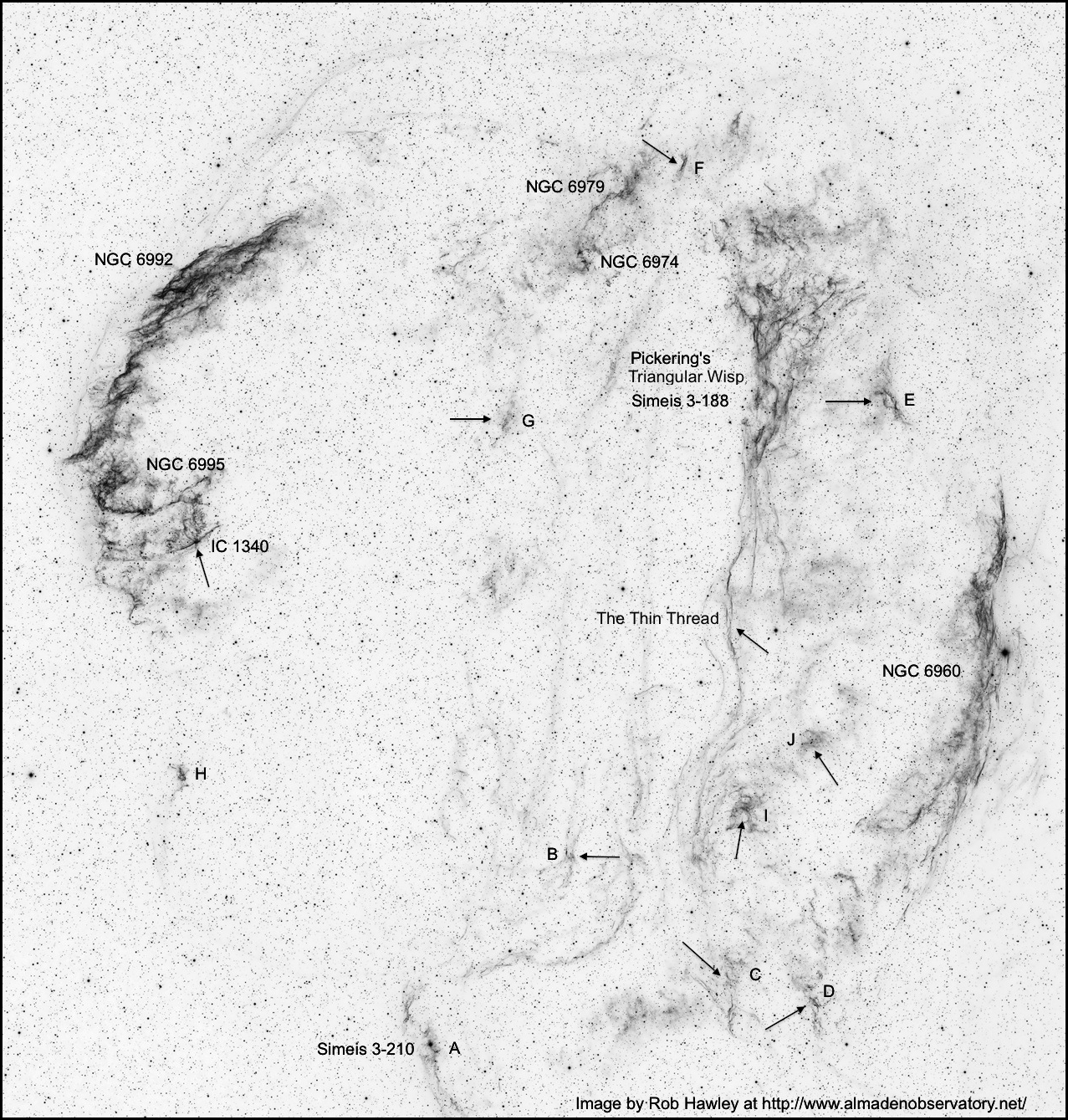
Another target that I had been planning to observe was the Veil Nebula, using my TEC 140 and an OIII filter.  With inspiration from the website of Steve Gottleib and using the chart at right I was able to observe many of the various labelled components.  I started at the "Witch's Broom" NGC 6960 and was able to easily identify the knot labelled 'D'.  I then moved back up to Pickering's Triangle also known as Simeis 3-188 and enjoyed the ethereal structure of this region while training my eye to pick out the fainter regions.  I then panned south and was able to detect the brighter portion of the "Thin Thread" as well as the knots labelled 'J' and 'I'.  I then relocated to the eastern portion of the Veil, NGC 6992 and 6995.  This is my favorite section of the nebula and my most traveled.  I made a point to observe IC 1340 and then located the star that would serve as a marker for knot 'A' which is Simeis 3-210.  This proved to be a little tougher than I expected given the glare from the star, but after careful observation I was able to positively identify the thin wisp of nebulosity.  Again, both Jerry and Bill were able to confirm this observation.

As the night wore on, we observed many targets from the popular Messiers, and double stars to interesting Arp galaxies, and of course Jupiter.  One of the highlights for me was Chris locating Comet 2012 J1 (Catalina) in the 20 inch despite it being close to the "Dob Hole" near the zenith.  This comet is cruising through Pegasus not far from Hergenrother and is approximately magnitude 14.5.  I had attempted this unsuccessfully in the 12 inch SCT.  I spent a few minutes revisiting some planetary nebula that I had observed from Portal two years ago with my buddy Christian (now back in Eurpoe), NGC 246 in Cetus, and IC 5148 in Grus  See this post for sketches of these objects.

Finally, a picture that was hard to take and that I had to mess with in photoshop to try and bring out the subject.  It is an attempt to image the Gegenschien, which is actually sunlight, back-scattered by interplanetary dust.    This soft glow forms opposite the Sun within the zodiacal light band and is only subtly brighter than the sky.  This is a phenomenon only visible under the darkest of skies.


All in all it was another great trip that ended all too quickly.  As great as the skies and observing are, it is the great friends and the unparalleled hospitality of the proprietor of Rancho de Farrar that make the trip.

Monday, May 21, 2012

2012 Annular Solar Eclipse

Unless you are nocturnal, you no doubt realize that yesterday many folks on Earth were treated to a very spectacular Annular Solar Eclipse.  The reason that this eclipse was annular (coming from the Latin, annulus, meaning ring) is that the moon was at it's furthest point from earth in its elliptical orbit when it passed between us and the Sun.  This was a very beautiful event to witness from start to finish, and I was fortunate to be working with my colleague Adam Block as we conducted a very special eclipse program at the Mount Lemmon SkyCenter.  We set up multiple telescopes providing guests views in both white light and hydrogen alpha, as well as providing everyone with specialized eclipse viewers.  While we had about 80 individuals on top of Mount Lemmon viewing the eclipse, we had literally thousands who watched a live stream of the eclipse over the internet.   We will do this again for the Transit of Venus on June 5th, and if you would like the web address, drop me an email.  I took the image at left near the time of greatest eclipse (6:38 PM local MST).

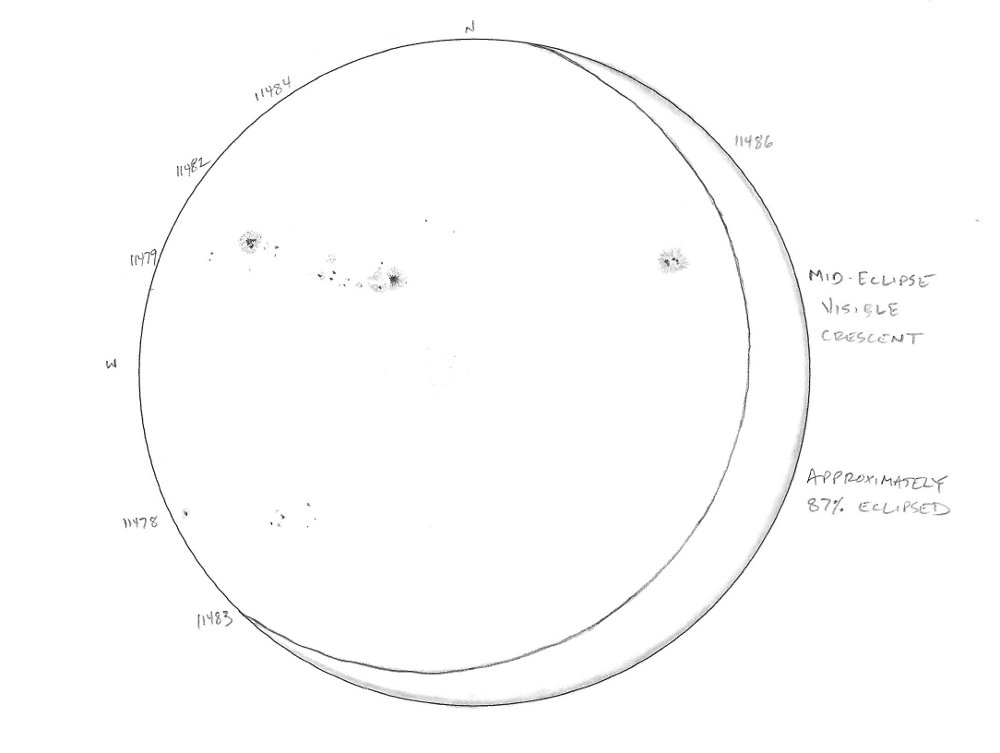
I made a white light sketch of the Sun prior to the eclipse to note the days spots, and then drew in the approximate maximum eclipse.  I was quite busy keeping an eye on our live feed as well as entertaining guests, so my sketch is truly an approximation as I lost track of which part of the Sun's disc was not eclipsed.  You can see in the sketch that we experienced about 87% of the Sun, including all the sunspots eclipsed by the moon.  Click the sketch to enlarge it.


I took many pictures with my trusty point and shoot camera and you can see a slide show of them at the bottom of the post.  For those of you suffering with devices that will not correctly display the slide show, I am pasting a few highlights here.  Below are shadow images of the eclipse, cast on our domes as the sunlight filtered through the pine trees.


 Here are some images of our guests enjoying themselves.


And of course sunset was spectacular!  There are wildfires to the north and the smoke attenuated the brightness of the Sun just enough that we could view the eclipsing Sun set naked eye...it was a beautiful magenta color and at the end, looked like a shark fin swimming on the horizon.  It was awesome to hear the guests break out in spontaneous applause when the Sun finally set.


And at last, here is the slide show!


Sunday, May 6, 2012

NOAA Active Region 11476


I was super busy yesterday as I was leading a program at the Mount Lemmon SkyCenter, yet early in the day I was hearing reports of a strong flare and coronal mass ejection emanating from a new active region on the Sun. As I did not really have time to set up my solar telescopes I did look on the Solar Dynamics Observatory webpage and discovered that the "latest" image, at left, was indeed spectacular.  The in progress coronal mass ejection was coming off of the northeast limb of the Sun.  As it turns out, this ejection was associated with an M class flare- quite a powerful event.  Be sure to click the image to enlarge it.


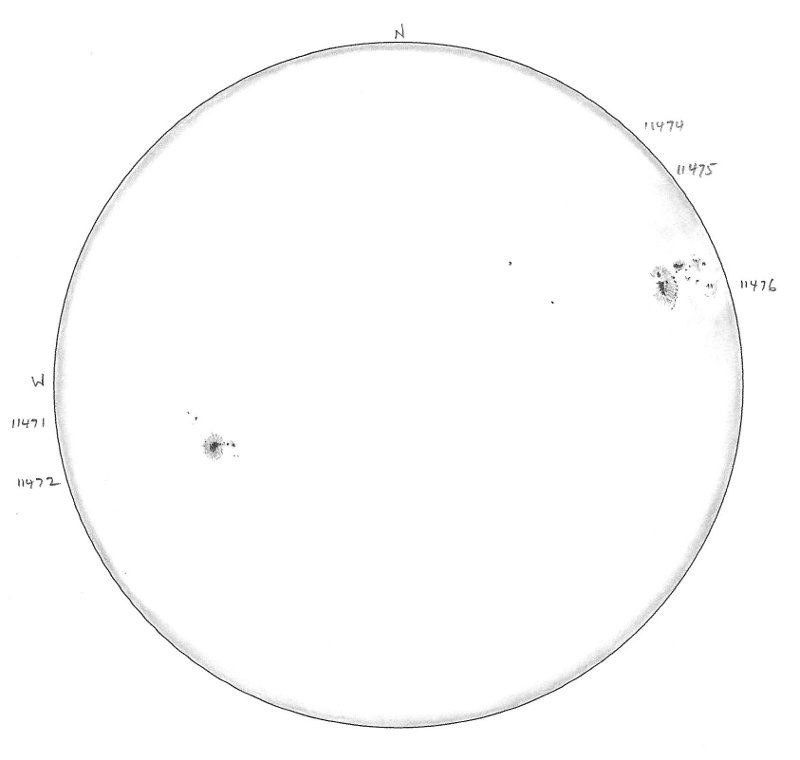
This morning, I set up both my hydrogen alpha and white light solar telescopes to check out the Sun.  While impressive in hydrogen alpha, the newly emerging region on the northeast limb is incredibly complex as seen in my white light sketch below.  I made the sketch at a magnification of approximately 50X, and the new region 11476 is sporting some dozen spots.  While this region is stealing the show, there are four other regions with spots as seen in the sketch.  Regions 11474, and 11475 in the northeast each contain one dark spot.  Region 11471 in the southwest contains 2 spots, and region 11472 contains a very large spot as well as 5 trailing spots.

Sketch completed at 1640 UT
Carrington rotation No. 2123
Solar Diameter: 31' 42"
Solar altitude: 51 degrees
Solar Azimuth: 104 degrees

Click the sketch to enlarge it

Saturday, April 28, 2012

See Spot(s) on the Sun

Today is a very exciting day at the Mount Lemmon SkyCenter as we will be formally dedicating the 32-inch Schulman Telescope later this afternoon.  The weather today is stunningly clear and warm and fortunately I had enough free time this morning to make a sketch of the Sun in white light.

Using my 102mm doublet achromatic refractor with a focal length of 1100mm (f/11), a Lunt Solar System Herschel Prism, and a 16mm eyepiece I observed the sun for about 30 minutes, completing my sketch at exactly 1600 UT (9 AM local MST).  To the right of my sketch is an image captured by the Solar Dynamics Observatory this morning not long after my sketch.

North is up and west is to the left.  For those of you who may not know, the Sun rotates from east to west.  In other words, the large dark spot just inside the southeast limb (which is as of yet an unnumbered region) has just rotated into view.  Besides the complex spot regions, the facula surrounding departing region 11465 in the southwest was quite bright.
Click to enlarge


Thursday, April 5, 2012

Mars Drawing

Today was a strange day at work...too many people not getting along with each other; a colleague who had a death in the family; and our department saddened by the suicide of a student.  It was one of those days where I felt that "I'd like to buy the world a coke"...Maybe I am showing my age with that little jingle, but certainly everyone needs to take a deep breath and look up at the night sky we are so fortunate to have here in Arizona.

And, while I never thought I would say something like this, a big shout out to the Governor of AZ for vetoing the electronic billboard legislation!  Our legislature quickly passed this asinine bill at the urging of Clear Channel Communications, and fortunately the Governor had a rare moment of clarity and realized that not only was the multi-million dollar astronomy related industry threatened, but these electronic billboards are safety hazards as well.  But I digress...back to the night skies...

While it is nearly full moon, I opened up my observatory and spent a little time observing Mars again this evening.  Using my 12" LX200 SCT I was treated to a night of exceptionally good seeing.  Using an 8mm eyepiece I was observing Mars at a magnification of 380X without any image breakdown.  I did try a 5mm eyepiece (608X), however, there was nothing visible at that power that I could not see much sharper at 380X.  Below left is my sketch, and at right a simulated view courtesy of CalSky.


Mars is currently 12.11 arcseconds in diameter and still shining at magnitude -0.6.  Mars is .773 astronomical units from Earth, or 6 minutes 25.6 seconds in light time.  My sketch was completed this evening at 8:44 PM MST (0344 UT, April 6th).  At the top is the North Polar Cap, and there was quite a bit of haze in the southern polar region.

Sunday, March 18, 2012

Night and Day


The wonderful thing about having a small home based observatory is that there is virtually no set-up or preparation involved in observing.  Simply head outside, roll off the roof and wake the telescope mount from hibernation.  After a long day of work it is simply a 30 foot walk out the backdoor and I am relaxing under the night sky.

Earlier this week I was at a meeting with University of Arizona Astronomer Carl Hergenrother, who maintains an excellent blog called The Transient Sky which deals with comets, asteroids and meteors.  I highly recommend a visit to his site.  Carl reminded me that Comet C/2009 P1 Garradd was still fairly bright in the evening sky in the northeast.  I have been following this comet since late August 2011, when I first sketched it at magnitude 8.2 and have since made about a half-dozen sketches of it.  I remarked to Carl that I was amazed at how long this comet had remained fairly bright.  He indicated that the sustained brightness is a result of a rather large comet that did not approach the Sun very closely.  He remarked that had it come closer, it may have become a "Great Comet."

I last visited this comet in early February (see this post) and decided to have another look.  The comet is currently heading for a rendezvous with the Big Dipper asterism in Ursa Major and is well placed for observation much of the night. Below is a diagram of the comets orbit (courtesy JPL).


Click to enlarge
 
Below is my sketch of Comet C/2009 P1 Garradd completed at 0420 UT on 3/15/2012 (9:20 PM MST 3/14/12).   At the time of my sketch, the comet was 1.301 AU from Earth and 1.91 AU from the Sun.

Click to enlarge

As you can see, I was not disappointed in the mighty comet.  It is moving along at a stately pace of approximately 3.27 arcseconds per min and is currently sporting two diffuse tails.  The tail to the east appears much broader and more diffuse than the tail to the west.  I made this observation using my recently acquired TEC 8 inch f/20 Maksutov, with a 35mm Panoptic eyepiece yielding a magnification of 116x.  Current estimates place the comet at approximately magnitude 7.4.  I will be in Portal, AZ this coming weekend under magnitude 7+ skies and am very excited to have a look at Comet Garradd under truly dark skies.  Look for a follow up sketch next week.

Of course, the Lost Pleiad Observatory is a round the clock operation and until I invent a way to see the deep sky in the daytime (in visible light), I still observe our nearest star, the Sun every chance I get.  Below is a sketch I made of the Sun using my dedicated Hydrogen Alpha telescope on March 17th.  Happy St. Patrick's Day!

Click to enlarge


Sunday, March 4, 2012

Mars - Still Curious

While NASA may be struggling to budget for future Mars exploration, as Astronomer-in-Chief of the Lost Pleiad Observatory, I remain curious.  In 154 days, on August 6th 2012, the Mars Science Laboratory, nicknamed Curiosity, will touch down on the red planet and if all goes well begin to enthrall us with information and data.  While we wait for this exciting event, I continue to do what I can to keep an eye on Mars.

Last night I made my first decent sketch of Mars with my TEC 8 inch f/20 Maksutov Cassegrain.  I plan to write a review of this scope one day, but it is really a very specialized instrument that delivers excellent contrast, a large image scale, and sharp views.  It is well regarded as a high end planetary instrument.  The telescope is about 16 years old, and I believe that it is slightly out of collimation.  I do mean slightly, and I will likely wait until this summer when I am in Colorado to personally deliver the scope to TEC for a tune-up.  You can see from these pictures that despite its age, it is in good used shape.

Click to enlarge
Even with a waxing gibbous moon, last nights seeing conditions were slightly above average, with reasonably stable skies allowing me to use a magnification of 253x.  My sketch was completed at 0447 UT on March 4th (9:47 PM MST, March 3rd), with Mars central meridian at 315.8 degrees.  Currently at Magnitude -1.2, Mars is .6739 AU from earth, or 5 minutes and 36 seconds in light time.  It subtends an angle of only 13.89 arcseconds, which is not very large when it comes to discerning dusky low contrast surface features.

This by the way, is the allure of observing Mars.  It is the only planet in our solar system where we can directly observe the surface.  Venus, Jupiter, Saturn, Uranus, Neptune...these planets only show us their cloud tops.  It is fun while sitting and observing Mars through a telescope to think back to the times when Astronomers such as Percival Lowell were making detailed visual observations of Mars and speculating on canals, water and plant life.  Without the benefit of missions to Mars to see the Martian environment up-close we would still be wondering.  Who knows what secrets Mars has yet to share with us?  I, for one, remain curious.


Saturday, February 18, 2012

Back to the drawing board

My life has been super busy-  In addition to a new job, I have a new telescope(yipee) and next week is my sons Bar Mitzvah for which he has been studying for a year...but that is fodder for another post or three when I get the chance. This morning we have the clearest skies we have had in about a week and I decided that before I did any of the 100 things I need to get done today that I was going to make a sketch of the Sun.  I love solar observing and sketching what I see and somehow we are mid-way through February and I had only managed three solar sketches this year! Finally, I present number four!

Click to enlarge
My sketch was completed at 1640 UT (9:40 MST) under clear skies, with average transparency.  There does seem to be a bit of humidity in the air as evidenced by the whitish color of our sky (typically our skies are a picturesque blue), as well as the water dripping off of the roof.  Regardless, the skies were still better than average and I was able to see much more detail that I could reasonably sketch.  Believe it or not, the infrequency of my sketching has also left me a bit out of practice...so this took a bit longer than usual and I am not quite as thrilled with the detail on paper.  The Sun was at an altitude of approximately 29 degrees, and an azimuth of approximately 129 degrees.

There are not many active regions on the face with AR 11420 quite near the meridian and containing a dark spot.  Just above this AR 11419 contains two smaller spots and is somewhat brighter.  To the east of these regions is a bright plage region that may be developing as evidenced by a strong dark filament within.  11418 near the SW limb is unremarkable.  Perhaps the most interesting feature of the day is the beautiful "filaprom" on the SE limb.  I do not know if this is the technical name, but this feature was very much 3D in my telescope as the filament and prominence were very clearly connected.

Below is a comparison image from the Big Bear Solar Observatory from 1659 UT, about 20 minutes following my sketch.  Big Bear maintains a very nice webpage of recent images.

Click to enlarge

Thursday, February 2, 2012

Re-visiting Comet Garradd

Click to enlarge
Comet C/2009 P1 Garradd is back.  Not that it really went anywhere, of course, but I had stopped following this comet when it was no longer visible in the evening/night sky due to its location in the constellation of Hercules.  Recently I had heard that despite the passing of a few months, the comet was still fairly bright and even visible in binoculars.  With Hercules now up in the early morning sky, I had been considering taking a look at it during one of my morning Mars observing sessions.  Yesterday I learned that the comet would be within 1 degree of the globular cluster M 92 this morning, so set my alarm for 4 AM to observe this conjunction.

I was not disappointed!  As can be seen in my sketch at left, the comet is quite bright, at approximately magnitude 7.  It contains a bright nucleus, and while difficult to detect, there appear to be two tails. (These are hard to bring out in the scan of my sketch).   It is unusual to see a bright comet in the same field of view as a globular cluster, and it was well worth the lack of sleep.  I also made a sketch and observation of Mars, but the seeing conditions were poor and the drawing is surely not as exciting as the event depicted at left.

Update:  The picture below was captured from New Mexico the morning following my observation and sketch, when the comet was within .5 degree of M92.


Friday, January 27, 2012

Mars update

Ares(Roman), god of war
As January winds down, Mars is becoming increasingly convenient to observe.  By about 11:00 PM local time, Mars is high enough for decent views, and it remains in the sky all night...meaning that if I miss the opportunity for the late night observation I can always get up an hour before sunrise to make an observation.  In addition, as Mars moves towards close approach, its apparent size is now increasing rapidly.  Closest approach will occur at 1701 UT (10:01 AM MST) on March 05, 2012 with an apparent planetary disk diameter of 13.9' arcseconds.  Mars will be at a distance of 0.673678350248 astronomical units (AU) or 62,622,315 miles (100,780,847 km).

Mars, as most of you know, was the Greek mythological god of war. In 1877 astronomer Asaph Hall discovered two very small moons and named them “Phobos” and “Deimos.” These were appropriate names as in reality, war is accompanied by "fear" and "terror."


I have made two sketches of Mars over the past week.  The first sketch, on January 20th was made in the early morning hours and was completed at 1325 UT (6:25 AM local time).  The Sketch was made using my TEC 140mm APO at 196 power.  Seeing conditions were excellent, with only occasional seconds of unsteady seeing.  Dominating the view is the North Polar Cap (NPC)  at top.

Central meridian:     111.7 degrees
Diameter:                10.7 arceseconds
Magnitude:              -0.3
Distance:                .875 AU (7.3 light minutes)


I made another observation on January 27th at 0552 UT (10:52 PM MST on Jan. 26th), using the same telescope and magnification.  The sketch at left is the more interesting side of Mars.  In addition to the NPC, Syrits Major is nearing the central meridian.  To the lower left, I believe, is Mare Tyrrhenum, and the dark streak on the lower right is, I believe, Sinus Sabaeus.


Central meridian:     297.74 degrees
Diameter:                11.35 arceseconds
Magnitude:              -0.4
Distance:                .82.48 AU (6.8 light minutes)