Sunday, March 17, 2013

Solar Stellarvue 90T

A couple years ago I owned a very nice 90mm triplet refractor from Stellarvue, which I had sold to pay for some other astronomy gear.  Recently, after trying other small aperture scopes, I decided that I wanted to purchase another one of these fine refractors.  At 90mm, the scope is a terrific size to take anywhere, and also has a bit more light gathering than the 80mm telescopes that dominate the small scope market. Additionally I wanted a telescope to use for white light solar observing that would compliment my Lunt 60mm HA without creating balance headaches when used simultaneously.  As it happened, Stellarvue had on their website a used SV 90T, with a carbon fiber tube and a very nice feathertouch focuser.  While one pays a slight premium buying used from Stellarvue as opposed to a private individual, Stellarvue does warranty their used telescopes for two years, just as they do with a new instrument.  To sweeten the deal, they also included a very nice, new soft-sided case with room for much more than just the telescope.  After a few days deliberation, I contacted Stellarvue and ordered the telescope.  It arrived in less than 48 hours, along with wind, dust and scattered clouds...typical with a new telescope, and quite frustrating after a week of clear steady night time skies that define the desert southwest!

While I have not yet had a chance to really shake down the telescope at night (other than point it at a few bright targets like Jupiter and the moon last night) I did have an extensive solar session with it this morning.  All in all, it provides exactly the view of the Sun I was expecting- sharp and detailed when used with my Lunt Solar Systems Herschel Prism.  I am fortunate to have a TEC 140 and compared to that telescope, the SV 90T definitely shows slight color on the limb of the Sun.  There is a very thin blue-green ring along the limb of the Sun, regardless of eyepiece used.  It is not in any way obtrusive and had I not been looking specifically for this color, I may not have noticed it.

Below is a sketch I made of the Sun, completed at 1631 UT 3.17.2013.  Although hard to note in my scan of my sketch, the 90T revealed very fine detail in spot regions, brighter facula surrounding regions near the limb, as well as hinting at granulaton in moments of very steady seeing.


So far, I am quite pleased with this small refractor.  It is light weight and delivers all the detail I expected given the 90mm aperture.  Below you can see my initial attempt at piggybacking my Lunt 60mm HA solar telescope on the SV90T.  It is likely not my final piggyback solution, but it was an exceptional experience being able to go back and forth between images.  Together, these telescopes and required accessories weigh  less than 20 lbs, and likely closer to 15.


Thursday, March 14, 2013

Comet Pan-STARRS

Comet C/2011 L4 Pan-STARRS has been all the talk among the amateur astronomy crowd these last few months.  While mostly putting on a show for our southern hemisphere friends, this bright comet did make a brief appearance this week in the northern hemisphere just following its close approach to the Sun on March 10th.  I spent the early part of the week camping and stargazing at Rancho De Farrar in Portal, AZ which will be the subject of the next post so missed the first few opportunities to observe this comet.


labelled
Last night I was leading a program at the Mount Lemmon SkyCenter so I had a great view of the comet with our guests- many of whom had never observed a comet before.  I tried to capture some pictures of the comet while entertaining our guests, and the image at left is one of the better ones.  You can see immediately below the comet, the planet Uranus...if you want to see it labelled, click on the thumbnail image at right.  This image was captured with my Canon T2i and a 300mm lens at F4.  It is a 2 second exposure at ISO 400.


Tonight, after a long day at work, I climbed onto our roof to try and get one last look at the comet.  It is quickly descending into the twilight and it is likely that tomorrow night the comet will be very close to the horizon by the time it would be dark enough to be visible in binoculars.  I found the comet when it was about 10 - 12 degrees above the horizon and again captured a few images.  The picture below was taken with the same camera, but this time with a lens at 200mm at F4. It is a 2 second exposure at ISO 1600.


Monday, March 4, 2013

Gone Caving...

In what seems like another lifetime, I used to do a bit of caving throughout southern Arizona.  The area is known for world class caves and if one is motivated and willing to invest the time, one can experience environments that are as unique as any on the planet.  The conservation ethic is quite strong among cavers as by their very nature these underground environments are extremely vulnerable to alteration and damage.  Descending below ground one literally steps into geologic time- and the Earth does not always act quickly.

I have not done much caving in the last few years due to several factors, among them my closest caving buddy has moved on to other adventures...further, I was never really connected with a local caving group, such as the Escabrosa Grotto.  Caving is best done in groups; not only for safety but there are always cavers with more and less experience than yourself and when in an underground environment you always have something to teach and something to learn.  Groups such as the Escabrosa Grotto do a marvelous job of supporting the USFS and other entities toward the ultimate goal of protecting these natural wonders.  I have been on 12-14 hour excursions into caves and assisted with everything from surveying, to restoration, to bat studies...but I digress.

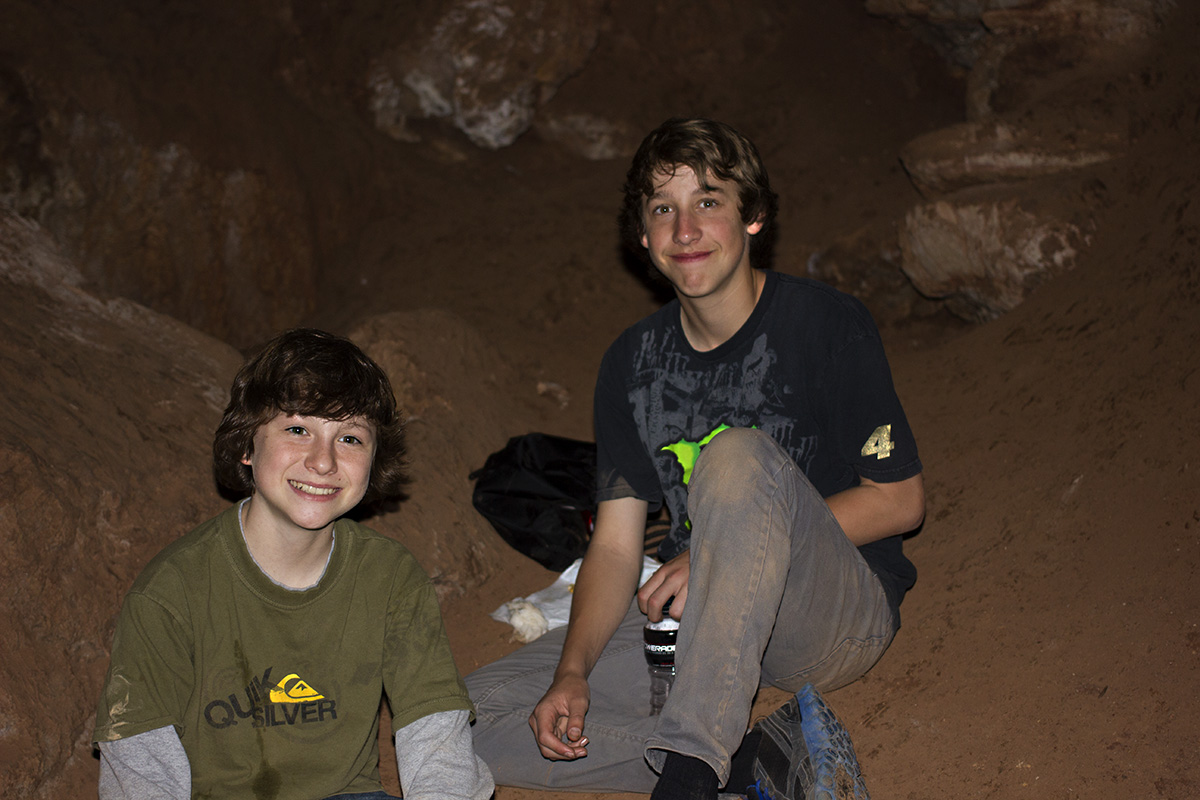
Friday, after a particularly tough week, Ian and I hatched a plan to revisit a non-gated cave in the Santa Rita Mountains.  It is a cave particularly well suited for young cavers, or as a first experience for someone who is unsure of their comfort level in a cave.  While it does not have a tremendous amount of cave features (due to nature, overuse and the fact that it is not gated), it is still a worthy introduction to caving.  At right, you can click on the image for a close up view of the stalactites and other features seen in the image above.

Tight squeezes, crawling, mud and even a few insects were experienced during the two hours we spent exploring the cave.  Ian invited his friend Tyler who had never been in a cave like this and Tyler had a great attitude as he explored beyond his comfort zone.  I have three rules in the outdoors:  Be safe, have fun, and learn a little.  I think we succeeded on all three fronts as evidenced by the pictures of our happy little caving group.  All images were taken with my Canon T2i and a 40mm lens.  As always, click the images to enlarge them:

Beth in the hole!
Ian in the hole!


Tyler in the hole!
Lunch break


Thursday, February 21, 2013

Snow at the Observatory!

It is true!  Yesterday Tucson saw it's most significant snowfall in several years.  While the Catalina mountains outside of Tucson receive many inches of snow every year (and are home to the nations southern most ski-lift), the Tucson valley receives only a dusting every few years.  Last night driving home through the foothills from a late dinner, was quite like the days when I lived in Colorado. Snow was blowing into the windshield faster than the wipers could handle and the road surface and lane lines were barely visible.  As soon as I got home I took the picture at left, which is only impressive if you have lived in Tucson.  You can see how much snow was falling and beginning to accumulate on the ground.

This morning I went outside to take a few pictures as I knew the couple inches of snow would quickly melt off and the "blizzard of 2013" would be only a memory.  (And yes, residents with a smartphone actually received a blizzard warning yesterday from the NWS!).  Again, these pictures are most impressive to individuals who have lived in Tucson or nearby.


Tuesday, February 12, 2013

Great Orion Nebula...again...

I have two telescopes that I use at the Lost Pleiad Observatory: a 140mm apochromatic triplet refractor (my 40th birthday present to myself), and a 12 inch Schmidt Cassegrain Telescope (SCT).  The refractor is hands down the better instrument, as it excels in all aspects of visual and photographic astronomy.  It delivers top of the line contrast, sharpness, and by design has an unobstructed light path.  Having a central obstruction as well as two mirrors that must be collimated and that take a couple hours to reach ambient temperature, the SCT is a compromise of sorts.  The image quality is not as perfect as the refractor,  but it does gather a tremendous amount of light- making it much better for hunting down faint fuzzy galaxies and planetary nebula.  You can read more about my equipment by clicking the equipment link at the top of the page.

As I only have one pier in the observatory  I tend to leave one telescope mounted for about a month or so, and then switch to the other telescope for a month or so...this gives me opportunities to use both during each season.  I have had the refractor mounted for the past two months, so tonight I made the switch and moved the 12 inch SCT onto the mount.  I spent about 2 hours enjoying the crisp, clear night air and decided to snap an image of the Great Orion Nebula through the 12 inch.  The image below is a single 20 second exposure, taken with my Canon T2i at ISO 1600, and acquired using the program BackyardEOS.  In case you are curious, the telescope has a focal length of 3045mm and is f/10.  The only processing I did in Photoshop was to slightly sharpen the image, and to adjust the levels slightly.  Despite not checking the collimation of the telescope and  not polar aligning the mount, the result is pretty cool...and also reflective of the time and desire that I have to spend taking astrophotos.  Call me old fashioned, but I still enjoy looking through the eyepiece.


Monday, February 11, 2013

Science Matters - Solar goosebumps

Does science matter?  What is our place in the Universe?  Are we all made of stardust?

Watch the incredible video below and once the goosebumps go away see how many questions you have...

(Watch it in HD with the volume on)

Friday, February 8, 2013

The Bee's Knees

Since may grandmother passed away in mid-January, I have been busy with work and life and have not really taken enough time to do the personal things that I enjoy, such as spending time in my backyard observatory.  Last weekend, while watching the Superbowl (about the only pro football game I watch in its entirety all season) Beth pointed out our front window and said "look at all those flies out there."  I looked up and realized that from our distance, we would not see flies that well...what we were seeing was a swarm of bees coming into our yard from the east.  I quickly grabbed my camera and snapped the image below from inside our house, looking through the front window.  Not the best way to take a picture mind you, but it came out well.  Partly a testament to the camera sensor, but also a testament to the new Canon 40 mm f/2.8 pancake lens that I recently purchased.  I am not a lens reviewer but what I can say is that it takes very sharp images at a nice image scale.  Anyway, back to the bees.  Click the image to enlarge it and you can see the outline of some of the bees.


My suspicion is that when I took this picture that more than half the swarm had already passed and settled into the palo verde tree on the right of the frame.  As the Superbowl was not totally capturing my attention, I started to search the internet for information on bee swarms, having heard that most of the bees in this area are Africanized (as the media would call them "Killer Bees").  Given the importance of bees as pollinators and key facilitators in our ecosystem, there is no shortage of information online about bees- and if it is on the internet, it must be true!  Most of the information I found quickly indicated that a swarm, if undisturbed, would likely move along in 2-3 days to their new hive location.  The swarm is a subset of bees from a hive, that set off with a queen bee to establish a new hive.  Swarming is essentially part of the bees reproductive cycle- and as the bees are not protecting young or food stores, they are believed to be somewhat docile in the swarming phase, as long as you do not disturb them.  Below is a picture that my son Ian took of the swarm hanging off the tree on the third day of residence.


Given the detail in the picture above, I was curious if I could find information that would assist me in identifying whether these bees were Africanized or not.  As it turns out, it is extremely difficult to tell if a bee is Africanized as they appear virtually identical to non-Africanized bees.  Generally, Africanized bees are slightly smaller, have shorter forewing length and femurs (yes, the bee's knees!) and weigh slightly less.  If you are scientifically curious, you can read this article on identification.  The chart at left is from Texas A & M University and is a nice visual that shows just how similar the size of the bees are.

While most of the information on the internet indicated that the bees would likely move on after 2-3 days, I have since spoken with about a half dozen friends and co-workers who have had swarms in their yards and they all have indicated that the swarms only moved on after 7-10 days! So we are patiently waiting and enjoying this natural process in our front yard.  I am a bit concerned as the temperatures this weekend are predicted to drop just below freezing for three nights in a row- and that could spell problems for the several thousand bees in the swarm.