Thursday, January 16, 2014

Jupiter's 'boring side'

Everyone loves the GRS (Great Red Spot); a giant storm that has persisted in the Jovian atmosphere since before the time a telescope was first pointed at Jupiter by Galileo.  Tonight, the GRS was somewhere on the side of Jupiter facing away from Earth and I imaged what astronomers jokingly refer to it's boring side.  The picture below is a stack of 3 images, each of which was itself a stack of between 250 and 400 individual frames, all taken within about 90 seconds of each other.  Jupiter rotates so quickly (a day on Jupiter is approximately 9 hours!) that if I were to spend more time taking video, the resulting stacked image would be blurred from Jupiter's rotation.  There is software to deal with this 'de-rotation' issue in processing, but I am still too far back on the learning curve to deal with that.  This is, I think, my best image of Jupiter to date.

Picture taken through my Celestron 11" Edge HD, using an ASI120MC camera

Tuesday, January 14, 2014

Jupiter, Io and Europa

Not a lot of time for words this morning, which for those of you that know me, is a good thing.  Below is an image of Jupiter I took last night at about 9:15 PM MST (0415 UT, 1.14.14).  To the right of Jupiter are the moons Io (top) and Europa (bottom).


Image was taken through my C11 Edge with an ASI120MC color camera.  Seeing was average and I came a little closer on focus and collimation.  It may be time for a Bahtinov mask to achieve focus, and studying some real processing techniques.  Image is a stack of about 450 frames.

Wednesday, January 8, 2014

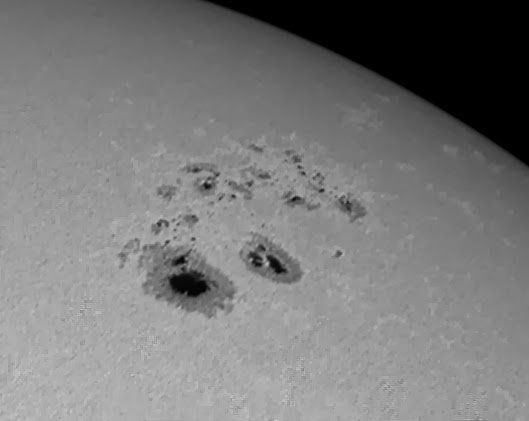
Active region 1944

The last few days have seen some remarkable images of the sunspots contained within active region 11944 that are making their way across the face of the Sun.  While I had taken a couple images late last week (posted here), I wanted to revisit the area this morning during a break from work.  Working at home this morning allowed me to run out and take a look at this region once again.  Seeing was a little above average with some some thin cirrus that are heralding an arriving cold front (maybe I should say a 'cooler front' in light of what our east coast brothers are experiencing this week).

All images were taken through my Stellarvue 90mm triplet and  Lunt Solar Systems Herschel Prism.  First, a whole disc image using my Canon T2i and a 2x Barlow lens- it is a single frame...click to enlarge.
Next, is a stack of 500/1000 frames captured with my ASI120MC video camera.  This comparison to the above image shows the benefit of stacking multiple images to obtain a higher and sharper level of detail than can be achieved in a single shot as above.  Again, click to enlarge.


Finally, an image of the same region using the ASI120MC and a 2x barlow.  This active region is massive, and with a proper solar filter can be seen without optical aid...it is perhaps the most impressive spot region I have seen in several years.  Click to enlarge.


Sunday, January 5, 2014

Naked eye observation of Jupiter's moons possible tonight!?!

Doing my Sunday morning reading on the internet of all things astronomical, it has come to my attention that it may be possible to observe one or more of Jupiter's moons tonight, with the unaided eye!  This is due to several favorable circumstances and the opportunity for such an observation is, I suspect, rather uncommon.

If you are interested in taking on what will be a challenging observation, I recommend beginning by reading a short article published in Sky and Telescope magazine in 1976, by the late Dr. Denis Dutton.  The linked article contains a bit of information on the history of naked eye observations of the Jovian moons, as well as references to other historical articles and observations.  In addition to the topic at hand, I particularly enjoyed his words at the end of the article when he wrote "The concept of true scientific discovery involves grasping the meaning or importance of what is revealed."  Contained in these words is the often unspoken wisdom that guides those of us who spend hours at the eyepiece, straining to tease out the faintest hints of light from the dark background.  What we are looking at is quite frequently not impressive at all, even to our fellow amateurs; it is only with an understanding of what we are looking at does the observation take on meaning and significance.

12.22.13/TEC 140 APO/Lost Pleiad Observatory


Today, January 5th, Jupiter is at opposition (exactly opposite the Sun in our sky) and rises at sunset.  Perhaps most remarkable about this opposition, is that if seen from Jupiter, the Earth would appear to transit the Sun!  The result is that the phase angle is quite small and the opposition effect on Jupiter and her moons will be quite strong.  Les Cowley has an explanation of the opposition effect on his website, and essentially it is a result of objects appearing brighter when they are near the anitsolar point in the sky.  As he identifies, "The Moon's brightness at full is greater than can be accounted for by the increase in its illuminated area compared with its partial phases."


How much brighter?  Due to the opposition effect, Jupiter's moons may appear as much as 30% brighter tonight!  As it happens, the crescent moon sets approximately 10:40 PM and is far from Jupiter in the sky.  Below is a graphic representation of Jupiter and the location of it's moons (created with Winjupos) at 10:30 PM MST (0530 UT Jan. 6th)
Click the graphic to enlarge
Here is some technical data on the moons (in order from left to right in the graphic), which will give one an idea how dark the skies at your observing site need to be to have a chance at seeing one or more moons naked eye, (not accounting for the opposition effect):

                   Diameter  Visual magnitude

Io                  1.190"           5.0 mag
Europa         1.029"           5.3 mag
Ganymede   1.725"           4.6 mag
Callisto         1.573"           5.7 mag

While all of the moons are intrinsically bright enough to be seen by most observers at a reasonably dark site, it is the glare of Jupiter that typically prevents their observations.  Tonight, Ganymede will be the easiest given that it is the brightest and will sit nearly 15 Jupiter diameters from the gas giant herself (one Jupiter diameter at tonight's opposition is 46.76 arcseconds).  Io, while the second brightest, will likely be lost in the glare of the planet, and Europa will be exceedingly difficult.  Callisto will be interesting as it is the faintest moon, yet will be furthest away at approximately 19 Jupiter diameters.

One recommended trick for attempting to see the moons is to stand (or sit) in a location where one can block Jupiter with the edge of a wall (or pole, tree, etc).  Doing so may reduce the perceived glare and make spotting one or more moons a bit easier.  Personally, I will attempt this observing challenge tonight, and would love to hear from others who attempt to see the Galilean moons without optical aid.   Drop me a note, lostpleiad@gmail.com  (or comment below). Good luck!


Friday, January 3, 2014

Venus closing in on inferior conjunction

Venus de Milo
Venus (the planet, not the goddess of love) is closing in on inferior conjunction - the point when it lies directly between Earth and the Sun in its orbit.  Inferior conjunction will take place on Sat, 11 Jan 2014 at 05:19 MST (12:19 UT).

Because Venus orbits between the Earth and the Sun, it moves through phases of illumination just like our Moon.  As Venus is now 8 days from inferior conjunction, only a very thin crescent is illuminated.  Below is a stack of 500 frames from an avi file of Venus I captured this afternoon through my TEC 140.  I may have overdone the processing a little as the extreme tips of Venus seem to have been lost, but either way you can appreciate how thin the crescent is.

Currently, Venus is nearly at its largest apparent size, with a diameter of 61.08 arcseconds and is a beacon of light shining at magnitude -4.26, making it far and away the brightest object in the evening sky.  In a nice coincidence of numbers, it is 2.3 light minutes away, and is also 2.3% illuminated.
Of course, Venus' orbit is tilted with respect to Earth's orbit and as a result it will not appear to transit across the face of the Sun as it did in June of 2012. From our vantage point on the Earth, Venus will pass within a 5 degrees of the Sun and will be lost in its glare. Venus will also pass perigee (the time when it is physically closest to the Earth) within a few days of inferior conjunction. It will move to within a distance of 0.27 Astronomical Units (AU) from the Earth, which is approximately six times closer to Earth than at superior conjunction (when Venus is on the far side of the Sun).  If it could be observed, it would measure 62.7 arcseconds in diameter, which is approximately 50% larger than Jupiter, yet it would not be illuminated at all! As Venus moves past inferior conjunction, it will once again become a morning object over the next few weeks.


NOAA Active Region 11944

When it comes to active regions (AR) on the Sun, this one is big...how big?  By my estimation, AR11944 is larger than Jupiter.  Click on the SDO image and scale at left to enlarge, and remember that the sunspots are contained within a larger region of magnetic activity.  This region made it's way around the Sun's eastern limb on New Years Day, and I expect that we will be able to observe this region and it's accompanying spots for approximately two weeks as it transits (the Sun rotates from east to west with a rotational period of approximately 25 days at the equator).  Below are two images from this morning, taken through my 90mm Stellarvue triplet and Lunt Solar Systems Herschel Prism.  They represent stacks of 750 frames (out of 3000) in average seeing captured with an ASI120MC camera.  This region is on the southeast limb of the Sun, but I liked the composition better as presented-


Below is a second image of the region, taken with the addition of a 2x Barlow lens- and I am not sure why, but blogger seems to compress images and much of the solar granulation is blurred, particularly above the spots...but at least the spots survived the blog platform!


If you have a solar telescope, this is one region worth taking a gander at...and, I suspect this region is large enough to be seen naked eye with the appropriate solar filter to protect one's eyes.


Wednesday, January 1, 2014

Happy New Year!

Today marks not only the New Year, but also the fourth anniversary of this blog...and most importantly my 18th wedding anniversary!  Life has treated me well and I am quite fortunate to have such a wonderful spouse and son.  18 years has gone by in the blink of an eye, and it seems only yesterday I was eyeing that cute grad student with the southern accent and the smell of eucalyptus in her hair.

It is somewhat of a personal tradition that I try to celebrate all holidays with a little observing and this morning I set up both my hydrogen alpha and white light solar telescopes.  There is a fair bit of action on the Sun and I took some images through both telescopes.  I began with the white light and took the images below.  All images are presented with north up and west to the right.


The seeing was steady enough that in addition to the images straight through the 90mm Stellarvue triplet, I was able to utilize a 2x barlow.


Finally, while the seeing was slowly worsening (as typically happens as the day progresses and the air and ground warm up) I was able to grab an image in hydrogen alpha.  I was having a hard time tuning the telescope and it may be time for me to take it in for a "tune up" at Lunt Solar Systems.  Again, north is up and west is to the right.


Happy New Year!