Friday, November 26, 2010

Carbon Stars, cold weather and other notes...

Thanksgiving has brought very cold temperatures to the Lost Pleiad Observatory.  Thanksgiving day saw a high temperature of 56 degrees, the lowest high temperature since the mid 1970's!  Last night was quite cold with temperatures dropping below freezing for the first time this winter.  Overall, this low pressure system has created fairly poor seeing conditions...however, holidays mean lots of free time to observe as well as markedly reduced light pollution from Tucson.

Last night, I decided to do some observing with my TEC 140 prior to moon rise.  I was rewarded with some of the darkest skies I have seen in the observatory in a long, long time.  Not only were businesses around town closed, but there must have been no one on the roads as the light dome over Tucson was perhaps 25% of its usual brightness, maybe less.  Two observations from last night are worth reporting here.  First, I wanted to find a nice Carbon Star that I could use while leading programs at the Mount Lemmon Sky Center.  Carbon stars are late-type giant stars whose atmospheres contain more carbon than oxygen.  The chemical reactions that take place in the upper layers of the star result in increasing production of carbon compounds, surrounding the star with a "shell" of carbon dust.  This leads to a ruby red like appearance at the eyepiece.  While there are hundreds of these stars known, some of the more famous ones are Mu Cephei, R Leporis, and T Lyrae.  I have been showing T Lyrae during programs, and R Leporis is not quite high enough in the sky yet to utilize.  Mu Cephei is too bright and most observers see it as simply a bit more orange than Betelgeuse in Orion.

If you are interested in observing some of these stellar gems, I'd suggest you visit this webpage which contains a list of carbon stars brighter than visual magnitude 8.5.  The image to the left is of a carbon star in the constellation Canes Venatici and was created by Greg Parker and Noel Carboni of the New Forest Observatory.  I decided to have a go at S Cephei, a long period Mira type variable star.  It's listed as magnitude 7.5  - 12.9 and has a period of 487 days.  Mira type variables are characterized (among other things) by very red colors and are in very late stages of stellar evolution.  These stars will eventually shed their outer layers and become planetary nebula.  S Cephei is currently around magnitude 9 - 9.5 and fading.  It appeared as a brilliant gemstone like red in the eyepiece and will be a very useful example of a carbon star in my programs.

The second Thanksgiving observation I'd like to share is that of NGC 253, the Sculptor Galaxy.  I have observed this object many times in just about every telescope I have owned.  It is a very large spiral galaxy in an intense star birth phase.  It is remarkable in the eyepiece as it reveals extremely complex dust lanes throughout.  Recently I observed it through the 32" Schulman telescope at the Mount Lemmon Sky Center, and was treated to more detail than I could ever capture with pencil and paper.  I wondered how it would look in my 140mm refractor, and last night was perfect for this as the constellation rides low in the south, where typically the light pollution is at its greatest from my location.  I made the sketch below at 75x with a 13mm eyepiece.  To the right of my sketch is an image of this galaxy, taken from the Mount Lemmon Sky Center (south is up in the image, down in my sketch).

Copyright Adam Block/Mount Lemmon SkyCenter/University of Arizona


Finally, speaking of the Mount Lemmon Sky Center, todays Astronomy Picture of the Day features NGC 2024, the Flame Nebula as imaged by my colleague Adam Block at the Mount Lemmon Sky Center.  This is the first MLSC image chosen by the APOD folks since the installation of the 32" Schulman telescope...check it out!

Sunday, November 14, 2010

Fall observing

Been awhile since the last post!  Mid-October through mid-Novermber was a busy month on the astronomy front for me- I attended the All Arizona Star Party, made a quick trip to Portal, AZ and also led about a half-dozen programs at the Mount Lemmon SkyCenter...all since the last post!

Rather than try and write a long post to capture it all, I'll just provide some brief details and some photos and hope that your imagination is as great as the real events were!  The All Arizona Star Party (AASP) is an annual event, that was held this year at what is referred to as the Antenna site...basically about 2 miles south of Interstate 10, and about 80  miles west of Phoenix, AZ.  I attended with my friend Jerry Farrar, and we camped next to Kevin and Brian from Lunt Solar Systems.  This was quite a treat as they brought the entire Lunt arsenal of scopes and filters.  I had a chance to double stack the new 60 front mounted etalon on my scope (to the left) and it was awesome!  Not only were the views of surface features rich with contrast and detail, but we observed an M 5.4 class solar flare on Saturday morning.  Below is my sketch of the sun, including the flare in region 11121.


Naturally I observed many nighttime objects as well, including many galaxies in the constellation of Aquarius.  Using my 12" LX-200 SCT, I observed NGC 7171, NGC 7184, NGC 7218, NGC 7392, NGC 7723, and the pair NGC 7724 & 7727 that shared the field of view at 152 power.  I also observed NGC 7492 which is a very faint, diffuse globular cluster.  This appeared almost as a mist in the eyepiece with about 6 stars resolved.  I spent some time observing NGC 708, the faith group of galaxies, also known as Abell 262, located in Andromeda.  I was drawn to check out this group of galaxies by a recent image created by my colleague Adam Block as part of the first light of the new 32" Schulman Telescope at the Mount Lemmon Sky Center. Below is a Digitized Sky Survey image and my sketch (reversed left to right), and underneath that is Adam's image of the galaxies.


Copyright Adam Block/Mount Lemmon SkyCenter/University of Arizona

If you have read my blog over the past many months, you know that Portal, AZ is home to Rancho del Farrar, one of my favorite places on earth to observe.  Jerry invited me out for a quick trip with some of his family and friends.  While the observing was pretty laid back, we had a great time and the company was excellent.  Prior to leaving Portal, Beth and Ian and I went on a short hike in Cave Creek Canyon to a small cave that can be explored in about 10 minutes. Enjoy the photos of our trip!


Saturday, October 16, 2010

Solar powered observing

It's been far too long since I had some time on a Saturday morning to observe and sketch the sun.  Lest you think that this morning was all sleeping in, drinking coffee and observing, I only had about an hour to set up the scopes, make the observations, and attempt some sketches due to Ian's little league game.  (Incidentally, he was 2 for 3 at the plate and perfect in 5 chances in the infield- whose kid is that?!?!)

The seeing this morning was nearly perfect.  There was only occasional slight atmospheric turbulence, but well over 90% of the time the image was steady as a rock even at high power.  This sketch was completed at 1625 UT (9:25 MST) using my Lunt Solar Systems 60mm HA scope with 12mm blocking filter.


Active region (AR) 11112 is the feature du jour, sporting some bright plage as well as a large and beautiful snakelike filament.  AR's 11113 and 11115 contain much weaker plage, yet there are obvious dark spots associated with these regions...this inspired me to set up my TEC 140 and Lunt solar prism to examine the spots in white light.  Finally, there is a bright ephemeral region on the central meridian in the northern hemisphere.

Below is my sketch of todays sunspots.   While nothing was noted in the ephemeral region, each of the aforementioned AR's contain spots.  AR 11113 contains a single spot, as does AR 11115 although it's umbra seemed like it may be splitting in two.  AR 11112 contains multiple small spots and is quite disorganized. This sketch was completed (quickly) at 1638 UT (9:38 MST).

Wednesday, October 13, 2010

New Moon Madness

This past weekend I went down to Portal, AZ to do some new moon observing with my good friend Jerry.  If you have read my previous posts regarding visiting and observing in this area, you already know that the skies are some of, if not THE, darkest and transparent skies in the United States.  We were joined this trip by our friends Bill Gates, Jerry and Debbie Hyman, and Christian Weiss.  In estimating the quality of the skies, we looked to stars of known magnitudes, and each of us was able to detect stars as faint as magnitude 7.  Before I share some of my observing highlights, I do want to mention what a great group we had.

Bill, is the master observer of "things that are not really there" objects.  He is a remarkably skilled observer who spent a fair bit of time hunting down some of the faintest nebulosity you can imagine...these areas are so faint that many of them do not even have catalog designations.  Bill finds them by downloading images from the Palomar Observatory Sky Survey (POSS)  and enhancing them on his computer to the point that he can see these faint clouds of gas.  He then hunts them down in the eyepiece.  Bill is observing objects that in all likelihood have never been observed visually by others...Both because they are virtually unknown, and also due to his incredible eyesight.  It is safe to say that while we use the expression "eagle eyes," eagles refer to themselves as having "Gates eyes."  Bill was able to identify stars as faint as magnitude 7.4 naked eye!  7.2 was the best I could muster...Of course, I was distracted by the bright zodiacal light and the Gegenschein, a phenomenon I had heard of but never seen...

Jerry and Debbie are friends that we have come to know through various "all Arizona" star party events.  They are quite passionate about amateur astronomy and spending time observing with them is always a treat.  I learn a lot from them, and the crisp wide-field views through their binoculars were simply stunning (not to mention the new 8 inch Celestron Edge HD they brought!).

Christian has been visiting Tucson while completing the research for his Masters Thesis in optics.  He is modeling the optics for Giant Magellan Telescope (I hope I have that right Christian!) and soon will return to Switzerland where he will graduate.  Christian is the type of observer who inspires each of us with both his passion and skill.  I know we will all miss him.  It is so refreshing to spend time with a group like this who appreciate observing all types of objects and sharing the experiences with each other.

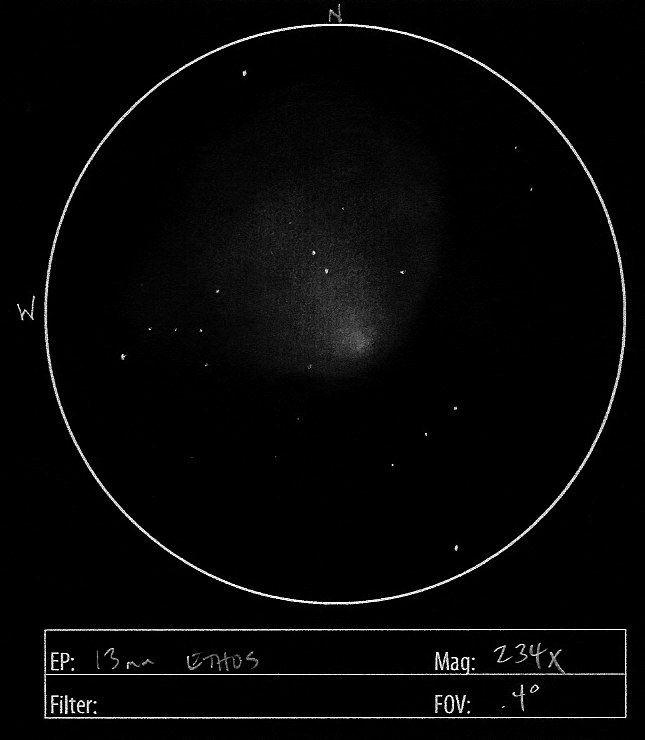
I am only going to post a few of the highlights from my two nights in Portal, beginning with Comet 103P/Hartley.  You can read about this comet that I have been observing over the past month in some of my earlier posts.  What was amazing was that the comet was visible to the naked eye as a fuzzy spot in the constellation of Cassiopeia.  It has brightened considerably and while still diffuse, sports a bright nucleus and extensive coma.  The comet is now appearing to move swiftly, approximately 5.8 arceseconds per minute during the time I was making the sketch...that translates to about 2.5 degrees of sky per day!  The sketch was made on the night of 10-10-2010 through my LX200 12 inch SCT and a 13mm Ethos eyepiece, yielding a magnification of 234X and a field of view of.4 degrees. The comet's distance from the earth was approximately .142 AU, and its distance from the sun was 1.093 AU (one AU = 93 million miles).


With Christian leading the way, I observed several planetary nebulas over the weekend. One of the benefits of having a telescope with 12 inches of aperture is that I can now begin to see subtle detail in these nebula that was not available to me with lesser aperture.  The sketch to the right is of NGC 7009, commonly known as the Saturn nebula, due to the extensions on either side the nebula that resemble Saturn's ring structure.  This nebula is obvious in most scopes at magnitude 8.3 as a small disc of uniform brightness. Magnifying this cluster with a power of 305 reveals the outer halo and extensions.  Careful observation also revealed some subtle darkening toward the center. This nebula is approximately 2900 light years away in the constellation of Aquarius.


To the left is another large but faint planetary that flies through the sky low in the south in the constellation of Grus (the crane).   IC 5148 is large, approximately 2 arc minutes in diameter, yet faint at magnitude 11.  Using a 20mm eyepiece (152X) and an Ultra High Contrast Filter (UHC) the nebula appeared to have a rift running through it, alomst separating it into two distinct objects.  The east half was marginally brighter than the west half, and the entire rim was brighter than the center.  I also observed this object through Christian's 16 inch Dobsonian, and he tells me that this object is actually designated twice in the IC, as object 5148 and 5150.  Either way, this is a very unique planetary and one well worth observing if you can see it from your location.  In Portal, it was perhaps 18 degrees above the horizon.


Finally, I'll share with you a sketch I made of NGC 246, commonly referred to as the Skull Nebula, haunting the constellation of Cetus.  This object was simply stunning from the dark site as it revealed several bright arcs along the perimeter, as well as dark cavities within the nebula itself.  the 12th magnitude central star was easily seen as well as a few other stars superimposed on the nebula.  NGC 246 is large, twice the apparent size of IC 5148 at 4.1 arcminutes in diameter.  It resides approximately 1300 light years away, and is estimated to be about 15,000 years old.

Of course, none of this would be possible without Jerry-  From sharing his property to sharing his food, no one hosts a better star party.  I have been to star parties in Colorado, California, Arizona, and even the vaunted Texas Star Party and can honestly say that there is no better place, and no better host than Jerry.  I have mentioned before that he is my mentor in observing and all the sketches above are due in part to observing and learning from him.  Thanks my friend.

Tuesday, October 5, 2010

Stormy sunset

One of the things that I enjoy about working at the Mount Lemmon Sky Center are the incredible experiences that only happen on a mountaintop.  We had a small cadre of guests earlier this week who decided to come up despite stormy weather that would preclude use of the new 32" Schulman Telescope.  As part of our "cloudy night" program, we headed over to the west ridge of the mountaintop to see what view, if any, we may have of sunset.  I think that these pictures speak for themselves....(and one thing they tell me that while the point and shoot camera is convenient, I may have to invest in a DSLR camera)


Sunday, September 26, 2010

Mount Lemmon Sky Center update

I have had a hard time posting this month, due to being incredibly busy as well as being limited in my observing time.  One of the things that has taken up more of my time has been volunteering up at the Mount Lemmon Sky Center (MLSC).  Previously I have posted about my efforts up there, and the week of September 13th, the 24" RCOS scope went offline as the new 32" RCOS Schulman Telescope was installed!  I spent a bit of time up on the mountain during the installation of the scope and thought that these pictures may be of interest.


Above you can see the telescope assembled with the west fork arm opened up.  This fork arm contains the optical encoders that communicate the telescopes position in declination to the computer.  The east fork arm (not shown) contains the declination motor and brake.  One of the neat things about this telescope is that it operates with friction drives and is therefore very quiet and has none of the periodic error that is inherent to geared drive systems.


Above left is the secondary cage and the approximately 12 inch secondary mirror.  In the mirror you can see reflected the primary mirror covers.  These are opened and shut electronically and the scope was not yet operational when I took these images, so no picture of the primary mirror yet.  Above right, is the brains of this telescope...this box contains a computer, drivers, and all the electronics necessary to communicate with the mount and telescope. 


Finally, this pictures was taken several nights later when we went up to do some adjusting of the polar alignment of the mount. You can see how massive the scope is in relation to the computer desk to the right.  This scope is the largest scope in the State of Arizona dedicated solely to public outreach and education.   One of the reasons I have been spending so much time at the MLSC of late, is that in addition to the typical volunteer duties assisting with outreach programs, I am now training to begin conducting the SkyNights programs!  It is very exciting and quite a bit of work.  While the telescope is impressive, it is simply a tool that we use to provide guests with an opportunity to learn and experience the night sky in ways that they never have before.  Mount Lemmon is a fantastic location for this program. Just as satisfying as hearing a guest exclaim "WOW!!" when seeing a globular cluster for the first time, is the contemplative silence of guests as they appreciate that their own shadow being cast on the ground is actually blue and not grey or black.  I can say that I learn as much as the guests each time I am there. As evidence, take a look at the picture below.  This picture was taken just prior to sunset looking opposite the sun in the sky, to the east.  In it, you will see a mountain range in the distance, as well as what at first glance appears to be a second, higher mountain in the background.  Look closely and you will see that it is not in fact a high mountain in the distance;  Rather, it is the shadow of Mount Lemmon being cast on the atmosphere.  This is just one example of something that can be experienced at the MLSC, something that most people have never seen before.

Saturday, September 11, 2010

103P/Harltey Update!

Cometary update! I had a chance to get out last night and take a look at this comet again (see the previous post).  It seems to be slightly brighter than my previous observation, as I was able to hold it in direct (as opposed to averted) vision.  The coma appears to be a bit brighter to the north, however, there is no central condensation to the comets nucleus that I could see.  NASA's Jet Propulsion Laboratory maintains a website where one can generate orbital diagrams for this comet, and they indicate that the comet is currently .317 AU from Earth, and 1.244 AU from the sun (and getting closer!).  The comet is moving approximately 1.67 arc seconds per minute across the sky, so it does not yet appear to move that far from night to night.  I estimated the comet to be between magnitude 10 and 10.5 and it is in the constellation Andromeda.  The sketch was completed at 0508 UT on 9-11-2010, which was 10:08 PM MST on 9-10.