Wednesday, November 6, 2013

First time Jupiter!

I awoke at 4:30 this morning specifically to observe Comet ISON, currently cruising through the constellation Virgo as it nosedives toward the Sun.  As comets go it was not that remarkable but I wanted to see it prior to it's close encounter with El Sol on November 26th.  Once I finished obseving I was not going to go back to sleep so I tried my hand at imaging Jupiter with the ASI120MC video camera that has been the subject of the past few posts.

The image below is a stack of approximately 900 frames out of 1510 processed in Registax.  The image was captured through my TEC 140 with a 2x Barlow in slightly below average seeing conditions, using the freeware program Firecapture.  Looking at the log file that is automatically generated in Firecapture, I noticed that it provided ephemerides and other information for Jupiter.  While I am not sure the source of these, pertinent data is as follows:

Diameter=41.96"
Magnitude=-2.42
CMI=320.2° CMII=223.8° CMIII=13.5°  (during mid of capture, which was 12:48:36 UT, Nov. 6th)

For a first attempt, I was nearly jumping up and down...of course I needed to stay warm and this helped restore blood flow....but seriously, with more practice (and perhaps a 2.5X Powermate in my future) I believe the images will only get better.  The moon closest to Jupiter is Callisto, and the two moons further out are Europa (upper) and Io (lower).


Monday, November 4, 2013

November 4th Sun

Quick capture this morning, trying to be more careful with the etalon tuning and also using a slightly shorter exposure time to freeze out some of the turbulence.  Seeing was not quite as good as yesterday but I still ended up with a reasonable image.  I think it is about time to start asking solar imagers about the settings that they use in Registax for the wavelet functions...I am having difficulty finding a good balance of sharpening/denoising.


Best thing about this above image is that it can be directly compared to yesterdays image and one can appreciate the changes and rotation of the Sun over 24 hours.  Note that I was able to capture some prominence detail along the limb in the right side.  To truly bring out the prominences, which are faint, the settings need to be adjusted (e.g. longer exposure, higher gain rate) and the surface detail will wash out.  The adventure continues...

Sunday, November 3, 2013

Solar imaging take two

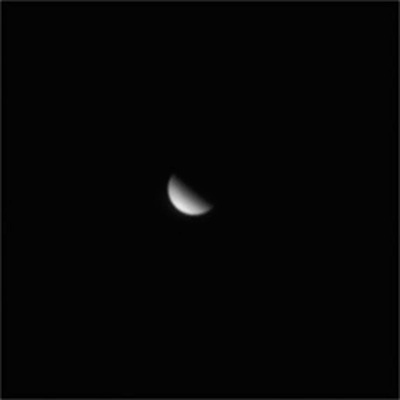
A week has passed since I first tried out my new ASI120MC camera, and I was able to image two targets with the camera over the past 24 hours:  Venus yesterday evening, and the Sun this morning.  Seeing conditions were variable last night as I attempted to capture Venus.  I have a very small window from my observatory where I can actually observe Venus around sunset before it quickly passes behind a tree in my neighbors yard.  Venus is inherently a difficult target to image in the evening skies as it is generally not more than 20 degrees above the horizon, and last night there were also clouds rushing in from the west.   As I live east of Tucson I am also looking right over the city when I observe to the west...so seeing conditions for evening apparitions of Venus are always a mixed bag.  I did manage to create the image below and it was my first attempt at using a cheap 2x Barlow lens with the camera.  In order to reach focus I also had to use a mirror star diagonal, which is likely not ideal for imaging.  Below is the result of stacking about 150 usable frames (out of 2000) and some processing in Registax.


While I was hoping to do some visual observing last night and ultimately try to image Jupiter, the aforementioned could bands rolled in and we were treated to a long steady rain lasting until near midnight.  This morning skies were mostly clear with some passing thin cirrus and as the coffee was brewing I set up my 60mm Lunt HA scope to try and create another solar image.  Seeing was fairly steady and other than the passing bands of cirrus I was able to take an avi of approximately 2000 frames.  The result is below, following a stack of about 750 frames and some processing in Registax.


In some ways, this image is better than my previous attempt.  Clearly (pun intended) the improved seeing conditions helped me to start with better data and more usable frames.  Having steady skies also made focusing a bit easier.  I also happier with the sharpening and denoising I did using the wavelet functions in Registax, although I could still be more effective with these techniques.  The exposure settings were not ideal as some of the active regions are a bit washed out and I also did not have the etalon filter on the telescope tuned as precisely as I would have liked.  While I had it tuned for the eyepiece I was using prior to image capture, it seems that it needs to be tuned slightly differently for the camera. This tuning process as well as precise focusing is something that I need to continue to explore if I am to improve the images.  If I had to rank the importance of these factors, focusing is probably number one, followed closely by the tuning, with the atmosphere being the third consideration (and the one I have no control over).  As I become more fluent in the exposure time, gamma, and gain rate settings, I will be able to compensate slightly for the atmospheric stability being less than perfect.

Saturday, October 26, 2013

solar imaging with the ASI120MC

I can not believe over a month has gone by since my last blog post...while not good blog form, I have been working almost 7 days a week for the last 6 weeks and having a ball.  As I continue to work alongside some remarkable staff and graduate students in the development of the UA Science: Sky School I am reminded every day why I love my job.  As satisfying as work can be, one still needs time to pursue one's hobbies and I have not had nearly enough time to observe through my telescopes.  Last night I stayed up until nearly 2 AM observing some departing summer objects as well as taking my first glimpses of the year at winter objects such as the Orion Nebula and also at Jupiter.  It was a beautiful night and so satisfying that I still pulled myself out of bed by 8:30 AM to play further....

(Note to self: I am not an astrophotographer...But, apparently I am attempting to play one on TV.)  On a lark last week I decided to purchase my first dedicated planetary/solar imaging camera and try my hand at taking images of the Sun through my Lunt 60mm Hydrogen Alpha telescope.  This morning I captured and processed my first 'reasonable' solar image using my new ASI120MC camera from ZWO Optical.  This little camera has been receiving more than its share of accolades in the amateur community as an incredible value for the money.  At left is an image of the key pieces that come with the camera.  In addition to the camera itself, it comes with a 1.25 inch nose-piece, a USB cable, and a 150 degree lens that allows the camera to be used as an "all-sky" camera. (It also comes with a pre-installed IR cut filter (which is removable), a cable for auto-guiding, and a CD with drivers).  I decided to purchase the color camera to get my feet wet in this imaging business, and the camera also comes in a monochrome version with the only difference being that instead of an IR filter, there is a clear filter installed.

So after downloading the freeware programs Firecapture and Registax, I set things up this morning and began to play with settings and features of the software to try and record a reasonable avi file of the Sun.  In addition to my own issues (which are far too numerous to list), the seeing was just average and there were passing cirrus clouds that kept interrupting my process.  Regardless, the little camera delivered in the sense that there is far more detail present in the captures than my processing skills are currently able to take advantage of.  Further, I really have no idea what the ideal settings are for this kind of imaging in terms of shutter speed, gain, gamma, etc.  The image below is the result of a trial and error process and represents 150 frames aligned and stacked in Registax...Fooling around with the wavelet functions (I do not even know what a wavelet is) resulted in some over sharpening.


Hopefully I'll have some time to research settings and learn from many of the fantastic solar imagers out there that have traveled this path ahead of me.  I do enjoy a modest amount of learning by figuring things out, however, if I can at least know that I am capturing the data in an optimal fashion then I can focus my time on learning to bring out the details from the data.


Wednesday, September 18, 2013

Crepuscular rays

As I arrived home from work on Monday, I noticed that there were some very nice crepuscular rays in the western sky. These rays, streaming through gaps in the cloud, are columns of sunlit air separated by darker cloud-shadowed regions. While these rays of sunlight appear to radiate outward from the specific point in the sky (where the sun is located), they are actually near-parallel shafts of sunlight, and their apparent convergence is a perspective effect. This is similar to the way that parallel lines will appear to converge at a point far in the distance.  These beautiful rays are commonly seen in the desert skies as a result of our dry atmosphere.  When humidity is high, the light is diffused in the atmosphere making these rays much more difficult to detect.

Click to enlarge


The picture was taken with my Canon T2i and a 24-105mm lens operating at 40mm f/10 with a polarizing filter.  The exposure was 1/200 of a second at ISO 100.

Wednesday, August 28, 2013

Pausing to remember Dr. King

Today the nation took a moment to recognize a defining moment in our collective civil rights story- and I am thankful that even though much work remains, the moment we commemorate has not slipped from our national consciousness.  Yesterday Ian showed me a couple pictures from his trip to Washington DC last spring- pictures he took standing on the steps of the Lincoln Memorial in the spot where Dr. King shared his dream.  50 years later, for Ian, the importance of the message is not lost.  In fact, it is as relevant as it ever has been as we prepare to stand up against the tyranny and mass murder being carried out in Syria.  There are no easy answers, and as the late Dr. King stated "Injustice anywhere is a threat to justice everywhere.”

I found this video of Dr. King online today, and it is quite prophetic.  It is a part of an interview he did with NBC news in 1967, about 4 years after his "I have a Dream" speech.  It is well worth watching...


Visit NBCNews.com for breaking news, world news, and news about the economy


Saturday, August 24, 2013

Giant Magellan Telescope mirror 3

Image Credit Dean Ketelsen
Working in education and public outreach in the Department of Astronomy's Steward Observatory at the University of Arizona, I try to keep abreast of the remarkable work that happens at the department's Mirror Lab (or SOML as they call it).  The mirror lab is the only facility of its kind in the world, where we cast and polish mirrors for the worlds largest (such as the Large Binocular Telescope - LBT) and next generation telescopes (such as the Giant Magellan Telescope - GMT).  Currently the 3rd off-axis mirror for the GMT is in the oven, and the glass is approaching/passing melt-point as I write this.  (EDIT: Glass is now melted and smoothing.)  Each of the mirrors for the GMT is 8.4 meters across and in total seven mirrors will work together forming a single mirror over 25 meters in diameter!

After extremely careful inspection, the glass chunks were loaded into the oven a couple weeks ago around the custom built mold, and this past Monday the oven was turned on.  Long time SOML employee and the inspiration for this blog, Dean Ketelsen published a report documenting the casting preparations which I would recommend and can be seen here.  Temperatures have been ramping up over night and maximum temperature of 1165 degrees C will be between 10 and 11 PM local time tonight.  Already, the glass has melted, acquiring the consistency of honey and running down into the mold.  As the oven continues to heat up and rotate at almost 5 rpm the surface will slowly smooth out and the glass will become clear.  Early in the hours of Sunday morning the furnace will begin a slow cool down (continuing to rotate) and around Thanksgiving the mirror will be revealed.

There are several cameras inside the oven (remarkable in and of itself!) that are taking pictures in order that the process can be closely monitored.  Below are images from various temperatures which give you peek into the formation of the mirror, and the changes that occur at increasing temperatures.  You can see subtle changes even between the images from 892 degrees and 900 degrees C as the glass is noticeably transforming from its slumped state to melting.  I'll post a couple updates later today if I have time with pictures later in the process.

Camera 7 showing the edge of the mirror - click the images to enlarge them:

499 C
750 C

892 C
900 C
922 C
934 C


Shifting to camera 5 as the image is clearer...and the glass is now smoothing

990 C


Camera 3 showing a wide angle view at similar temps to above - click the images to enlarge them:

499 C
750 C


892 C
900 C


922 C
934 C


At this point the glass is now smoothing and you can see the reflection of the furnace top in the surface, as well as the very nice honeycomb structure of the mirror mold.

990 C
1012 C


At 1028 degrees C now, you can see the air bubbles that are rising up through the glass as it continues to smooth.

1028 C


UPDATE- 10:25 PM local time (MST) the furnace is now nearly at "high fire" maximum temperature.  You can see in both the edge view and wide view that the glass is clear and smooth.  At 1160 degrees Celsius, the furnace is only 5 degrees from its top temperature.

1160 C
1160 C


This is a short video I shot last year while the furnace was rotating during the high fire day for the second GMT mirror.