Showing posts with label ASI120MC. Show all posts

Saturday, January 3, 2015

Solar flashback and why I am not an astrophotographer

One reason I am not a serious astrophotographer: Patience.

I enjoy taking some casual images of bright targets such as the Sun, moon, or a planet but I rely heavily on being able to process these images in a quick and efficient fashion.  I do not have the motivation or desire to spend a lot of time learning the ins and outs of varied software packages to create astronomical images of the highest quality.  Many call my approach to obtaining a nice image "lucky imaging."  At left is a single shot of the Sun taken back on October 23rd when we had the largest sunspot in 24 years near the center of the Solar disc.  On the same day I made a video (AVI) recording of the Sun using my ASI120MC astronomical video camera in the hopes of stacking multiple frames to achieve a sharp, high resolution image.  Below is the AVI file as captured.


This is where the story takes a long break.  Back in the fall I broke down (and nearly went broke...emotionally and economically...) and purchased a new laptop.  I had a very nice 5 year old laptop that was still humming along quite well, yet technology has improved dramatically and doing a lot more work on the go I wanted something a bit lighter than the old 5+ pound beast.  I did my research, moved through periods of analysis-paralysis, wavered on what features I was looking for, and ended up with a Samsung Ativ Book 9 plus.  It is a very nice laptop and I only have two issues that remain.  One is Windows 8.1 which I can't do anything about, and the other is that the display has a resolution of  3200 x 1800 pixels, in a 13-inch class screen.  While this produces stunningly sharp images and can be useful in processing photos, it is somewhat of an annoyance in that several software programs do not always display properly and one can end up with text that is so small as to render it unreadable even with reading (magnifiers) glasses!  There are work arounds and settings that can be tweaked and for the most part things can be set effectively.

Two specific examples that are driving me nuts are Registax 6 and Adobe Camera Raw, both of which I use in the image processing I do.  Registax is used to align and stack multiple frames from AVI recordings (of say the Sun) and is just not displaying properly or working properly on the new laptop.  I have been fighting it since the fall and as a result have not been able to process a single AVI file.  I have known this day was coming but I finally decided to try another program and this morning downloaded and made a first attempt using a freeware program called Autostakkert2!  It seems to work fine, but does not contain the wavelet sharpening tools that Registax does.  Fortunately that functionality of Registax is still usable.  I Also will try a program called Avistack to see which I like better.

Adobe is particularly frustrating in that I was able to get Photoshop to display in a small but reasonable fashion, yet when opening a raw file the window does not display at the proper settings. See the image below and compare the text (not the title bar, but the controls) in the raw window to the application window in the background.


In any event, back to the AVI file I captured back on October 23rd.  Using Autostakkert2! this morning, I did stack and align the best 50% of the frames (out of about 1000) and then use the wavelet filters in Registax to create an image.  While not perfect, you can immediately see it is sharper than the single shot at the top of the post.  I think I can do better as I learn to use AutoStakkert2! (or Avistack) but at least I am back in business with AVI files.  Jupiter season is here, we have a bright comet in the sky, and stacking images is a must to capture these sights!


Monday, September 1, 2014

Hydrogen hotness

I spent the better part of this weekend in Denver, Colorado and it seems that while I was gone Tucson went from the humidity of monsoon season to hot and dry.  While the weather in Colorado was perfect (to this Arizonan) with daytime temperatures in the low 80's and early afternoon showers, the weather back home is reminding us that our rainy season is all too fleeting.  It is hot and dry again, with the hope of some last gasp monsoon activity late in the week.  Before long, the sights and sounds of thunderstorms will be gone for another year.

Of course the upside to drying out is the return of the clear skies that make Southern Arizona a mecca for amateur astronomers.  As the coffee was brewing this morning I stepped outside and was immediately moved to set up my solar telescope and do some observing of the Sun for the first time in months.  The skies were bright blue with no breeze and observing the Sun with my hydrogen alpha telescope confirmed that the atmosphere was fairly steady as well.  After a few minutes observing I finished a cup of java and decided to try and image through the telescope.  It has been some time since I last attempted this and immediately recognized how out of practice I was.  Focusing was difficult, tuning the etalon filter to achieve detail on the laptop screen was challenging, and getting the gain, gamma and exposure times to balance out nicely was nearly a chore.  Looking in the mirror I do not see an astrophotographer.

Even my post-processing routine was something of a distant memory.  I had taken 30-second videos of the Sun at the full resolution of the ASI120MC sensor (my astronomical video camera) as well as binned 2x2.  The best 300 frames (out of about 900) were aligned and stacked in registax with some sharpening and denoising applied as well.  First up, the binned image:

Next is the full resolution image and you can see that the atmosphere was impacting the final image more than when binning during capture.  The active region left of center was, I think, flaring subtly during the exposure as it seemed to brighten slightly more even after I pulled the camera and put the eyepiece back in.  Click the image to enlarge it to full size

So what is the endgame of this sweaty exercise this morning?  Well, I am motivated for the first time since June to spend several hours after dark looking through my telescope!


Monday, May 12, 2014

Portal, AZ dark skies and good times

Milky Way over Chiricauhuas
My good friend Jerry and I have been planing to go down to Portal, AZ and do some serious deep sky observing around the new moon since about the new year...and finally, after three attempts to head down were thwarted by bad weather, we did make it down at the beginning of this month.  We spent three glorious nights with observing friends extraordinaire Mike Wiles and Chris Hanrahan (AKA ServoChris) under dark and steady skies.

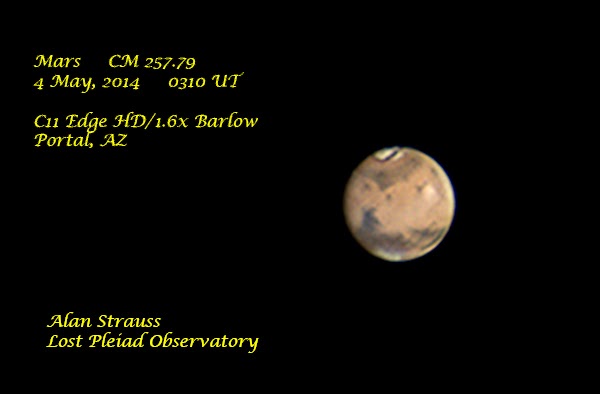
Slowly this blog is turning to more photos than text and I guess that is a factor of being so busy with work.  When I have free time I spend it with family or in my own observatory and do not take much time to write the blog these days.  In fact, I am about to head out to Mount Lemmon for a UA Sky School trip and need to finish up this brief post quickly.  Below I present three images from the Portal trip...one taken of Mars through my 11-inch Celestron Edge HD, and two of the milky way rising.


First, Mars:

In the Milky Way images below, I was using my new Canon 10-22mm zoom, at the 22mm setting.  These are single 30-second exposures and I used a red flashlight to 'paint' Jerry and myself during the exposures.  I am in the upper image, Jerry in the lower.


While these images are a bit noisy due to the high ISO, what is notable is the lack of light domes near the horizon. There are now small domes visible from El Paso and Lordsburg that rise perhaps 2 degrees above the horizon in long exposures, but these domes are a bit to the north of this exposure.


Sunday, April 6, 2014

Spotting a solar prominence and prominent solar spots

Spending this weekend at home, catching up on all the wonderful responsibilities and tasks that accompany being a husband, father and law abiding citizen, finally afforded me some time to enjoy observing the Sun.  As much as I enjoy preparing my state and federal taxes I believe I enjoy observing more...and the good news this year is that I do not need to pawn an eyepiece or two to pay a tax bill.

Saturday I spent a bit of time observing the Sun through my 60mm Hydrogen Alpha telescope, and was just starting to take some images when the power went out in our neighborhood.  Fortunately, I had already captured an image of a fantastic prominence before the power went out...and it is presented below.  I had to blow out the disc in order to expose the prominence, but you can see just how impressive it was.  Consider that the Sun is about a million miles in diameter and that this prominence was approximately 15% of the solar diameter in size and it is safe to assume that this tower of plasma was standing at least 150,000 miles high!


This morning I opened up my observatory and used my 90mm Stellarvue triplet equipped with a Lunt Solar Systems Herschel Prism to observe the Sun in white light.  I was rewarded with some steady views that showed several spot regions.  Below is a stack of 300 frames taken with my ASI120MC camera, at 9:04 AM local time (1604 UT).  Click the image to enlarge it to full size.


For comparison, here is an image from the Solar Dynamics Observatory taken near the same time with the active regions labelled.  As you can see, good optics, a decent camera and steady seeing can produce some impressive results!


Friday, April 4, 2014

A little Mars love

Between working many days and nights and generally poor skies on my days off, there have not been many opportunities for me in the past few weeks to get out and practice observing or imaging Mars in my backyard.  Last night was the rare night where skies were clear and I was at home with some time to observe.  Both seeing and transparency were slightly below average, but this photon deprived boy was not about to complain.

I opened up the roof and spent some time observing mars through my C11 between about 9:00 and 9:30 local time (0400 and 0430 UT).  The north polar cap has noticeably diminished in size over the past month as the Martian spring advances and there is a darker collar on the southern edge of the cap.  There continues to be very bright limb haze.  I had a hard time noting many dark features, likely due to Mars still hanging low in the east during my early observation.  I was able to identify Terra Cimmeria in the south, but that was about it.  While the image would no doubt be better with Mars higher in the sky, I was not about to stay up until midnight as I was looking forward to sleeping in my own bed for the first time in a few nights.

Below is an image I took using my ASI120MC camera, and it represents a stack of about 200 frames out of 2500, taken through the C11 and a 1.6x barlow lens.  You can see the north polar cap as well as the thin dark collar below it.  The wider, dark area south of the polar cap is Utopia Panitia.  At the south of the planets disc, the darkest feature facing us is Terra Cimmerium.  The bright spot near the limb on the right is Olympus Mons, and you can see the haze on the limb.


For comparison, here is a simulated image from calsky.com of mars at about the same time:


Currently, Mars is visual magnitude -1.40 with a true distance of 0.6286784 AU (94048948 km) from Earth.  In light time, it is 0h 05m 13.71s distant.  Hopefully as Mars come to opposition next week, I'll have more opportunities to take some images of the other side of the planet as well.

Tuesday, March 25, 2014

Passages of time

Let's just put it out there up front:  Today, is my 45th birthday.  This week I am at the summit of Mount Lemmon as we host students from Altar Valley middle school at our UA Sky School.  I posted awhile back about the development of the Sky School here and I can not emphasize enough how rewarding this aspect of my job is.  Last week I was honored to accompany Sky School co-founder Ben Blonder as we traveled to the White House where he was honored as a White House Champion of Change in Environmental Conservation Leadership for his vision and work at developing the Sky School.  Above left is an image of one of the students taking a tree ring sample this morning as part of her groups inquiry project to explore the possible relationship between tree growth rates and density.

So while I celebrate the passage of 45 years (gulp) of my life and marvel at how quickly time seems to pass as I grow older, I am fortunate to be spending this time at the Sky School, with incredible colleagues, public school students, friends, and even my dearest Beth and Ian who drove up to celebrate.  As is my custom, I like to mark significant events with astronomical observations, and I took a couple minutes early this morning to set up a solar telescope and take an image.  I was using a 90mm Coronado Hydrogen Alpha Telescope at the summit of Mount Lemmon, and despite steady breezes and an encroaching cold front managed a decent picture.


And with that, time for some cake!


Wednesday, March 12, 2014

Mars approaches!

No, this is not a blog post to let you know that Mars will pass closer to Earth than at any point in the history of our solar system in early April.  You can find that story circulating on the internet as it does approximately every two years as Mars approaches opposition.  This year, Mars will be at opposition on April 8th and will have an apparent diameter of approximately 15" (arcseconds).  Currently, Mars is .73 astronomical units from Earth and is 96.7% illuminated with an apparent diameter of 12.74"

A few months ago I purchased my first astronomical camera in order to learn to take planetary images in a run up to this Mars apparition.  Mars has always been my favorite planet to observe visually and I want to be able to capture some nice images as well.  Two nights ago I was out observing and imaging Jupiter and was impressed with how steady the seeing conditions were.  Below is an image of Jupiter I captured with my 11" Celestron Edge SCT and a 1.8x barlow lens.
As the seeing conditions were so favorable I decided to stay up far too late and try my hand at my first image of Mars.  I will not go into detail about the trials and tribulations of the process, but keep in mind that Mars is much smaller in apparent size than Jupiter, that its details are quite subtle, and the seeing conditions had deteriorated quite a bit by 1 AM.  I was not able to use the Barlow lens to increase the image scale so the picture below is straight through the C11.
All in all I am happy with the first effort.  I pushed the processing a little too hard but may go back and try again if I have some time.  Of note, you can see clouds in the Olympus Mons region on the right side! Olympus Mons is the largest volcano in our solar system and these are likely orographic clouds.  For comparison, below is a simulated image from the website calsky.com.


Tuesday, February 18, 2014

Jupiter February 17th

Last night was the first clear night in several for us here in Tucson and I spent a few hours observing.  In addition to some typical targets, I observed the Supernova in M82 and was pleasantly surprised to see that it has dimmed only slightly.  It was still easily visible even in my 90mm refractor.  Using the 11 inch SCT, it seemed to have a slight yellow cast to it!?!

Of course, I also took an image of Jupiter under average seeing conditions-  and to my surprise, there is a very interesting feature on the "boring side" of the planet...a disturbance that is nearly as large as the great red spot and is also a shade of red.  It is more stretched than typical storms, and it will be interesting to obsreve how this region changes and how long it persists.  The image below was taken through my 11 inch Celestron Edge HD SCT with an ASI120MC camera...it is approximately 250 frames aligned and stacked in Registax with some tweaks in Photoshop.


Wednesday, February 12, 2014

Jupiter and Io's shadow

To my surprise tonight, Io was making a transit of Jupiter about the time I started observing tonight.  Naturally, I used the experience to practice taking an image, despite the fact that my telescope was not acclimated to ambient temperature...and the result is below.  It is a stack of approximately 400 frames.  Seeing conditions were slightly above average, and certainly good enough for my level of processing skill!


Sunday, February 9, 2014

Copernicus

After a solid week of rather cloudy skies we had somewhat clear skies this evening over the Lost Pleiad Observatory.  While there were some passing cirrus, it was a very comfortable night to open up the roof and let the telescopes do what they do best- collect photons.  Tonights target for the little ASI120MC camera was the lunar crater Copernicus. This is a crater well known to most amateur astronomers as it dominates the Earth facing side of the moon and has a very large and bright set of rays extending from it.  The image below is a stack of about 500 frames aligned and stacked in Registax, with some additional sharpening in Photoshop.  It was taken through my Celestron 11 inch Edge HD SCT.


While this is certainly a reasonable image given my skill and the average seeing conditions, I can not look at any lunar images without thinking about the amazing images generated by NASA's Lunar Reconnaissance Orbiter (LRO). The images below are the central peak region of Copernicus and give you an idea of just how impressive the images from LRO are.  Make sure and click the images to enlarge them to full size!


If you want to read more about these images and see others, check out this blog post from the LRO camera. If you have not had enough (and how could you?!?) watch the video below...and turn up the speakers to listen to the narration.

Monday, January 27, 2014

Jupiter, Io and a shadow transit

Arriving home from work tonight under partly cloudy skies, I did not even bother to open the observatory roof.  This turned out to provide good karma as my poor planning led to skies that were crystal clear at 9 PM.  While the transparency (clarity of the atmosphere) was reasonable for observing Jupiter, the seeing (atmospheric stability) went from average to poor rather quickly between 9 and 10 PM.  This was unfortunate as tonight was a transit of the Galilean moon Io and its shadow.  Regardless of sky conditions, being the faithful amateur astronomer that I am, I took several videos through my 11-inch Celestron Edge HD SCT and my ASI120MC camera in order to stack the frames and create an image of the event.

First up, is a stack of 2 images, each of which itself represented a stack of approximately the best 450 frames out of a 60 second video.  That is Io's shadow cruising through the south equatorial band.  Just think, if you were on Jupiter standing in the shadow you would be seeing a solar eclipse!
Seeing had deteriorated significantly by the midpoint of the transit, and the image below is a stack of three images, each of which was a stack of only 90-120 frames each from a 30 second video.  Compared to the above image the details are far less clear.  Io's shadow is nearly on the center of the disc, and the Great Red Spot has come around onto the face.
Next up is the image I was after.  You can see that the Great Red Spot has rotated onto the face (less than an hour after the previous image), Io's shadow has moved further along, and on the limb of Jupiter the moon itself is now visible!  Despite the obviously poorer seeing conditions, I ended up with a salvageable picture, and the process gives me confidence that with better conditions I may be able to capture some nice transit images.


Thursday, January 23, 2014

Jovian improvements

My faithful readers (you two know who you are) have seen that I have been learning to take planetary images of Jupiter and Venus these last few months.  I do not have the patience required to get into serious deep-space astrophotgraphy, but the planets are bright targets whose ever changing appearances make for constant photo opportunities, and require less investment of time and money.  My hope is to develop some skill at imaging Jupiter so that I can successfully image Mars in a way that will reveal some of the Martian detail.  Mars holds a special place for me as an observer in that it rewards patience.  It is often quite small and the details are subtle...so I hope to achieve a level of skill and confidence with the camera and techniques as the current Mars apparition unfolds.

Alas, I digress (again, those of you who know me...)...with all the excitement of the supernova in M82, I have not gotten around to posting what is my best Jupiter image to date.  Below is an image captured through my Celestron 11" Edge HD SCT using the ASI120MC camera on Tuesday night.  I can say that I am making progress and soon, I will be ready get to work on Mars.  The moon closest to Jupiter is Io, and the one near the right edge is Europa.


Sunday, January 19, 2014

Jupiter meets the Stellarvue

Recently, I mounted my 90mm Stellarvue triplet in a side by side configuration with my Celestron 11-inch Edge HD SCT.  This has turned out to be an exceptional set up combining the high powered views the C11 can deliver, with a small telescope that can provide the wider context.  While the Stellarvue is by any definition a small telescope,  it excels at wide field views of the Milky Way as well as views of extended objects such as the Great Andromeda galaxy or the Pleiades.  It is also useful for observations of Jupiter and Saturn as among planets these two have enough angular diameter to reveal details.  Last night seeing conditions were better than they had been in some weeks and observing Jupiter revealed a great bit of detail in both telescopes.  I wondered how an image through the Stellarvue would compare to the C11 and so took my first ever image of Jupiter through my Stellarvue 90mm Triplet.  I was surprised at the level of detail, given the small aperture.

The image below is a stack of about 600 frames taken using a 2x barlow and my ASI120MC camera.  The Great Red Spot is actually in the southern equatorial band on Jupiter, but the composition was much nicer placing south up in the image.  Io is the moon at far left and Ganymede at far right.


Thursday, January 16, 2014

Jupiter's 'boring side'

Everyone loves the GRS (Great Red Spot); a giant storm that has persisted in the Jovian atmosphere since before the time a telescope was first pointed at Jupiter by Galileo.  Tonight, the GRS was somewhere on the side of Jupiter facing away from Earth and I imaged what astronomers jokingly refer to it's boring side.  The picture below is a stack of 3 images, each of which was itself a stack of between 250 and 400 individual frames, all taken within about 90 seconds of each other.  Jupiter rotates so quickly (a day on Jupiter is approximately 9 hours!) that if I were to spend more time taking video, the resulting stacked image would be blurred from Jupiter's rotation.  There is software to deal with this 'de-rotation' issue in processing, but I am still too far back on the learning curve to deal with that.  This is, I think, my best image of Jupiter to date.

Picture taken through my Celestron 11" Edge HD, using an ASI120MC camera

Tuesday, January 14, 2014

Jupiter, Io and Europa

Not a lot of time for words this morning, which for those of you that know me, is a good thing.  Below is an image of Jupiter I took last night at about 9:15 PM MST (0415 UT, 1.14.14).  To the right of Jupiter are the moons Io (top) and Europa (bottom).


Image was taken through my C11 Edge with an ASI120MC color camera.  Seeing was average and I came a little closer on focus and collimation.  It may be time for a Bahtinov mask to achieve focus, and studying some real processing techniques.  Image is a stack of about 450 frames.

Wednesday, January 8, 2014

Active region 1944

The last few days have seen some remarkable images of the sunspots contained within active region 11944 that are making their way across the face of the Sun.  While I had taken a couple images late last week (posted here), I wanted to revisit the area this morning during a break from work.  Working at home this morning allowed me to run out and take a look at this region once again.  Seeing was a little above average with some some thin cirrus that are heralding an arriving cold front (maybe I should say a 'cooler front' in light of what our east coast brothers are experiencing this week).

All images were taken through my Stellarvue 90mm triplet and  Lunt Solar Systems Herschel Prism.  First, a whole disc image using my Canon T2i and a 2x Barlow lens- it is a single frame...click to enlarge.
Next, is a stack of 500/1000 frames captured with my ASI120MC video camera.  This comparison to the above image shows the benefit of stacking multiple images to obtain a higher and sharper level of detail than can be achieved in a single shot as above.  Again, click to enlarge.


Finally, an image of the same region using the ASI120MC and a 2x barlow.  This active region is massive, and with a proper solar filter can be seen without optical aid...it is perhaps the most impressive spot region I have seen in several years.  Click to enlarge.


Sunday, January 5, 2014

Naked eye observation of Jupiter's moons possible tonight!?!

Doing my Sunday morning reading on the internet of all things astronomical, it has come to my attention that it may be possible to observe one or more of Jupiter's moons tonight, with the unaided eye!  This is due to several favorable circumstances and the opportunity for such an observation is, I suspect, rather uncommon.

If you are interested in taking on what will be a challenging observation, I recommend beginning by reading a short article published in Sky and Telescope magazine in 1976, by the late Dr. Denis Dutton.  The linked article contains a bit of information on the history of naked eye observations of the Jovian moons, as well as references to other historical articles and observations.  In addition to the topic at hand, I particularly enjoyed his words at the end of the article when he wrote "The concept of true scientific discovery involves grasping the meaning or importance of what is revealed."  Contained in these words is the often unspoken wisdom that guides those of us who spend hours at the eyepiece, straining to tease out the faintest hints of light from the dark background.  What we are looking at is quite frequently not impressive at all, even to our fellow amateurs; it is only with an understanding of what we are looking at does the observation take on meaning and significance.

12.22.13/TEC 140 APO/Lost Pleiad Observatory


Today, January 5th, Jupiter is at opposition (exactly opposite the Sun in our sky) and rises at sunset.  Perhaps most remarkable about this opposition, is that if seen from Jupiter, the Earth would appear to transit the Sun!  The result is that the phase angle is quite small and the opposition effect on Jupiter and her moons will be quite strong.  Les Cowley has an explanation of the opposition effect on his website, and essentially it is a result of objects appearing brighter when they are near the anitsolar point in the sky.  As he identifies, "The Moon's brightness at full is greater than can be accounted for by the increase in its illuminated area compared with its partial phases."


How much brighter?  Due to the opposition effect, Jupiter's moons may appear as much as 30% brighter tonight!  As it happens, the crescent moon sets approximately 10:40 PM and is far from Jupiter in the sky.  Below is a graphic representation of Jupiter and the location of it's moons (created with Winjupos) at 10:30 PM MST (0530 UT Jan. 6th)
Click the graphic to enlarge
Here is some technical data on the moons (in order from left to right in the graphic), which will give one an idea how dark the skies at your observing site need to be to have a chance at seeing one or more moons naked eye, (not accounting for the opposition effect):

                   Diameter  Visual magnitude

Io                  1.190"           5.0 mag
Europa         1.029"           5.3 mag
Ganymede   1.725"           4.6 mag
Callisto         1.573"           5.7 mag

While all of the moons are intrinsically bright enough to be seen by most observers at a reasonably dark site, it is the glare of Jupiter that typically prevents their observations.  Tonight, Ganymede will be the easiest given that it is the brightest and will sit nearly 15 Jupiter diameters from the gas giant herself (one Jupiter diameter at tonight's opposition is 46.76 arcseconds).  Io, while the second brightest, will likely be lost in the glare of the planet, and Europa will be exceedingly difficult.  Callisto will be interesting as it is the faintest moon, yet will be furthest away at approximately 19 Jupiter diameters.

One recommended trick for attempting to see the moons is to stand (or sit) in a location where one can block Jupiter with the edge of a wall (or pole, tree, etc).  Doing so may reduce the perceived glare and make spotting one or more moons a bit easier.  Personally, I will attempt this observing challenge tonight, and would love to hear from others who attempt to see the Galilean moons without optical aid.   Drop me a note, lostpleiad@gmail.com  (or comment below). Good luck!


Friday, January 3, 2014

Venus closing in on inferior conjunction

Venus de Milo
Venus (the planet, not the goddess of love) is closing in on inferior conjunction - the point when it lies directly between Earth and the Sun in its orbit.  Inferior conjunction will take place on Sat, 11 Jan 2014 at 05:19 MST (12:19 UT).

Because Venus orbits between the Earth and the Sun, it moves through phases of illumination just like our Moon.  As Venus is now 8 days from inferior conjunction, only a very thin crescent is illuminated.  Below is a stack of 500 frames from an avi file of Venus I captured this afternoon through my TEC 140.  I may have overdone the processing a little as the extreme tips of Venus seem to have been lost, but either way you can appreciate how thin the crescent is.

Currently, Venus is nearly at its largest apparent size, with a diameter of 61.08 arcseconds and is a beacon of light shining at magnitude -4.26, making it far and away the brightest object in the evening sky.  In a nice coincidence of numbers, it is 2.3 light minutes away, and is also 2.3% illuminated.
Of course, Venus' orbit is tilted with respect to Earth's orbit and as a result it will not appear to transit across the face of the Sun as it did in June of 2012. From our vantage point on the Earth, Venus will pass within a 5 degrees of the Sun and will be lost in its glare. Venus will also pass perigee (the time when it is physically closest to the Earth) within a few days of inferior conjunction. It will move to within a distance of 0.27 Astronomical Units (AU) from the Earth, which is approximately six times closer to Earth than at superior conjunction (when Venus is on the far side of the Sun).  If it could be observed, it would measure 62.7 arcseconds in diameter, which is approximately 50% larger than Jupiter, yet it would not be illuminated at all! As Venus moves past inferior conjunction, it will once again become a morning object over the next few weeks.


NOAA Active Region 11944

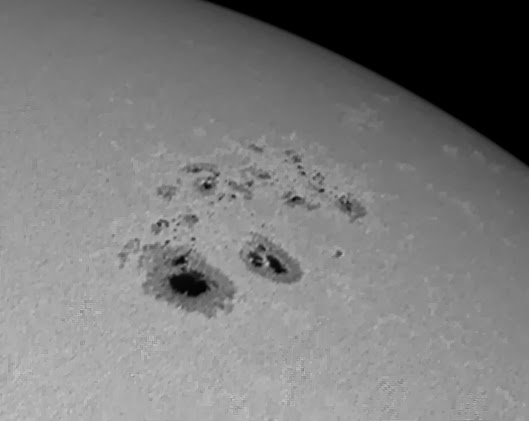
When it comes to active regions (AR) on the Sun, this one is big...how big?  By my estimation, AR11944 is larger than Jupiter.  Click on the SDO image and scale at left to enlarge, and remember that the sunspots are contained within a larger region of magnetic activity.  This region made it's way around the Sun's eastern limb on New Years Day, and I expect that we will be able to observe this region and it's accompanying spots for approximately two weeks as it transits (the Sun rotates from east to west with a rotational period of approximately 25 days at the equator).  Below are two images from this morning, taken through my 90mm Stellarvue triplet and Lunt Solar Systems Herschel Prism.  They represent stacks of 750 frames (out of 3000) in average seeing captured with an ASI120MC camera.  This region is on the southeast limb of the Sun, but I liked the composition better as presented-


Below is a second image of the region, taken with the addition of a 2x Barlow lens- and I am not sure why, but blogger seems to compress images and much of the solar granulation is blurred, particularly above the spots...but at least the spots survived the blog platform!


If you have a solar telescope, this is one region worth taking a gander at...and, I suspect this region is large enough to be seen naked eye with the appropriate solar filter to protect one's eyes.


Wednesday, January 1, 2014

Happy New Year!

Today marks not only the New Year, but also the fourth anniversary of this blog...and most importantly my 18th wedding anniversary!  Life has treated me well and I am quite fortunate to have such a wonderful spouse and son.  18 years has gone by in the blink of an eye, and it seems only yesterday I was eyeing that cute grad student with the southern accent and the smell of eucalyptus in her hair.

It is somewhat of a personal tradition that I try to celebrate all holidays with a little observing and this morning I set up both my hydrogen alpha and white light solar telescopes.  There is a fair bit of action on the Sun and I took some images through both telescopes.  I began with the white light and took the images below.  All images are presented with north up and west to the right.


The seeing was steady enough that in addition to the images straight through the 90mm Stellarvue triplet, I was able to utilize a 2x barlow.


Finally, while the seeing was slowly worsening (as typically happens as the day progresses and the air and ground warm up) I was able to grab an image in hydrogen alpha.  I was having a hard time tuning the telescope and it may be time for me to take it in for a "tune up" at Lunt Solar Systems.  Again, north is up and west is to the right.


Happy New Year!