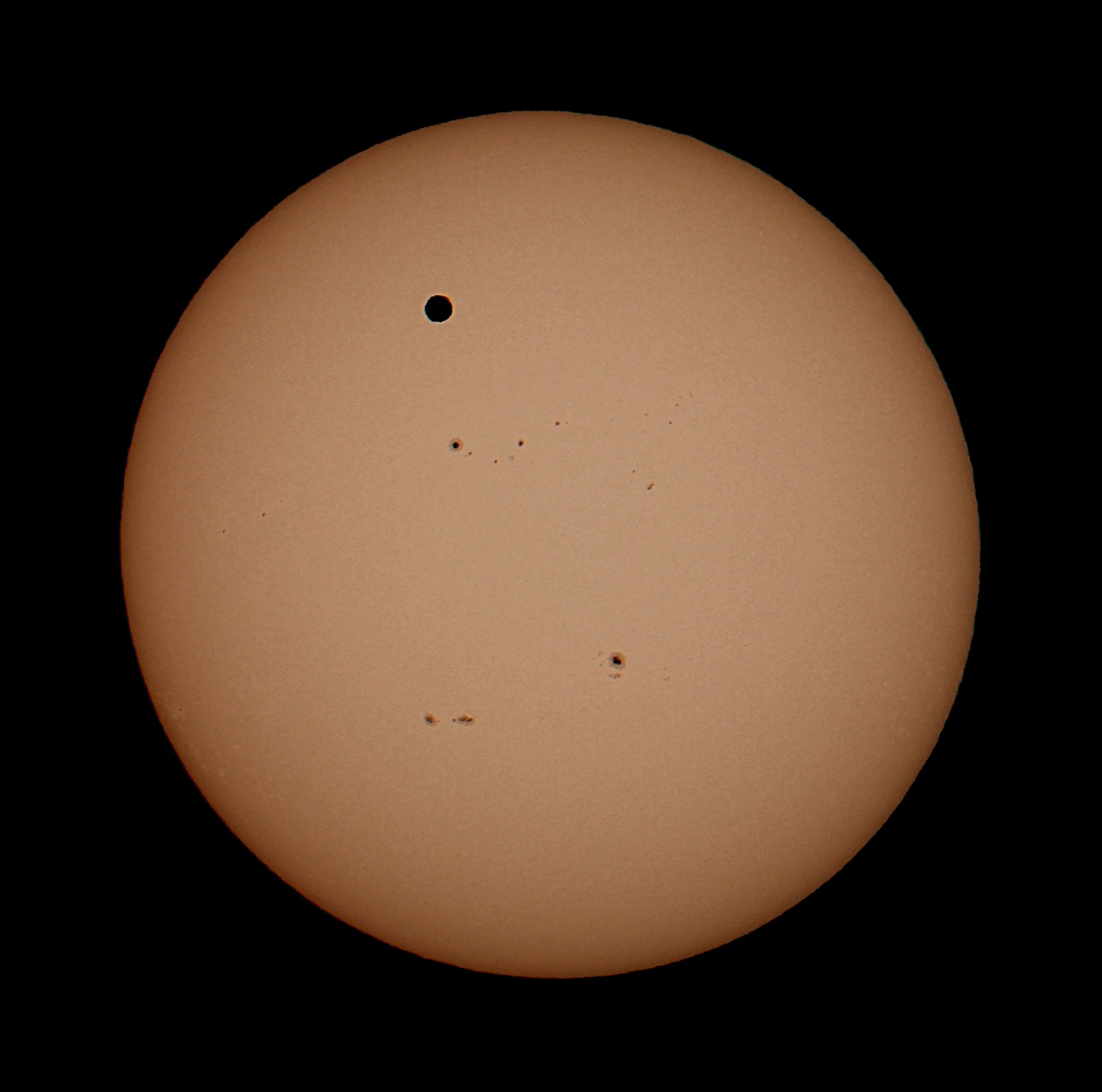
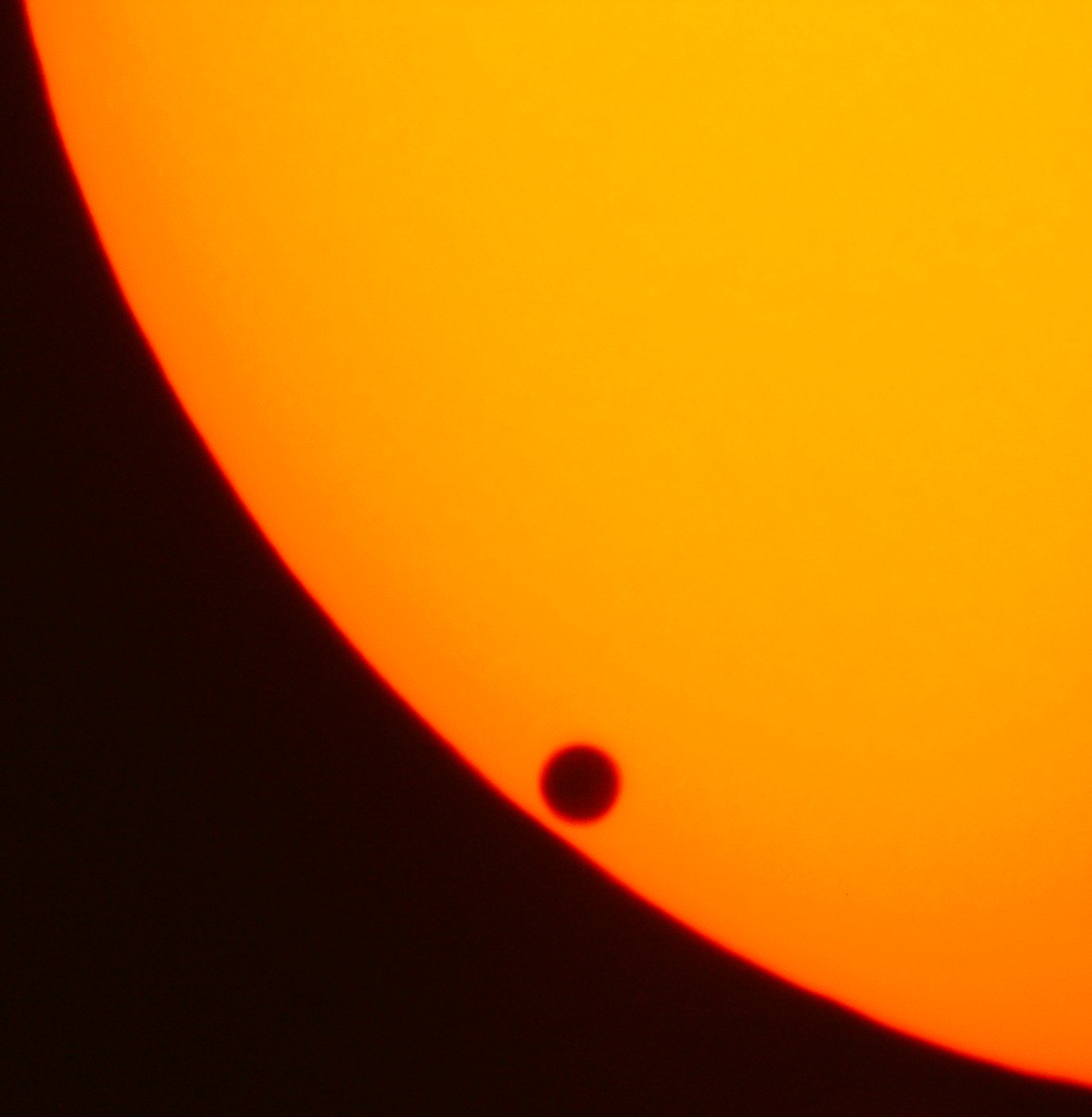
Showing posts with label Venus. Show all posts

Sunday, August 28, 2016

Venus-Jupiter conjunction

2065.  That is the number running around in my head this morning...or to be clear, the year 2065.  In 2065, should I still be kicking and screaming, I'll be in my 96th year here on the 3rd rock from the Sun...and that is the next time that Earth, Venus, and Jupiter will be lined up as closely as they are now.  Below, is a picture I took from the roof of our home last night of Venus and Jupiter in the western sky just after sunset.  You will need to click to enlarge it to appreciate the planets near center.

Click to enlarge and see the planets near center!

I arrived home later than anticipated and barely had time to climb up to the roof and take pictures of the conjunction- and for the life of me could not seem to get a decent exposure quickly.  Of course when I came back into the house it was then that I discovered I had left my circular polarizing filter on the lens.  Very good for landscape, not so good in low light!

Venus is the brighter planet above and to the left of Jupiter.  Last night these planets were separated in our sky by less than the diameter of our full moon!  Keep in mind that these planets are not actually near each other in space-  after all Venus (the 2nd planet) is inside our orbit to the Sun and Jupiter (the 5th planet) much further outside our orbit.  It is just that from Earth, looking out on a line to Jupiter, we see Venus in its orbit right next to that line.

So, 2065 until we experience such similar geometry...if I'm around, I hope we have limited artificial lighting enough to see the alignment...and if not, perhaps my family members will have opportunities to see an Earth - Jupiter conjunction from Mars!


Tuesday, December 8, 2015

Occultation of Venus

Yesterday, observers in North America were treated to a rare celestial alignment as the waning crescent moon passed in front of Venus.  At approximately 9:23 AM Venus was covered by the illuminated edge of the moon as it (the moon) slowly trekked eastward across our sky.  I had my eye on the sky all morning in anticipation of this event and did not think I would get to see it as the sky had a thick covering of cirrus even before sunrise.

If I have learned one thing in my life as an amateur astronomer, it is much better to attempt to make a trip or an observation in the face of uncertain weather,than to throw in the towel in advance.  It is weather after all- it is unpredictable.  Countless times I have awoken during the night to make an observation that others skipped because it was overcast when they went to bed...and certainly I have driven 16 hours to a star party and been clouded out for 4 nights! (Texas Star Party).

In this spirit, I loaded up my binoculars, camera, lens, extender and tripod into a backpack and took them to work with me...At 8:30 AM I looked outside and the sky was a mess in the area where the moon would be.  So much so that I went back inside and nearly forgot about the occultation.  At 9:15 I remembered it was about to happen and grabbed my equipment and ran outside.  Sure enough, the haze had thinned just to the point where I could barely see the moon! It was difficult to focus and I was in a terrible hurry to catch Venus before it disappeared, yet I managed to get the image below.  It is nothing to write home about, but considering the effort I went to observe this occultation, I figured it deserved a post!


My friend and comrade in astronomy Dean Ketelsen has a very nice post on his blog with better images of the occulation.  In addition, Dale Cupp (also a friend and a volunteer who works with me) took the amazing image below through his 11-inch telescope.


Friday, January 3, 2014

Venus closing in on inferior conjunction

Venus de Milo
Venus (the planet, not the goddess of love) is closing in on inferior conjunction - the point when it lies directly between Earth and the Sun in its orbit.  Inferior conjunction will take place on Sat, 11 Jan 2014 at 05:19 MST (12:19 UT).

Because Venus orbits between the Earth and the Sun, it moves through phases of illumination just like our Moon.  As Venus is now 8 days from inferior conjunction, only a very thin crescent is illuminated.  Below is a stack of 500 frames from an avi file of Venus I captured this afternoon through my TEC 140.  I may have overdone the processing a little as the extreme tips of Venus seem to have been lost, but either way you can appreciate how thin the crescent is.

Currently, Venus is nearly at its largest apparent size, with a diameter of 61.08 arcseconds and is a beacon of light shining at magnitude -4.26, making it far and away the brightest object in the evening sky.  In a nice coincidence of numbers, it is 2.3 light minutes away, and is also 2.3% illuminated.
Of course, Venus' orbit is tilted with respect to Earth's orbit and as a result it will not appear to transit across the face of the Sun as it did in June of 2012. From our vantage point on the Earth, Venus will pass within a 5 degrees of the Sun and will be lost in its glare. Venus will also pass perigee (the time when it is physically closest to the Earth) within a few days of inferior conjunction. It will move to within a distance of 0.27 Astronomical Units (AU) from the Earth, which is approximately six times closer to Earth than at superior conjunction (when Venus is on the far side of the Sun).  If it could be observed, it would measure 62.7 arcseconds in diameter, which is approximately 50% larger than Jupiter, yet it would not be illuminated at all! As Venus moves past inferior conjunction, it will once again become a morning object over the next few weeks.


Saturday, December 14, 2013

Venus Transit re-processed

Over Thanksgiving week I was leading a public observing program at the Mount Lemmon SkyCenter and one of the guests asked me what were my most memorable observations.  It was a question that motivated me to think about all of the wonderful times I have spent with friends and colleagues enjoying time at the eyepiece.  I hope to actually write up a blog post where I attempt to answer that question, and included in the answer will be observing the 2012 Transit of Venus.

Guest observing sunset - note the sun projecting on his eye
I observed the transit from the summit of Mount Lemmon with my colleague Adam Block and somewhere in the neighborhood of 100 guests that attended our special Transit of Venus program.  We had multiple telescopes set up, including some brought by visitors themselves, through which we observed the event.  I had purchased my first DSLR (ever!) the week of the Transit in the hopes that I would be able to take some pictures through my telescope.  I posted those images on the blog shortly after the transit, and to say I was lucky is an understatement.  I had very little understanding of how the camera worked, and practiced with the camera and telescope for just a couple days leading up to the Transit.  You can read about the adventure and see the original images on this post from June of 2012. About a month after the Transit I made an attempt to process my best raw image of second contact and was fairly satisfied with the results at the time. That post and image can be found here.

As I have been playing around with solar imaging a little bit this year, I have gained more experience in processing the images that I take.  While I was previously using the freeware program GIMP, I am now using using Adobe Photoshop and have been able to identify a few techniques to improve my images.  Below, is my latest attempt to bring out the best of my image of second contact-  I am quite happy with the result!  Click on it to enlarge.


Wednesday, June 12, 2013

Planetary aesthetics

If you have been watching the evening skies this past month you know that we have had some very nice alignments of Jupiter, Venus and Mercury following sunset.  While Jupiter is now departed from view, Venus and Mercury remain and this week were joined by a fresh crescent moon.  This past Saturday I was at the Arizona Sonora Desert Museum doing some astronomy outreach in support of the UA Cancer Center and took the image below.  Venus is the lower planet and Mercury the upper.  Click to enlarge to full size!


Two nights later (this past Monday), I took this image from in front of my house where the planets were joined by the crescent moon, making a nice triangle.  If you click to enlarge to full size and look closely, you will see above the moon another interloper in the image, a bat!


Wednesday, May 29, 2013

Planetary conjunctions!

Today I returned from LA to the comfy confines of Tucson and my observatory.  As the sun was setting and I was noting the beautiful colors in the Belt of Venus I was reminded of how lucky I am to live in an area with such open horizons and frequently clear atmosphere.   The evening was so nice I decided to take a picture of the planetary conjunction in the west  from my home so as to capture many of the colors in the sky that I could simply not capture from the middle of LA.  The image below was taken at 8:13 MST (0313 UT) with my canon T2i and a 24-105mm zoom lens at 88mm.  The image was .8/sec, ISO 200 at f/4.5.  Click on the images to enlarge them and if your browser automatically re-sizes images you may need to click them a second time.  The images are identical with the exception of the labels on the right hand image.


As it happens, I discovered on my cameras memory card another conjunction image that I had taken earlier in the month, on May 13th at 0332 UT when the Moon was very close to Jupiter.  Jupiter is the bright dot near the lower right of the image (click to enlarge):

This was a 1 second exposure at f/4 with a Canon 15-85mm EF-S lens set at 85mm, at an ISO of 400.  I am quite happy with the exposure on the moon, particularly in that one can appreciate not only the Earthshine, but also some of the detail on the lunar terminator.  For instance you can see how some of the crater floors are not yet illuminated by the rising Sun, resulting in a scalloped look to the bright terminator.  Below is a full resolution crop of the moon from the above image...as always, click to enlarge.


Good night moon!


Tuesday, March 26, 2013

Sunsets from the summit of Mt. Lemmon

Working as I do at the Mount Lemmon SkyCenter, I am often treated to sunset from the 9157 foot summit of Mt. Lemmon.  Whether it is with our guests looking for the Sun's Green Rim or simply at the end of a day doing other work it remains a special place and special time.  Here are a few of the various sunset images that I have taken over the past year.  Remember you can click each image to enlarge it.

Guests enjoying the late season snow while preparing to view the Green Rim

Beautiful Sunset portending a very stable evening of observation

Sun setting into a layer of dust in the valley
Sun having dipped below the dust layer


The shadow of Mount Lemmon rising in the east (Sun is behind me)

A view of Kitt Peak National Observatory

Shafts of light through a late summer monsoon
And of course, my favorite sunset image of the past year is the image below, taken during the June 2012 Transit of Venus.  It was taken through my TEC 140 with a Herschel Prism and shows quite a bit of atmospheric distortion...Obviously, Venus is the blob at lower left, just touching the horizon.  This is my favorite as not only had I purchased my first DSLR the week ahead of the transit, but this event will not repeated for anyone alive today.

2012 Transit of Venus Sunset


Sunday, September 9, 2012

Photoshop - Baby steps

I finally broke down this week and purchased Adobe Photoshop-  While it is fairly expensive software, I was able to purchase it with an educational discount through the University which eased the pain...slightly.  Already, I can see that it is a very powerful program for manipulating digital images to bring out the maximum amount of detail in a way that is aesthetically pleasing.  I had been using the freeware program Gimp 2.8, however, this most recent version of the program had a difficult time utilizing the RAW images that I was taking with my Canon T2i and trying to work around this issue finally pushed me into the decision to purchase photoshop.  My next step is to find a good tutorial on line for using the program with my pictures, particularly those of the Sun.  Unfortunately an internet search for photoshop tutorials turns up far too may sites for my patience level...so if you know of a particularly good one, drop me a line.

I decided to play around with a shot of second contact from the Venus Transit to start understanding a little of how the program works...believe it or not, even the concept of 'layers' is new to me and I have a steep learning curve ahead.  Below is a processed shot of second contact from the transit, as well as an inverted image which is kind of cool in an artistic way.  Be sure and click the images to enlarge them to full size.


Sunday, July 8, 2012

Venus Transit part two

If you read my previous posts leading up to and including the Venus Transit, you know that I purchased my first digital DSLR camera 6 days in advance of the Tranist. things worked out fairly well and I captured some memorable pictures of this once in a lifetime event. When I was taking images, I had the camera set to record both JPEG and RAW files with each exposure. You can see the JPEG pictures posted here. For the minimal processing that I have been doing with digital pictures, I have been using the freeware program GIMP. In fact, I have not yet been able to even preview the RAW files.  This morning, I decided to search and see if digital RAW files could be viewed and manipulated using GIMP. I discovered that they can, to an extent, by using a secondary program called UFRAW. (If you decide to try UFRAW, you must have GIMP installed first).

Well, to cut to the chase, I decided to open one of my RAW images from the Venus Transit to see the difference...and HOLY DETAILS BATMAN! Below is the only image I have opened so far and needless to say I am now motivated to get to work on the rest of the images from the Transit of Venus. Be sure to click and enlarge the image (and if your browser automatically re-sizes the picture to fit your window, click it again to bring it up to full size).


Again, this was 1/4000 of a second at ISO 100.  Keep in mind that this image has been cropped and converted to JPEG format for presentation here, so there is actually more data than one can see in the above image.  In the hands of a skilled image processor, the results could be even more spectacular.

Saturday, June 9, 2012

Mass Transit

Even if you are completely saturated with images of the 2012 Transit of Venus, you must watch the video below created by NASA.  The video is from the Solar Dynamic Observatory, and defies description.  The Transit was a moving event (pun intended) to watch in person, and this video montage captures the grandeur of the event in breathtaking fashion.

Adjust the settings to HD, turn up your speaker volume and prepare to be entranced.


It is worthwhile to keep in mind that SDO only began science operations a little over two years ago!  In other words, three years ago no human had ever been able to observe the dynamic behavior of a star the way that we can now...up close, in high definition, in so many varied wavelengths of light.  I can not begin to image the technology that will exist for the next Transit of Venus in 2117.


Friday, June 8, 2012

2012 Transit of Venus

Unless you have been living under a rock, you know that this past Tuesday Venus transited across the face of the Sun...see the previous few posts.  While it has only been three days, it feels like I am the last person on Earth to get my pictures posted.  I have seen some incredible images taken by observers around the world, and  there is no way that my images can compare.  Of course, I just purchased my camera and began my foray into the world of astrophotography last week!

Click to enlarge
We hosted about 30 individuals at a special Transit program at the Mount Lemmon SkyCenter and we simultaneously provided a live web stream of the Transit.  The stream was available on our You Tube channel and our website.  While we do not yet have numbers directly from You Tube, we had over 30,000  folks check out the stream via our website!  Despite having to attend to our guests and the live stream, I did manage to run over to my TEC 140 and snap some pictures every now and then.  I took a few hundred images and ended up with just a handful of decent ones.  At left is a nice image of the Sun early in the day that I took to make sure everything was set and working.

It's funny how much my inexperience came into play.  Taking a sharp image of the Sun as above, about 90 minutes after sunrise while leisurely drinking a cup of coffee is relatively easy.  There is hardly any breeze and the atmosphere is quite stable.  Life is good.  Fast forward to the Transit- While minding my real responsibilities and trying to entertain guest, capturing the Transit photos took on a life of its own.  In addition to being rushed and distracted, the atmosphere at 3 PM is anything but calm as it is the hottest part of the day here in Tucson.  In addition to the atmospheric instability, I was set up on the summit ridge of Mt. Lemmon and experiencing fairly continuous breezes and gusts of wind in the 10-12 mph range.  I had also installed a foam shield on my telescope to keep my camera shaded and did not realize but the shield was acting like a sail keeping the telescope shaking subtly all the time.  Of course, I also forgot to engage the mirror lock up function on the camera, although I suspect with the wind it would not have mattered.  Finally, I had never practiced at sunset and had no idea about useful shutter speeds or ISO settings as the light from the Sun was being extinguished.  All in all, given my inexperience and the atmospheric challenges I am quite happy with the few usable images I ended up with.

Click on images to enlarge them:


First Contact (upper right)
in-progress now


My favorite image, Second Contact!


The Transit continues...the images get darker as the Sun was moving toward the horizon.  Click the images to enlarge:


And of course, the obligatory shot of the Venus transiting the setting Sun, terribly distorted by the atmosphere!


I think it appropriate to close this post, not with my words, but with words from the journal of Jerimiah Horrox, who first predicted and observed the Transit of Venus in 1693.  In describing his colleagues experience he wrote:

"he eagerly betook himself to his observations, and happily saw the most agreeable of all sights, Venus just entered upon the Sun.  He was so ravished with this most pleasing contemplation, that he stood for some time viewing it leisurely, as it were; and, from an excess of joy, could scarce prevail upon himself to trust his won senses.  For we astronomers have a certain womanish disposition, distractedly delighted with the light and trifling circumstances, which hardly make the least impression upon the rest of mankind...


...For what youth, such as we are, would not fondly admire Venus in conjunction with the Sun, what youth would not dwell with rapture upon the fair and beautiful face of a lady, whose charms derive an additional grace from her fortune?"

Sunday, June 3, 2012

Final test for the Transit of Venus

One more attempt this morning to try some different settings on the camera.  It appears that at the moment I am still seeing the best results from 1/4000 of a second at ISO 100.  I tried shooting in monochrome as well as with some different color schemes, but the standard is still giving the best results.  Below is an image taken this morning with my TEC 140 and Herschel solar prism at 7:52 AM MST (1452 UT).  I did play around with this shot using the freeware program GIMP, and used the unsharp mask tool and I also increased the contrast slightly. Overall, assuming the weather holds, I should be able to get some decent shots of the Transit on Tuesday.  Make sure and click on the image to see the full size.


If you are interested in what got me to this point with the new camera, read this post from yesterday. My next post on the Transit will be after the fact!

Saturday, June 2, 2012

Venus Transit Authority

2004 Transit
I believe it is safe to day I've boarded the A train (Alan train) to H-E- double hockey sticks...(this is a family friendly blog, no cursing!).  I am so excited for the Venus Transit that will occur on Tuesday that I decided I was going to attempt to image the event.  After all, this is the last Transit of Venus that will occur in my lifetime and the only previous one in 2004 was not visible from the west coast of the US.  The next Transit is in December of 2117 at which point I, along with everyone else alive today will have been reduced back to stardust.

This decision to take images of the Transit of Venus was made about 7 days in advance....i.e. last Tuesday.  The "problem," if you will, is that in all my years as an amateur astronomer I have been strictly a visual observer.  Sure, I look at many astrophotos every day, but take one!?!  I leave that to the experts like my colleague Adam Block at the Mount Lemmon SkyCenter.  Back in the veyr late 1990's and until about 2001 I had an old Ricoh 35mm film camera that I used to snap some occasional shots of the Sun through my trusty C8...however, the difficulties of getting decent focus and the expense of developing rolls of film for one or two good shots quickly turned me off.  I simply enjoyed using the old peepers and making a sketch. Skip ahead a dozen years and along comes the Transit of Venus.  Impulsively on Wednesday, I purchased my ticket on the A-Train and am now traveling the road to...

I decided to take the plunge and purchase a Canon T2i DSLR camera.  I went with Canon for a few reasons.  One is that when I graduated college (shortly after the invention of the wheel) I purchased a then brand new first generation EOS Rebel 35mm film camera.  I backpacked through Mexico and took countless other trips with that camera and it really delivered excellent images.  Secondly, the astrophotographers that I know and trust who own DSLR cameras utilize Canon.  Finally, although I have not yet downloaded or tested it, there is a software program called BackyardEOS that has been developed by an astrophotographer that is not only economical ($30) but well regarded among amateurs like myself.  Below are pictures of the Canon T2i for those of you wondering what it looks like.


Just so one can appreciate my timeliness in preparing for this event, I purchased the camera on Wednesday afternoon and then hightailed to Starizona in order to purchase a T ring and adapter so that I could couple the camera to my telescope.  Wednesday night I read key parts of the manual and did a little internet research on some recommended settings for imaging the Sun.  Thursday morning I awoke an hour early to set up my white light solar telescope and take some practice shots.  Using my 102mm f/11achromatic  refractor and my Lunt Solar Systems Herschel Prism I quickly ran into my first problem...I could not achieve focus.  With no time to consider alternatives, I packed up and went to work.   Thinking through things later that night, I decided that I really should use my TEC 140 apochromatic refractor to capture this historic event as it is a precision telescope. Why would I purchase such a nice camera and then consider using a cheap lens?  Further, the TEC 140 is shorter at f/7 and has a feathertouch focuser which is designed for imaging!

Faithfully on Friday morning I again got up an hour early and tried to reach focus....Success!  I spent about 30 minutes trying different exposures and then hustled off to work.  I had a lot to get done in the morning and then had to drive a couple hours north to Phoenix to give a talk at the Saguaro Astronomy Club monthly meeting.  The meeting ended at 10 PM and I was home in bed by 12:30 AM.  Thank goodness my dear spouse runs faithfully several times per week...not only does it give me a heavenly body to observe (remember, family friendly) but she runs shortly after sunrise and as a result I was awake at 0700 this morning to try again.

Below, I give you a single shot taken at 1/4000 of a second, ISO 100, at 8:15 AM MST (1515UT) through the TEC 140 and Lunt Herschel Prism.  The only processing done here was to reduce the image scale (which I cut about in half) and to slightly sharpen the image.  The color (hopefully) comes from the fact that there is a layer of smoke in the sky from the Gila fire across the New Mexico border.  This is the largest wildfire in NM history and the smoke has been filling our skies for days.  You can see in the image that I know nothing about processing yet.  Make sure to click on the image and enlarge it to full size.

Click to enlarge

You can see in the image that I captured the visible sunspot groups as well as some extensive facula surrounding the spot groups near the limb.  Overall I am quite happy with this first attempt, and my plan is to capture many raw images of the Transit of Venus on Tuesday and then I can take my time and learn how to process them after the fact.

Friday, December 3, 2010

Sunrise spectacular

Here in the "Naked Pueblo" we are somewhat famous for our beautiful sunsets...head pretty much anywhere with a view of the western horizon, on pretty much any day of the year, and chances are you will be treated to picture postcard view.  This morning as I headed out to work I was treated to an absolutely fantastic sunrise.  A heavy dose of cirrus clouds were illuminated beautifully, along with an old waning crescent moon.


Click on and look carefully at the picture below, you will notice Venus above the moon- it is labelled in the second picture in case you missed it...