Showing posts with label TEC 140. Show all posts

Monday, January 1, 2018

International Space Station Transit

Happy New Year and welcome 2018!  There is much to celebrate!!

It is fitting that 2018 started off for me with an astronomical adventure, as it provided some fodder for a blog post...and in addition, New Years Day is the anniversary of this blog!  It all began here, in Googleland, on January 1, 2010.  While I have trailed off in the frequency of blog posts, my enthusiasm for astronomy remains strong.  The icing on the cake, is that today is the 22nd anniversary of my marriage to the love of my life, Beth.

As for the astronomical adventure, it happened that there was a transit of the International Space Station across the disc of the Sun as seen from central Tucson today.  This is the third time I have observed a transit of the ISS across the Sun, and you can read about the first adventure here, and the second here.

Today, I headed out to Himmel Park in central Tucson with my friends Jerry and Travis and set up my TEC 140 refractor with a Herschel Prism.  At the last minute I decided to use my Canon 6D to record video, instead of attempting to 'burst shoot' the transit.  This would take a lot of stress out of having to touch the camera and capturing an event that lasts approximately 1 second!

Without writing a novel, it was a success!  I am posting the original video at the bottom of this post, and I also created a composite of 32 individual frames showing the transit.  You can see in the composite image below that we were not perfectly centered under the ISS shadow, but we were very, very close.

Click the image to enlarge


To appreciate the scale here, consider that the Sun is about 93 million miles away and the ISS was approximately 421.5 miles downrange from me during the transit!  Because the ISS is so close, one must be on a very narrow ground track of the ISS' shadow in order to have the transit appear centered on the Sun.  Today's transit lasted 1.4 seconds on the center-line.

How fast does the ISS orbit?  It orbits the Earth in approximately 92.6 minutes, which results in an apparent ground speed of 7.885 km/second (4.9 miles/second)!  The ISS is also fairly small-  It's dimensions are approximately:
Length 72.8 m (239 ft)
Width 108.5 m (356 ft)
Height ≈ 20 m (66 ft)

The distance of the Space Station today, coupled with it's actual size, translates into an apparent angular diameter of 41 arcseconds- and the Sun is about 1800 arcseconds in diameter.  So the ISS is about 2.2% of the apparent diameter of the Sun...in other words, you could fit about 44 ISS's across the Sun's face today.  You can now appreciate why a video capture is the easiest.

Here is the short video...pay close attention as the transit is only 1 second!  Watch it full screen for easier viewing.


Wednesday, December 23, 2015

The annual (almost) winter solstcie sunset trip

Several years ago my friend Dean Ketelsen carefully scouted the Catalina Highway to identify a location from which he could take a picture of the Sun setting behind Kitt Peak National Observatory, some 60 miles distant.  Dean maintains an excellent blog and I highly recommend visiting-  In addition to being a knowledgeable amateur astronomer, his professional career has led him to work at the Steward Observatory Mirror Lab, where among other projects they fabricate the largest telescope mirrors in the world.  His blog often features work from the lab, such as this post yesterday.

Each year Dean organizes a trip up to the spot on the Catalina Highway to observe and take pictures of the Sun as it sets behind Kitt Peak- and it does this very near the winter solstice.  Approximately 3 days before solstice the alignment is favorable, and again 3 days following the solstice just as the Sun is again trekking northward in our sky.  I have done this trip a few times in the past and you can read about these adventures on my blog from 2013 (my favorite images), 2012, and I even attempted a time-lapse in 2013.

This year I headed up with Dean and a few others on Thursday, December 17th and set up with my TEC 140 triplet refractor, Solar Prism (i.e. Herschel Wedge) Canon 6D DSLR.  I focused on the Sun in advance and had the mount tracking as the Sun moved towards the Horizon.  I had planned to try another time-lapse but unfortunately I forgot to turn off the tracking on the mount until halfway through sunset- so instead of seeing the sunset, the time-lapse would have shown Kitt Peak rising. First, a single shot of the Sun taken just after set-up with addition of a 1.6x Barlow lens (a converter).


Below is a single shot from the moment when all the structures atop Kitt Peak were illuminated by the Sun.  Note the green rim on the upper limb of the Sun caused by refraction of the sunlight through the Earth's atmosphere.


As always, click the above images to enlarge them and finally, Happy New Year to all!


Tuesday, November 10, 2015

Trident Missile Test from Portal, AZ!

This past weekend I spent in Portal, AZ for what was again a spectacular 4 nights of observing with great friends.  The skies are wickedly dark, and when the atmosphere cooperates, some among us can see stars around magnitude 7.2 - 7.3 at zenith!  Over the years the El Paso light dome has grown slightly to where it can be seen faintly rising about 5 degrees above the southeastern horizon.  It does not impact observing in any fashion, yet it is a stark reminder that even in the proverbial middle of nowhere, our dark skies are a diminishing resource.

The two images of the milky way seen here are each a 30 second shot- taken with my Canon 6d and a Rokinon 14mm wide angle lens.  (At left, you can see my very sexy TEC 140 posing with the Milky Way.)  The picture below was taken with the camera tracking the stars on my Sky-Watcher Star Adventurer mount.


As pretty much everyone has heard, there was a Trident Missile (ICBM) test conducted off the coast of Huntington Beach, CA on Saturday night.  While this is approximately 525 miles northwest of Portal, AZ, the test lit up the sky to the point where the milky way was nearly invisible!  The expanding cloud of vapor from the test rose at least 40 degrees into the sky and appeared to be rather layered.  As we later learned, the layers were caused by the separating stages of the rocket as it rose into the upper atmosphere.  Anyway, after watching this military muscle flexing freak show for a few moments, it occurred to me that I should take a picture of it....so I ran and grabbed my camera and quickly tried to capture it before the missile itself disappeared behind the Chiricauhua mountains just to our west.  Below is an image that represents what we saw, and given how quickly I was trying to get the camera on tripod and working, came out better than I deserved!  I got several more, but this one has a little of everything from the stars to the layers of vapor to the missile itself.  Be sure to click to enlarge it (and this is reduced in size for the blog...thanks Google!)


Friday, February 6, 2015

Comet C/2014 Q2 Lovejoy

Comet C/2104 Q2 Lovejoy has been putting on quite a show for observers in the northern hemisphere for the last month, and as the moon begins to wane there are again a few hours after sunset to observe this beautiful comet.  I had not taken a good look at Lovejoy since the last new moon weekend when I was camping with friends in Portal, AZ and the comet was very near the Pleiades in Taurus.  Tonight it was very near the bright star Almach in the constellation Andromeda and made for a very pretty sight in both binoculars and in my TEC 140mm refractor.

I recently acquired my first full frame DSLR, a Canon 6D, and below is a 120 second exposure of the comet at ISO 800 taken through the telescope.  I had to stretch the image a bit to bring out the tail, but it was visible with averted vision in the eyepiece.


Wednesday, December 31, 2014

Star Adventurer testing night 2

After my first successful night using the Star Adventurer mount (detailed here), I wanted to do a more thorough job of learning the ins and outs of the mount and seeing if I could truly take some long exposure images.  The first thing I did was to check during the day to see if the polar alignment scope was calibrated to the mount itself.  This is done simply by placing a distant object on the cross-hairs of the polar scope and then rotating the mount in right ascension.  If the object drifts off the cross-hairs then the polar scope is not centered precisely in the mount housing.  To my delight, the polar scope appeared nearly perfectly calibrated!  There may have been a very slight drift, yet it was so small I felt that I would not be able to make a meaningful improvement using the set-screw adjustments, and in fact I was not totally sure that I was not causing the apparent drift simply by having to move the mount manually.  Yet, sometimes I can obsess (the only enemy of good is better!), so to test this I turned the mount on and set it for 12x sidereal rate and let it track for about 10 minutes.  This would represent 180 degrees of rotation if I let it go for an hour, so in 10 minutes I had about 18 degrees of rotation and there was no appreciable drift.  This is certainly longer than any exposure I see myself doing in the near term as 18 degrees of apparent motion equates to 72 minutes of real time!

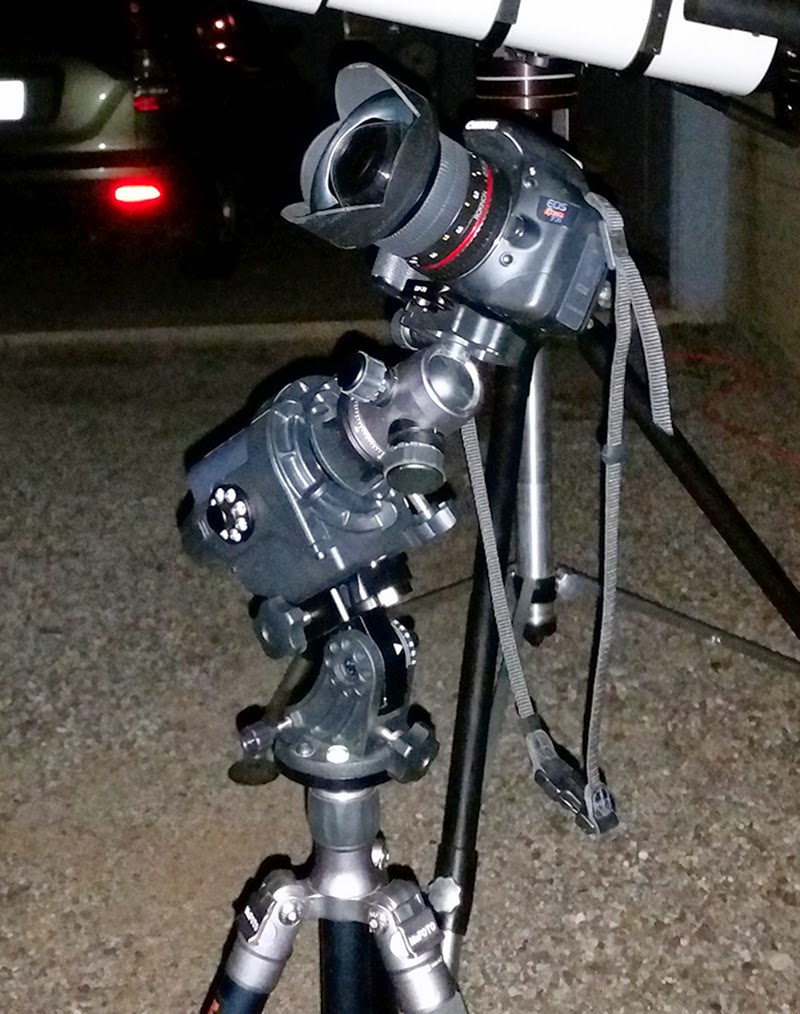
As you can see in the image above at left, I set the mount up in my driveway as I wanted to be able to do some visual observing while the camera was running some tests, and in particular I wanted to observe Comet Lovejoy which was very low in south and not visible from within my observatory until much later in the evening.  The downside of this location is that in addition to the moonlight that was pervading everything, I am looking out over our neighborhood (lots of ground level lighting) and there is periodic traffic that comes down the street- hence, one car during an exposure means I need to repeat the test!

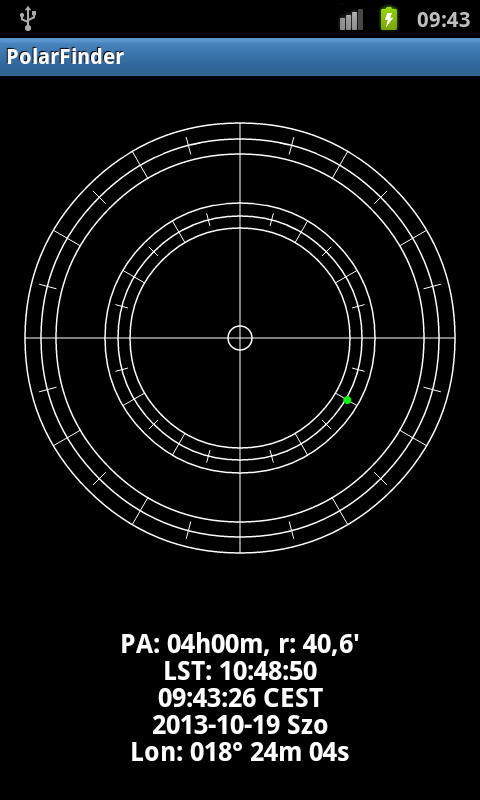
Historically, when I have done a rough polar alignment I have started by pointing about a half degree from Polaris towards the 'bright' star Kochab, as this is approximately the location of the north celestial pole.  I wanted to do a fairly precise alignment (short of drifting) and grabbed my phone to look up the location of the pole for the current time...in doing so I wondered if there was an application for my Android that might tell me and sure enough I found a great little application called "Polar Finder" which uses GPS for my time and location and then with the reticle of my choosing shows me where Polaris should be placed in the polar alignment scope.  At right is a generic screenshot from the application which shows a basic reticle (there are patterns for most well known polar scope makers) and Polaris as a green dot.

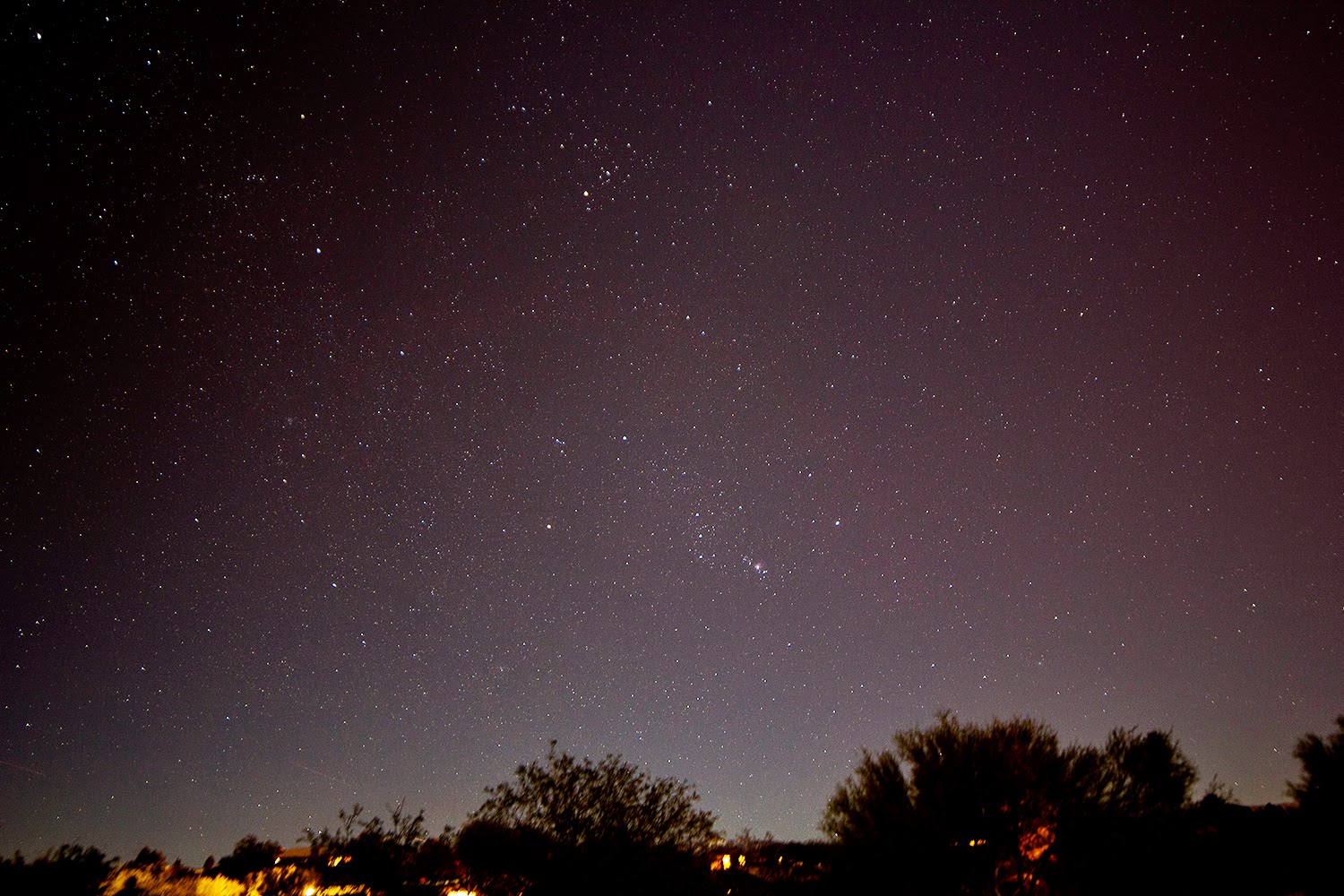
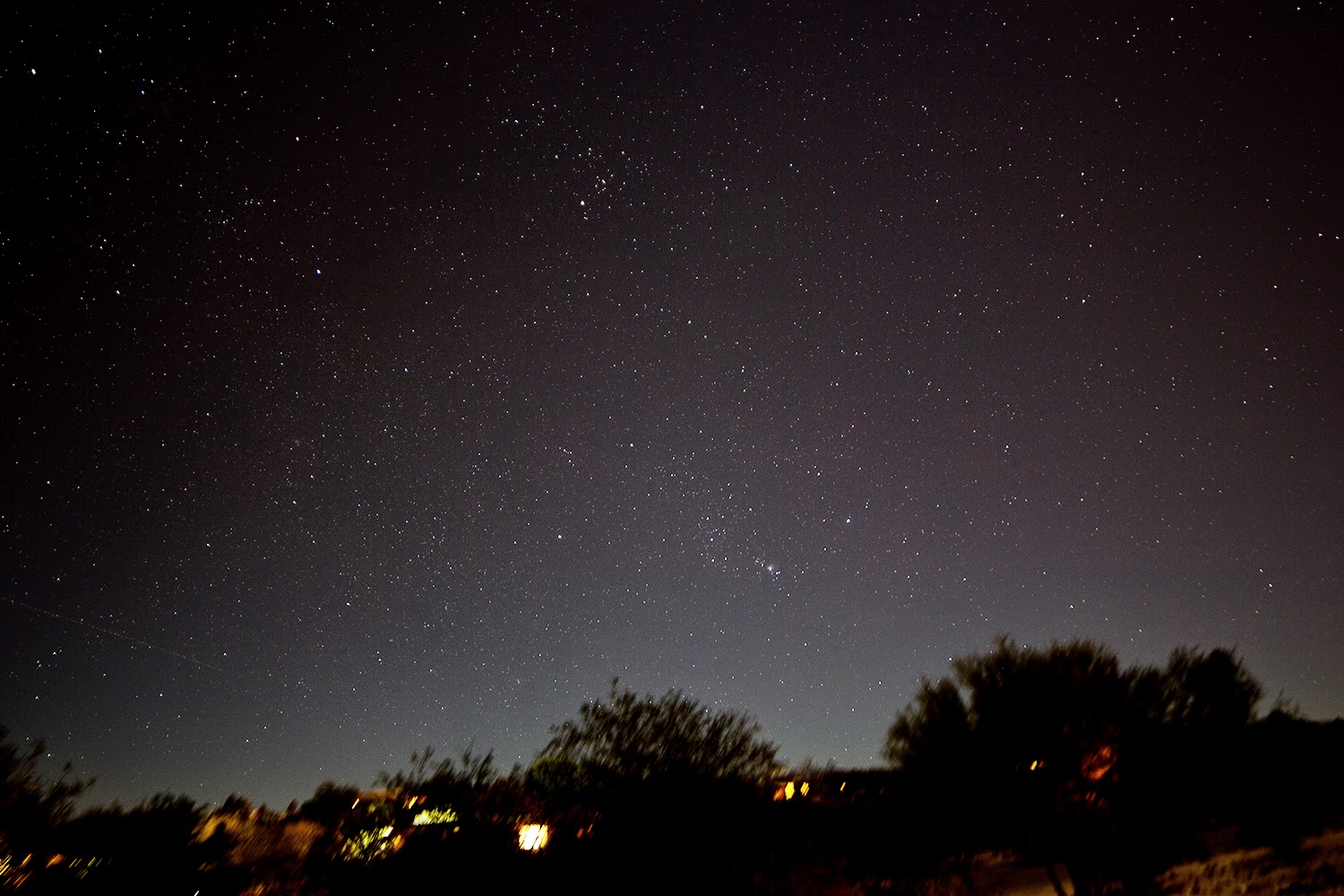
I know, get to the point, right?  Well, after polar aligning things I set up the Canon with my 14mm Rokinon f/2.8 and started taking exposures.  I did discover that in messing around as much as I was, I had the lens very slightly out of focus.  I'll post them below, but keep in mind that I was only checking to see if stars were trailing and not trying to make pretty pictures...Don't make any assumptions about the sky brightness as I did utilize Photoshop to darken the sky background as the moonlight was wickedly bright, and for most (not all) of the images I also set the ISO to 100 to reduce the sensitivity of the sensor in attempt to not get images that looked like daylight.  Below are the images with the duration in the captions, but the bottom line is that for DSLR long exposure photography, the mount delivers.

60 second test
120 second test


240 second test
360 second test


Finally, as I mentioned, I was doing some visual observing while the camera was doing its thing and lastly I looked at the moon through my TEC 140.  I couldn't resist sticking the camera in there and snapping a shot before heading in. The image below is a single shot, taken at ISO 800 for 1/1000 of a second.  Note that this was done on a non-tracking, alt-az mount!  Enjoy!


Wednesday, September 3, 2014

Comet Jacques (C/2014 E2)

I have always enjoyed observing comets and have sketched several nice ones over the last decade.  More recently with my foray into the world of DSLR photography I have also taken a couple pictures of comets such as C/2011 L4 Pan-Starrs in the evening sky.  With a few clear nights this week as the monsoon season wraps, I made a couple observations of Comet Jacques (C/2014 E2) which has been in the northern sky for a few months.  This comet was discovered this past March, and reached perihelion (its closest point to the Sun) on July 3rd 2014, passing Venus ten days later at a fairly close 7.9 million miles!  On August 28th, the comet made its closest approach to Earth at 52,415,761 miles, which is comfortably, a little more than half the distance to the Sun.

Two nights ago, on Sept 2 (UT) I took my first pictures of a comet through a telescope!  Using my 140mm refractor, I captured ten 20-second images of the comet, at ISO 1600 using the program BackyardEOS.  Below is a single image of the comet with the levels and contrast adjusted in photoshop.


My intention in taking 10 exposures was to stack them, bringing out any detail that may not be visible to the eye or in a single exposure.  In the stacked image below, you can see that I aligned the images on the comets nucleus and as a result the stars appear to trail.  There is a brighter inner coma around the nucleus as visible in the above image, and stacking the exposures revealed a fainter outer envelope of glowing gas.


Being my first try with a comet, I think this little experiment turned out quite well.  This attempt was all about getting my feet wet imaging a comet with a DSLR.  Next time I will pay more attention to timing my exposures in order that the star trails are more uniform, and will also spend a little more time figuring out the optimal exposure.

Sunday, January 5, 2014

Naked eye observation of Jupiter's moons possible tonight!?!

Doing my Sunday morning reading on the internet of all things astronomical, it has come to my attention that it may be possible to observe one or more of Jupiter's moons tonight, with the unaided eye!  This is due to several favorable circumstances and the opportunity for such an observation is, I suspect, rather uncommon.

If you are interested in taking on what will be a challenging observation, I recommend beginning by reading a short article published in Sky and Telescope magazine in 1976, by the late Dr. Denis Dutton.  The linked article contains a bit of information on the history of naked eye observations of the Jovian moons, as well as references to other historical articles and observations.  In addition to the topic at hand, I particularly enjoyed his words at the end of the article when he wrote "The concept of true scientific discovery involves grasping the meaning or importance of what is revealed."  Contained in these words is the often unspoken wisdom that guides those of us who spend hours at the eyepiece, straining to tease out the faintest hints of light from the dark background.  What we are looking at is quite frequently not impressive at all, even to our fellow amateurs; it is only with an understanding of what we are looking at does the observation take on meaning and significance.

12.22.13/TEC 140 APO/Lost Pleiad Observatory


Today, January 5th, Jupiter is at opposition (exactly opposite the Sun in our sky) and rises at sunset.  Perhaps most remarkable about this opposition, is that if seen from Jupiter, the Earth would appear to transit the Sun!  The result is that the phase angle is quite small and the opposition effect on Jupiter and her moons will be quite strong.  Les Cowley has an explanation of the opposition effect on his website, and essentially it is a result of objects appearing brighter when they are near the anitsolar point in the sky.  As he identifies, "The Moon's brightness at full is greater than can be accounted for by the increase in its illuminated area compared with its partial phases."


How much brighter?  Due to the opposition effect, Jupiter's moons may appear as much as 30% brighter tonight!  As it happens, the crescent moon sets approximately 10:40 PM and is far from Jupiter in the sky.  Below is a graphic representation of Jupiter and the location of it's moons (created with Winjupos) at 10:30 PM MST (0530 UT Jan. 6th)
Click the graphic to enlarge
Here is some technical data on the moons (in order from left to right in the graphic), which will give one an idea how dark the skies at your observing site need to be to have a chance at seeing one or more moons naked eye, (not accounting for the opposition effect):

                   Diameter  Visual magnitude

Io                  1.190"           5.0 mag
Europa         1.029"           5.3 mag
Ganymede   1.725"           4.6 mag
Callisto         1.573"           5.7 mag

While all of the moons are intrinsically bright enough to be seen by most observers at a reasonably dark site, it is the glare of Jupiter that typically prevents their observations.  Tonight, Ganymede will be the easiest given that it is the brightest and will sit nearly 15 Jupiter diameters from the gas giant herself (one Jupiter diameter at tonight's opposition is 46.76 arcseconds).  Io, while the second brightest, will likely be lost in the glare of the planet, and Europa will be exceedingly difficult.  Callisto will be interesting as it is the faintest moon, yet will be furthest away at approximately 19 Jupiter diameters.

One recommended trick for attempting to see the moons is to stand (or sit) in a location where one can block Jupiter with the edge of a wall (or pole, tree, etc).  Doing so may reduce the perceived glare and make spotting one or more moons a bit easier.  Personally, I will attempt this observing challenge tonight, and would love to hear from others who attempt to see the Galilean moons without optical aid.   Drop me a note, lostpleiad@gmail.com  (or comment below). Good luck!


Friday, January 3, 2014

Venus closing in on inferior conjunction

Venus de Milo
Venus (the planet, not the goddess of love) is closing in on inferior conjunction - the point when it lies directly between Earth and the Sun in its orbit.  Inferior conjunction will take place on Sat, 11 Jan 2014 at 05:19 MST (12:19 UT).

Because Venus orbits between the Earth and the Sun, it moves through phases of illumination just like our Moon.  As Venus is now 8 days from inferior conjunction, only a very thin crescent is illuminated.  Below is a stack of 500 frames from an avi file of Venus I captured this afternoon through my TEC 140.  I may have overdone the processing a little as the extreme tips of Venus seem to have been lost, but either way you can appreciate how thin the crescent is.

Currently, Venus is nearly at its largest apparent size, with a diameter of 61.08 arcseconds and is a beacon of light shining at magnitude -4.26, making it far and away the brightest object in the evening sky.  In a nice coincidence of numbers, it is 2.3 light minutes away, and is also 2.3% illuminated.
Of course, Venus' orbit is tilted with respect to Earth's orbit and as a result it will not appear to transit across the face of the Sun as it did in June of 2012. From our vantage point on the Earth, Venus will pass within a 5 degrees of the Sun and will be lost in its glare. Venus will also pass perigee (the time when it is physically closest to the Earth) within a few days of inferior conjunction. It will move to within a distance of 0.27 Astronomical Units (AU) from the Earth, which is approximately six times closer to Earth than at superior conjunction (when Venus is on the far side of the Sun).  If it could be observed, it would measure 62.7 arcseconds in diameter, which is approximately 50% larger than Jupiter, yet it would not be illuminated at all! As Venus moves past inferior conjunction, it will once again become a morning object over the next few weeks.


Saturday, December 14, 2013

Venus Transit re-processed

Over Thanksgiving week I was leading a public observing program at the Mount Lemmon SkyCenter and one of the guests asked me what were my most memorable observations.  It was a question that motivated me to think about all of the wonderful times I have spent with friends and colleagues enjoying time at the eyepiece.  I hope to actually write up a blog post where I attempt to answer that question, and included in the answer will be observing the 2012 Transit of Venus.

Guest observing sunset - note the sun projecting on his eye
I observed the transit from the summit of Mount Lemmon with my colleague Adam Block and somewhere in the neighborhood of 100 guests that attended our special Transit of Venus program.  We had multiple telescopes set up, including some brought by visitors themselves, through which we observed the event.  I had purchased my first DSLR (ever!) the week of the Transit in the hopes that I would be able to take some pictures through my telescope.  I posted those images on the blog shortly after the transit, and to say I was lucky is an understatement.  I had very little understanding of how the camera worked, and practiced with the camera and telescope for just a couple days leading up to the Transit.  You can read about the adventure and see the original images on this post from June of 2012. About a month after the Transit I made an attempt to process my best raw image of second contact and was fairly satisfied with the results at the time. That post and image can be found here.

As I have been playing around with solar imaging a little bit this year, I have gained more experience in processing the images that I take.  While I was previously using the freeware program GIMP, I am now using using Adobe Photoshop and have been able to identify a few techniques to improve my images.  Below, is my latest attempt to bring out the best of my image of second contact-  I am quite happy with the result!  Click on it to enlarge.


Sunday, November 10, 2013

Jupiter's bland side

I am a glutton for punishment.  Not only did I watch/listen to the entire UA vs. UCLA football game last night, I stayed up until nearly 3 AM to take an image of Jupiter and also to observe Comet Lovejoy (C/2013 R1).  The comet is fantastic right now sporting a very large coma and a condensed nucleus.  It is a much better target than ISON, despite the apparent lack of a tail.  The comet is high enough over the eastern horizon by about 1 AM to start observing, although as it rises higher there is less atmospheric extinction and it appears brighter.

Jupiter on the other hand was much less forgiving than the comet last night.  Comets are inherently fuzzy objects and one does not notice the turbulent seeing conditions as readily.  Point the telescope at Jupiter and all of a sudden it looks like a living and breathing monster of a planet.  The image below is a stack of only 200 frames (out of 1800!) aligned, stacked and processed in Registax.  Left to right, the moons are Europa and Io.  According to Firecapture (freeware used for image acquisition), the ephemerides are:

Diameter=42.44"
Magnitude=-2.45
CMI=82.5° CMII=316.8° CMIII=107.5°  (during mid of capture)


The image was taken through my TEC 140 with a 2x Barlow and the ZWO ASI120MC camera.

Wednesday, November 6, 2013

First time Jupiter!

I awoke at 4:30 this morning specifically to observe Comet ISON, currently cruising through the constellation Virgo as it nosedives toward the Sun.  As comets go it was not that remarkable but I wanted to see it prior to it's close encounter with El Sol on November 26th.  Once I finished obseving I was not going to go back to sleep so I tried my hand at imaging Jupiter with the ASI120MC video camera that has been the subject of the past few posts.

The image below is a stack of approximately 900 frames out of 1510 processed in Registax.  The image was captured through my TEC 140 with a 2x Barlow in slightly below average seeing conditions, using the freeware program Firecapture.  Looking at the log file that is automatically generated in Firecapture, I noticed that it provided ephemerides and other information for Jupiter.  While I am not sure the source of these, pertinent data is as follows:

Diameter=41.96"
Magnitude=-2.42
CMI=320.2° CMII=223.8° CMIII=13.5°  (during mid of capture, which was 12:48:36 UT, Nov. 6th)

For a first attempt, I was nearly jumping up and down...of course I needed to stay warm and this helped restore blood flow....but seriously, with more practice (and perhaps a 2.5X Powermate in my future) I believe the images will only get better.  The moon closest to Jupiter is Callisto, and the two moons further out are Europa (upper) and Io (lower).


Saturday, October 26, 2013

solar imaging with the ASI120MC

I can not believe over a month has gone by since my last blog post...while not good blog form, I have been working almost 7 days a week for the last 6 weeks and having a ball.  As I continue to work alongside some remarkable staff and graduate students in the development of the UA Science: Sky School I am reminded every day why I love my job.  As satisfying as work can be, one still needs time to pursue one's hobbies and I have not had nearly enough time to observe through my telescopes.  Last night I stayed up until nearly 2 AM observing some departing summer objects as well as taking my first glimpses of the year at winter objects such as the Orion Nebula and also at Jupiter.  It was a beautiful night and so satisfying that I still pulled myself out of bed by 8:30 AM to play further....

(Note to self: I am not an astrophotographer...But, apparently I am attempting to play one on TV.)  On a lark last week I decided to purchase my first dedicated planetary/solar imaging camera and try my hand at taking images of the Sun through my Lunt 60mm Hydrogen Alpha telescope.  This morning I captured and processed my first 'reasonable' solar image using my new ASI120MC camera from ZWO Optical.  This little camera has been receiving more than its share of accolades in the amateur community as an incredible value for the money.  At left is an image of the key pieces that come with the camera.  In addition to the camera itself, it comes with a 1.25 inch nose-piece, a USB cable, and a 150 degree lens that allows the camera to be used as an "all-sky" camera. (It also comes with a pre-installed IR cut filter (which is removable), a cable for auto-guiding, and a CD with drivers).  I decided to purchase the color camera to get my feet wet in this imaging business, and the camera also comes in a monochrome version with the only difference being that instead of an IR filter, there is a clear filter installed.

So after downloading the freeware programs Firecapture and Registax, I set things up this morning and began to play with settings and features of the software to try and record a reasonable avi file of the Sun.  In addition to my own issues (which are far too numerous to list), the seeing was just average and there were passing cirrus clouds that kept interrupting my process.  Regardless, the little camera delivered in the sense that there is far more detail present in the captures than my processing skills are currently able to take advantage of.  Further, I really have no idea what the ideal settings are for this kind of imaging in terms of shutter speed, gain, gamma, etc.  The image below is the result of a trial and error process and represents 150 frames aligned and stacked in Registax...Fooling around with the wavelet functions (I do not even know what a wavelet is) resulted in some over sharpening.


Hopefully I'll have some time to research settings and learn from many of the fantastic solar imagers out there that have traveled this path ahead of me.  I do enjoy a modest amount of learning by figuring things out, however, if I can at least know that I am capturing the data in an optimal fashion then I can focus my time on learning to bring out the details from the data.


Saturday, June 1, 2013

Globular Cluster Messier 14

For amateur astronomers, spring may be galaxy observing season, yet summer provides the opportunity to observe most of the globular clusters that inhabit the outer halo of our galaxy.  Globular clusters are to me, the most beautiful objects to observe through a telescope as they are tight swarms of stars- containing well over 100,000 stars (and some many more!) all within an apparent diameter of a few arc-minutes.  Many folks describe them as diamonds spilled on black velvet and that description is apt.  At left is an image I took of the large globular cluster M 22 in Sagittarius last summer with my Canon T2i through my TEC 140.  (It is a single exposure, not multiple exposures integrated)

These clusters are tightly bound by gravity which gives them a general spherical shape and a higher density of stars toward the center.  There are upwards of 150 known globular clusters in our Milky Way galaxy. While they contain some of the oldest stars in the Universe, the origin and role of globular clusters in the evolution of galaxies remains unclear and this is an area of active research.   Astronomers who study galactic evolution have been able to detect globular clusters in most of the galaxies they have studied, and some galaxies contain extraordinary numbers. For instance, the great Andromeda Galaxy has more than 500, and the giant elliptical galaxy M 87 in Virgo contains approximately 13,000!  (See this post for my observation of the jet emanating from the center of M 87).

Last night I was out observing and spent quite a bit of time observing globular clusters in the constellation of Ophiuchus.  There are 20 reasonably bright globular clusters in this constellation, most if not all of which should be visible in my 140mm refractor under reasonably dark skies.  Among these globulars are 7 Messier objects, from M 107 which is the dimmest of the Messier globular clusters to the majestic clusters M 10 and M 12.  After observing these, as well as M 62, M 9 and M 19, I slewed the telescope to M 14 and was surprised at what I saw.

I have observed all of the Messier objects at some point years ago, yet  I am not sure that I have returned to this cluster since that time.  The cluster, discovered by Messier in 1764, lies in a remote area of the constellation and at first glance the cluster is unimpressive.  It is difficult to resolve many stars and appears more nebulous than cluster like...which is probably why it did not stick in my memory as a great visual target.  More experienced now than I was those years ago, I began to wonder why this cluster appeared so large and reasonably bright in my telescope yet resolution of the stars was so difficult.  A little reference checking and I learned that this globular contains several hundred thousand stars and has an absolute luminosity about 400,000 times that of our own sun!  This cluster is about 30,000 light years away, and as it turns out, the light from the cluster is obscured by an extensive amount of dust in our galaxy.  Below is my sketch from last night of M 14 at a magnification of 163x.


The cluster has a brighter central region with a fainter outer halo and it is difficult to resolve member stars (the sketch is generous in this regard).  The cluster has a grainy appearance and with averted vision it does seem that some faint stars come and go.  The cluster is approximately magnitude 7.6 and has an apparent diameter of 11 arc minutes.  Again, with a cluster this large and bright one would expect to resolve stars.   Often, it is not simply the aesthetics of objects in the eyepiece that make an observation interesting; it is knowing what it is that one is looking at.  In this case, one of the most impressive facts about this cluster is that it has a diameter of approximately 110 light years.  Our galaxy is approximately 100,000 light years across, so it would take only 1000 of these clusters to span the galaxy.  that may not sound impressive until one considers that our galaxy has between 200 and 300 billion stars...


Saturday, January 12, 2013

Naked eye sunspot ~ AR 11654

Today is a good day to get out the solar glasses if you own them and take a look at the Sun.  Sunspot region 11654 is large enough to be seen without magnification.  It goes without saying that you MUST have specially manufactured solar glasses or film to try this...do not look at the Sun otherwise.

Noting how large the spot complex was, I attempted to take a few pictures of the Sun in white light using my TEC 140 refractor, a Lunt Solar Systems Herschel Prism, and my Canon T2i.  Despite passing clouds and a very unstable atmosphere, I ended up with three usable images- one of the whole Sun, one with a 2x Barlow lens to double the magnification, and one with the Barlow attached directly to the camera (without its normal extension) which results in something like a magnification factor of 1.6.  To acquire the images, I used the software program BackyardEOS.  For reference at left, is today's image from the Solar and Heliospheric Observatory labeled with the active spot region numbers.  Click the images below to enlarge them.


Full Disc


Approx. 1.6x Barlow


2x Barlow


Saturday, January 5, 2013

Comet 2012 K5 (Linear)

Comets are engaging objects to observe, particularly as the come through the inner solar system nearer the Earth and Sun. They can be quite rewarding to the observer who, following them from night to night, will see subtle changes in brightness and shape along with the occasional outbursts and dramatic changes. I enjoy reading the blog of Carl Hergenrother, The Transient Sky, as he regularly observes comets as part of his professional and personal work as an astronomer. In December and again this month Carl wrote about comet 2012 K5 (Linear) noting that 2012 K5 "is a long-period comet discovered by the LINEAR near-Earth asteroid survey program on May 25, 2012. At the time the comet was around magnitude 17-18. Though it passed through perihelion on Nov. 28 at a distance of 1.14 AU, the comet reached its brightest last month as it rapidly approached Earth. Close approach occurred at the very end of December at a distance of 0.29 AU (27 million miles or 44 million km).  Recent visual observations place the comet around magnitude ~8.6 at the end of December. Since the comet is now moving away from the Earth and Sun this month, it should rapidly fade to magnitude ~11.4 by the end of the month. The comet is now an evening object as it moves from Auriga through Taurus into Eridanus."

Last night was the clearest night we have had in about a week at the observatory, and I took advantage of the moonless sky to take a look at this outbound comet while it is still bright enough to appreciate. Using the Minor Planet Ephemeris and Comet Service I generated coordinates for the comet and directed the telescope to the specified location. (Note that this comet is moving rather quickly to the southwest, at a rate of 11.38 arcseconds per minute last night, so it is important that if you plan to observe this comet that you generate ephemerides for very close to the time you will be observing.) Currently, the comet is in Taurus and during the time of my observation was approximately .326 AU from Earth, which is about 2.7 light minutes.  The comet was immediately visible in an 8mm eyepiece (122X) using my TEC 140mm refractor. Below is my sketch of the comet from approximately 0440 UT on the 5th of January.

I have a difficult time estimating the brightness of diffuse objects, yet I would suspect that the comet is somewhere between magnitude 10 and 10.5. The nucleus is somewhat condensed and the coma fades quickly. There did appear to be a brighter section of a tail stretching out to the northeast, as I tried to capture in the sketch. This "brighter" ray was best seen with averted vision, but was not a difficult feature to note.

While I enjoy the conveniences of using the internet to generate precise coordinates as well as a "go-to" mount, if you are the type that enjoys the hunt, there is a detailed .pdf finder chart here that shows the comets path through late January. Whichever method you prefer, I encourage you to observe this interloper while you can!

Tuesday, January 1, 2013

Lost Pleiad Blog - 3 years and counting!

Happy New Year!  Today is a day of celebration at the Lost Pleiad Observatory.  Not only is it the New Year, but it is the third birthday of this blog, and Beth and I are happily celebrating our 17th wedding anniversary!  (No wonder I can hardly remember watching the Rose Bowl over the last 17 years... fortunately, Arizona has never played in that "granddaddy of them all"...).

As is my tradition, I like to observe the Sun on holidays- see this post from last year. Today I made a white light sketch of the Sun, complimented by an image of the Sun, taken using the Canon T2i DSLR camera I acquired earlier this year to photograph the Transit of Venus.

They make a nice pair, although looking at the image from the camera is nowhere near as satisfying as the eyeball view I had.  The image was taken first, at 11:58 AM (1858 UT) through my TEC 140 and a Lunt Solar Systems Herschel Prism.  There was a bit of high cirrus which helped to steady the image, yet there was also a lot of sunlight being diffused by the clouds...thanks to Photoshop  that diffuse light is no longer an issue!  Click to enlarge:

After taking the above image, I made a sketch using a 17mm Delos eyepiece and a single polarizing filter.  Again, the high level cirrus helped the seeing and I was able to see many spots in the active regions.  According to spaceweather.com today's sunspot number is 87.  You will quickly notice that the sketch is reversed horizontally from the image-  I flipped the image as just about any image of the Sun you look at will have north at the top and west to the right.  The sketch below represents the eyepiece view with west to the left. Click to enlarge:


The sketch was completed at 12:15 PM local time (1915 UT) and it a fairly accurate representation of the spot regions...other than I have drawn them a little too large and slightly out of place.  No surprise, considering I am slightly out of practice!.  While I made between 75 and 100 sketches of the Sun in 2010 and again in 2011, I only made about 30 sketches in 2012.  This is a result of working more, and also of acquiring the camera.  While it is quick and easy to take a solar picture, I was reminded today how much more I see when I spend the time observing and sketching.  I guess if I was the type to make New Year resolutions, one of mine would be to spend more time doing astronomical sketching in the coming year....and that is certainly easier and more rewarding than trying to drop the 5 pounds that seem to have shown up in my early 40's!

Friday, December 28, 2012

Solar maximum...did I miss something?

Click to enlarge
With some time on my hands today, I opened up my observatory at high noon to take a look at the Sun and see what was up.  As anyone who follows the Sun is aware, we are well along in solar cycle 24 and despite being somewhere near Solar maximum, things have been generally calm.  Sure there has been the occasional strong flare, and every now and again we have been treated to several active regions at once.  Overall, however, the Sun is relatively quiet.  It was no surprise then that there were very few spots today that were visible in white light.  There are a couple active regions that have rotated into view on the east limb, as well as a region departing to the west.  For the most part though, the solar disc remains featureless in white light.  At left is a sketch that I made at 12:40 PM local time (1940 UT) and I am embarrassed to say it is the first sketch I have made since the Annular Eclipse in May!

Thinking about the relative calm of Solar Cycle 24, I decided to visit Spaceweather.com and see what the sunspot number was for today (78, in case you were wondering).  Interestingly they had a story and graph from the NOAA Space Weather Prediction Center addressing exactly how calm (in relative terms) this cycle has been as well as when maximum is predicted to occur.  Here is the chart they had reproduced:


Updated in early December, the above chart shows you the actual number of observed spots from January of 2000, through November of this year.  With the red line identifying the predicted sunspot values for the remainder of this cycle, it is curious to see that we are well below the line of even what was predicted to be a weak cycle.  And while the cycle certainly progressed slowly, Spaceweather.com has noted that we may already be past the maximum for this cycle!  I agree, as it appears to me that the actual observation curve (the blue line) has begun to taper down.  There are historical cycles that have had double peaks, so what happens over the next year will be interesting.  If you care to see the cycle that was predicted (in May of 2009) click on the graph at right.  You can see that the maximum was predicted to occur in mid-2013.


Sunday, December 16, 2012

Las Cienegas observing

With all the excitement regarding the close pass of Asteroid 4179 Toutatis (see the previous post), I neglected to share that the night before I made the trek to the Las Cienegas National Conservation Area to do some dark sky observing.  For many years, the Tucson Amateur Astronomy Association utilized an old airstrip within Las Cienegas as a dark sky site for monthly club star parties.  Despite being about 45 minutes from the east side of Tucson, the skies are quite dark, and it is my experience that the naked eye limiting magnitude at zenith can approach 7.0.  It is much darker than the clubs site west of town at TIMPA.  Over the last few years the TAAA has discontinued use of the site for regular star parties due to the acquisition and development of a club owned dark site about about 2 hours from town.  In addition, many members are uncomfortable driving down the sometimes rutted dirt road that leads to the old airstrip.

As mentioned, the site is about 45 minutes from Tucson, and from my house I can arrive in about 60-70 minutes.  This affords me the ability to work all day and then head to the site in time for darkness.  Last Monday night I made such a trip, joining my good fiends Jerry and Bill for several hours of dark skies, conversation, and of course observing.  Recently, we have identified a very nice spot in Las Cienegas to set up our telescopes, that is only about 5 minutes drive from the entrance.  The spot is in a slight depression in the rolling grasslands, which does seem to affect the temperatures, with cooler air settling in more quickly.  During our session temperatures were balmy, in the mid-20's, about 15-20 degrees colder than back at home.

Below is a 20 second exposure of Orion rising in the east.  The yellow glow on the horizon is the light dome from Fort Huachuca.  Despite how bright it seems in the image, the skies are still markedly darker than in Tucson as evidenced by the winter milky way extending down left of Orion.  Click the image to enlarge it.


I had decided to make the trip very lightweight and brought along an alt-az mount for the TEC 140.  I spent quite a bit of time panning through the milky way from Cassiopeia eastward.  This is the less bright region of the milky way in our sky, as we are peering away from the center of our galaxy.  I chose this area due to the simple fact that the summer milky way from Cassiopeia westward is where I have spent the last several months observing.  The skies were quite cooperative and I enjoyed my first extended views of objects such as the various nebulas in Orion (M42, M43, the Flame, The Running Man, etc).  One of the great things about a refractor are the beautiful low power wide field views one can achieve.  I was truly lost among all the open clusters in Cassiopeia, as every nudge of the telescope seemed to bring another into view.  At times, I would wonder what NGC cluster I was looking at, but before I could get up and go consult a chart I would again lose myself in the sheer aesthetics of the view through the eyepiece.

We had a great compliment of telescopes for the evening, with a 63mm Zeiss refractor, my 140mm TEC refractor, and a 9.25 inch SCT.   If you know Bill, it will not surprise you to hear that he was able to spot the same 14th and 15th magnitude Arp Galaxies in his 63mm Zeiss as we could observe in Jerry's 9.25 SCT.  Certainly there were no galactic details to be seen in the Zeiss, but the fact that we could detect the small, faint glow at all says something about the quality of the telescope and the transparency of the skies.  And yes, I said "we could detect," as I also observed some of them in Bill's telescope.

This has been a fairly long winded post for a Sunday morning, but if you are reading it and are a Tucson based amateur astronomer, I would strongly suggest that you consider the Las Cienegas area as a nearby location.  It's ease of access and reasonably dark skies make it quite enjoyable.

Wednesday, December 12, 2012

Asteroid 4179 Toutatis

Tonight was a first for the Lost Pleiad Observatory staff (that's me...sole proprietor, operator, custodian and resident trouble maker).  Asteroid 4179 Toutatis is in the process of making a close pass to Earth, and while I have observed asteroids previously, tonight I decided to take a series of pictures of the asteroid and then stitch them together to make an animation.

Before I provide the goods, it is worth knowing that asteroid Toutatis will only come within 4.3 million miles of Earth on this pass.  The images at left are computer-generated views of Toutatis, constructed using radar observations from NASA's Goldstone Observatory.

Toutatis is about 3 miles wide and makes one trip around the sun every four years.  Toutatis is a potentially hazardous asteroid, meaning that it could pose a threat to our planet at some point in the far future. The current flyby is no cause for concern, however, and I suppose that if you are reading this you know this to be true!  You made it through the night! At its closest approach, which was at approximately 11:40 PM MST Tuesday night, Toutatis was about 18 times farther away from Earth than the moon is.

Using my TEC 140 APO, along with my Canon T2i and the software program BackyardEos, I ended up with 49 usable exposures of the asteroid (don't ask about the others...even the dog managed to mess a few up!).  Each exposure was for 30 seconds and I have stitched them into the looping GIF below at 10 frames per second using Photoshop CS6.  I did no processing of the images, other than to reduce the size of each exposure so that the GIF was not a bazillion megabytes.  As it ended up the animation is a 12.8 MB GIF, so do allow it time to load.  The animation runs from approximately 8:59 to 9:48 PM local time, or 0359 - 0448 UT 12/12/12.  (Or, as folks in the UK would note the date, 12/12/12.)  Finally, you may notice that the background sky is brighter in the later frames...this is due to the asteroid appearing to move in the direction of the Tucson light dome.  Without further ado...the GIF!
Click to enlarge (and remember to give it time to load!)


Monday, December 3, 2012

Auriga Messier Clusters 36, 37, 38

Tonight I thought I would try something a little easier and I took some pictures of the three Messier open clusters in the constellation of Auriga, numbers 36, 37 and 38.  Again, I am using my Canon T2i and my TEC 140 refractor (f/7). The best part of the time I spent taking these pictures tonight was sitting back in my observatory and enjoying the crisp night air.  Carefully, so as not to touch the telescope, I also enjoyed the views through my 50mm Stellarvue finder scope while waiting for the camera to finish it's business.

Without further ado, here are the images (reduced in size for the blog)...each of them was 25 seconds at ISO 1600.
Click the images to enlarge them.


M 36

M 37

M 38 with NGC 1907 at upper right