Showing posts with label Mars. Show all posts

Monday, May 12, 2014

Portal, AZ dark skies and good times

Milky Way over Chiricauhuas
My good friend Jerry and I have been planing to go down to Portal, AZ and do some serious deep sky observing around the new moon since about the new year...and finally, after three attempts to head down were thwarted by bad weather, we did make it down at the beginning of this month.  We spent three glorious nights with observing friends extraordinaire Mike Wiles and Chris Hanrahan (AKA ServoChris) under dark and steady skies.

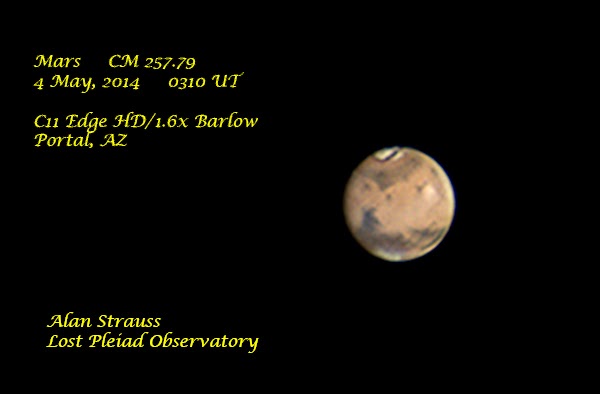
Slowly this blog is turning to more photos than text and I guess that is a factor of being so busy with work.  When I have free time I spend it with family or in my own observatory and do not take much time to write the blog these days.  In fact, I am about to head out to Mount Lemmon for a UA Sky School trip and need to finish up this brief post quickly.  Below I present three images from the Portal trip...one taken of Mars through my 11-inch Celestron Edge HD, and two of the milky way rising.


First, Mars:

In the Milky Way images below, I was using my new Canon 10-22mm zoom, at the 22mm setting.  These are single 30-second exposures and I used a red flashlight to 'paint' Jerry and myself during the exposures.  I am in the upper image, Jerry in the lower.


While these images are a bit noisy due to the high ISO, what is notable is the lack of light domes near the horizon. There are now small domes visible from El Paso and Lordsburg that rise perhaps 2 degrees above the horizon in long exposures, but these domes are a bit to the north of this exposure.


Friday, April 4, 2014

A little Mars love

Between working many days and nights and generally poor skies on my days off, there have not been many opportunities for me in the past few weeks to get out and practice observing or imaging Mars in my backyard.  Last night was the rare night where skies were clear and I was at home with some time to observe.  Both seeing and transparency were slightly below average, but this photon deprived boy was not about to complain.

I opened up the roof and spent some time observing mars through my C11 between about 9:00 and 9:30 local time (0400 and 0430 UT).  The north polar cap has noticeably diminished in size over the past month as the Martian spring advances and there is a darker collar on the southern edge of the cap.  There continues to be very bright limb haze.  I had a hard time noting many dark features, likely due to Mars still hanging low in the east during my early observation.  I was able to identify Terra Cimmeria in the south, but that was about it.  While the image would no doubt be better with Mars higher in the sky, I was not about to stay up until midnight as I was looking forward to sleeping in my own bed for the first time in a few nights.

Below is an image I took using my ASI120MC camera, and it represents a stack of about 200 frames out of 2500, taken through the C11 and a 1.6x barlow lens.  You can see the north polar cap as well as the thin dark collar below it.  The wider, dark area south of the polar cap is Utopia Panitia.  At the south of the planets disc, the darkest feature facing us is Terra Cimmerium.  The bright spot near the limb on the right is Olympus Mons, and you can see the haze on the limb.


For comparison, here is a simulated image from calsky.com of mars at about the same time:


Currently, Mars is visual magnitude -1.40 with a true distance of 0.6286784 AU (94048948 km) from Earth.  In light time, it is 0h 05m 13.71s distant.  Hopefully as Mars come to opposition next week, I'll have more opportunities to take some images of the other side of the planet as well.

Wednesday, March 12, 2014

Mars approaches!

No, this is not a blog post to let you know that Mars will pass closer to Earth than at any point in the history of our solar system in early April.  You can find that story circulating on the internet as it does approximately every two years as Mars approaches opposition.  This year, Mars will be at opposition on April 8th and will have an apparent diameter of approximately 15" (arcseconds).  Currently, Mars is .73 astronomical units from Earth and is 96.7% illuminated with an apparent diameter of 12.74"

A few months ago I purchased my first astronomical camera in order to learn to take planetary images in a run up to this Mars apparition.  Mars has always been my favorite planet to observe visually and I want to be able to capture some nice images as well.  Two nights ago I was out observing and imaging Jupiter and was impressed with how steady the seeing conditions were.  Below is an image of Jupiter I captured with my 11" Celestron Edge SCT and a 1.8x barlow lens.
As the seeing conditions were so favorable I decided to stay up far too late and try my hand at my first image of Mars.  I will not go into detail about the trials and tribulations of the process, but keep in mind that Mars is much smaller in apparent size than Jupiter, that its details are quite subtle, and the seeing conditions had deteriorated quite a bit by 1 AM.  I was not able to use the Barlow lens to increase the image scale so the picture below is straight through the C11.
All in all I am happy with the first effort.  I pushed the processing a little too hard but may go back and try again if I have some time.  Of note, you can see clouds in the Olympus Mons region on the right side! Olympus Mons is the largest volcano in our solar system and these are likely orographic clouds.  For comparison, below is a simulated image from the website calsky.com.


Wednesday, August 8, 2012

Mars Science Laboratory

NASA/JPL/University of Arizona
Back in March I posted one of my Mars sketches and mentioned the Mars Science Laboratory mission nicknamed Curiosity which was en-route to Mars.  Well, here we are three days after an amazing touchdown and already stunning images are coming back.  Unless you have been under a rock the past three days you have no doubt seen many of the amazing pictures and images coming from the HiRise camera aboard the Mars Reconnaissance Orbiter showing the rovers descent by parachute (at left) as well as the hardware scattered about the Martian surface.  If not, visit the HiRise website!

It is, however, time to visit the surface of the red planet...and without further ado, Welcome to Mars!!!


Click to enlarge to full size


Image Credit: NASA/JPL - Caltech
According to NASA, "These are the first two full-resolution images of the Martian surface from the Navigation cameras on NASA's Curiosity rover, which are located on the rover's "head" or mast. The rim of Gale Crater can be seen in the distance beyond the pebbly ground.  The topography of the rim is very mountainous due to erosion. The ground seen in the middle shows low-relief scarps and plains. The foreground shows two distinct zones of excavation likely carved out by blasts from the rover's descent stage thrusters."

For those of you wanting to stay current with the MSL Curiosity mission, there are nearly daily updates on the mission website.

Thursday, April 5, 2012

Mars Drawing

Today was a strange day at work...too many people not getting along with each other; a colleague who had a death in the family; and our department saddened by the suicide of a student.  It was one of those days where I felt that "I'd like to buy the world a coke"...Maybe I am showing my age with that little jingle, but certainly everyone needs to take a deep breath and look up at the night sky we are so fortunate to have here in Arizona.

And, while I never thought I would say something like this, a big shout out to the Governor of AZ for vetoing the electronic billboard legislation!  Our legislature quickly passed this asinine bill at the urging of Clear Channel Communications, and fortunately the Governor had a rare moment of clarity and realized that not only was the multi-million dollar astronomy related industry threatened, but these electronic billboards are safety hazards as well.  But I digress...back to the night skies...

While it is nearly full moon, I opened up my observatory and spent a little time observing Mars again this evening.  Using my 12" LX200 SCT I was treated to a night of exceptionally good seeing.  Using an 8mm eyepiece I was observing Mars at a magnification of 380X without any image breakdown.  I did try a 5mm eyepiece (608X), however, there was nothing visible at that power that I could not see much sharper at 380X.  Below left is my sketch, and at right a simulated view courtesy of CalSky.


Mars is currently 12.11 arcseconds in diameter and still shining at magnitude -0.6.  Mars is .773 astronomical units from Earth, or 6 minutes 25.6 seconds in light time.  My sketch was completed this evening at 8:44 PM MST (0344 UT, April 6th).  At the top is the North Polar Cap, and there was quite a bit of haze in the southern polar region.

Sunday, March 4, 2012

Mars - Still Curious

While NASA may be struggling to budget for future Mars exploration, as Astronomer-in-Chief of the Lost Pleiad Observatory, I remain curious.  In 154 days, on August 6th 2012, the Mars Science Laboratory, nicknamed Curiosity, will touch down on the red planet and if all goes well begin to enthrall us with information and data.  While we wait for this exciting event, I continue to do what I can to keep an eye on Mars.

Last night I made my first decent sketch of Mars with my TEC 8 inch f/20 Maksutov Cassegrain.  I plan to write a review of this scope one day, but it is really a very specialized instrument that delivers excellent contrast, a large image scale, and sharp views.  It is well regarded as a high end planetary instrument.  The telescope is about 16 years old, and I believe that it is slightly out of collimation.  I do mean slightly, and I will likely wait until this summer when I am in Colorado to personally deliver the scope to TEC for a tune-up.  You can see from these pictures that despite its age, it is in good used shape.

Click to enlarge
Even with a waxing gibbous moon, last nights seeing conditions were slightly above average, with reasonably stable skies allowing me to use a magnification of 253x.  My sketch was completed at 0447 UT on March 4th (9:47 PM MST, March 3rd), with Mars central meridian at 315.8 degrees.  Currently at Magnitude -1.2, Mars is .6739 AU from earth, or 5 minutes and 36 seconds in light time.  It subtends an angle of only 13.89 arcseconds, which is not very large when it comes to discerning dusky low contrast surface features.

This by the way, is the allure of observing Mars.  It is the only planet in our solar system where we can directly observe the surface.  Venus, Jupiter, Saturn, Uranus, Neptune...these planets only show us their cloud tops.  It is fun while sitting and observing Mars through a telescope to think back to the times when Astronomers such as Percival Lowell were making detailed visual observations of Mars and speculating on canals, water and plant life.  Without the benefit of missions to Mars to see the Martian environment up-close we would still be wondering.  Who knows what secrets Mars has yet to share with us?  I, for one, remain curious.


Friday, January 27, 2012

Mars update

Ares(Roman), god of war
As January winds down, Mars is becoming increasingly convenient to observe.  By about 11:00 PM local time, Mars is high enough for decent views, and it remains in the sky all night...meaning that if I miss the opportunity for the late night observation I can always get up an hour before sunrise to make an observation.  In addition, as Mars moves towards close approach, its apparent size is now increasing rapidly.  Closest approach will occur at 1701 UT (10:01 AM MST) on March 05, 2012 with an apparent planetary disk diameter of 13.9' arcseconds.  Mars will be at a distance of 0.673678350248 astronomical units (AU) or 62,622,315 miles (100,780,847 km).

Mars, as most of you know, was the Greek mythological god of war. In 1877 astronomer Asaph Hall discovered two very small moons and named them “Phobos” and “Deimos.” These were appropriate names as in reality, war is accompanied by "fear" and "terror."


I have made two sketches of Mars over the past week.  The first sketch, on January 20th was made in the early morning hours and was completed at 1325 UT (6:25 AM local time).  The Sketch was made using my TEC 140mm APO at 196 power.  Seeing conditions were excellent, with only occasional seconds of unsteady seeing.  Dominating the view is the North Polar Cap (NPC)  at top.

Central meridian:     111.7 degrees
Diameter:                10.7 arceseconds
Magnitude:              -0.3
Distance:                .875 AU (7.3 light minutes)


I made another observation on January 27th at 0552 UT (10:52 PM MST on Jan. 26th), using the same telescope and magnification.  The sketch at left is the more interesting side of Mars.  In addition to the NPC, Syrits Major is nearing the central meridian.  To the lower left, I believe, is Mare Tyrrhenum, and the dark streak on the lower right is, I believe, Sinus Sabaeus.


Central meridian:     297.74 degrees
Diameter:                11.35 arceseconds
Magnitude:              -0.4
Distance:                .82.48 AU (6.8 light minutes)


Sunday, January 8, 2012

Mars time

C8+ She was a beauty!
Back when I still had my first "real" telescope, a Celestron Super C8+ I spent many nights and mornings observing and drawing Mars during it's 2003 apparition.  this was the famously close pass between Mars and Earth when the apparent size of Mars exceeded 25 arcseconds in diameter.  Two things happened as a result of all those observations: First, I decided I needed an even better planetary scope and sold that Super C8+ to fund a refractor. Second, I became a much better observer.

I regret selling that telescope for several reasons, including the sentimental fact that it was the telescope that took me from having a passing interest in astronomy into the realm of being a serious amateur astronomer.    Using the Super C8+ I observed all the Messier objects, several comets, a couple asteroids, all the planets, and a few hundred other delights.  Additionally, now that I have much more experience using telescopes, I believe it had the best optics of any of the SCT design telescopes I have owned (4 as of now).  Sure I purchased an excellent Stellarvue 4 inch refractor with the money from the sale, but in hindsight that refractor should have complimented the C8+ not replaced it.

Click to enlarge
Observing and drawing Mars night after night back in 2003 honed my skills as an observer more than any other period of time.  Many of you know that Mars reveals is dusky markings only to the most patient of observers, and perhaps more than most types of observations, practice and repetition makes a large difference.  It is typical to sit at the eyepiece for 20 to 30 minutes to note the subtle shading of Martian surface features.  Many times I will show folks Mars in my telescopes and all they will see is a red globe (or orange, or salmon, etc...depending on the observer).  At right is a page from my log book from that 2003 apparition, including 2 sketches made with the Super C8+.

Currently, Mars is much farther from Earth than it was on that night in September 2003.  Back then, Mars was .399 AU and had an apparent diameter of 24.9 arcseconds.  Today, Mars is nearly the same distance from us as the Sun at .973 AU, and it's apparent size is a paltry 9.6 arcseconds!  (One AU is the average distance between the Sun and the Earth, or approximately 93 million miles).  Nevertheless, observing Mars in a fine planetary instrument like my TEC 140 is sublime.

Click to enlarge
I completed the sketch at left at 14:10 UT (7:10 AM MST) using a magnification of 196X.  I began my observation of Mars about 40 minutes earlier at 6:30 AM local time and watching Mars as the dawn light was breaking was a peaceful and satisfying way to make my first Mars observation of the current apparition.  At magnitude 0.0, Mars is fairly bright and observing in the light of dawn aided in reducing the glare of the planet.  It is hard to capture in a sketch how subtle the markings on the planet are- however the feature that is most obvious is the North Polar cap, at the top of my sketch.  the planet rotates from east to west, or from left to right in the drawing.  You will notice that Mars is not fully illuminated, and is currently 92.3% full.  In the coming weeks, I will continue to make morning observations of Mars and over the next month will observe features on the other side of the planet.  Mars rotates once every 24.6 hours, so if one observes Mars at the same time each day, it will take several days to begin to see other areas of the Martian surface.  In my sketch, the central meridian of Mars is approximately 233 degrees.

Wikipedia maintains an excellent page on Mars, and for more detailed observing information,  I recommend Jeff Biesh's article "The 2011-2012 Aphelic Apparition of Mars."  It is also worth noting that in November, NASA launched the latest mission to Mars, The Mars Science Laboratory, nicknamed Curiosity.  The homepage for the mission has a tremendous amount of information and some cool video of the launch.


Monday, February 8, 2010

Observing at last ~ Mars!

It has been awhile since my last post, as the weather here in Tucson has been quite wet, limiting observing opportunities.  In addition, I have been busy with my "training" for the 24 hours in the Old Pueblo mountain bike race which is happening this coming weekend.  Finally, Beth and I escaped Tucson this past weekend to the winter wonderland that is Flagstaff.  We had just enough time to do a little snowshoeing and skiing before returning to Tucson.

Tonight the atmosphere proved to be quite stable and the sky was fairly dark with no moon during my observation of Mars.  As during recent observations, the North polar cap is bright, although it is noticeably smaller than several weeks ago.  The proceeding limb is quite bright tonight (on the left in the sketch) and the following limb (on the right) also shows distinctly bright regions, with the brightest being just below the polar cap.  As an interesting aside, since the opposition of Mars on 1/29, it is taking the light from Mars .2 minutes longer to reach us, or about 12 more seconds!


Instrument: TEC 140mm APO
Time of sketch 0325 UT, Feb. 9, 2010
Central Meridian: 358.8
RA: 8h 37m 35s Dec: 4 deg 54' 10"

Illumination: 100%      Magnitude: -1.1
Distance: .681 AU (5.7 light mins.)      Size: 13.8 arcseconds

Comparing my sketch to the Mars A.L.P.O. Albedo Map, I believe that the dark feature to the upper right is Mare Acidalium; the extremely bright region following Mare Acidalium is Eden; the dark feature to the lower right is Mare Erythraeum; the dark area near the bottom on the central meridian is Solis Lacus, with the extension to the left of Solis Lacus being Aonius Sinus.

Saturday, January 30, 2010

2010 Mars Oppostion

Last night Mars was at oppostion.  When a planet is at oppostion, it means that the Sun is opposite the planet in our sky.  In other words, if one looked down at the solar system from above, one would see the Sun, Earth, and Mars in a straight line (with Earth in the middle).  Interestingly, Mars comes to oppostion slightly after the time of Mars closest approach to Earth.  Closest approach of Mars and Earth happened on January 27th when the planets were separated by .664 Astronomical Units, or 99.33 million km.  This is due to the planets orbital geometry (specifically, the eccentric elliptical orbits and orbital inclination). Another less well known factor is the influence of the Moon which makes Earth move around a common center of mass.  If this technical information is interesting to you and you would like to know more, I suggest you check out the Students for the Exploration and Development of Space (SEDS) website on Mars Oppositions.

I was able to observe Mars last night, through a solid layer of high thin clouds.  The cloud cover was fairly thick with Mars, Sirius, and only about 6-8 other stars visible.  The full moon was about 6.5 degrees from Mars, and there was a beautiful halo surrounding the full moon, with Mars inside this Halo.  While the clouds and moonlight essentially compromised the transparency, the atmosphere was quite stable.  To the right is a simulated image of Mars from the freeware program Winjupos representing the time of my sketch.  I brightened the image to simulate the effect of the cloud cover and resulting scattered light.  Below is my sketch:

Instrument: TEC 140mm APO
Time of sketch 0320 UT, Jan. 30, 2010

Central Meridian: 87.5
RA: 8h 53m 39s  Dec:  22 deg 11' 4"
Illumination: 100%       Magnitude: -1.3
Distance: .665 AU (5.5 light mins)    Size: 14.1 arcseconds

Another nice online source of Mars information is William Sheehan's The Planet Mars: A History of Observation and Discovery.  The University of Arizona Press has made this book available free online!

Finally, Ralph Aeschliman Planetary Cartography and Graphics provides excellent maps of Mars that are available for download.

Friday, January 29, 2010

Ian's birthday, a huge full moon, and Mars Opposition!

Lots going on today, as it is Ian's 11th birthday, the full moon, and Mars is at oppostion.  If there is any symbolism in it all, when Ian was very young he would tell Beth that he came to us from the moon.  My wish is that in his lifetime, he will have an opportunity to go back for a visit!  Interestingly, this full moon is the closest full moon we will have all year (see below).  While 11 years ago today my life changed dramatically, it was nothing compared to the change Ian was experiencing...leaving the comfort of the womb where he had sole authority...headed for a childhood ruled by the Queen and King of the Universe, Beth and me. I can't fathom how 11 years have gone by, but looking at him now I understand how fathers speak of a love for their son's that only another father would understand.

In just 11 years, Ian has experienced so much, traveling throughout Arizona, California, Nevada, Oregon, Washington (including the San Juan Islands), New Mexico, the Navajo Nation, Colorado, North Carolina, New York and Rocky Point, Mexico to name a few places. His life has had its hard lessons as well, from having to wear an eye patch and use eyedrops for 2 years to correct his vision, to the untimely loss of his beloved aunt Laura.  Through all the experiences, he has emerged with strength and wisdom beyond his few years.  I certainly had an exciting and rewarding life prior to Ian, however, every day is increasingly rich as we share experiences together.  Some of my greatest memories are of the father son trips that we have taken, and I am already beginning to get excited thinking about what our summer 2010 adventure will look like.  To the right we are atop Mt. Democrat in Colorado, over 14,100 feet!

This is an astronomy blog after all, so lets take a look at some of the interesting facts about this full moon and the Mars oppostion. Here is part of what Universe Today (click the link for the full story) has to offer on this event:  
A full Moon and Mars will be putting on a show, and the pair will be prominently close to each other in the sky. Plus, this Friday night's full Moon is the biggest and brightest full Moon of the year. It's a 'perigee Moon,' as much as 14% wider and 30% brighter than other full Moons you'll see later in 2010, according to Spaceweather.com. And, even though you've likely not gotten an email from an excited acquaintance relaying that Mars is really close to the Earth now — that is the case. Mars is at opposition on the 29th, which means it lines up opposite the Sun and is now the closest to Earth their orbits, and so will shine brighter.

This is not a great opposition for Mars because it occurs around the time that Earth is closest to the Sun and Mars is farthest. The gap between the two planets will be a hefty 62 million miles (99 million km). The smallest possible distance at opposition is about 35 million miles (56 million km), which happened a back in August of 2003, and prompted the infamous emails that now surface every August, that Mars would be as big the full Moon, which of course, is not — and was not — true. Mars appeared more than twice as bright then as it will this year, but was still a star-like dot in the sky.

This Nasa article provides more information on the Mars oppostion and has sky maps.  The bottom line is that no telescope is neccesary, just head outside and look up!

Sunday, January 17, 2010

New Moon in Portal, Arizona

Portal has long been one of may favorite spots in Arizona.  It is a little town, or more accurately a cluster of ranch properties, nestled at the mouth of Cave Creek Canyon on the east slope of the Chiricauhua mountains of southeastern Arizona.  Amazingly, they have a webpage.  A portal if you will, to Portal.  As an interesting side note, Laura, my sister-in-law who inspired  the Lost Pleiad Observatory (you can read the story here), met her husband Mack, while on a caving trip with me near Portal.  These are some of the photos from inside Crystal Cave taken on that trip-

Portal is also home to the Arizona Sky Village, a small development of homes with observatories, as well as a number of other private observatories.  I travelled to Portal on Friday afternoon with my good friend Jerry Farrar to spend the new moon weekend observing.  The weather reports were good for Friday night, but sketchy for Saturday and Sunday.  This area has undoubtedly some of the most pristine dark skies anywhere in the continental U.S.  On a clear moonless night, it is not uncommon to have a naked eye limiting magnitude of 7 to 7.5 depending on the observer. In amateur astronomy, naked eye limiting magnitude refers to the faintest stars that can be seen with the unaided eye near the zenith on clear moonless nights.  The greater the number, the fainter the object.  By way of comparison the outskirts of Tucson may have a limiting magnitude of 4 to 5.   If I recounted here some of the things that I have observed from Portal, you would probably stop reading thinking such things are not possible.  Consider, for a moment, the possibility of an unfiltered observation of the Horsehead nebula...heresy?  Hardly.  It was a reality- confirmed by 3 different observers.

Friday night was a very clear night, with the milky way burning bright right down to the southern horizon.  While the seeing was above average, the transparency was close to perfect.  In practical terms what this means is that the atmosphere was slightly unsteady, making stars twinkle and critical detail in planetary observation a little tricky.  At the same time, the perfect transparency allowed for very faint objects such as nebula and galaxies to be obseved.

I have been working on observing the Caldwell objects for some time, and Caldwell 51 has been very difficult.  Despite several tries I have never seen this object, until tonight!  Caldwell 51, which is IC 1613 is a dwarf irregular galaxy in Cetus.  It is an extremely difficult visual object and is only visible as a subtle brightening.  Despite being listed as Magnitude 9.2, this ranks among the most difficult of visual observations I have made.  In fact, once I had the correct star field, it took several minutes and slowly panning around to detect the brightening.

Jerry was using his 12 inch SCT to observe faint galaxies in Fornax, so I decided to join him for a little while observing the same galaxies in my 9.25 inch SCT.  I made this sketch of NGC 1316, which I scanned and inverted to simulate the eyepiece view.  While NGC 1316 is the brightest galaxy in this sketch, NGC 1317 is visible just below 1316, and NGC 1310 is visible as a faint circular haze to the upper right .  NGC 1316 has a magnitude of 8.2, while 1317 is magnitude 10.8, and 1310 is magnitude 12.5.

In addition, to these galaxies, I observed several others in Fornax.

NGC 749 - a faint magnitude 12.7 galaxy, slightly oval, with a bright core
NGC 823 - another magnitude 12.7 galaxy, elongated east-west with a star attached to the east end of the galaxy.  (At first we thought this could be a supernova but a check of the DSS image revealed a star)
NGC 986 - An oval shaped galaxy with a bright nucleus extending about 2/3 of the length of the magnitude 10.9 galaxy
NGC 1097 - A very attractive elongated galaxy, with a bright nucleus and an oval halo.  Just north of the 9.2 magnitude galaxy, its companion NGC 1097a is visible as a fuzzy spot.

Before leaving Fornax, I observed NGC 1049.  This is a 12.9 magnitude extragalactic globular cluster- it is actually the brightest globular cluster (of 4) visible in the Fornax dwarf galaxy.  The photo to the left belies the faint smudge that was in the eyepiece.  It had the appearance of a star with a very faint halo.  It is likely that this object would appear as a star from all but the darkest locations.  The faint halo was easy to miss.  The Fornax Dwarf galaxy itself has too low a surface brightness to be observed.

Mars was blazing high in the east by about 11:30, so after viewing a few more galaxies (such as NGC 2292/2293 and NGC 2295 in Canis Major), I decided it was time to sketch Mars.


Time of sketch: 0700 UT, 1-16-10
RA: 9h 15m 1.9s     Dec: +20 deg. 27'
Central Meridian: 263

Illumination: 99%     Magnitude: -1.1
Distance: .679 au (5.6 light minutes!)     Size: 13.8 arcseconds

Mars is almost as large as it will be this aparrition.  Seeing was just above average, and bright planets do not benefit from dark skies.  So despite the world class location, the observation of details was typical of that seen from the Lost Pleiad Observatory.  The polar cap was bright, as was the limb, with the Hellas basin area also bright.  Syrtis major was promienet as was again, the dark collar below the north polar cap.

On Saturday, we woke up and the sky was completely overcast.  With solar observing out of the question, we treated ourselves to a nice breakfast in Rodeo, NM which is about 7 miles east of Portal.  The cafe in Rodeo is fairly non-descript, however, they bake their own breads and cinnamon rolls- enough said.  After a breakfast fit for kings (or in our case two aging but classy amateur astronomers) we took a drive out to Animas, NM to check out Rancho Hidalgo and meet up with Gene Turner.  Gene is one of the developers behind the Arizona Sky Village as well as this more recent astronomy and equestrian community. 

Rancho Hidalgo is home to the still under development observatory of Astronomy Magazine, and is also the current (final?) resting place of Clyde Tombaugh's personal 16 inch telescope.  In case you don't know who Clyde Tombaugh is, he is most famous as the discoverer of Pluto.  Interestingly, despite having a PhD, Tombaugh discovered Pluto before he ever attended college.  The Astronomy Magazine observatory currently houses a 14" Meade SCT, with a Televue 102 riding piggyback.  The TV 102 is equipped with a Hydrogen Alpha 100mm double stack for solar observing.

The Tombaugh telescope is quite impressive in person, made of many sections of angle iron and lots of bolts.  The pictures do not do it justice, but considering the primary mirror is 16 inches, I think you can see how massive this instrument is.  In the picture to the right you can see the primary housing and also the setting circles near the top.

I climbed up a ladder to take the picture at left to try and give some further perspective on how massive the telescope is.  I am about 10 feet above the deck and you can see that my point and shoot camera can not get the whole telescope in the image.

If you ever find yourself in the area, Rancho Hidalgo is worth a visit.  After Gene's tour of the grounds, Jerry and I headed off into the desert to hike around.  We hiked to a grotto that had obviously been occupied at some point, as evidenced by the campfire smoke blackening on the roof, as well as the worked stone chips that littered the area.  All in all, a great trip.


Wednesday, January 6, 2010

Mars

Mars is approaching!  Closest ever!  Big as the full moon!  Well, at least that is what the email your crazy uncle forwarded to you would have you believe.  The truth is that Mars is approaching its closest point to Earth during its current orbit around the sun...only, its not all that close for visual observation.  In 2003 when Mars was extremely close it reached an apparent diameter of almost 25 arcseconds.  Tonight, a few weeks before closest approach, Mars is a scant 13.1 arcseconds in diameter.  Consider that the full moon is about a half degree in diameter (or 1800 arcseconds) and you can appreciate that those emails your old uncle keeps forwarding are in fact an internet hoax.

Mars is a difficult object to observe visually as its features are dusky and low contrast. Seeing them is highly dependent on practice, patience, and even more importantly the atmospheric stability at your observing location.  Tonight proved to be a decent night at the Lost Pleiad Observatory.  Two mild days with little change in the weather made for a relatively stable night with good transparency.  As evidence, I was able to observe the A through F stars in the trapezium easily at 122x in my 5.5" refractor.  There was minimal dust in the air and the moon had not risen during my observation of Mars.  I am working on finding a good technique for sketching Mars, including finding the right pencils and smudging tool (fingers!).  Soon, I will have to learn how to better scan my images so that they do not show you every stray bit of graphite on the paper that are invisible on the original.

Instrument: 140mm Refractor at F/7
Eyepiece: 4mm Nagler Zoom (245x)
Time of sketch: 0500-0525 UT, 1/6/10 (10-10:25 PM MST, 1/5/10)

RA: 9h 26m 11.8s
Dec: 19 deg 15' 29"
Central Meridian: 330
Constellation: Leo

Syrtis Major is obvious, as is the collar below the north polar cap.  Interestingly, the Hellas Basin is visible as a bright area south of Syrtis Major.  (I believe that the feature to the right is Sinous Sabeous, but I need to locate a good map of Mars)


Illumination: 97.3%
Magnitude: -.9
Distance: .7138 AU (That is 5.9 light minutes away!)
Size: 13.1 arcseconds


Here is a simulated image of Mars from the freeware program Winjupos


That's all for tonight, I will post more on Mars in the coming days, including some of my sketches from 2003 when Mars was really close...