Showing posts with label Comets. Show all posts

Friday, February 6, 2015

Comet C/2014 Q2 Lovejoy

Comet C/2104 Q2 Lovejoy has been putting on quite a show for observers in the northern hemisphere for the last month, and as the moon begins to wane there are again a few hours after sunset to observe this beautiful comet.  I had not taken a good look at Lovejoy since the last new moon weekend when I was camping with friends in Portal, AZ and the comet was very near the Pleiades in Taurus.  Tonight it was very near the bright star Almach in the constellation Andromeda and made for a very pretty sight in both binoculars and in my TEC 140mm refractor.

I recently acquired my first full frame DSLR, a Canon 6D, and below is a 120 second exposure of the comet at ISO 800 taken through the telescope.  I had to stretch the image a bit to bring out the tail, but it was visible with averted vision in the eyepiece.


Sunday, December 28, 2014

Star Adveturer! And Comet Lovejoy (C/2014 Q2)!

Nearly New Years and I am finally writing another blog post!  Shortly after the eclipse which was the subject of my last post, Tucson hosted the 3rd annual Arizona Science and Astronomy Expo (ASAE).  You can read a report on this annual show on the blog of my friend Dean Ketelsen.  At the show I ran into another friend, Kevin Legore, who works for Sky-Watcher USA and Kevin showed me a new product that they were carrying called the "Star Adventurer," which is essentially a mini-equatorial mount and wedge designed for use on a photo tripod and with a DSLR.  Kevin noted that they would not be able to ship until the end of November so as soon as I got home from the show I went on their webpage and ordered a Star Adventurer knowing I had about a month to save the money.

I have enjoyed taking wide-field images of the milky way with my camera and have even made a few attempts at time-lapse photography such as from the Grand Canyon this summer.  Naturally, I have been limited to exposures in the range of 20-25 seconds before stars would start to trail.  This is less of an issue from my home due to light pollution, however, from Mount Lemmon or other dark sites such as Portal I would enjoy taking longer exposures.  One common way to track stars and take long exposures is to piggy back one's camera on a telescope, however, that has two disadvantages for me.  One is that it requires far more set up and gear than a simple camera tripod, and two, it means that I can not observe an astronomical target through the telescope if my priority is framing a milky way image.

Right on cue at the end of November, I received an email indicating that my credit card was being charged and that the Star Adventurer was being sent on its way.  Due to busy work schedules, poor weather, and a home renovation project (now complete) I was not able (or motivated) to test the Star Adventurer until last night.  It is not my intention to write a thorough review of the mount, nor could I after only one night of use.  Just like any other piece of equipment it takes some time and practice to learn the finer points of alignment and use.  As you will see below the Star Adventurer works as advertised.  Running on 4 AA batteries (it can also be powered by USB) it tracks the apparent motion of the sky at one of several user-selected speeds.  I only used the stellar setting in my attempts last night.  In addition, I did not calibrate the included polar scope to the mount (meaning it could be slightly misaligned), and I only performed a rough polar alignment placing Polaris about where it ought to be in the scopes reticle.  My main objective was simply to see if the unit worked as I was a fairly early adopter.  Good enough for government work anyway!


My first target, as it should be this time of year, was the constellation of Orion.  The camera attaches to the Star Adventurer with a user supplied ball-head and the first lesson I learned was that everything needs to be tightened down securely!  Not just to prevent a major disaster, but also to prevent the camera from slowly slipping/rotating during the exposure.  Once I had everything snug, I took the picture below with a 14mm f/2.8 Rokinon manual lens at ISO 800 for 30 seconds. Click to enlarge (and ignore the lens flare at lower left from a neighbors security light!).


As the sensor was exposing, I remembered that Comet Lovejoy (C/2014 Q2) was moving up through Lepus and toward Orion.  I grabbed my binoculars, found the comet easily and noted its location.  I then zoomed in on the image I had just taken and BAM! there was the comet! Below is the same image and you will see at lower right that Comet Lovejoy is labelled.


I then decided to see how the Star Adventurer would handle a heavier load and installed my Canon 70-200 f/4 zoom in place of the smaller Rokinon to image the comet.  Below is am image of the comet.


Recent images of this comet have shown that its tail has been having a very interesting past few weeks, separating from the comet with a new tail growing in place of the previous- this article from Universe Today explain matters.  I took another exposure with the ISO too high (3200) to see if I could detect any tail structure...sure enough I thought I could see hints of one, so I inverted the image, stretched things a little and sure enough, you can see a thin tail stretching to the NE in the image!


Finally, as long as I had the the heavy lens out I centered the Orion Nebula and took a 30 second image of that region, and below is the result.


All in all, pretty impressive results for night one, and remember that all the above are single shots, no stacking of images.  Taking images with heavy lenses will likely require the optional counterweight kit that Sky-Watcher sells as it did seem that the mount would struggle at certain orientations.  Also, while I stuck to 30 second exposures last night just to make sure the mount worked (I have it on some authority I ordered the first one in the US!), a more critical polar alignment is needed for me to take long exposures.

Wednesday, September 3, 2014

Comet Jacques (C/2014 E2)

I have always enjoyed observing comets and have sketched several nice ones over the last decade.  More recently with my foray into the world of DSLR photography I have also taken a couple pictures of comets such as C/2011 L4 Pan-Starrs in the evening sky.  With a few clear nights this week as the monsoon season wraps, I made a couple observations of Comet Jacques (C/2014 E2) which has been in the northern sky for a few months.  This comet was discovered this past March, and reached perihelion (its closest point to the Sun) on July 3rd 2014, passing Venus ten days later at a fairly close 7.9 million miles!  On August 28th, the comet made its closest approach to Earth at 52,415,761 miles, which is comfortably, a little more than half the distance to the Sun.

Two nights ago, on Sept 2 (UT) I took my first pictures of a comet through a telescope!  Using my 140mm refractor, I captured ten 20-second images of the comet, at ISO 1600 using the program BackyardEOS.  Below is a single image of the comet with the levels and contrast adjusted in photoshop.


My intention in taking 10 exposures was to stack them, bringing out any detail that may not be visible to the eye or in a single exposure.  In the stacked image below, you can see that I aligned the images on the comets nucleus and as a result the stars appear to trail.  There is a brighter inner coma around the nucleus as visible in the above image, and stacking the exposures revealed a fainter outer envelope of glowing gas.


Being my first try with a comet, I think this little experiment turned out quite well.  This attempt was all about getting my feet wet imaging a comet with a DSLR.  Next time I will pay more attention to timing my exposures in order that the star trails are more uniform, and will also spend a little more time figuring out the optimal exposure.

Thursday, March 14, 2013

Comet Pan-STARRS

Comet C/2011 L4 Pan-STARRS has been all the talk among the amateur astronomy crowd these last few months.  While mostly putting on a show for our southern hemisphere friends, this bright comet did make a brief appearance this week in the northern hemisphere just following its close approach to the Sun on March 10th.  I spent the early part of the week camping and stargazing at Rancho De Farrar in Portal, AZ which will be the subject of the next post so missed the first few opportunities to observe this comet.


labelled
Last night I was leading a program at the Mount Lemmon SkyCenter so I had a great view of the comet with our guests- many of whom had never observed a comet before.  I tried to capture some pictures of the comet while entertaining our guests, and the image at left is one of the better ones.  You can see immediately below the comet, the planet Uranus...if you want to see it labelled, click on the thumbnail image at right.  This image was captured with my Canon T2i and a 300mm lens at F4.  It is a 2 second exposure at ISO 400.


Tonight, after a long day at work, I climbed onto our roof to try and get one last look at the comet.  It is quickly descending into the twilight and it is likely that tomorrow night the comet will be very close to the horizon by the time it would be dark enough to be visible in binoculars.  I found the comet when it was about 10 - 12 degrees above the horizon and again captured a few images.  The picture below was taken with the same camera, but this time with a lens at 200mm at F4. It is a 2 second exposure at ISO 1600.


Saturday, January 5, 2013

Comet 2012 K5 (Linear)

Comets are engaging objects to observe, particularly as the come through the inner solar system nearer the Earth and Sun. They can be quite rewarding to the observer who, following them from night to night, will see subtle changes in brightness and shape along with the occasional outbursts and dramatic changes. I enjoy reading the blog of Carl Hergenrother, The Transient Sky, as he regularly observes comets as part of his professional and personal work as an astronomer. In December and again this month Carl wrote about comet 2012 K5 (Linear) noting that 2012 K5 "is a long-period comet discovered by the LINEAR near-Earth asteroid survey program on May 25, 2012. At the time the comet was around magnitude 17-18. Though it passed through perihelion on Nov. 28 at a distance of 1.14 AU, the comet reached its brightest last month as it rapidly approached Earth. Close approach occurred at the very end of December at a distance of 0.29 AU (27 million miles or 44 million km).  Recent visual observations place the comet around magnitude ~8.6 at the end of December. Since the comet is now moving away from the Earth and Sun this month, it should rapidly fade to magnitude ~11.4 by the end of the month. The comet is now an evening object as it moves from Auriga through Taurus into Eridanus."

Last night was the clearest night we have had in about a week at the observatory, and I took advantage of the moonless sky to take a look at this outbound comet while it is still bright enough to appreciate. Using the Minor Planet Ephemeris and Comet Service I generated coordinates for the comet and directed the telescope to the specified location. (Note that this comet is moving rather quickly to the southwest, at a rate of 11.38 arcseconds per minute last night, so it is important that if you plan to observe this comet that you generate ephemerides for very close to the time you will be observing.) Currently, the comet is in Taurus and during the time of my observation was approximately .326 AU from Earth, which is about 2.7 light minutes.  The comet was immediately visible in an 8mm eyepiece (122X) using my TEC 140mm refractor. Below is my sketch of the comet from approximately 0440 UT on the 5th of January.

I have a difficult time estimating the brightness of diffuse objects, yet I would suspect that the comet is somewhere between magnitude 10 and 10.5. The nucleus is somewhat condensed and the coma fades quickly. There did appear to be a brighter section of a tail stretching out to the northeast, as I tried to capture in the sketch. This "brighter" ray was best seen with averted vision, but was not a difficult feature to note.

While I enjoy the conveniences of using the internet to generate precise coordinates as well as a "go-to" mount, if you are the type that enjoys the hunt, there is a detailed .pdf finder chart here that shows the comets path through late January. Whichever method you prefer, I encourage you to observe this interloper while you can!

Wednesday, October 31, 2012

Discovery story of Comet P/2012 T7 (Vorobjov)

This is the second of three posts that relate to my work at the University of Arizona's Mount Lemmon SkyCenter.  In an earlier post I mentioned that a comet had been discovered using the 32-inch Schulman telescope at the SkyCenter and now UA News has written a piece that details the partnerships and circumstances that led to the discovery.  It was gratifying to have this comet discovered at the SkyCenter as this demonstrates exactly the type of public access that was envisioned when funds for the telescope were generously provided to the University by the Schulman's Foundation.

Read the UA News Story by following this link.

Next up...coverage of our pilot youth programs...


Saturday, October 20, 2012

Comet Discovered at SkyCenter!

Most of you know that I work with the Mount Lemmon Skycenter at the University of Arizona, and this week we had a significant first!  A comet was discovered by an observer using our 32 inch Schulman telescope remotely.  Mr. Tomas Vorobjov discovered what is now known as Comet Vorobjov last Sunday night while acquiring data searching for Near Earth Objects. Mr. Vorobjov directs the Data Reduction Team of the International Astronomical Search Collaboration (IASC) project, and discovered the comet in data he acquired through work with IASC.   The comet was officially recognized, designated, and named Thursday afternoon through the International Astronomical Union's Minor Planet Center, as P/2012 T7 (Vorobjov).

At left is the sequence of discovery images acquired remotely, in partnership with the Sierra Stars Observing Network (SSON).  Ignoring the blue and green circled objects, the comet can be seen moving near the center of the image and a faint tail can be seen moving along with the comet on its right side.  As I mentioned, this is significant for us as we work in partnership with SSON to make the .8 meter (32 inch) Schulman Telescope available for remote use to astronomers, educators and citizen scientists world-wide.  This level of public access to the Schulman Telescope is central to our mission of education and public outreach.  This is the first comet discovered by Mr. Vorobjov, as well as the first comet discovered by observers using the Schulman Telescope.  Yippee!

Sunday, October 14, 2012

Seeing the light in the dark

I just returned from Portal, AZ where I spent two nights with very good friends observing under some of the darkest skies in the western U.S.  I have blogged previously about Portal and what a great place it is to relax by day and observe by night, and this trip was certainly as rewarding as any.  We camp out at one of the premiere observing retreats known to amateur astronomers, the world famous Rancho de Farrar.  The early days of Rancho de Farrar are mostly unknown, however, historians have accepted local legends of it's beginnings...stories that seem to center on bonfires, whiskey, and heavenly bodies.  Speaking of amateur astronomers, below you can see our group of heavenly bodies as dusk settles over the ranch.   From left to right: Chris H., Shak (the 20 inch Dobsonian), Mike W., yours truly, Bill G., and El Jefe of the Ranch, Jerry F.


Folks living in places like Arizona are fortunate in that we often have clear views of the eastern horizon after sunset and can appreciate the beautiful colors of the "Belt of Venus."  The distant horizon and clear dry air in Portal combine to show beautiful colors as night approaches.  The blue color just above the distant hills is the shadow of the Earth being cast on our atmosphere and slowly ascending as the Sun continues to descend below the horizon.  As we say, often seen, rarely noticed!


Last week I acquired a very nice lens for my Canon T2i, a 15-85 mm EF-S.  I had wanted something that I could use to walk around with that was of higher quality than the kit lens, and also something that had a very wide field so that I could try to take some shots of the night sky.  I quickly learned that one of the most difficult parts is focusing the lens on the stars.  Simply turning the focus to infinity results in blurred stars, and there seems to be a sweet spot not quite to infinity.  The images of the milky way are far from perfect, however, I am  happy with them given that they are simply single shots, 25 seconds each with the lens at the 15mm setting...and that these are really my first attempts at this kind of photography from a dark site.

At left is an image of the Milky Way running nearly vertical into the foothills of the Chiricauhua Mountains.  This was taken at ISO 6400.  It is somewhat noisy, yet that is currently my trade off for obtaining the most color in the Milky Way.  Another reason why I need to get back to learning how to use Photoshop.

Below is an image of the Milky Way with a different composition, and I am not sure which I like better...And if you are a faithful reader that is not much into astronomy, I should point out that the reason that Milky Way is so bright in the south, is that we are looking toward the center of our galaxy in this area of the sky.


The image below was taken from a bit further back of the Ranch in order to capture some of gear.  It was also a 25 second exposure, but with an ISO of 3200.


 This next picture is a bit higher up in the sky and shows the Milky Way as it runs through Cygnus and the asterism known as the "Summer Triangle"


Despite all these pictures, I spent quite a bit of time looking through the telescopes that we had assembled within the circled wagons on the ranch:  a 20 inch Dobsonian, two 12 inch Meade SCT's, an 8 inch Celestron orange tube SCT, a TEC 140mm refractor, and a Zeiss 62mm refractor.  Truly, it was an embarrassment of astronomical riches.  And while we all enjoyed the various views, Mike was in and out of the "command center" where he was checking in on the data streaming in from his remote imaging set up.  Soon, I expect he will post a very impressive image of M 33, the Triangulum Galaxy, on his blog.

While he was imaging M 33, we observed it in nearly all of the telescopes on the field, save the 8 inch.  In my own 12 inch SCT I was blown away by details I had previously not seen in this low surface brightness galaxy.  Instead of the usual broad "S" shaped galaxy with two arms and a handful of bright knots, I was able to observe two additional spurs (arms) of the galaxy and more bright HII regions than I had ever seen.  Realizing how transparent the night was I pointed the scope at M 31, the Great Andromeda Galaxy and was again stunned by the detail.  Two dust lanes were easy and the edges of the lanes hinted at a mottled structure.  As I panned around, I was awestruck my M110, a satellite galaxy that is undergoing a merger with Andromeda.  As I pushed the magnification up to about 235X there was clearly mottling to this galaxy, and the bright nucleus was offset from center.  As I continued to observe  I realized that the reason the core seemed offset was that I was detecting an elongation of the galaxy back toward Andromeda.  This "light bridge" was confirmed by both Bill and Jerry.

I have been observing comet 168P/Hergenrother on and off over the past week and wanted to take a look at it from Portal.  I was not disappointed as the comet sported a stubby fan shaped tail- yet with averted vision there was clearly a long stream heading to the SE.  You can see this stream in my sketch at left, although it appeared fainter than in my drawing (obviously).  In addition to the comet, we observed a faint galaxy in the field of view, which Chris identified for us as NGC 7777, a 14th magnitude galaxy.  How dark was it last night?  We were able to detect this galaxy with averted vision in the 62mm Zeiss!  Had we not known it was there it would have been missed, however, with patience we were all able to tease it out of the background.

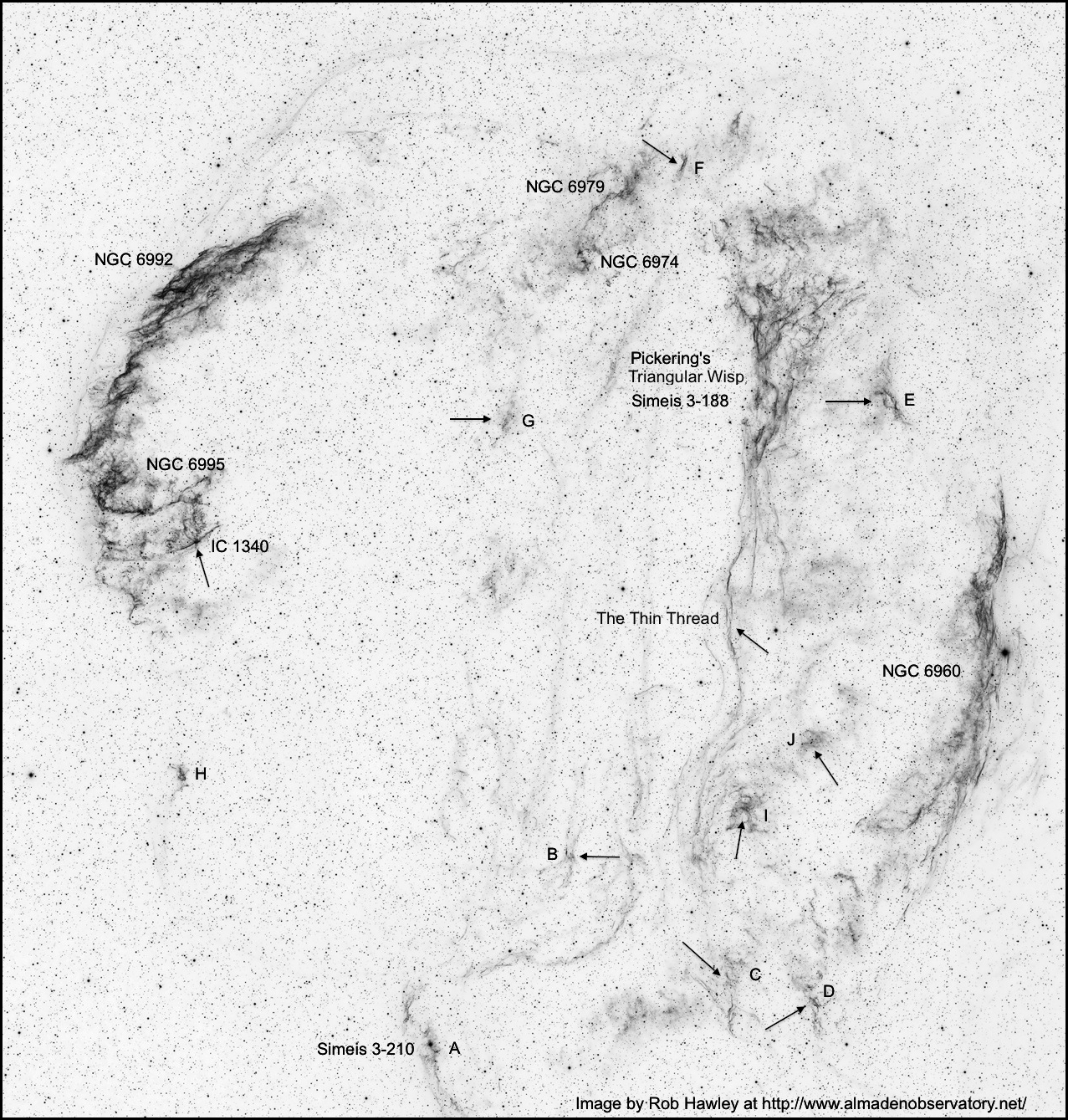
Another target that I had been planning to observe was the Veil Nebula, using my TEC 140 and an OIII filter.  With inspiration from the website of Steve Gottleib and using the chart at right I was able to observe many of the various labelled components.  I started at the "Witch's Broom" NGC 6960 and was able to easily identify the knot labelled 'D'.  I then moved back up to Pickering's Triangle also known as Simeis 3-188 and enjoyed the ethereal structure of this region while training my eye to pick out the fainter regions.  I then panned south and was able to detect the brighter portion of the "Thin Thread" as well as the knots labelled 'J' and 'I'.  I then relocated to the eastern portion of the Veil, NGC 6992 and 6995.  This is my favorite section of the nebula and my most traveled.  I made a point to observe IC 1340 and then located the star that would serve as a marker for knot 'A' which is Simeis 3-210.  This proved to be a little tougher than I expected given the glare from the star, but after careful observation I was able to positively identify the thin wisp of nebulosity.  Again, both Jerry and Bill were able to confirm this observation.

As the night wore on, we observed many targets from the popular Messiers, and double stars to interesting Arp galaxies, and of course Jupiter.  One of the highlights for me was Chris locating Comet 2012 J1 (Catalina) in the 20 inch despite it being close to the "Dob Hole" near the zenith.  This comet is cruising through Pegasus not far from Hergenrother and is approximately magnitude 14.5.  I had attempted this unsuccessfully in the 12 inch SCT.  I spent a few minutes revisiting some planetary nebula that I had observed from Portal two years ago with my buddy Christian (now back in Eurpoe), NGC 246 in Cetus, and IC 5148 in Grus  See this post for sketches of these objects.

Finally, a picture that was hard to take and that I had to mess with in photoshop to try and bring out the subject.  It is an attempt to image the Gegenschien, which is actually sunlight, back-scattered by interplanetary dust.    This soft glow forms opposite the Sun within the zodiacal light band and is only subtly brighter than the sky.  This is a phenomenon only visible under the darkest of skies.


All in all it was another great trip that ended all too quickly.  As great as the skies and observing are, it is the great friends and the unparalleled hospitality of the proprietor of Rancho de Farrar that make the trip.

Saturday, October 6, 2012

Comet 168P/Hergenrother

Yesterday I heard reports that Comet 168P/Hergenrother had made a sudden brightening, with some observers estimating the comet to be around 10th magnitude.  Predictions for this periodic comet have it around 15 magnitude, which would be out of reach of my telescopes from my suburban yard.  Last night I opened up my observatory to look for this comet with my TEC 140.  I utilized the Minor Planet Centers Ephemeris Service to generate coordinates for the comet and sent my mount off into northern Pegasus to see  what this icy interloper was up to.

The comet was a nice visual treat after so many months without making any cometary observations.  It was obvious in the 140mm telescope, with a condensed bright nucleus and a short stubby tail.  I am notably poor at making estimates of magnitude but I would optimistically report that it was a little brighter than 10th magnitude.  Naturally, I wanted to try and take a picture with my Canon T2i DSLR, so below is a 25 second exposure at ISO 1600, taken at 0421 UT on October 6th.  Interestingly, this image is far less impressive to me than the visual observation of the comet.  I am headed to Portal, AZ next weekend and if the weather cooperates I will make some sketches of the comet.


Sunday, March 18, 2012

Night and Day


The wonderful thing about having a small home based observatory is that there is virtually no set-up or preparation involved in observing.  Simply head outside, roll off the roof and wake the telescope mount from hibernation.  After a long day of work it is simply a 30 foot walk out the backdoor and I am relaxing under the night sky.

Earlier this week I was at a meeting with University of Arizona Astronomer Carl Hergenrother, who maintains an excellent blog called The Transient Sky which deals with comets, asteroids and meteors.  I highly recommend a visit to his site.  Carl reminded me that Comet C/2009 P1 Garradd was still fairly bright in the evening sky in the northeast.  I have been following this comet since late August 2011, when I first sketched it at magnitude 8.2 and have since made about a half-dozen sketches of it.  I remarked to Carl that I was amazed at how long this comet had remained fairly bright.  He indicated that the sustained brightness is a result of a rather large comet that did not approach the Sun very closely.  He remarked that had it come closer, it may have become a "Great Comet."

I last visited this comet in early February (see this post) and decided to have another look.  The comet is currently heading for a rendezvous with the Big Dipper asterism in Ursa Major and is well placed for observation much of the night. Below is a diagram of the comets orbit (courtesy JPL).


Click to enlarge
 
Below is my sketch of Comet C/2009 P1 Garradd completed at 0420 UT on 3/15/2012 (9:20 PM MST 3/14/12).   At the time of my sketch, the comet was 1.301 AU from Earth and 1.91 AU from the Sun.

Click to enlarge

As you can see, I was not disappointed in the mighty comet.  It is moving along at a stately pace of approximately 3.27 arcseconds per min and is currently sporting two diffuse tails.  The tail to the east appears much broader and more diffuse than the tail to the west.  I made this observation using my recently acquired TEC 8 inch f/20 Maksutov, with a 35mm Panoptic eyepiece yielding a magnification of 116x.  Current estimates place the comet at approximately magnitude 7.4.  I will be in Portal, AZ this coming weekend under magnitude 7+ skies and am very excited to have a look at Comet Garradd under truly dark skies.  Look for a follow up sketch next week.

Of course, the Lost Pleiad Observatory is a round the clock operation and until I invent a way to see the deep sky in the daytime (in visible light), I still observe our nearest star, the Sun every chance I get.  Below is a sketch I made of the Sun using my dedicated Hydrogen Alpha telescope on March 17th.  Happy St. Patrick's Day!

Click to enlarge


Thursday, February 2, 2012

Re-visiting Comet Garradd

Click to enlarge
Comet C/2009 P1 Garradd is back.  Not that it really went anywhere, of course, but I had stopped following this comet when it was no longer visible in the evening/night sky due to its location in the constellation of Hercules.  Recently I had heard that despite the passing of a few months, the comet was still fairly bright and even visible in binoculars.  With Hercules now up in the early morning sky, I had been considering taking a look at it during one of my morning Mars observing sessions.  Yesterday I learned that the comet would be within 1 degree of the globular cluster M 92 this morning, so set my alarm for 4 AM to observe this conjunction.

I was not disappointed!  As can be seen in my sketch at left, the comet is quite bright, at approximately magnitude 7.  It contains a bright nucleus, and while difficult to detect, there appear to be two tails. (These are hard to bring out in the scan of my sketch).   It is unusual to see a bright comet in the same field of view as a globular cluster, and it was well worth the lack of sleep.  I also made a sketch and observation of Mars, but the seeing conditions were poor and the drawing is surely not as exciting as the event depicted at left.

Update:  The picture below was captured from New Mexico the morning following my observation and sketch, when the comet was within .5 degree of M92.


Sunday, October 23, 2011

Near and Far

I just returned home from a quick two night trip to Portal, Arizona where I had two excellent nights with my good friends Jerry Farrar and Bill Gates.  If you appreciate dark skies and stars, you owe it to yourself to make a visit to this little back country area on the southeast flank of the Chricauhua Mountains.  The weather was extremely cooperative and we had two nights of very low humidity and transparent skies.  While Friday night was excellent by most standards, Saturday night was very nearly perfect.  (For the astronomers among you, Bill commented that his impression was that we were experiencing sub-arcsecond seeing).  In terms of naked eye limiting magnitude at the zenith, I could see stars around magnitude 7.2...while Bill could see fainter.  At left is a picture of the purple light that was filling the western sky shortly after sunset.

HST image of NGC 6751
I observed many targets over two nights, near and far, more than I can recount here without putting you quickly to sleep.  For example, using my 12 inch LX 200 SCT, I observed the central star in the ring nebula at 610 power.  In addition to this easy planetary nebula, I decided to make a tour of some of the planetaries within the constellation of Aquila.  I made a few notes on about a half dozen of them with the most interesting (in other words, something more than a diffuse stellar blip, or an ethereal glow) being NGC 6751 and NGC 6804.  NGC 6751 revealed an easy central star at 381x, and increasing the magnification to 610x brought out the delicate structure, central hollow, and slightly brighter arcs on the perimeter.  NGC 6804 is a large oval shaped nebula with an easy central star and two additional stars superimposed on the nebula.

For some time I had been wanting to make a sketch of the Pleiades star cluster and nebula.  Considering the honored place that this object has in my life (it is after all, the Lost Pleiad Observatory), I was waiting for a trip to Portal where using my TEC 140 APO and a low power eyepiece I could fit the entire cluster into the field of view and see the nebula.  At left is my sketch completed at 0730 UT on October 23rd.  The bright stars of the cluster are very young in stellar terms, only about 100 million years old.  They are approximately 400 light years distant appearing in the constellation of Taurus the Bull.  While I was drawing, I enjoyed memories of camping with my late sister-in-law very near to Portal and looking up at these same stars.


Relatively near to us, almost two astronomical units away (about twice the earth-sun distance), Comet Garradd continues its slow trek through the solar system.  The comet has brightened considerably, and I would estimate it very close to magnitude 7.  Under the dark and steady skies of Portal, the tail was extensive with three main streamers visible, although not nearly as bright as my sketch at right would imply.  My drawing was completed at 0255 UT on October 22nd, at 147x with the 12 inch SCT telescope.  Comet Garradd is currently in Hercules and is an easy target even in a pair of 7 x 50 binoculars.


Finally, something far away...well, extra-galactic anyway.  Guided to the location by Jerry Farrar, I made an observation of Globular Cluster G1 (Mayall II) in the Andromeda Galaxy.  At 2.52 million light years away, this is the brightest cluster in the Andromeda galaxy, and quite possibly the remnant core of a dwarf galaxy that has merged with Andromeda.  What confirms this observation is separating the small 15th magnitude stars that closely attend the cluster.  While not much to look at, it is incredible to consider that using a small telescope we are able to see this object as clearly non-stellar, in another galaxy! Obviously, it is very massive, probably twice the size of Omega Centauri, the largest known globular cluster in the milky way.  It is theorized that there may be a black hole at the center of G1.  I made the sketch below with my 12 inch SCT at a magnification of 381x.  At right is an HST image of the cluster.  This cluster resides approximately 130,000 light years from the core of the Andromeda galaxy.  (If you are interested in hunting it down, it is at RA 00:32:46.8 ~ DEC +39:34:42)

HST image
Click to enlarge


Sunday, September 25, 2011

Chiracauhua Astronomy Complex Grand Opening


Price Ranch and Perseus intersection
"Eat more chicken"
This past Saturday night, the Tucson Amateur Astronomy Association (TAAA) held the grand opening to show off the completed "phase 2a" construction of the new Chiracauhua Astronomy Complex (CAC).   I had wanted to take my telescopes to some dark skies this weekend, so on Friday afternoon I packed up and headed to the site one night early.  I had checked the weather forecast and while there was a slight chance of thundershowers each night, Friday looked to be most promising.  As I approached the CAC, I was met by the official bovine sentries, who upon seeing all the gear I was hauling, decided to let me pass unharmed.  Here are a few quick images of what has taken shape under the dark skies of Cochise County.  In hindsight I should have taken pictures of the amphitheater, the 18 inch dobsonian, and the inside of the observatory, but perhaps I can add some images to this post if any of the TAAA folks in attendance would like to share (Keith...are you listening?)

At left, you can see my scope cooling down on Friday night when I was alone at the site.  The sky was incredible and if I had a decent camera (and knew how to use it), I could have taken some amazing images.  Below left, is a picture of the roll off roof observatory that houses the new C14 and AP1200 mount donated by Wally Rogers.  The picture is taken from the amphitheater looking southwest.  In the background you can see some of the new member observing pads.  In the picture at right, you can see that there are ten of these pads, each measuring 12 x 12 with electricity.  This is a great size for a pad as there is ample room for a large telescope, a table and two or three chairs.  At one point, I had two telescopes set up on my pad, and still had room for all my gear.  The pads are spaced several feet apart, with just enough room to navigate but close enough that you can still chat with your neighbors without having to shout.  As you can see in the picture, we filled up all 10 pads on Saturday night for the grand opening.


Click to enlarge
In terms of observing, Friday night was excellent, with transparency around 9/10.  Using my 12 inch SCT I observed many objects, and made a sketch of comet 2009 P1 Garradd.  I have observed and sketched this comet several times over the past month, and this was the first time that I was able to detect streams in the tail.  The sketch at right was completed at 0320 UT on September 24th.

Overall, despite getting clouded out early on Saturday, it was a fun weekend at a great astronomy complex.  Kudos to everyone in the TAAA that had a hand in the development of the CAC.  Not only are the skies excellent, but having access to an observatory housed 14 inch telescope, restrooms, showers, and observing pads with power make for an amateur astronomers dream.

Update...below is an image of the attendees preparing for "first light" of the clubs new 18 inch Obsession Telescope...Thanks to Bill Lofquist for this image.


Sunday, August 28, 2011

Comet Garradd

As a follow up to the previous post on white light observing with the 4 inch f/11 achromat, I observed and sketched Comet C/2009 P1 Garradd tonight.  There was a bit of dust and smoke in the atmosphere all day and I think that the transparency was impacted tonight.  Contrast in the scope is excellent, and I do believe that I was seeing a broad and faint tail extending in an easterly direction from the nucleus.

Click to enlarge
Sketch was completed at 0325 UT under average skies, using a 10mm Pentax XW (110X).  The comet has an estimated magnitude of 8.1

Wednesday, October 13, 2010

New Moon Madness

This past weekend I went down to Portal, AZ to do some new moon observing with my good friend Jerry.  If you have read my previous posts regarding visiting and observing in this area, you already know that the skies are some of, if not THE, darkest and transparent skies in the United States.  We were joined this trip by our friends Bill Gates, Jerry and Debbie Hyman, and Christian Weiss.  In estimating the quality of the skies, we looked to stars of known magnitudes, and each of us was able to detect stars as faint as magnitude 7.  Before I share some of my observing highlights, I do want to mention what a great group we had.

Bill, is the master observer of "things that are not really there" objects.  He is a remarkably skilled observer who spent a fair bit of time hunting down some of the faintest nebulosity you can imagine...these areas are so faint that many of them do not even have catalog designations.  Bill finds them by downloading images from the Palomar Observatory Sky Survey (POSS)  and enhancing them on his computer to the point that he can see these faint clouds of gas.  He then hunts them down in the eyepiece.  Bill is observing objects that in all likelihood have never been observed visually by others...Both because they are virtually unknown, and also due to his incredible eyesight.  It is safe to say that while we use the expression "eagle eyes," eagles refer to themselves as having "Gates eyes."  Bill was able to identify stars as faint as magnitude 7.4 naked eye!  7.2 was the best I could muster...Of course, I was distracted by the bright zodiacal light and the Gegenschein, a phenomenon I had heard of but never seen...

Jerry and Debbie are friends that we have come to know through various "all Arizona" star party events.  They are quite passionate about amateur astronomy and spending time observing with them is always a treat.  I learn a lot from them, and the crisp wide-field views through their binoculars were simply stunning (not to mention the new 8 inch Celestron Edge HD they brought!).

Christian has been visiting Tucson while completing the research for his Masters Thesis in optics.  He is modeling the optics for Giant Magellan Telescope (I hope I have that right Christian!) and soon will return to Switzerland where he will graduate.  Christian is the type of observer who inspires each of us with both his passion and skill.  I know we will all miss him.  It is so refreshing to spend time with a group like this who appreciate observing all types of objects and sharing the experiences with each other.

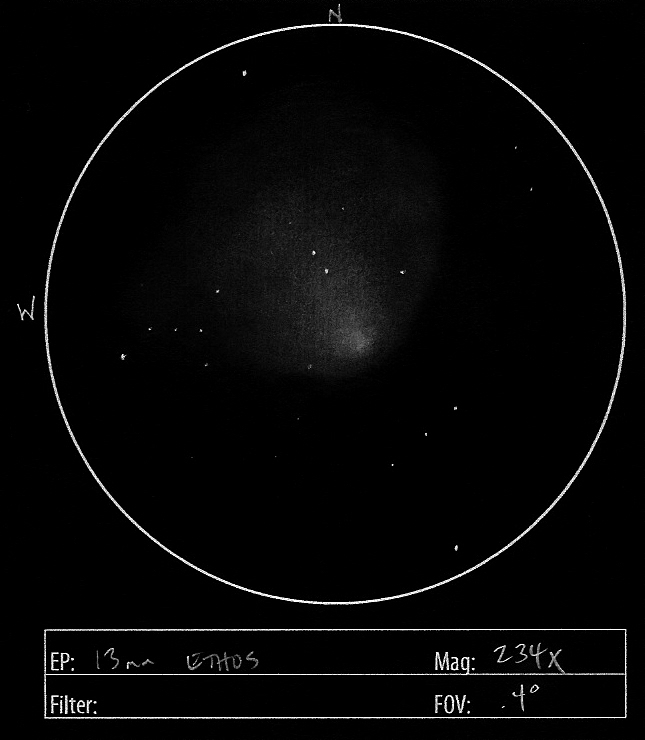
I am only going to post a few of the highlights from my two nights in Portal, beginning with Comet 103P/Hartley.  You can read about this comet that I have been observing over the past month in some of my earlier posts.  What was amazing was that the comet was visible to the naked eye as a fuzzy spot in the constellation of Cassiopeia.  It has brightened considerably and while still diffuse, sports a bright nucleus and extensive coma.  The comet is now appearing to move swiftly, approximately 5.8 arceseconds per minute during the time I was making the sketch...that translates to about 2.5 degrees of sky per day!  The sketch was made on the night of 10-10-2010 through my LX200 12 inch SCT and a 13mm Ethos eyepiece, yielding a magnification of 234X and a field of view of.4 degrees. The comet's distance from the earth was approximately .142 AU, and its distance from the sun was 1.093 AU (one AU = 93 million miles).


With Christian leading the way, I observed several planetary nebulas over the weekend. One of the benefits of having a telescope with 12 inches of aperture is that I can now begin to see subtle detail in these nebula that was not available to me with lesser aperture.  The sketch to the right is of NGC 7009, commonly known as the Saturn nebula, due to the extensions on either side the nebula that resemble Saturn's ring structure.  This nebula is obvious in most scopes at magnitude 8.3 as a small disc of uniform brightness. Magnifying this cluster with a power of 305 reveals the outer halo and extensions.  Careful observation also revealed some subtle darkening toward the center. This nebula is approximately 2900 light years away in the constellation of Aquarius.


To the left is another large but faint planetary that flies through the sky low in the south in the constellation of Grus (the crane).   IC 5148 is large, approximately 2 arc minutes in diameter, yet faint at magnitude 11.  Using a 20mm eyepiece (152X) and an Ultra High Contrast Filter (UHC) the nebula appeared to have a rift running through it, alomst separating it into two distinct objects.  The east half was marginally brighter than the west half, and the entire rim was brighter than the center.  I also observed this object through Christian's 16 inch Dobsonian, and he tells me that this object is actually designated twice in the IC, as object 5148 and 5150.  Either way, this is a very unique planetary and one well worth observing if you can see it from your location.  In Portal, it was perhaps 18 degrees above the horizon.


Finally, I'll share with you a sketch I made of NGC 246, commonly referred to as the Skull Nebula, haunting the constellation of Cetus.  This object was simply stunning from the dark site as it revealed several bright arcs along the perimeter, as well as dark cavities within the nebula itself.  the 12th magnitude central star was easily seen as well as a few other stars superimposed on the nebula.  NGC 246 is large, twice the apparent size of IC 5148 at 4.1 arcminutes in diameter.  It resides approximately 1300 light years away, and is estimated to be about 15,000 years old.

Of course, none of this would be possible without Jerry-  From sharing his property to sharing his food, no one hosts a better star party.  I have been to star parties in Colorado, California, Arizona, and even the vaunted Texas Star Party and can honestly say that there is no better place, and no better host than Jerry.  I have mentioned before that he is my mentor in observing and all the sketches above are due in part to observing and learning from him.  Thanks my friend.

Saturday, September 11, 2010

103P/Harltey Update!

Cometary update! I had a chance to get out last night and take a look at this comet again (see the previous post).  It seems to be slightly brighter than my previous observation, as I was able to hold it in direct (as opposed to averted) vision.  The coma appears to be a bit brighter to the north, however, there is no central condensation to the comets nucleus that I could see.  NASA's Jet Propulsion Laboratory maintains a website where one can generate orbital diagrams for this comet, and they indicate that the comet is currently .317 AU from Earth, and 1.244 AU from the sun (and getting closer!).  The comet is moving approximately 1.67 arc seconds per minute across the sky, so it does not yet appear to move that far from night to night.  I estimated the comet to be between magnitude 10 and 10.5 and it is in the constellation Andromeda.  The sketch was completed at 0508 UT on 9-11-2010, which was 10:08 PM MST on 9-10.

Sunday, September 5, 2010

Comet 103/P Hartley

In November of this year,  the EPOXI mission spacecraft will make a close flyby of comet Hartley 2, also known as 103/P Hartley.  The EPOXI name is a combination of EPOCH (Extrasolar Planet Observation and Characterization) and DIXI (Deep Impact eXtended Investigation).  The goal of this flyby is to gather data that will help us understand the structure, formation and composition history of cometary nuclei.  This information is important as it relates directly to our increasing understanding of the origin of our solar system.

This comet is predicted to reach naked eye brightness in late October, perhaps as bright as magnitude 5.  Last night night I decided to see if I could spot the comet in the LX200 12" SCT as it is currently well placed in the constellation Lacerta.  I had downloaded ephemerides for this comet from the IAU (International Astronomical Union) Minor Planet Center which indicated that the comet may currently be as bright as magnitude 8.5.  I was a bit skeptical as I had "googled" this comet and there are not many amateur images out there, suggesting that it is not exactly an interesting target...yet.  Gary Kronk maintains an excellent site called Cometography and there is information on this comet as well as a couple of images if you are interested.

Despite my skepticism (unusual, I know) I slewed the scope over the comets location and saw...nothing.  I decided to completely shut off the dim red lights that were on in the observatory and increase the magnification to 234x to darken the sky background in the eyepiece.  Sure enough, there in the center of the eyepiece was the faint glow of the comet.  My sketch of this comet is at left, and you will probably need to click on it so you can see the full size image.  It was hard to sketch such a faint glow, one that was essentially seen using averted vision.  It was also difficult to ascertain the size of the comet as it was extremely diffuse with no central condensation visible.  I would estimate that this comet is closer to magnitude 10-11, as it has a very low surface brightness...but again, I do not know the extent of the comet, so any estimate of it's magnitude is more of a guess than anything.  I completed this sketch at 0346 UT on 9/5/2010 (which was 8:46 PM MST on 9/4).  I should mention that the sky conditions were excellent with seeing that was estimated at 4/5 and a level of transparency that was as good as it gets from my location on the city's perimeter.  The milky way was visible from Sagittarius through Cygnus and beyond.

After spending some time on the comet I decided to have a look at NGC 40, a planetary nebula in Cepheus, also known as Caldwell 2.  Since I installed the 12" SCT I have been having fun observing planetary nebulas looking for features that were not visible to me with my previously smaller telescopes.  NGC 40 is a wonderful target, one that deserves more popularity.  The 11.6 magnitude central star is visible in most telescopes, and it is surrounded with a large circular shell of nebulosity.   As you know from previous posts, planetary nebula often hold up to greater magnifications without breaking down as other targets do, and NGC 40 was no exception.  I observed NGC 40 using an 8mm Ethos eyepiece, which in the 12" results in  a magnification of 381x and a field of view of .3 degrees.


You can see in the sketch that at high power the nebula is no longer a neat circular haze, rather it has bright arcs on both the east and west sides.  The arc on the west is the brighter of the two, and it seems to arc away from the nebula to the south in a manner reminiscent of a galactic spiral arm.  This planetary nebula is approximately 3500 light years away and spans a diameter of 38 arcseconds.  If you have never observed this target, it is highly recommended.