Showing posts with label Galaxy. Show all posts

Friday, January 15, 2016

More proof I am not an astrophotographer

I think I need to make a T-shirt that says "I am not an astrophotographer" mostly to poke fun at myself.  I have no desire to devote time to either data acquisition (hours per image) or learning the processing skills to create beautiful images of space (hundreds of hours learning, several hours for each image).  Yet, for some reason, every few months I go through a phase where I stick a camera into a telescope and take some pictures to try and capture something pretty.

I stretch the contrast, try and clean up the noise a little, and assuming I did a decent job with focus call it a day.  Then, I proceed to look at my pictures and realizing that I have the potential to do better I say to myself "Self, you need to learn how to this properly."  I start to play around with photoshop, read about various techniques online and quickly retreat from the notion that I will be furthering my skills in astrophotography.  Time goes by and soon it is "rinse and repeat."  I suspect the truth is that I like taking pictures through a telescope, but am not going to devote myself to it.  The lesson of course is to be satisfied with the process and results and not compare them to the many fantastic images taken by my friends and others on the internet.

Without further ado, more proof that I am not an astrophotographer.  Three more pictures from my recent time on Mount Lemmon (see the previous post).  Again, all of these images were taken with my Canon 6D through a 100mm Sky Watcher Esprit triplet refractor, and all are single exposures.


M31, M32, M110 - The Andromeda Galaxy and companions

M45 - The Pleiades

M42 - The Orion Nebula and NGC 1977 the Running Man Nebula (at top)

Wednesday, January 22, 2014

Supernova in M82!

Word has spread quickly of the likely Type Ia supernova in nearby galaxy M82 (The cigar Galaxy).  Surely news will continue to flow about this event as professional and amateur astronomers around the world turn telescopes, eyes and cameras toward the galaxy to observe the Supernova.  M82 is only 12 million light years away, which is fairly close as galaxies go.

In an absolutely amazing coincidence, two nights ago I was taking an image of Jupiter and after I finished I decided to take my first look at this galaxy this season.  I was very tired, but as I observed it in my 11-inch SCT I noticed a star in the central portion of the galaxy and thought to myself that I did not recall that star.  Typically I would not know the star patterns around galaxies but it happens that I have observed this galaxy more than perhaps any other galaxy.  You can see my sketch and report on this galaxy in a post I made back in February of 2010.  I even have a wonderful image of it hanging in my office on canvas.  My reaction two nights ago was that somehow I had never noticed this faint star before, and my thought was that as seeing conditions were very good, my new 11 inch telescope was delivering a fine image.  Imagine my surprise today when I heard that there was in fact a supernova!  So in my own way, I feel like I discovered it without any prior knowledge...if only I had put 2 and 2 together!

The best part of the story is that when I called my good friend and astronomy mentor Jerry Farrar today to let him know there was a supernova, his cut me off to exclaim "You are kidding!  I saw that two nights ago!"  He did not know either and described to me its exact location...so we are both reveling in our own independent "discovery" of this transient event.

Tonight I wanted to take a picture of the supernova and that meant I had to attempt my first image of a galaxy.  I used my Canon T2i and the software BackyardEOS attached to my 11 inch Celestron Edge SCT.  Now that I have a little experience stacking images of Jupiter, I took a sequence of 10 images of 15 seconds each at ISO 1600.  I aligned and stacked the images and with a little processing in photoshop ended up with the image below.  It is far from an inspirational image, yet it is really exciting for me to get this result...and of course, it shows the supernova (marked by the red lines)!


Sunday, October 14, 2012

Seeing the light in the dark

I just returned from Portal, AZ where I spent two nights with very good friends observing under some of the darkest skies in the western U.S.  I have blogged previously about Portal and what a great place it is to relax by day and observe by night, and this trip was certainly as rewarding as any.  We camp out at one of the premiere observing retreats known to amateur astronomers, the world famous Rancho de Farrar.  The early days of Rancho de Farrar are mostly unknown, however, historians have accepted local legends of it's beginnings...stories that seem to center on bonfires, whiskey, and heavenly bodies.  Speaking of amateur astronomers, below you can see our group of heavenly bodies as dusk settles over the ranch.   From left to right: Chris H., Shak (the 20 inch Dobsonian), Mike W., yours truly, Bill G., and El Jefe of the Ranch, Jerry F.


Folks living in places like Arizona are fortunate in that we often have clear views of the eastern horizon after sunset and can appreciate the beautiful colors of the "Belt of Venus."  The distant horizon and clear dry air in Portal combine to show beautiful colors as night approaches.  The blue color just above the distant hills is the shadow of the Earth being cast on our atmosphere and slowly ascending as the Sun continues to descend below the horizon.  As we say, often seen, rarely noticed!


Last week I acquired a very nice lens for my Canon T2i, a 15-85 mm EF-S.  I had wanted something that I could use to walk around with that was of higher quality than the kit lens, and also something that had a very wide field so that I could try to take some shots of the night sky.  I quickly learned that one of the most difficult parts is focusing the lens on the stars.  Simply turning the focus to infinity results in blurred stars, and there seems to be a sweet spot not quite to infinity.  The images of the milky way are far from perfect, however, I am  happy with them given that they are simply single shots, 25 seconds each with the lens at the 15mm setting...and that these are really my first attempts at this kind of photography from a dark site.

At left is an image of the Milky Way running nearly vertical into the foothills of the Chiricauhua Mountains.  This was taken at ISO 6400.  It is somewhat noisy, yet that is currently my trade off for obtaining the most color in the Milky Way.  Another reason why I need to get back to learning how to use Photoshop.

Below is an image of the Milky Way with a different composition, and I am not sure which I like better...And if you are a faithful reader that is not much into astronomy, I should point out that the reason that Milky Way is so bright in the south, is that we are looking toward the center of our galaxy in this area of the sky.


The image below was taken from a bit further back of the Ranch in order to capture some of gear.  It was also a 25 second exposure, but with an ISO of 3200.


 This next picture is a bit higher up in the sky and shows the Milky Way as it runs through Cygnus and the asterism known as the "Summer Triangle"


Despite all these pictures, I spent quite a bit of time looking through the telescopes that we had assembled within the circled wagons on the ranch:  a 20 inch Dobsonian, two 12 inch Meade SCT's, an 8 inch Celestron orange tube SCT, a TEC 140mm refractor, and a Zeiss 62mm refractor.  Truly, it was an embarrassment of astronomical riches.  And while we all enjoyed the various views, Mike was in and out of the "command center" where he was checking in on the data streaming in from his remote imaging set up.  Soon, I expect he will post a very impressive image of M 33, the Triangulum Galaxy, on his blog.

While he was imaging M 33, we observed it in nearly all of the telescopes on the field, save the 8 inch.  In my own 12 inch SCT I was blown away by details I had previously not seen in this low surface brightness galaxy.  Instead of the usual broad "S" shaped galaxy with two arms and a handful of bright knots, I was able to observe two additional spurs (arms) of the galaxy and more bright HII regions than I had ever seen.  Realizing how transparent the night was I pointed the scope at M 31, the Great Andromeda Galaxy and was again stunned by the detail.  Two dust lanes were easy and the edges of the lanes hinted at a mottled structure.  As I panned around, I was awestruck my M110, a satellite galaxy that is undergoing a merger with Andromeda.  As I pushed the magnification up to about 235X there was clearly mottling to this galaxy, and the bright nucleus was offset from center.  As I continued to observe  I realized that the reason the core seemed offset was that I was detecting an elongation of the galaxy back toward Andromeda.  This "light bridge" was confirmed by both Bill and Jerry.

I have been observing comet 168P/Hergenrother on and off over the past week and wanted to take a look at it from Portal.  I was not disappointed as the comet sported a stubby fan shaped tail- yet with averted vision there was clearly a long stream heading to the SE.  You can see this stream in my sketch at left, although it appeared fainter than in my drawing (obviously).  In addition to the comet, we observed a faint galaxy in the field of view, which Chris identified for us as NGC 7777, a 14th magnitude galaxy.  How dark was it last night?  We were able to detect this galaxy with averted vision in the 62mm Zeiss!  Had we not known it was there it would have been missed, however, with patience we were all able to tease it out of the background.

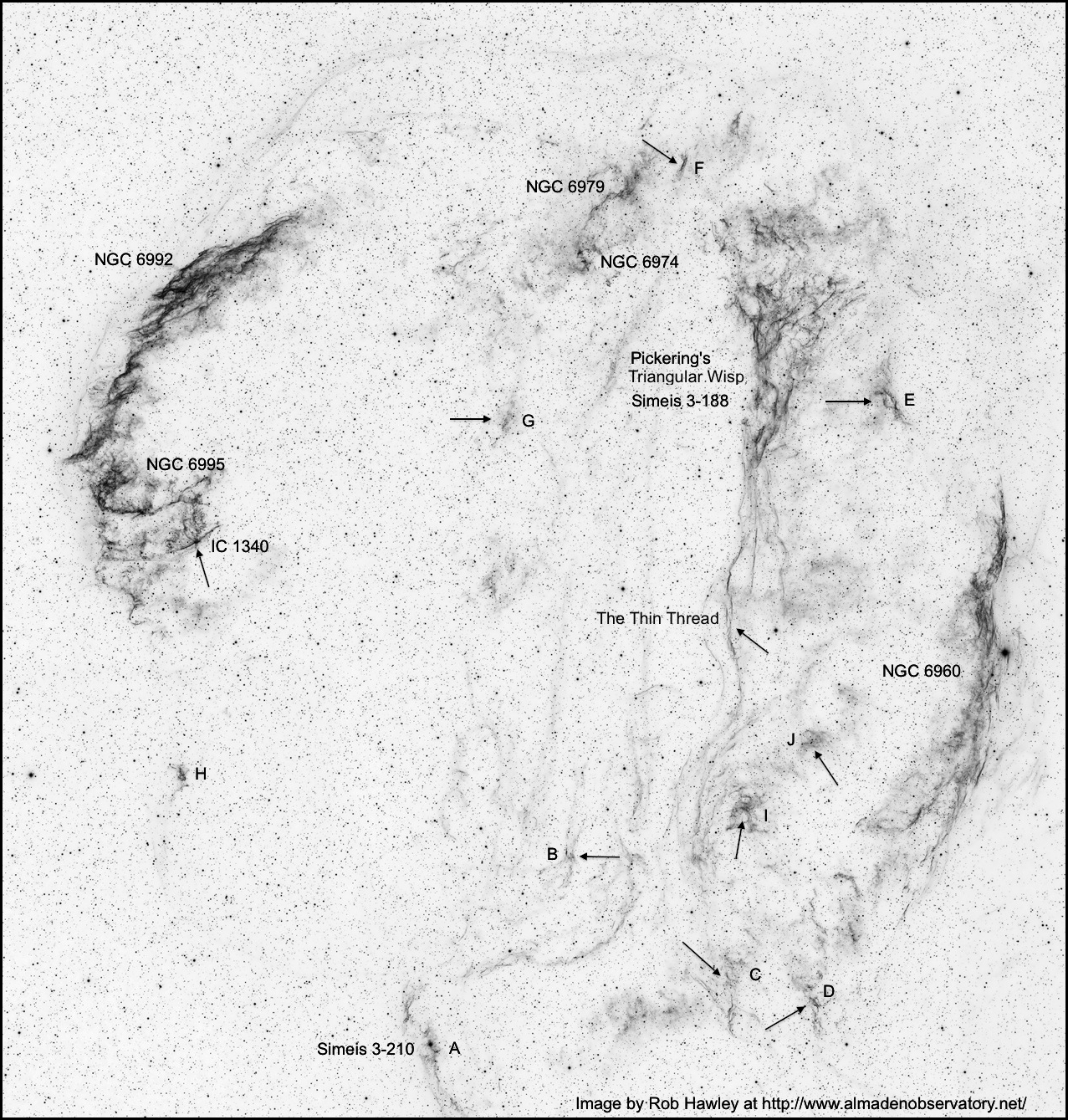
Another target that I had been planning to observe was the Veil Nebula, using my TEC 140 and an OIII filter.  With inspiration from the website of Steve Gottleib and using the chart at right I was able to observe many of the various labelled components.  I started at the "Witch's Broom" NGC 6960 and was able to easily identify the knot labelled 'D'.  I then moved back up to Pickering's Triangle also known as Simeis 3-188 and enjoyed the ethereal structure of this region while training my eye to pick out the fainter regions.  I then panned south and was able to detect the brighter portion of the "Thin Thread" as well as the knots labelled 'J' and 'I'.  I then relocated to the eastern portion of the Veil, NGC 6992 and 6995.  This is my favorite section of the nebula and my most traveled.  I made a point to observe IC 1340 and then located the star that would serve as a marker for knot 'A' which is Simeis 3-210.  This proved to be a little tougher than I expected given the glare from the star, but after careful observation I was able to positively identify the thin wisp of nebulosity.  Again, both Jerry and Bill were able to confirm this observation.

As the night wore on, we observed many targets from the popular Messiers, and double stars to interesting Arp galaxies, and of course Jupiter.  One of the highlights for me was Chris locating Comet 2012 J1 (Catalina) in the 20 inch despite it being close to the "Dob Hole" near the zenith.  This comet is cruising through Pegasus not far from Hergenrother and is approximately magnitude 14.5.  I had attempted this unsuccessfully in the 12 inch SCT.  I spent a few minutes revisiting some planetary nebula that I had observed from Portal two years ago with my buddy Christian (now back in Eurpoe), NGC 246 in Cetus, and IC 5148 in Grus  See this post for sketches of these objects.

Finally, a picture that was hard to take and that I had to mess with in photoshop to try and bring out the subject.  It is an attempt to image the Gegenschien, which is actually sunlight, back-scattered by interplanetary dust.    This soft glow forms opposite the Sun within the zodiacal light band and is only subtly brighter than the sky.  This is a phenomenon only visible under the darkest of skies.


All in all it was another great trip that ended all too quickly.  As great as the skies and observing are, it is the great friends and the unparalleled hospitality of the proprietor of Rancho de Farrar that make the trip.

Wednesday, May 16, 2012

Observing Jets in Centaurus A

I am a pretty faithful reader of Phil Plait's blog for Discover Magazine titled "Bad Astronomy."  Phil is an entertaining and informative science writer who frequently utilizes images generated at the Mount Lemmon SkyCenter as the subjects of his posts.  For example, see this post on NGC 5426/5427 from a few days ago.

Today, Phil posted an interesting piece on the jets emanating from the black hole at the heart of the "Centaurus A" galaxy.  As soon as I read the piece, I laughed to myself and thought how ironic it is that an Astronomer like Phil, (and I am sure he is far from alone in this) is surprised that these jets can be seen in visible light.  At it's heart, Astronomy is an observational science...yet, Phil's post is a reminder of how far the science has gone from having Astronomers spend time at the eyepiece.  This is not a bad thing, simply a reminder that the machines are not yet ready to take our place...I hope.  Incidentally, the image of Centaurus A (NGC 5128) at right is from NASA and can be found here with an accompanying article on the jets.

At left is a page from one of my observing logs from April 9th 2010.  Click on the image and enlarge it and read what is inside the red box I have drawn...yes, I believe I saw one of these jets visually in a 9.25 inch Schmidt Cassegrain telescope.  I was in Portal, Arizona under approximately magnitude 7.5 skies with my good friends Jerry Farrar and Bill Gates.  Bill was observing the galaxy with us and noticed these jets.  When he pointed them out, I was able to spot one of them by gently bumping the telescope back and forth.  Now I can not say for certain that our observations of light streaming from the galaxy is necessarily the same feature that Phil points to in his article, but it is hard not to believe they are related.

In case the writing is hard to decipher, I wrote "Bill Gates pointed out the bright areas streaming from the galaxy, perpendicular to the dark lane.  This was extremely low contrast and resembled the faintest of cometary tails streaming south (generally).  He could see glow to the north as well, although this was a "maybe" for me using the 9.25 inch SCT."


EDIT:  I actually wrote about this observation in a blog post back in April 2010!!  Read it here.

Were these the jets we saw?  Who knows...Either way, Bill is an amazing observer, and as my friend Jerry commented upon seeing Phil's blog post, the ESA, NASA, and the NSF should consider funding Bill to look through his telescope!

Sunday, November 27, 2011

Thanksgiving thanks to Herschel

Tonight was the third clear night in a row here at the Lost Pleiad Observatory, and unfortunately, the last night of this extended Thanksgiving weekend.   I knew that I would not last as long tonight so decided to concentrate on just two constellations in my Herschel 400 observing program, Triangulum and Pegasus.  Together these constellations account for 6 of the Herschel 400 objects and one of them in particular is quite captivating...

Triangulum - The Triangle:

Click to enlarge
NGC 598 - The Triangulum galaxy, M33.  This object has always been fascinating to me.  I have seen it with naked eye averted vision from Portal, AZ., and on other occasions been unable to see it in binoculars.  It has a very low surface brightness and despite it's large apparent size, detecting any spiral structure is a challenge.  My best view has actually been in my TEC 140 APO from Portal, AZ.  Tonight, in my 12 inch SCT I was able to make out the "S" shape of the galaxy, as well as several knots in the arms, particularly the northern arm.  The small nebular HII region NGC 604 was the brightest.  Not one of my best, but the sketch at left was completed tonight (0345 UT 11.28.2011) using a magnification of 145x.


Pegasus - The Winged Horse:

NGC 7217 - A fairly large and slightly elongated 11th magnitude galaxy with a slightly brighter nucleus.
NGC 7331 - A famous target in this constellation that I have observed in many different telescopes.  Very bright, elongated galaxy with a very bright elongated nucleus, containing an even brighter central region.
NGC 7448 - Large galaxy, much fainter than previous two.  No detail seen- slightly elongated.
NGC 7479 - Another galaxy that I have observed frequently in the Schulman 32 inch telescope at the Mount Lemmon SkyCenter where I work.  This galaxy is quite elongated in the eyepiece, but no trace of the spiral arms is noted tonight.  Slight brightening in the middle.
NGC 7814 - A very bright elongated galaxy with a very bright but small nucleus.

Herschel 400 count:  65 down, 335 remaining!

Herschel 400 ~ Part Deux

William Herschel
Well, night number two of the official Herschel 400 observation program was more relaxed than the aggressive pace of night number one.  Last night, (Saturday night) I headed out a little bit later to continue my observations.  We are just past new moon, and with a long Thanksgiving holiday weekend it is wonderful to have these dark nights with no reason to get up early in the morning.  Unfortunately, the seeing (atmospheric stability) was basically garbage {I had some better adjectives, but this is after all a family friendly blog} in the best of moments.  Bright stars were blobs of shimmering light and even the faint stars were hard to bring into focus.  I consoled myself thinking about all those great nights we do have here in the desert and went ahead using a maximum magnification of 145x under what were truly very transparent skies.  All observations made with my Meade Instruments 12 inch LX-200 SCT telescope.  I took several breaks to drink some mint tea and just gaze naked eye at the milky way.  Last nights constellations were in the same general areas as night number one and consisted of Auriga, Taurus, Orion, and Eridanus.  While it may seem like a lot of sky, (and in truth, it is) these four constellations only represent 19 of the Herschel 400 objects.

Auriga- The Charioteer:

NGC 1664 - An open cluster that displays several relatively bright stars, spread well apart, with a nice line of faint stars leading away from the cluster.
NGC 1857 - Another open cluster with many more stars than the above cluster; more condensed and generally a more pleasing view.
NGC 1907 - A fainter cluster than the ones above, but I'd still consider it bright overall although it contains many more faint stars.
NGC 1931 - As stars go this is nothing unusual for an open cluster...however, near the center is a very bright patch of nebulosity that contains three very close stars.  Most of the time, due to seeing, only two stars were visible but at high power during the fractions of a second where things steadied, a third star popped into view.
NGC 2126 - A medium sized open cluster with about 20-30 stars.
NGC 2281 - Another typical open cluster.  Unremarkable.  About 10 bright stars with a smattering of fainter ones.

Taurus - The Bull:

NGC 1647 - A very large cluster nearly filling the field of view (eyepiece TFOV = .7 degrees) with several brighter stars.
NGC 1817 - A pretty open cluster with well over 100 stars, the richest cluster yet tonight!  Less than .25 degree in size.

Orion - The Hunter...I've spent a lot of time in this constellation and previously observed most of these objects:

NGC 1788 - A bright patch of nebulosity with two stars embedded.  It is irregular in shape.
NGC 1980 - Another bright nebula at the end of the sword of Orion.  Small, surrounding the star Iota Orionis.  Often ignored in favor of it's famous neighbor, the Great Orion Nebula.
NGC 1999 - Another "bright" nebula.  Not much to look at visually, but photographically this is the famous "keyhole" nebula, containing a true dark void (not dust) in it's center.
NGC 2022 - Yes, a planetary nebula...probably my favorite class of deep sky object due to their subtle nature.  This one is definitely blue/green with a brighter center.  No sign of the central star.
NGC 2024
NGC 2024 - The Flame nebula- have seen this in much better detail from a darker site...still obvious in the suburbs, but rather ghostly.  Dust lanes most visible when Zeta Orionis is moved out of the field of view.  Image at right copyright Adam Block/Mount Lemmon SkyCenter/University of Arizona
NGC 2169 - A nice compact grouping of similarly bright stars that exactly form the numerals "3" and "7"...I recognized this cluster at once as the "37" cluster but did not recall the NGC number!
NGC 2186 - A compact group of fainter stars, maybe 30 of them...a deep sky stepchild in this constellation.
NGC 2194 - An unusually shaped cluster, almost a rectangle.  Fairly bright and rich and well condensed.

Eridanus - The River:

NGC 1084 - This is an elongated galaxy that appears a little brighter than its listed 12th magnitude.  No details seen.
NGC 1407 - A round galaxy with an obviously brighter nucleus.  These targets are low on the horizon making observations challenging.
NGC 1535 - A striking planetary nebula that is quite blue in color.  Quite round.  The central 2/3 of the nebula is markedly brighter than the outer 1/3.

59 objects down, 341 to go!

Saturday, November 26, 2011

Herschel 400, the official start

Often when observing at night, I tend to follow a familiar pattern.  I will observe any planets that are in the sky, I make sketches of any available comets, I visit some of my favorite Messier objects, and then I'll pick a constellation and observe some of its deep sky objects until I am ready to head indoors.  Last night was a very dark and clear night at the Lost Pleiad Observatory, and on a lark I said to myself  "self, lets finally, officially, start the Herschell 400."  Now faithful reader, you have been brought in on one of my secrets...I talk to myself.  Why, you ask?  Well, to be honest, I usually agree with myself.

According to Wikipedia, The Herschel 400 are a "subset of William Herschel's original deep sky catalog of 2,500 deep sky objects, selected by Brenda F. Guzman (Branchett), Lydel Guzman, Paul Jones, James Morrison, Peggy Taylor and Sara Saey of the Ancient City Astronomy Club in St. Augustine, Florida, USA circa 1980."  They represent 400 of the brighter deep sky objects cataloged by William Herschel and are all observable from mid-northern latitudes.  I have probably observed well over half of these objects already, but I have done so in a haphazard fashion and being a poor note taker, likely have no record of many of them...and even where records exist in my notes, they are written in a notebook by date of observation and are not collected or organized in any fashion whatsoever.  As a resource, click here for the Herschell 400 catalog arranged by constellation published by the Astronomical League.

Distribution of Herschel 400 objects
Red = Galaxy///Green = Nebula///Yellow = Star Cluster

We just had a fairly wet storm leave the area and temperatures last night were much cooler than they had been over the past few weeks.  I had a feeling that the night could be one of the few at my observatory where dew would actually be a concern.  I pulled the dew shield for my 12 inch SCT out of storage, screwed it on.  After observing Jupiter and taking a look at comet C/2010 G2 (Hill) (ephemerides here), I began to officially observe the Herschel 400.

The darkest and best skies from the Lost Pleiad Observatory are to the North and East and I decided to start my observations in the constellation of Andromeda...that and alphabetically they are first on the list, so it just seemed the right thing to do.  All observations are made at  magnifications of 145X and 234X, with occasional looks at planetary nebula and galaxies at 305X.  While transparency was excellent last night, the seeing 9atmospheric stability) was average to below average...it never really became steady.  Regardless, in order of NGC designation:

NGC 891
Andromeda - The Princess

NGC 205 - Also known as M110 this is a large satellite of the the Great Andromeda Galaxy and at low power shares the view with M31 herself.
NGC 404 - Very close to the orange star Beta Andromeda, commonly called Mirach...sometimes called the Ghost of Mirach.  Moving the star out of the field of view reveals a brighter nucleus and a round galaxy.
NGC 752 - One of only two Herschel 400 objects in Andromeda that I do not recall observing.  An open cluster of stars, pretty, bright and not condensed.  Magnitude 5.7
NGC 7662
NGC 891 - An old favorite.  This is an elusive edge on galaxy that I have observed in almost every telescope of decent aperture I have used.  Dust lane visible with averted vision, quite ethereal.  Sketch above right made with the Mt. Lemmon SkyCenter 32 inch Schulman Telescope
NGC 7662 - The Blue Snowball nebula shows a nice blue color and increasing the magnification reveals the incomplete bright inner ring.  Sketch at left also made with the Schulman 32 inch.
NGC 7688 - The other Herschel 400 object in Andromeda not previously observed.  Another bright open cluster...what else is there to say?


Aries (A good second constellation as it is my "sign"):

NGC 772 - A small 8 x 5 arcminute galaxy which is slightly elongated.  No sign of arms, however, the nucleus is somewhat brighter than outer areas.  Also known as Arp 78.

Cassiopeia - The Queen.

NGC 129 - Open cluster, attractive with many bright stars, probably 30-40 overall.
NGC 136 - A very small, faint, condensed patch of light...averted vision reveals a smattering of elusive pinpoints of light.  Apparently an open cluster, but perhaps I am observing something in the background of the cluster?
NGC 185 - Also known as Caldwell 18, this is a small galaxy that seems slightly disturbed using averted vision.  Also, a touch elongated.
NGC 225 - Another open cluster of bright stars...probably better in binoculars.
NGC 278 - A small round galaxy with a brighter nucleus.  Just a couple arcminutes in diameter.
NGC 381 - One of the nicer open clusters so far with 50 - 70 stars, many of them faint giving the cluster a busy appearance.
NGC 436 - Yet another open cluster, containing many brighter stars with a few multiple stars among them.
NGC 457 - One of my favorite open clusters out there...looks best at low power where it looks like a winged creature.  I like to call it the Owl, but at Halloween call it the Bat...some locals call it the Kachina Dancer.  Whatever the name, it appears to have two bright eyes staring back at the observer while spreading it's wings wide.
NGC 559 - Another open cluster, bright stars, not very impressive.
NGC 637 - Duplicate of the above!  Different stars, same impression in the 12 inch scope...yawn...
NGC 654 - OK, a little better in the eye candy department with twice as many stars as the above two objects and a higher level of condensation.
NGC 659 - Back to basics...maybe 10 cluster members well spread apart.  Where are my (goto) binoculars?
NGC 663 - Now we are talking!  Many faint stars, well condensed, at 145 power this cluster should be more famous.  It has a delicate appearance with a dark lane running the length of the cluster.
NGC 1027 - Another open cluster, typical of others in this constellation.  Bumping the telescope I think I can detect a subtle nebulosity enveloping this cluster...averted imagination?  Maybe...Worth returning to at a truly dark site.
NGC 7789 - Wow!  This is a beautiful cluster with well over 100 stars.  As I continue to observe this cluster it started to appear as if it had a spiral shape to it...maybe time to get some rest.  I took a walk around the yard to get the blood flowing, took a drink of water and came back to the scope.  Sure enough, this cluster has a distinct spiral shape to it...once noticed I can not avoid seeing this obvious pattern.  Favorite Herschel 400 object in Cassiopeia!!
NGC 7790 - What else?  Another open cluster...about 30 stars gathered together...a let down after the previous cluster, but typical of these Cassiopeia clusters.

Cepheus - The King.

NGC 40
NGC 40 - This is a favorite planetary nebula that I have observed and sketched a couple times previously (example at left).  The central star is easily visible in a circular shell of nebulosity with a bright "polar caps".  Also known as Caldwell 2.
NGC 6939 - A well populated open cluster with many chains of stars emanating from its central regions.  Probably upwards of 75 stars.  In a lower power telescope one can observe this pretty cluster together with the galaxy below
NGC 6946 - A small low surface brightness galaxy that is very nearby to the cluster above.  No sign of spiral arms, and only a slight brightening toward toward the nucleus.  Also known as Caldwell 12, The Fireworks Galaxy.
NGC 7142 - Run of the mill open cluster- 20+ stars, fairly bright.
NGC 7160 - Barely an open cluster in the 12 inch scope...not many stars at all, although they are relatively bright ones.
NGC 7380 - A bright cluster embedded within some nebulosity.  From a dark site this would likely be striking.
NGC 7510 - Open cluster (too many of these tonight!) with approximately 30 stars in the cluster.  Relatively bright at magnitude 7.9

Perseus - The Hero.

NGC 651 - Planetary nebula widely known as the Little Dumbbell, M76.  Pushing the power up to 305 reveals the bipolar nature of this nebula with brighter regions at the poles.  Hints of the nebulous looping extensions noted when nudging the scope, although these would likely be invisible if I did not know they are there from previous observations.
NGC 869 and NGC 884 - The famous "Double Cluster" is the only object tonight for which I pulled out the 56mm plossl.  At very low power I can almost appreciate the beauty of these two objects, containing several hundred stars, including some colorful stars near the center of each cluster.
NGC 1023
NGC 1023 - This is a bright elongated galaxy nicely offset by a chain of stars south of the galaxy.  A bright nucleus with some faint extensions make for a sight unique so far tonight.  I took a break from simply observing and sketched this galaxy as seen at right.
NGC 1245- An open cluster, containing a fair number of stars, somewhat condensed with stars of similar brightness.
NGC 1342 - Another open cluster, not much to note, maybe 40 stars.
NGC 1444 - Small and faint cluster of stars, Herschel must have been sleepy by this point!
NGC 1513 - This is an interesting cluster in that it is shaped somewhat like a "U"...it is a bright a large cluster with 30 to 40 stars.
NGC 1528 - This is also an interesting open cluster with dark lanes passing between the lines of stars.
NGC 1545 - Final open cluster of the evening...and not an impressive one by any stretch.  Dominated by two brighter stars.

Well, that is my report on night one of the official Herschel 400 observing run of the Lost Pleiad Observatory.  I may try and get a few more objects in tonight, but am already quite happy with my Thanksgiving weekend start.  40 objects down, 360 to go!  That means that if I average one object per night I should finish in a year...we'll see!


Monday, June 6, 2011

On dark skies, family, friends, and telescopes...Life is good

The title says it all...dark skies, my lovely family, good friends and great telescopes.  Life my faithful readers, is good.  Despite my total slacking off from maintaining the blog, I have continued to have some excellent astronomical adventures, including a trip this past weekend to a site in northern Arizona that is frequently referred to as Frederickson Meadow.  The meadow was named in memory of longtime Saguaro Astronomy Club member Dave Frederickson, and it is a well deserved name.  The meadow is quite beautiful and provides expansive views of the sky.  In addition to my family, I travelled to the meadow with my friend Jerry Farrar to spend the weekend observing.  As luck would have it, there was a group of about a dozen astronomers from the Phoenix area who quickly welcomed us to their star party.

The meadow is situated roughly between Flagstaff and Payson and is approximately a 4.5 hour drive from Tucson, with only the last 5 miles on a well maintained dirt road.  As soon as one sees the Discovery Channel Telescope situated on the next ridge, one knows that the sight is likely very good for astronomy.

Most folks camp in the trees on the north side of the meadow, and the Forest Service has requested that we not drive into the meadow itself.  This makes great sense as it preserves the meadow and allows many grasses and wildflowers to flourish.  For our night time observations, I had taken along my TEC 140 refractor and Jerry brought along his 12 inch SCT as these scopes are quite complimentary when parked alongside each other.  Below, you can see Jerry observing the sun through his dedicated hydrogen alpha telescope which he also brought on the trip.

Each day brought very stiff breezes, which I would estimate between 10 and 20 mph, with occasional gusts closer to 30 mph.  As if on cue, these winds would vanish at sunset and start up at sunrise...(perhaps the late Mr. Fredrickson was taking care of us).  These breezes kept the daytime temps comfortable in the low 80's, however, the nights were much colder with Thursday night in mid-20's and Friday and Saturday nights in the mid-30's!  Certainly a reprieve from the June desert heat.

One of the nice things about the meadow, is that one can choose to spend time in cool shade of the pines reading, napping, snacking, planning your nights observing run, or whatever strikes your fancy.  If one is after a bit more activity, it is a great area for an easy walk around, a more strenuous hike, or a game of nerf football.  Nearby, about 30 minutes back up the road, there is even an RV resort where one can grab a bite to eat or take a shower ($5).  Of course, we were there to observe and I am sure that at this point you are wondering when I will get to the point, and tell you about the observations we made...but before I get to that, take a look at the "Great Comet of Frederickson meadow" alongside the crescent moon just after sunset.


Click the image to see the supernova!
Those of you who are amateur astronomers know that on Friday it was widely reported that a supernova had erupted in one of the arms of the whirlpool galaxy, M51.  French Observer Stephan Lamotte Bailey, created the image at left...Click on it and you will then see the animation which blinks the supernova in and out.  This was the talk of the group as the sun was setting Friday evening, and nearly every scope and camera in the meadow was targeting the grand galaxy.  I first attempted to spot it in my TEC 140mm APO, and with a bit of patience it was clearly there with averted vision, reminiscent of observing a challenging central star in a planetary nebula.  Jerry took a look and was also seeing the same star.  Naturally, we then went over to his 12 inch SCT and the supernova was clearly visible with direct vision, as an approximately 13th to 14th magnitude star.  What is so neat about this, is the fact that we were observing an extragalactic star....which is not something one does every day!

The main reason I brought along the refractor on this trip was that I had limited space, and this was the first chance that I had this year to spend extended time sweeping through the milky way...and the high contrast wide field TEC 140 is a world class instrument practically made for this purpose.  The scope garnered high praise from all who looked through it; which in this case was a group of very experienced amateurs who appreciated the nearly 3 dimensional views that the scope provides.  Whether it was Saturn at 300X, Omega Centauri and globular star clusters in Ophiuchus and Sagittarius, planetary nebula, or dark nebula, everyone commented on that sharpness and contrast of the TEC 140. In addition to having my fun with the bright Messier objects and generally sweeping around the milky way, I also observed some galaxies- mostly in Canes Venatici and Coma Berenices.  This may seem crazy with only 5.5 inches of aperture, but being able to see them in a wide field setting adds a context that is missing when observing them in my 12 inch SCT.  This post is getting long, so I will only share some of my favorites from these constellations below:

Hickson 68, a galaxy group composed of NGC's 5353, 5354, 5350, 5355, and 5358 (in order of magnitude from brightest to faintest...a to e in the image at left).  All five of these galaxies were visible in the refractor, despite the presence of a magnitude 6.5 star only 3 arc minutes away.  It is a very pretty grouping of galaxies with the brightest members shining at magnitude 11.5 and the faintest, tiny little NGC 5358 at magnitude 13.6.   I would highly recommend this target if you are interested in galaxy groups as each of the members is distinct.

NGC 4244 is a popular target due being large and bright, and is also known as Caldwell 26.  It is an edge on galaxy, and at high power, the TEC revealed some of the galaxies mottling as well as a distinctly bright nucleus.  The galaxy is nicely pinned down by stars off each end. 

NGC 4217 is a another elongated galaxy but is much more difficult to see, requiring averted vision.  While listed at magnitude 11.2, it has a surface brightness of around magnitude 13 and it shares the field with three 9th or 10th magnitude stars whose light interferes with seeing the galaxy.  Most interesting is that this galaxy is often overlooked as it is overwhelmed by its neighbor and possible companion M106.  At 75x, both of these galaxies were visible in the eyepiece. 4217 is the edge on galaxy in the lower right of the image.

NGC 4298 and 4302 make a beautiful, ghostly pair in the TEC.  4298 is a diffuse glow with no discernible nucleus, and 4302 is a thin edge on galaxy, also without detail.  These galaxies sit quite close to each other in the eyepiece, perhaps only 2 or 3 arcminutes apart. It is easier to hold 4298 with direct vision, even though it is only .3 magnitudes brighter at 11.3 versus 11.6
I did observe some other areas of the sky, including NGC 5128, the Centauraus A galaxy.  This has long been a favorite target of mine for the wealth of detail visible in the hamburger like galaxy.  Unfortunately, this galaxy was sitting in the Phoenix light dome (yes, there is a light dome despite being 100 miles+ away) and the amount of detail was not as great as I have seen at other locations.  If you are interested, the phoenix light dome is about 15 degrees high on the southern horizon and spans about 15 degrees in azimuth.  Even though this area is not free from the light dome, it is overall the second best site I have been to in Arizona for observing, with Portal being the first.  Overhead, 7th magnitude stars are visible and the setting is is delightful. I'll be heading back next new moon, weather permitting!


Monday, April 4, 2011

Observing the Jet in M87

Working part time at the Mount Lemmon SkyCenter (MLSC) has been a tremendous experience for me over the past several months.  Not only do I have regular opportunities to introduce folks to astronomy and the night sky, but I have access to a world class instrument; the Schulman 32 inch  RCOS telescope. Last night I administered our SkyNights program, and after the guests departed I spent some time with my very good friend, mentor, and SkyCenter volunteer Jerry Farrar observing galaxies in the constellations of Sextans and Virgo.  The night was very dark with no moon, and even the light dome from nearby Tucson was diminished on this Sunday Night.  For those of you not familiar with the mountain or the observatory, the MLSC sits at the summit of Mount Lemmon, just north of Tucson at an elevation of 9500 feet.

Temperatures last night were in the mid 30's around 11:00 PM MST when on a whim I decided to point the telescope at M87 to see if we could observe the jet that emanates from the super massive black hole at the center of this galaxy.  Lobes from this jet extend out to 250,000 light years from the nucleus, and can be seen in the Hubble space telescope image of the galaxy at left.  Below is an image of this galaxy taken at the SkyCenter which was featured in the March issue of Astronomy magazine.  Click on the image and you will see the small jet shooting out from the core. Utilizing a 21mm Televue Ethos eyepiece and a 2x Barlow (542 power, .2 degree field of view), both Jerry and I observed the galaxy as well as the jet!  It took a few minutes to spot, but we were able to independently locate the jet as well as see a star like bright spot on the jet itself.   To the right of the image is the sketch I completed at approximately 0600 UT on April 4th.


Until 1990, there had been only one recorded visual observation of this jet...an observation made by Otto Struve using the 100 inch Hooker Telescope at Mount Wilson.  It is the kind of observation that very few individuals are lucky enough to make.  This was a difficult observation, but one that makes my personal list of all time favorites, right up there with the whirlpool galaxy through the 40 inch telescope belonging to the late Dave Fredrickson.  

Friday, November 26, 2010

Carbon Stars, cold weather and other notes...

Thanksgiving has brought very cold temperatures to the Lost Pleiad Observatory.  Thanksgiving day saw a high temperature of 56 degrees, the lowest high temperature since the mid 1970's!  Last night was quite cold with temperatures dropping below freezing for the first time this winter.  Overall, this low pressure system has created fairly poor seeing conditions...however, holidays mean lots of free time to observe as well as markedly reduced light pollution from Tucson.

Last night, I decided to do some observing with my TEC 140 prior to moon rise.  I was rewarded with some of the darkest skies I have seen in the observatory in a long, long time.  Not only were businesses around town closed, but there must have been no one on the roads as the light dome over Tucson was perhaps 25% of its usual brightness, maybe less.  Two observations from last night are worth reporting here.  First, I wanted to find a nice Carbon Star that I could use while leading programs at the Mount Lemmon Sky Center.  Carbon stars are late-type giant stars whose atmospheres contain more carbon than oxygen.  The chemical reactions that take place in the upper layers of the star result in increasing production of carbon compounds, surrounding the star with a "shell" of carbon dust.  This leads to a ruby red like appearance at the eyepiece.  While there are hundreds of these stars known, some of the more famous ones are Mu Cephei, R Leporis, and T Lyrae.  I have been showing T Lyrae during programs, and R Leporis is not quite high enough in the sky yet to utilize.  Mu Cephei is too bright and most observers see it as simply a bit more orange than Betelgeuse in Orion.

If you are interested in observing some of these stellar gems, I'd suggest you visit this webpage which contains a list of carbon stars brighter than visual magnitude 8.5.  The image to the left is of a carbon star in the constellation Canes Venatici and was created by Greg Parker and Noel Carboni of the New Forest Observatory.  I decided to have a go at S Cephei, a long period Mira type variable star.  It's listed as magnitude 7.5  - 12.9 and has a period of 487 days.  Mira type variables are characterized (among other things) by very red colors and are in very late stages of stellar evolution.  These stars will eventually shed their outer layers and become planetary nebula.  S Cephei is currently around magnitude 9 - 9.5 and fading.  It appeared as a brilliant gemstone like red in the eyepiece and will be a very useful example of a carbon star in my programs.

The second Thanksgiving observation I'd like to share is that of NGC 253, the Sculptor Galaxy.  I have observed this object many times in just about every telescope I have owned.  It is a very large spiral galaxy in an intense star birth phase.  It is remarkable in the eyepiece as it reveals extremely complex dust lanes throughout.  Recently I observed it through the 32" Schulman telescope at the Mount Lemmon Sky Center, and was treated to more detail than I could ever capture with pencil and paper.  I wondered how it would look in my 140mm refractor, and last night was perfect for this as the constellation rides low in the south, where typically the light pollution is at its greatest from my location.  I made the sketch below at 75x with a 13mm eyepiece.  To the right of my sketch is an image of this galaxy, taken from the Mount Lemmon Sky Center (south is up in the image, down in my sketch).

Copyright Adam Block/Mount Lemmon SkyCenter/University of Arizona


Finally, speaking of the Mount Lemmon Sky Center, todays Astronomy Picture of the Day features NGC 2024, the Flame Nebula as imaged by my colleague Adam Block at the Mount Lemmon Sky Center.  This is the first MLSC image chosen by the APOD folks since the installation of the 32" Schulman telescope...check it out!

Sunday, November 14, 2010

Fall observing

Been awhile since the last post!  Mid-October through mid-Novermber was a busy month on the astronomy front for me- I attended the All Arizona Star Party, made a quick trip to Portal, AZ and also led about a half-dozen programs at the Mount Lemmon SkyCenter...all since the last post!

Rather than try and write a long post to capture it all, I'll just provide some brief details and some photos and hope that your imagination is as great as the real events were!  The All Arizona Star Party (AASP) is an annual event, that was held this year at what is referred to as the Antenna site...basically about 2 miles south of Interstate 10, and about 80  miles west of Phoenix, AZ.  I attended with my friend Jerry Farrar, and we camped next to Kevin and Brian from Lunt Solar Systems.  This was quite a treat as they brought the entire Lunt arsenal of scopes and filters.  I had a chance to double stack the new 60 front mounted etalon on my scope (to the left) and it was awesome!  Not only were the views of surface features rich with contrast and detail, but we observed an M 5.4 class solar flare on Saturday morning.  Below is my sketch of the sun, including the flare in region 11121.


Naturally I observed many nighttime objects as well, including many galaxies in the constellation of Aquarius.  Using my 12" LX-200 SCT, I observed NGC 7171, NGC 7184, NGC 7218, NGC 7392, NGC 7723, and the pair NGC 7724 & 7727 that shared the field of view at 152 power.  I also observed NGC 7492 which is a very faint, diffuse globular cluster.  This appeared almost as a mist in the eyepiece with about 6 stars resolved.  I spent some time observing NGC 708, the faith group of galaxies, also known as Abell 262, located in Andromeda.  I was drawn to check out this group of galaxies by a recent image created by my colleague Adam Block as part of the first light of the new 32" Schulman Telescope at the Mount Lemmon Sky Center. Below is a Digitized Sky Survey image and my sketch (reversed left to right), and underneath that is Adam's image of the galaxies.


Copyright Adam Block/Mount Lemmon SkyCenter/University of Arizona

If you have read my blog over the past many months, you know that Portal, AZ is home to Rancho del Farrar, one of my favorite places on earth to observe.  Jerry invited me out for a quick trip with some of his family and friends.  While the observing was pretty laid back, we had a great time and the company was excellent.  Prior to leaving Portal, Beth and Ian and I went on a short hike in Cave Creek Canyon to a small cave that can be explored in about 10 minutes. Enjoy the photos of our trip!