Showing posts with label Moon. Show all posts

Wednesday, January 31, 2018

Super Blue Lunar Eclipse

Living here in the USA, things have been a bit surreal over the past year.  As the Great Orange One (GOO) that occupies the office reserved for President has done his best to divide our citizenry and alienate us from the rest of the conscious world, it is sometimes difficult to remain optimistic about our future.  Fortunately, there are events that remind us of our place in the universe; and despite the deep divisions that are being cultivated by the GOO, there are greater forces at work that serve to unite us here on Earth.  There is something about seeing the solar system in motion in a way that we do not witness frequently, that seems to recharge my desire to make the world a better place.

Early this morning we were treated to a widely publicized total Lunar Eclipse.  This eclipse occurred on the second full moon within a calendar month (a "Blue" moon), and also at the time of perigee, when the moon is at the closest point in its elliptical orbit around the Earth (the "Super" moon).  The occurrence of a "Super Blue Lunar Eclipse" is indeed rare, with the last one occurring in 1866, one hundred and fifty two years ago! I observed the eclipse from work, (The Mount Lemmon SkyCenter) where we were providing a live stream of the eclipse for NASA.

The image at left was taken with my Canon 6D and a 70-200mm lens set to 100mm, just before sunrise.  You can see the eclipsed moon hanging in the dawn sky with Picacho peak in the distance at lower right (along with I-10 traffic just in front of it).


Below is a collage of some of the images I captured during the eclipse, using my Canon 6D and my Stellarvue 90mm refractor.  Remember to click to enlarge (perhaps twice if your browser automatically resizes images to fit the window)
So you missed the eclipse and are wondering when the next lunar eclipse is here in AZ? The next eclipse in Tucson will be on January 20, 2019 starting at 7:36 PM local time.

Finally, my friend Roger who observed and photographed the eclipse with me, had a little fun with my image above...


Wednesday, September 30, 2015

Lunar Eclipse

By now, there have been many images of the Total Lunar Eclipse this past Sunday circulating around the internet.  I was leading a public eclipse observing group of about 75 folks so taking pictures was not my primary objective for the evening...yet, I did try and capture some between talking about the eclipse, debunking the "blood moon" nonsense, and generally just enjoying the warm fall evening.

Two images below, one of the partial phase prior to totality, and one image from near totality.  These were taken with my Canon 6D and a 70-200mm f/4 set to 200mm with a 1.4 extender.  There was a slight breeze and I wish I had more time to play with the camera as I would have set the ISO a bit higher in order to capture images a bit faster (resulting in sharper images).   As things were, the images near totality was a 2 second exposure.


Wednesday, October 8, 2014

Lunar Eclipse in LA

I am in Los Angeles visiting my sister and her family in advance of some meetings related to work over the next three days (I hope to post some photos from today's meeting later...).  Very early this morning there was a total lunar eclipse, which is the type of event that even the drastic light pollution of Los Angeles can not diminish.  After spending yesterday at the beach, I was too tired to watch the whole eclipse, but I did manage to pull myself out of bed at about 2:50 AM to watch the moon slip towards totality at 3:25 AM PDT.  I was joined by my insomniac sister, who despite having instructed me not to wake her to watch the eclipse is rumored to have enjoyed it.  Below are two images I took with my Canon T2i and my 70-200mm f/4 lens during the eclipse.  Somehow in all my fiddling I did not extend the zoom all the way, so the images are taken at 180mm.

First, approaching totality at 3:19 AM (1019 UT), 1/2 second at ISO 400.  Note the blue dot to the left of the moon...and be sure to enlarge the image to see the blue dot.


Second, at 3:35 AM (1035 UT) about 10 minutes into totality.  1/3 second also at ISO 400...again, note that blue dot about a half-degree left of the moon...Anatomical jokes aside, that little blue dot is Uranus!  Make sure to enlarge to full size to see it.


And just in case you are having a hard time, here it is labelled!


Tuesday, April 15, 2014

Total Lunar Eclipse

The full report and images will come later, but I wanted to quickly share one of the images I took during last nights total lunar eclipse.  I captured a couple hundred images through my 90mm Stellarvue triplet refractor and 1.6x Barlow lens using my Canon T2i, and they are all in RAW format...so when I have the time to go through them I hope to perhaps make a time-lapse of the eclipse, or at least share some of the nicer shots.  For now, enjoy this image taken at 12:54:54 local time (0754 UT on April 15th).  Click the image to enlarge.


Sunday, February 9, 2014

Copernicus

After a solid week of rather cloudy skies we had somewhat clear skies this evening over the Lost Pleiad Observatory.  While there were some passing cirrus, it was a very comfortable night to open up the roof and let the telescopes do what they do best- collect photons.  Tonights target for the little ASI120MC camera was the lunar crater Copernicus. This is a crater well known to most amateur astronomers as it dominates the Earth facing side of the moon and has a very large and bright set of rays extending from it.  The image below is a stack of about 500 frames aligned and stacked in Registax, with some additional sharpening in Photoshop.  It was taken through my Celestron 11 inch Edge HD SCT.


While this is certainly a reasonable image given my skill and the average seeing conditions, I can not look at any lunar images without thinking about the amazing images generated by NASA's Lunar Reconnaissance Orbiter (LRO). The images below are the central peak region of Copernicus and give you an idea of just how impressive the images from LRO are.  Make sure and click the images to enlarge them to full size!


If you want to read more about these images and see others, check out this blog post from the LRO camera. If you have not had enough (and how could you?!?) watch the video below...and turn up the speakers to listen to the narration.

Wednesday, June 12, 2013

Planetary aesthetics

If you have been watching the evening skies this past month you know that we have had some very nice alignments of Jupiter, Venus and Mercury following sunset.  While Jupiter is now departed from view, Venus and Mercury remain and this week were joined by a fresh crescent moon.  This past Saturday I was at the Arizona Sonora Desert Museum doing some astronomy outreach in support of the UA Cancer Center and took the image below.  Venus is the lower planet and Mercury the upper.  Click to enlarge to full size!


Two nights later (this past Monday), I took this image from in front of my house where the planets were joined by the crescent moon, making a nice triangle.  If you click to enlarge to full size and look closely, you will see above the moon another interloper in the image, a bat!


Wednesday, May 29, 2013

Planetary conjunctions!

Today I returned from LA to the comfy confines of Tucson and my observatory.  As the sun was setting and I was noting the beautiful colors in the Belt of Venus I was reminded of how lucky I am to live in an area with such open horizons and frequently clear atmosphere.   The evening was so nice I decided to take a picture of the planetary conjunction in the west  from my home so as to capture many of the colors in the sky that I could simply not capture from the middle of LA.  The image below was taken at 8:13 MST (0313 UT) with my canon T2i and a 24-105mm zoom lens at 88mm.  The image was .8/sec, ISO 200 at f/4.5.  Click on the images to enlarge them and if your browser automatically re-sizes images you may need to click them a second time.  The images are identical with the exception of the labels on the right hand image.


As it happens, I discovered on my cameras memory card another conjunction image that I had taken earlier in the month, on May 13th at 0332 UT when the Moon was very close to Jupiter.  Jupiter is the bright dot near the lower right of the image (click to enlarge):

This was a 1 second exposure at f/4 with a Canon 15-85mm EF-S lens set at 85mm, at an ISO of 400.  I am quite happy with the exposure on the moon, particularly in that one can appreciate not only the Earthshine, but also some of the detail on the lunar terminator.  For instance you can see how some of the crater floors are not yet illuminated by the rising Sun, resulting in a scalloped look to the bright terminator.  Below is a full resolution crop of the moon from the above image...as always, click to enlarge.


Good night moon!


Monday, March 18, 2013

Stellarvue 90T first night

After a good morning yesterday with the Stellarvue 90T, I briefly used the telescope last night to observe the Moon, Jupiter, and the Pleiades star cluster (which is, after all, the namesake of of the observatory).  It was a beautiful night to observe all these targets naked eye, as Jupiter and the moon were within a few degrees of each other and the Pleiades were not far to the northwest.  I used the telescope (seen at left)  at low power to observe the Pleiades  and with a 35mm Panoptic eyepiece the entire cluster was nicely framed...of course this represents a magnification of 18X with a very large exit pupil meaning that I had to be careful to keep my eye centered quite a bit above the lens of the eyepiece.  I have no doubt that from a dark site on a moonless night that I would easily be able to see some of the nebulosity surrounding this cluster, using this instrument.

Still using the 35mm Panoptic, I was able to get the Moon and Jupiter in the same field of view.  Aesthetically pleasing for sure, but certainly not useful to tease out any real detail in either target.  Increasing the magnification on Jupiter to 126X (5mm eyepiece) brought out the subtle color and shading in the equatorial bands and polar regions that make Jupiter such a  lovely target.  The planet was slightly more tan in color than when observing in my larger 140mm refractor.  There was no spurious color on the planets limb, which was a good sign.  Below is a shot I took with my Canon T2i.  It was 1/50 of a second at ISO 100.  I was using a non-tracking mount, but did use the mirror lock feature of the camera along with a 2 second delay on the shutter release.  Jupiter is at the upper right...click to enlarge.

After observing the moon at various magnifications, I then took a picture of the moon, using a very cheap 2x barlow lens.  This image was 1/13 of a second, also at ISO 100.  Click the image to enlarge.


Saturday, September 29, 2012

Harvest Moon

This weekend is the full moon- and this particular full moon which occurs nearest the Autumnal Equinox is called the Harvest Moon.  After watching the U of A football team give away a game against Oregon State and realizing that those wasted 3.5 hours of my life are now gone forever, I thought I would take a look at the moon and Uranus.  I had heard that they would be very close tonight and wondered if they would be in the same field of view at this late hour.  Unfortunately they were not, however, the nearly full Harvest Moon was rather pretty in my TEC 140 and I took the image below before heading in for the night.  The picture was taken with my Canon T2i at ISO 100 with an exposure of 1/500 of a second, acquired using BackyardEOS, and processed slightly in Photoshop CS6.

Click to enlarge to full size and remember that if your browser automatically re-sizes images you will have to click it again to achieve the full resolution.


Monday, September 24, 2012

Moon shot

While I do not have much energy to spend time observing tonight, I did roll back the observatory roof and take a picture of the Moon with my Canon T2i and TEC 140.  The picture below was taken at 1/400 of a second ISO 100.  Click to enlarge to full size.


For fun, here is the full resolution of the craters at the upper right (again, click to enlarge)


Sunday, August 26, 2012

Moonlit night with Neil Armstrong

Yesterday saw the passing of an American icon, Neil Armstrong- While I am not old enough to remember his footsteps on the moon (apparently I was engrossed at the time in whatever captures the attention of 4 month old babies) his legacy defined for kids my age what is possible-

"Maybe when we grow up, we can move to the moon!"

Not me, I am going to live on Mars!"

"Oh yeah, I am going to go to another star!!"

This was not an actual conversation, but we had many like it- and while things such as cell phones have become part and parcel of our existence, human exploration of space is no longer the stuff of present day childhood dreams.  The model rockets that adorned the bookshelves of our youth, the favorite astronaut that we all had, have been supplanted by ipods and star athletes.  I am not against progress and I am in fact a big sports fan-  but what has happened to our sense of space exploration?

Last night was relatively clear and to honor Neil Armstrong in my own small way I snapped a few images of the moon with my Canon T2i using my 12 inch LX200 SCT and a 2X barlow lens.

Montes Apenninus, Eratosthenes (Terraced crater, left of center at bottom)

Straight Wall (Rupes Recta), Mare Nubium

Archimedes, Autolycus, Aristillus, Cassini, Montes Alps, Plato 

In closing, the video below is a nice reminder of where we have been as explorers of space, and where we are headed-  Turn up your speakers and listen to Optimus Prime!


Monday, May 21, 2012

2012 Annular Solar Eclipse

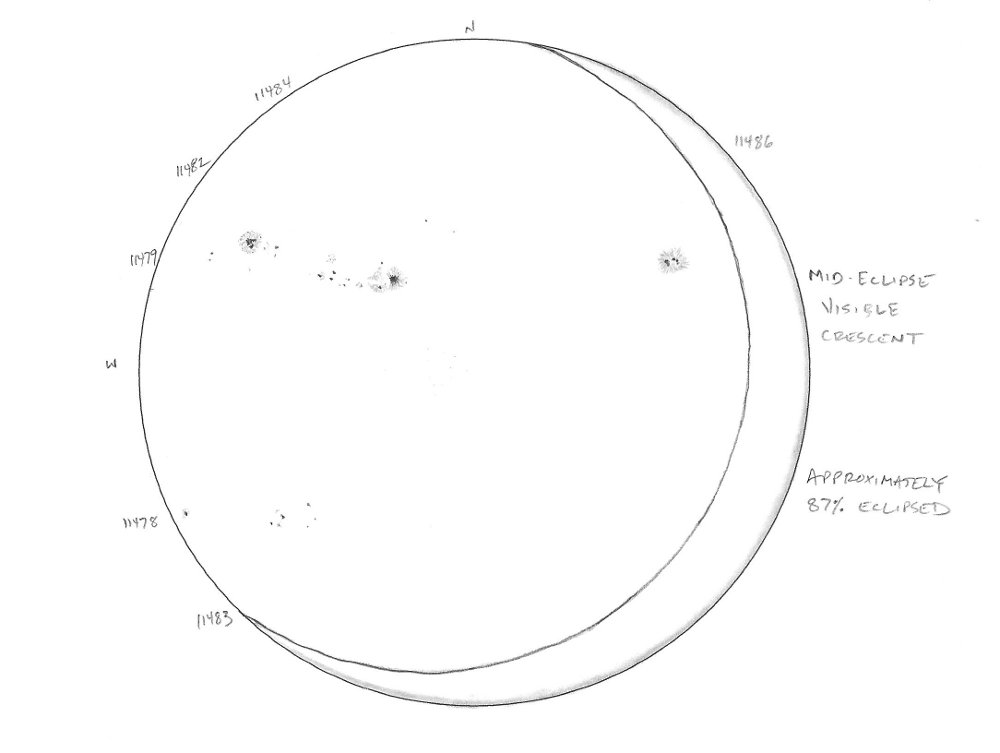
Unless you are nocturnal, you no doubt realize that yesterday many folks on Earth were treated to a very spectacular Annular Solar Eclipse.  The reason that this eclipse was annular (coming from the Latin, annulus, meaning ring) is that the moon was at it's furthest point from earth in its elliptical orbit when it passed between us and the Sun.  This was a very beautiful event to witness from start to finish, and I was fortunate to be working with my colleague Adam Block as we conducted a very special eclipse program at the Mount Lemmon SkyCenter.  We set up multiple telescopes providing guests views in both white light and hydrogen alpha, as well as providing everyone with specialized eclipse viewers.  While we had about 80 individuals on top of Mount Lemmon viewing the eclipse, we had literally thousands who watched a live stream of the eclipse over the internet.   We will do this again for the Transit of Venus on June 5th, and if you would like the web address, drop me an email.  I took the image at left near the time of greatest eclipse (6:38 PM local MST).

I made a white light sketch of the Sun prior to the eclipse to note the days spots, and then drew in the approximate maximum eclipse.  I was quite busy keeping an eye on our live feed as well as entertaining guests, so my sketch is truly an approximation as I lost track of which part of the Sun's disc was not eclipsed.  You can see in the sketch that we experienced about 87% of the Sun, including all the sunspots eclipsed by the moon.  Click the sketch to enlarge it.


I took many pictures with my trusty point and shoot camera and you can see a slide show of them at the bottom of the post.  For those of you suffering with devices that will not correctly display the slide show, I am pasting a few highlights here.  Below are shadow images of the eclipse, cast on our domes as the sunlight filtered through the pine trees.


 Here are some images of our guests enjoying themselves.


And of course sunset was spectacular!  There are wildfires to the north and the smoke attenuated the brightness of the Sun just enough that we could view the eclipsing Sun set naked eye...it was a beautiful magenta color and at the end, looked like a shark fin swimming on the horizon.  It was awesome to hear the guests break out in spontaneous applause when the Sun finally set.


And at last, here is the slide show!


Thursday, May 3, 2012

Perigee Moon - Luna de Perigeo

This Saturday, May 5th 2012 is a Perigee full moon, meaning that the moon will be at the closest point to earth in its elliptical orbit while fully illuminated.  This happens on average about once per year (most recently on March 19th 2011) and unfortunately these events, popularly called 'Supermoons', seem to take on a life of their own.  It is true that the moon is closer and will appear larger and brighter in the sky than a typical full moon. The difference, however, is marginal and certainly not noticeable to an observer looking up in the sky.  The only way to appreciate the difference is to have an image of the Perigee moon to compare to an image of an Apogee moon, the point when the moon is farthest in it's orbit...as in this image.

For those of you hoping that this post would be translated into Spanish, La Luna de Perigeo, I do not speak Spanish...yet, it happens that this Luna de Perigeo falls on Cinco De Mayo so here in the southwest we have two reasons to have a margarita on Saturday.  By the way, Perigee is about 8:30 PM MST.  Watch the NASA video below for a nice explanation of the event.

Monday, April 30, 2012

Moon Dance

Last night I went out to the observatory and really had no plan other than to use my TEC 140 to observe Saturn and the Moon.  I decided to check out Saturn first and inserted an 8mm eyepiece.  The seeing conditions (atmospheric stability) were incredible, and I decided to go for broke immediately.  I inserted my Pentax XW 3.5mm eyepiece for a magnification of 280x and was rewarded with no image breakdown.  I was so impressed with being able to easily discern the delicate inner C ring around Saturn that I ran inside to bring Ian out to take a look.  He was pretty impressed as well and thought that we should try and take some pictures of Saturn and the Moon.  Of course, I am not an imager, so we grabbed our little Canon point and shoot camera (The Elph!) and held it up to the eyepiece.  It was hard to hold the camera steady for Saturn as you can see at right, but even with the blurry image, you can see the C ring just inside the main rings.  It helps to click on the image to see it full size.

The main show was the moon- Ian's favorite target.  We had a bit more success taking hand-held shots of the moon through the telescope...actually, pretty impressive if I must say so myself!  Click the images to enlarge them.


Finally, this morning I was outside cutting up some tree branches and noticed two rather large lizards playing a game of tag...the game went on for well over an hour as I worked, and clearly the lizards were so engrossed in the game, that they really did not care about me or the noisy chainsaw I was using.  Finally the chase ended in the oldest of all moon dances...


Saturday, December 10, 2011

Lunar Eclipse ~ There's nothing to see here...move along

Click to enlarge
Odds are that if you are reading this blog you know that this morning just before sunrise western North America was treated to a total lunar eclipse.  This eclipse was unusual in that the Moon entered totality at 7:06 AM local time, just before sunrise, and then set behind the western horizon while still in the central umbra of Earth's shadow.  For a very good primer on Lunar Eclipses, visit the website of Mr. Eclipse, Fred Espenak of NASA.  I took the picture at left during the total lunar eclipse of October 27th, 2004, with a much better camera than I presently own.  Typically, total lunar eclipses render the moon shades of red/orange depending on the types and amounts of particulate matter in the Earth's atmosphere.  Everything from dust to automotive exhaust, to volcanic ash affects the color of the Moon during a total eclipse.

I had planned to get out of bed at about 5:30 to brew some coffee and start watching the eclipse, but subconsciously I must have been fairly excited as my eyes popped open at 4 AM and I could not fall back asleep.  I took a look outside as the predictions were for thick cirrus clouds and to my surprise the skies were reasonably clear.  I had not been up at this hour to do any astronomy in quite some time, so with well over an hour prior to the eclipse, I opened up my observatory and took my first look at Mars during this apparition.  Unfortunately, the seeing was poor and using my 12 inch SCT I had to keep magnifications very low to obtain a steady image at the eyepiece.  As Mars is only about 7.5 arcseconds in diameter right now, it was very difficult to tease out any of the features at low magnification, other than the bright north polar cap...and even that was ill defined.  Given that Mars was high overhead in Leo, I was not expecting much more when pointing the scope over to Saturn.  Saturn is not far from the bright star Spica and is sitting much closer to the southern horizon.  Similar to Mars, the image of Saturn in the eyepiece was mush.  Back inside to warm up and pour a cup of coffee and start eclipse watching.

Click to enlarge
It was quite relaxing to be able watch the moon move through the partial phases from the warmth of my kitchen window while sipping some fresh coffee.  Occasionally I would go outside to appreciate the "all-sky" view that I was not getting through the kitchen window.  I did not have a watch on, but sometime about 6:43 - 6:45 MST (1343-1345 UT) I observed a satellite moving straight up from the western horizon.  What caught my eye was it's sudden brightening and immediate fading leading me to believe it may have been an iridium flare.  As the moon approached totality and began to turn red/orange, I again wandered outside to get a better view and to try and capture a photo. The image at right was taken with my little pocket sized Cannon point and shoot but gives you an idea of how dark the moon appeared as it neared and entered totality.  In fact, as the moon entered it's total phase, it became invisible to the eye.  Binoculars did not help either.  I believe that the lack of contrast due to the dawn light in the sky as well as the extinction of the moonlight as it passed through the atmosphere near the horizon led to the complete disappearance of La Luna.  There is something quite tranquil about watching a Lunar eclipse, and as much as I wanted the eclipse observing experience to continue I immediately thought to myself, "there is nothing to see here,  move along."

While I am not a photographer, I do want to call attention to accomplished Arizona amateur astronomer Tom Polakis who imaged the eclipse.  Based near Phoenix, Tom Polakis captured several nice images that he stitched into a time lapse.  Click on the image below to see the time lapse full size.  This represents exactly how the eclipse appeared to me visually.


Tucson based amateur astronomer and photographer Sam Rua traveled east of Kitt Peak National Observatory and captured this beautiful photograph of the eclipsed moon and some thin cirrus clouds setting behind the observatories. You can visit Sam's gallery by clicking here.


Wednesday, March 16, 2011

March 19th Perigee Full Moon

It's true and not an internet hoax...the full Moon of March 19th will be the biggest since 1983!  Approximately 14% larger and 30% brighter!  Check out the explanation video from NASA.

Sunday, December 19, 2010

Care to dance?

In just about 36 hours, we will be treated to a rare spectacle when the full moon is totally eclipsed from the Sun, by the Earth's shadow.  These events are quite spectacular and I will be observing this celestial dance from the Mount Lemmon SkyCenter where we will be hosting approximately 30 guests for a special lunar eclipse program.  For information on this and other eclipses, I highly recommend NASA's Eclipse Web site.  I took the picture to the left with a handheld point and shoot camera near maximum of the October 27th 2004 Lunar eclipse.  The color and darkness of the moon varies from eclipse to eclipse and is affected by the amount and types of dust, volcanic ash and other pollutants in the atmosphere.  The diagram below can be found on Fred Espinak's 2010 lunar eclipse page and shows the path of travel the moon will take through Earth's shadow, as well as the various timings of the event.

Penumbral Eclipse Begins:          05:29:17 UT
Partial Eclipse Begins:                06:32:37 UT
Total Eclipse Begins:                  07:40:47 UT
Greatest Eclipse:                        08:16:57 UT
Total Eclipse Ends:                    08:53:08 UT
Partial Eclipse Ends:                  10:01:20 UT
Penumbral Eclipse Ends:            11:04:31 UT


While all the talk is of the moon this week, I did manage to get out this morning and observe the Sun through my Hydrogen Alpha Solar Telescope.  There is not a tremendous amount of activity, with only one active region (AR 11135) near the central meridian in the northern hemisphere.  There are some small plage areas in the east, yet none are remarkable.  Perhaps the most interesting features were the striking dark filaments along the northeastern limb, as well as the broad filament dominating the southern polar region.  The sketch was completed at 1658 UT (9:58 AM MST) under slightly hazy skies.

Friday, December 3, 2010

Sunrise spectacular

Here in the "Naked Pueblo" we are somewhat famous for our beautiful sunsets...head pretty much anywhere with a view of the western horizon, on pretty much any day of the year, and chances are you will be treated to picture postcard view.  This morning as I headed out to work I was treated to an absolutely fantastic sunrise.  A heavy dose of cirrus clouds were illuminated beautifully, along with an old waning crescent moon.


Click on and look carefully at the picture below, you will notice Venus above the moon- it is labelled in the second picture in case you missed it...