Showing posts with label Solar. Show all posts

Monday, January 1, 2018

International Space Station Transit

Happy New Year and welcome 2018!  There is much to celebrate!!

It is fitting that 2018 started off for me with an astronomical adventure, as it provided some fodder for a blog post...and in addition, New Years Day is the anniversary of this blog!  It all began here, in Googleland, on January 1, 2010.  While I have trailed off in the frequency of blog posts, my enthusiasm for astronomy remains strong.  The icing on the cake, is that today is the 22nd anniversary of my marriage to the love of my life, Beth.

As for the astronomical adventure, it happened that there was a transit of the International Space Station across the disc of the Sun as seen from central Tucson today.  This is the third time I have observed a transit of the ISS across the Sun, and you can read about the first adventure here, and the second here.

Today, I headed out to Himmel Park in central Tucson with my friends Jerry and Travis and set up my TEC 140 refractor with a Herschel Prism.  At the last minute I decided to use my Canon 6D to record video, instead of attempting to 'burst shoot' the transit.  This would take a lot of stress out of having to touch the camera and capturing an event that lasts approximately 1 second!

Without writing a novel, it was a success!  I am posting the original video at the bottom of this post, and I also created a composite of 32 individual frames showing the transit.  You can see in the composite image below that we were not perfectly centered under the ISS shadow, but we were very, very close.

Click the image to enlarge


To appreciate the scale here, consider that the Sun is about 93 million miles away and the ISS was approximately 421.5 miles downrange from me during the transit!  Because the ISS is so close, one must be on a very narrow ground track of the ISS' shadow in order to have the transit appear centered on the Sun.  Today's transit lasted 1.4 seconds on the center-line.

How fast does the ISS orbit?  It orbits the Earth in approximately 92.6 minutes, which results in an apparent ground speed of 7.885 km/second (4.9 miles/second)!  The ISS is also fairly small-  It's dimensions are approximately:
Length 72.8 m (239 ft)
Width 108.5 m (356 ft)
Height ≈ 20 m (66 ft)

The distance of the Space Station today, coupled with it's actual size, translates into an apparent angular diameter of 41 arcseconds- and the Sun is about 1800 arcseconds in diameter.  So the ISS is about 2.2% of the apparent diameter of the Sun...in other words, you could fit about 44 ISS's across the Sun's face today.  You can now appreciate why a video capture is the easiest.

Here is the short video...pay close attention as the transit is only 1 second!  Watch it full screen for easier viewing.


Wednesday, December 23, 2015

The annual (almost) winter solstcie sunset trip

Several years ago my friend Dean Ketelsen carefully scouted the Catalina Highway to identify a location from which he could take a picture of the Sun setting behind Kitt Peak National Observatory, some 60 miles distant.  Dean maintains an excellent blog and I highly recommend visiting-  In addition to being a knowledgeable amateur astronomer, his professional career has led him to work at the Steward Observatory Mirror Lab, where among other projects they fabricate the largest telescope mirrors in the world.  His blog often features work from the lab, such as this post yesterday.

Each year Dean organizes a trip up to the spot on the Catalina Highway to observe and take pictures of the Sun as it sets behind Kitt Peak- and it does this very near the winter solstice.  Approximately 3 days before solstice the alignment is favorable, and again 3 days following the solstice just as the Sun is again trekking northward in our sky.  I have done this trip a few times in the past and you can read about these adventures on my blog from 2013 (my favorite images), 2012, and I even attempted a time-lapse in 2013.

This year I headed up with Dean and a few others on Thursday, December 17th and set up with my TEC 140 triplet refractor, Solar Prism (i.e. Herschel Wedge) Canon 6D DSLR.  I focused on the Sun in advance and had the mount tracking as the Sun moved towards the Horizon.  I had planned to try another time-lapse but unfortunately I forgot to turn off the tracking on the mount until halfway through sunset- so instead of seeing the sunset, the time-lapse would have shown Kitt Peak rising. First, a single shot of the Sun taken just after set-up with addition of a 1.6x Barlow lens (a converter).


Below is a single shot from the moment when all the structures atop Kitt Peak were illuminated by the Sun.  Note the green rim on the upper limb of the Sun caused by refraction of the sunlight through the Earth's atmosphere.


As always, click the above images to enlarge them and finally, Happy New Year to all!


Saturday, January 3, 2015

Solar flashback and why I am not an astrophotographer

One reason I am not a serious astrophotographer: Patience.

I enjoy taking some casual images of bright targets such as the Sun, moon, or a planet but I rely heavily on being able to process these images in a quick and efficient fashion.  I do not have the motivation or desire to spend a lot of time learning the ins and outs of varied software packages to create astronomical images of the highest quality.  Many call my approach to obtaining a nice image "lucky imaging."  At left is a single shot of the Sun taken back on October 23rd when we had the largest sunspot in 24 years near the center of the Solar disc.  On the same day I made a video (AVI) recording of the Sun using my ASI120MC astronomical video camera in the hopes of stacking multiple frames to achieve a sharp, high resolution image.  Below is the AVI file as captured.


This is where the story takes a long break.  Back in the fall I broke down (and nearly went broke...emotionally and economically...) and purchased a new laptop.  I had a very nice 5 year old laptop that was still humming along quite well, yet technology has improved dramatically and doing a lot more work on the go I wanted something a bit lighter than the old 5+ pound beast.  I did my research, moved through periods of analysis-paralysis, wavered on what features I was looking for, and ended up with a Samsung Ativ Book 9 plus.  It is a very nice laptop and I only have two issues that remain.  One is Windows 8.1 which I can't do anything about, and the other is that the display has a resolution of  3200 x 1800 pixels, in a 13-inch class screen.  While this produces stunningly sharp images and can be useful in processing photos, it is somewhat of an annoyance in that several software programs do not always display properly and one can end up with text that is so small as to render it unreadable even with reading (magnifiers) glasses!  There are work arounds and settings that can be tweaked and for the most part things can be set effectively.

Two specific examples that are driving me nuts are Registax 6 and Adobe Camera Raw, both of which I use in the image processing I do.  Registax is used to align and stack multiple frames from AVI recordings (of say the Sun) and is just not displaying properly or working properly on the new laptop.  I have been fighting it since the fall and as a result have not been able to process a single AVI file.  I have known this day was coming but I finally decided to try another program and this morning downloaded and made a first attempt using a freeware program called Autostakkert2!  It seems to work fine, but does not contain the wavelet sharpening tools that Registax does.  Fortunately that functionality of Registax is still usable.  I Also will try a program called Avistack to see which I like better.

Adobe is particularly frustrating in that I was able to get Photoshop to display in a small but reasonable fashion, yet when opening a raw file the window does not display at the proper settings. See the image below and compare the text (not the title bar, but the controls) in the raw window to the application window in the background.


In any event, back to the AVI file I captured back on October 23rd.  Using Autostakkert2! this morning, I did stack and align the best 50% of the frames (out of about 1000) and then use the wavelet filters in Registax to create an image.  While not perfect, you can immediately see it is sharper than the single shot at the top of the post.  I think I can do better as I learn to use AutoStakkert2! (or Avistack) but at least I am back in business with AVI files.  Jupiter season is here, we have a bright comet in the sky, and stacking images is a must to capture these sights!


Monday, October 27, 2014

Partial Solar Eclipse

Last Thursday we witnessed a partial solar eclipse of the Sun- and for some reason this particular eclipse did not grab the attention of the media the way that the past few have.  It seemed that there were far more stories in the popular media for the lunar eclipse a couple weeks ago than for this event, despite the lunar eclipse happening in the middle of the night and the solar eclipse happening in mid-afternoon.  I was up at the Mount Lemmon SkyCenter with my colleagues (we streamed the eclipse live) and took the opportunity to take some images of the eclipse of my own.

I was using my Stellarvue 90mm triplet refractor with a Lunt Solar Systems Herschel Prism and my Canon T2i.  All the images were taken at 1/4000 of a second, ISO 100 and were shot in raw format.  I was shooting at a very high shutter speed in order to try and minimize the effects of atmospheric turbulence in my images.  I later used photoshop to increase the exposure value and stretch the contrast of the images.  Overall, the seeing conditions ranged from good to spectacular during the first part of the eclipse, but as mid-eclipse approached the conditions deteriorated slightly.  Below are a few of the best images that I captured, and as always, click to enlarge.

Start of Eclipse

Sharpest of my images, quite happy with this one!

Near greatest eclipse

A nice view after maximum eclipse, atmosphere not as stable

EDIT: The large sunspot region on the face of the Sun during the eclipse, Active Region 12192, has produced (as of yesterday) 9 X-class flares and is obviously quite large.  "How large" you are wondering?...well the blog of the SDO mission has published an interesting post comparing AR 12192 to previous spots.  If you look at the graph they provide you will see that this is the largest spot region (by area) in the past two solar cycles!  They report that it is the 33rd largest on record, and within the top .01% of all spots.  Pretty impressive stuff!

We were rather lucky to have this spot during the eclipse, and even luckier that it was in the Sun's southern hemisphere and not eclipsed by the moon, making for some pretty pictures.  Looking forward to the August 2017 Total Eclipse!

Sunday, October 12, 2014

Visiting Griffith Observatory


Perched high above Hollywood, California is another landmark of American astronomy- Griffith Observatory.  While Mount Wilson has a unique place in the history of astronomical discovery, Griffith is best known for its significant outreach program.  It is an iconic structure, visible from 360 degrees below, and is recognizable even to those not (yet) interested in astronomy and space sciences. From Rebel Without a Cause to The Terminator and the Transformers, the building has captured the imagination of many since its completion in 1935.


I was visiting the observatory with my colleague Adam to tour the facilities and to meet with Griffith staff to discuss best practices and ways that we could be mutually supportive of each other.  We were treated to a comprehensive tour of the facilities and also took in a planetarium show in the Samuel Oschin theater, Centered in the Universe, which was without a doubt the best planetarium theater show either Adam or I had ever seen.

As mentioned, the observatory was completed in 1935 as the result of the vision of Griffith J. Griffith who had visited Mount Wilson and observed through the largest telescope in the word at the time, the 60-inch reflector.  He was so moved by the experience that following consultation with Mount Wilson founder George Ellery Hale, he established a fund with the goal of providing all of mankind the opportunity for inspiration that he had experienced at Mount Wilson. Unfortunately, Griffith passed away in 1919 and his dream was not realized until after his death.

Griffith Observatory
The observatory was opened with the same telescope still in use today, the 12-inch Zeiss Refractor.  This telescope is a work of optical and mechanical art and is housed in the east dome (at left in the above image) of the observatory.  I have provided a few images of this telescope below, on its original mounting.  Riding atop the 12-inch is a 9-inch refractor and Celestron 9.25-inch Schmidt Cassegrain.


In the west dome of the observatory (at left) is a Coelostat; a telescope dedicated to observing the Sun.  Coelostat is from the Latin and means "Sky Stopper."   Below, you can see Griffith's Coelostat which consists of three 13-inch mirror flats.  These are actually the 'second' mirrors in the optical path, as there is a larger flat out of view in the image which is pointed at the Sun and reflecting the image to the three flats.  Each of these three mirrors directs an image of the Sun to a different display inside the observatory exhibit hall: A white light image, a hydrogen alpha image, and a solar spectrum.  The other two images below are of the shaft of light being focused down through the dome floor to another flat and into the hydrogen alpha telescope assembly.


Finally, a fun image from inside the exhibit hall where there is a large Tesla Coil.  This is among the most popular exhibits at Griffith and certainly is unique.  Our host fired up the coil and I managed to take a picture of it in action.  At left  is an image of the whole exhibit, as well as a full resolution crop of the electrical current below.


After a week in LA, it is good to be home!

Thursday, October 9, 2014

A visit to Mount Wilson Observatory

100-inch Hooker Telescope
I am in Los Angeles this week visiting my sister and her family and also doing a bit of business related to my day job as Director the Mount Lemmon SkyCenter.  My colleague Adam and I are visiting some of our partners in astronomical outreach on the west coast, and yesterday we visited Mount Wilson Observatory where we received an informative and inspiring tour from one of their senior docents and 60-inch telescope operator Nik Arkimovich.  Walking around the site with Nik for 2.5 hours discussing the history, politics and economy of the early 1900's provided wonderful context for considering the astronomical facilities that were erected, as well as the groundbreaking discoveries that were made at Mount Wilson.

As an amateur astronomer the visit was as impressive as a visit to any significant landmark or museum of American history.  Progressing through the afternoon was akin to progressing through a history of American Astronomy.  We walked in the footsteps of Mount Wilson Observatory founder George Ellery Hale, as well as visionaries such as Edwin Hubble, Harlow Shapley, Fritz Zwicky, and some physics genius named Albert Einstein.  Much of the site remains as it was during the early to mid 1900's when some of the most significant discoveries in astronomy were made at the the observatory.  While improvements have been made related to safety, access and technological advances, the original Snow solar telescope, the 60 and 150 foot solar towers, the 60-inch and the 100-inch Hooker telescope as well as the large trees throughout the observatory grounds bear witness to the people and ideas that have walked the paths over the past century.  Briefly, these are some of the highlights of our visit to Mount Wilson:

150 and 60 foot Solar Towers
Snow telescope enclosure
Shortly after beginning our tour, the 60 and 150 foot solar towers (image at right) came into view.  These telescopes were actually the second and third solar telescopes on site, with the first being the famous Snow telescope.  Mount Wilson's founder, George Ellery Hale, installed the Snow solar telescope in 1904 following its relocation from Yerkes Observatory in Wisconsin.  It is the oldest telescope at Mount Wilson and it's optical path is actually horizontal (parallel to) and just above ground.  At left is an image of the Snow telescope enclosure running along the ground, with the 60 foot solar tower in the background.  The design of the Snow proved to be rather poor as the image of the Sun was dramatically impacted by thermal currents swirling all along the optical path.  We were told that Hale quickly surmised that a vertical optical path would be better and the story is that he climbed various trees on site with a telescope to evaluate the localized seeing conditions.  By 1908, Hale had arranged for construction of the 60 foot solar tower and it was using this instrument that he soon identified magnetic fields in sunspots, and thus for the first time proved that magnetic fields existed outside of Earth!  Given his success and the utility of the solar tower design Hale then constructed a 150 foot solar tower in 1912, and began a daily recording of sunspots and study of their position, polarity, and strength that continues today.  You can see the most recent daily sunspot drawing from Mount Wilson by visiting this webpage.  Below is an image of the 150 foot Solar Towers.

150 foot Solar Tower
As we progressed further into the observatory grounds we were soon within the dome for the 60-inch telescope.  The 60 inch telescope was built by Hale in 1908 and funded primarily by the Carnegie Institution.  The mirror blank itself had been cast in 1894 in France and was acquired by Hale as a gift from his father.  While currently used exclusively for public outreach, this telescope was utilized for many of the pioneering studies in spectroscopy that led to the stellar spectral classification system.  Impressively, this was the largest telescope in the world until 1917 when the 100-inch Hooker telescope was finished.  Below are two images of the telescope in its dome.


Immediately below the 60-inch observatory floor are a darkroom and the original lockers that were provided for observers.  These two pictures of the lockers are worth enlarging in order to read the names...


Next up was a quick pass by the CHARA array of Georgia State University that sits atop the observatory grounds.  At right is one of the six enclosures that make up the Center for High Angular Resolution Astronomy array at Mount Wilson.  Together, these 6 one-meter "telescopes are dispersed over the mountain to provide a two-dimensional layout that provides the resolving capability (but not the light collecting ability!) of a single telescope a fifth of a mile in diameter. Light from the individual telescopes is conveyed through vacuum tubes to a central Beam Synthesis Facility in which the six beams are combined together. When the paths of the individual beams are matched to an accuracy of less than one micron, after the light traverses distances of hundreds of meters, the Array then acts like a single coherent telescope for the purposes of achieving exceptionally high angular resolution." (Quoted from this source).  Among the many notable achievements of this array was the first direct image of an interacting binary star (Beta Lyrae).

100-inch Hooker
Hooker Dome
Continuing on we approached the building and dome housing the 100-inch Hooker Telescope (at left).  The Hooker telescope was completed in 1917 and served as the largest telescope in the world until 1948 when the 200-inch telescope was installed at Palomar Mountain to the south.  The telescope is beautiful to behold and along with the furnishings and the building itself hearken back to to a time of seminal discoveries in astronomy.  In 1919, representing the first ever use of an interferometer in astronomy, an optical interferometer was used on this telescope to measure the sizes of distant stars.  Most famously, on the night of October 5-6, 1923 (almost exactly 91 years ago!) Edwin Hubble imaged a Cepheid variable star in the great Andromeda Galaxy and for the first time proved with certainty that the Andromeda 'nebula' was outside of our own galaxy and in fact a galaxy completely separate from our own.  This discovery was a key part of Hubble's pioneering work on the expansion of the Universe and the establishment of a cosmic distance scale.

Below are two images of the original, and still functional control panel for the telescope.  At left you can see the two periscope like devices that using a series of prisms allowed the observer to see the distant setting circles mounted on the telescope to note it's position.  At right you can see a close up of the brass control buttons for the telescope


If you have read this far and are interested in seeing more pictures (such as of the backside of the 100-inch mirror, or the mounting and gear system of the 60-inch) email me!  For the rest of you, I did make a one-minute video of the 100-inch Hooker telescope as I stood on the rotating platform (at the base of the dome) above the observatory floor.  Click on the settings icon (looks like a gear) to set it to HD and watch it full screen:


Again, a big thank you to Mount Wilson for hosting us, and especially to Nik for taking the time to show us around.

Monday, September 1, 2014

Hydrogen hotness

I spent the better part of this weekend in Denver, Colorado and it seems that while I was gone Tucson went from the humidity of monsoon season to hot and dry.  While the weather in Colorado was perfect (to this Arizonan) with daytime temperatures in the low 80's and early afternoon showers, the weather back home is reminding us that our rainy season is all too fleeting.  It is hot and dry again, with the hope of some last gasp monsoon activity late in the week.  Before long, the sights and sounds of thunderstorms will be gone for another year.

Of course the upside to drying out is the return of the clear skies that make Southern Arizona a mecca for amateur astronomers.  As the coffee was brewing this morning I stepped outside and was immediately moved to set up my solar telescope and do some observing of the Sun for the first time in months.  The skies were bright blue with no breeze and observing the Sun with my hydrogen alpha telescope confirmed that the atmosphere was fairly steady as well.  After a few minutes observing I finished a cup of java and decided to try and image through the telescope.  It has been some time since I last attempted this and immediately recognized how out of practice I was.  Focusing was difficult, tuning the etalon filter to achieve detail on the laptop screen was challenging, and getting the gain, gamma and exposure times to balance out nicely was nearly a chore.  Looking in the mirror I do not see an astrophotographer.

Even my post-processing routine was something of a distant memory.  I had taken 30-second videos of the Sun at the full resolution of the ASI120MC sensor (my astronomical video camera) as well as binned 2x2.  The best 300 frames (out of about 900) were aligned and stacked in registax with some sharpening and denoising applied as well.  First up, the binned image:

Next is the full resolution image and you can see that the atmosphere was impacting the final image more than when binning during capture.  The active region left of center was, I think, flaring subtly during the exposure as it seemed to brighten slightly more even after I pulled the camera and put the eyepiece back in.  Click the image to enlarge it to full size

So what is the endgame of this sweaty exercise this morning?  Well, I am motivated for the first time since June to spend several hours after dark looking through my telescope!


Sunday, April 6, 2014

Spotting a solar prominence and prominent solar spots

Spending this weekend at home, catching up on all the wonderful responsibilities and tasks that accompany being a husband, father and law abiding citizen, finally afforded me some time to enjoy observing the Sun.  As much as I enjoy preparing my state and federal taxes I believe I enjoy observing more...and the good news this year is that I do not need to pawn an eyepiece or two to pay a tax bill.

Saturday I spent a bit of time observing the Sun through my 60mm Hydrogen Alpha telescope, and was just starting to take some images when the power went out in our neighborhood.  Fortunately, I had already captured an image of a fantastic prominence before the power went out...and it is presented below.  I had to blow out the disc in order to expose the prominence, but you can see just how impressive it was.  Consider that the Sun is about a million miles in diameter and that this prominence was approximately 15% of the solar diameter in size and it is safe to assume that this tower of plasma was standing at least 150,000 miles high!


This morning I opened up my observatory and used my 90mm Stellarvue triplet equipped with a Lunt Solar Systems Herschel Prism to observe the Sun in white light.  I was rewarded with some steady views that showed several spot regions.  Below is a stack of 300 frames taken with my ASI120MC camera, at 9:04 AM local time (1604 UT).  Click the image to enlarge it to full size.


For comparison, here is an image from the Solar Dynamics Observatory taken near the same time with the active regions labelled.  As you can see, good optics, a decent camera and steady seeing can produce some impressive results!


Tuesday, March 25, 2014

Passages of time

Let's just put it out there up front:  Today, is my 45th birthday.  This week I am at the summit of Mount Lemmon as we host students from Altar Valley middle school at our UA Sky School.  I posted awhile back about the development of the Sky School here and I can not emphasize enough how rewarding this aspect of my job is.  Last week I was honored to accompany Sky School co-founder Ben Blonder as we traveled to the White House where he was honored as a White House Champion of Change in Environmental Conservation Leadership for his vision and work at developing the Sky School.  Above left is an image of one of the students taking a tree ring sample this morning as part of her groups inquiry project to explore the possible relationship between tree growth rates and density.

So while I celebrate the passage of 45 years (gulp) of my life and marvel at how quickly time seems to pass as I grow older, I am fortunate to be spending this time at the Sky School, with incredible colleagues, public school students, friends, and even my dearest Beth and Ian who drove up to celebrate.  As is my custom, I like to mark significant events with astronomical observations, and I took a couple minutes early this morning to set up a solar telescope and take an image.  I was using a 90mm Coronado Hydrogen Alpha Telescope at the summit of Mount Lemmon, and despite steady breezes and an encroaching cold front managed a decent picture.


And with that, time for some cake!


Wednesday, January 8, 2014

Active region 1944

The last few days have seen some remarkable images of the sunspots contained within active region 11944 that are making their way across the face of the Sun.  While I had taken a couple images late last week (posted here), I wanted to revisit the area this morning during a break from work.  Working at home this morning allowed me to run out and take a look at this region once again.  Seeing was a little above average with some some thin cirrus that are heralding an arriving cold front (maybe I should say a 'cooler front' in light of what our east coast brothers are experiencing this week).

All images were taken through my Stellarvue 90mm triplet and  Lunt Solar Systems Herschel Prism.  First, a whole disc image using my Canon T2i and a 2x Barlow lens- it is a single frame...click to enlarge.
Next, is a stack of 500/1000 frames captured with my ASI120MC video camera.  This comparison to the above image shows the benefit of stacking multiple images to obtain a higher and sharper level of detail than can be achieved in a single shot as above.  Again, click to enlarge.


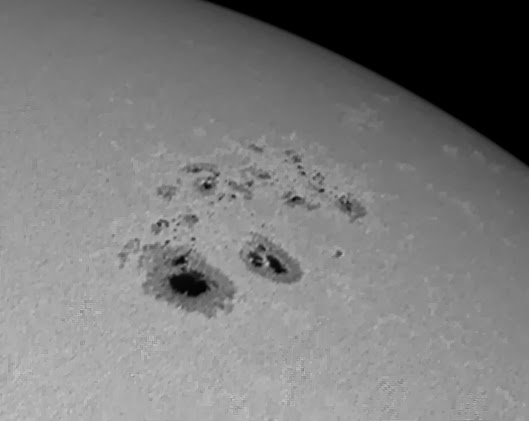
Finally, an image of the same region using the ASI120MC and a 2x barlow.  This active region is massive, and with a proper solar filter can be seen without optical aid...it is perhaps the most impressive spot region I have seen in several years.  Click to enlarge.


Friday, January 3, 2014

NOAA Active Region 11944

When it comes to active regions (AR) on the Sun, this one is big...how big?  By my estimation, AR11944 is larger than Jupiter.  Click on the SDO image and scale at left to enlarge, and remember that the sunspots are contained within a larger region of magnetic activity.  This region made it's way around the Sun's eastern limb on New Years Day, and I expect that we will be able to observe this region and it's accompanying spots for approximately two weeks as it transits (the Sun rotates from east to west with a rotational period of approximately 25 days at the equator).  Below are two images from this morning, taken through my 90mm Stellarvue triplet and Lunt Solar Systems Herschel Prism.  They represent stacks of 750 frames (out of 3000) in average seeing captured with an ASI120MC camera.  This region is on the southeast limb of the Sun, but I liked the composition better as presented-


Below is a second image of the region, taken with the addition of a 2x Barlow lens- and I am not sure why, but blogger seems to compress images and much of the solar granulation is blurred, particularly above the spots...but at least the spots survived the blog platform!


If you have a solar telescope, this is one region worth taking a gander at...and, I suspect this region is large enough to be seen naked eye with the appropriate solar filter to protect one's eyes.


Wednesday, January 1, 2014

Happy New Year!

Today marks not only the New Year, but also the fourth anniversary of this blog...and most importantly my 18th wedding anniversary!  Life has treated me well and I am quite fortunate to have such a wonderful spouse and son.  18 years has gone by in the blink of an eye, and it seems only yesterday I was eyeing that cute grad student with the southern accent and the smell of eucalyptus in her hair.

It is somewhat of a personal tradition that I try to celebrate all holidays with a little observing and this morning I set up both my hydrogen alpha and white light solar telescopes.  There is a fair bit of action on the Sun and I took some images through both telescopes.  I began with the white light and took the images below.  All images are presented with north up and west to the right.


The seeing was steady enough that in addition to the images straight through the 90mm Stellarvue triplet, I was able to utilize a 2x barlow.


Finally, while the seeing was slowly worsening (as typically happens as the day progresses and the air and ground warm up) I was able to grab an image in hydrogen alpha.  I was having a hard time tuning the telescope and it may be time for me to take it in for a "tune up" at Lunt Solar Systems.  Again, north is up and west is to the right.


Happy New Year!