
Showing posts with label Travel. Show all posts
Showing posts with label Travel. Show all posts
Saturday, May 6, 2017
Zodiacal light and a bolide
Going through some pictures this morning and I found one that I took in Portal a couple weeks ago that I thought was worth sharing. Not long after sunset I was setting up my camera for some late night attempts at the Summer Milky Way, and took the picture below as a test shot to make sure I had the focus set properly. You can see the setting winter Milky Way, intersected by the zodiacal light, and in the lower right is a very bright bolide. A bolide is a large meteor that is exploding in the atmosphere (they are often referred to as fireballs). You can see the green color, which was easily visible to the naked eye. Unfortunately, this one was on the horizon and not overhead- Had it been overhead the streak would have been much longer, it would have appeared brighter (less atmospheric extinction of light), and there may even have been a visible vapor trail.


Monday, April 24, 2017
Portal to the stars
Just back from another weekend adventure out to the dark Skies of Portal, AZ. Seems that my blog is slowly turning into the Portal report...in any event, below is an image of the Milky Way just after it cleared sufficiently above the horizon for a picture. In this image we are looking toward the center of our galaxy, in the constellation of Sagittarius.
The green glow just above the horizon is air glow- light being emitted by Earth's atmosphere. This is from several sources, such as the recombination of atoms which were ionized by the sun during the day, light caused by cosmic rays striking the upper atmosphere, and energy emitted by the combining of nitrogen and oxygen in the upper atmosphere.
While the entire sky has air glow (and as a result it is never truly dark), the glow is most obvious about 10-20 degrees above the horizon. This is because the glow is subtle, and we are looking through about twice as much atmosphere looking across the horizon than when peering overhead. (We do not notice the air glow on the horizon due to atmospheric extinction of the light on the horizon).

Tuesday, March 21, 2017
Winter Milky Way
Time for what is becoming a quarterly tradition...a blog post!
In February, I made a trip to the dark skies of Portal, AZ with my good friends, "The League of Extraordinary Ordinary Observers" for our regular gathering of opinions, half-baked ideas, conspiracy theories, and of course telescopes. We had our usual good time and saw some wonderful celestial sights.
I have posted pictures before of the summer milky way from Portal (see my previous post, for example...remember, quarterly tradition!), yet I do not believe I have ever captured a decent photo of the winter milky way. One reason for this is that we tend to take our trips when it is warmer than February and the other is that the winter milky way is much fainter than the summer. To explain quickly, in the summer night sky we are looking toward the central bulge of our galaxy in Sagittarius, and the center of our galaxy contains a much higher density of stars. In the winter night sky, we are looking out away from the center of our galaxy and our view across the plane of the galaxy is not nearly as bright as when we look inward toward the center.
Below is an image of the winter milky way, that I captured in Portal. It is a stack of 3 individual frames and is to me, quite striking. Not only can you see detail and dust lanes in the plane of our galaxy that are invisible anywhere near a city or town, but you can also see several subtle (and I mean subtle) pink nebula such as The California Nebula, Barnard's loop, The Rosette Nebula, etc. Be sure to click the image to enlarge.

These nebula would be more visible if my camera was astro-modified to be more sensitive in the red, however, I am impressed that the Canon 6D and Rokinon 14mm combination caught them at all. The (distorted) bright star lower left is Sirius and the double cluster in Perseus is visible in the upper right, just to give you a sense of how wide this shot is. I would be remiss if I did not mention the zodiacal light reaching from the lower left up through the Pleiades into the milky way. The Zodiacal light is sunlight, scattered by dust in the plane of our solar system left over from the time of our solar system formation. It is visible in dark skies after sunset and before sunrise, and is brightest in the spring and fall.
 The other fun thing that occurred during the trip to Portal, is that I took a day to drive to Socorro, NM where I met a fellow amateur astronomer from whom I was purchasing a dobsonian telescope. It is my first dob after all these years and it reminds me I need to update the equipment page of this blog as the only telescope that I currently have listed on that page is my TEC 140! In any event, at left is the new scope and I hope to share some adventures with it soon...In case you are wondering, it is a 12.5" Obsession Dobsonian, with a mirror by OMI.
Sunday, October 2, 2016
A picture (or several) is worth a thousand words
I just returned from 3 nights attending to my favorite dark-sky astronomy activity...a new moon trip to Portal, AZ hosted by my good friend Jerry. Accompanied by several other great friends- and most importantly my son, Ian, this trip was just what the doctor ordered It had been a long time since we had a father-son trip and it fed my soul to be with him for just a few days.
Despite our best astronomical intentions, we only had one clear night (which was tremendous). We were instead treated to some intense and dramatic monsoon storms for two days. Below are several pictures from the trip- so instead of rambling on about spending time with my son and good friends, here are some pictures...
So that is the Portal roundup- we observed many objects through several telescopes, but the best part was being with great people under desert skies.
Despite our best astronomical intentions, we only had one clear night (which was tremendous). We were instead treated to some intense and dramatic monsoon storms for two days. Below are several pictures from the trip- so instead of rambling on about spending time with my son and good friends, here are some pictures...
 |
| Thursday night thunderstorm- looking north |
 |
| Same cell, a few minutes later! |
 |
| After dark, cloud to cloud lightning illuminating the sky with stars in the background |
 |
| Friday night, a pass of the International Space Station through a hold in the clouds |
 |
| Clouds did clear somewhat late Friday night, allowing for this shot of the Milky Way |
 |
| Milky Way at last! Saturday night was our reward (Horizon is blurred due to tracking on stars) |
 |
| Looking to the northeast Saturday night, lots of green airglow (which was noticeable to the eye) |
So that is the Portal roundup- we observed many objects through several telescopes, but the best part was being with great people under desert skies.
Saturday, April 2, 2016
Payette Lake, McCall, Idaho
This week I traveled to McCall, Idaho to spend time visiting with the faculty and staff of the McCall Outdoor Science School (MOSS). MOSS is an immersive, residential science school for middle and high school students affiliated with the University of Idaho, and is the program that we bench-marked when we started our UA Sky School program 4 short years ago. It has been a great visit with our colleagues and we are returning home with some great ideas to improve our program and also to begin some longer term collaborations with MOSS.
This is a beautiful part of the country- we flew into Boise and drove north along the North Fork of the Payette River to Cascade and then up to McCall. (Along the way, the stretch or river between Smith's Ferry and Banks is an amazing stretch of whitewater with nearly continuous class V rapids.) The MOSS campus is situated on the shores of Lake Payette and the lake is just beginning to thaw from its winter freeze.
Yesterday morning we had a break in our meeting schedule and drove around to the south shore of the lake where the thaw is most obvious and were treated to a beautiful view of the mountains reflected in the water. The image below represents a field of view of about 120-140 degrees. Unfortunately, Google limits the size of images on the blog , and the picture below is about 25% of original size! Click to enlarge!!

I took this image with my new Sony a6000 mirrorless camera and a Sigma 30mm f/2.8 lens. This is my first outing with the camera and I am still learning how to use it. One of the neat features is the in-camera panoramic mode, as seen above. The camera takes several still images while one pans the camera and then they are stitched into a panoramic image in-camera. The resulting file is a jpeg, not raw, which does limit the ability to post-process. Yet, it is a fun and effective way to capture scenes as above. If one wanted a higher quality panorama, one would simply take single images in raw format for processing and then stitching together using software.
Sunday, March 6, 2016
Spring Portal trip attempt 1
As we say, a bad night in Portal is better than a good night most other places. I just returned from 3 nights camping with friends in Portal- and while we packed along all our telescopes and other observing gear, we only experienced about 2 hours of observing each of the first 2 nights. While many would be frustrated with the high cirrus that dominated the skies during our trip, good friends and beautiful mountains more than make up for the lack of celestial delights.
I did take a couple pictures on the second night which are below. These were both taken with my Canon 6D, a Rokinon 14mm manual lens (@ f/2.8), and were 30 second exposures on a non-tracking mount. First, is an image of the winter milky way, and notably you can see the star Canopus just hugging the horizon left of center. Canopus is the second brightest star in Earth's sky, with Sirius being the first. Sirius is the brightest star in the image...Orion is visible as are the Pleiades, Hyades, etc.

Below is an image of the Zodiacal light as it reaches up toward the milky way. (The zodiacal light is sunlight reflecting off of dust in the plane of our solar system.)

I hope that Spring attempt 2 to Portal, for the April new moon, provides clear skies and great company!
Tuesday, November 10, 2015
Trident Missile Test from Portal, AZ!

The two images of the milky way seen here are each a 30 second shot- taken with my Canon 6d and a Rokinon 14mm wide angle lens. (At left, you can see my very sexy TEC 140 posing with the Milky Way.) The picture below was taken with the camera tracking the stars on my Sky-Watcher Star Adventurer mount.

As pretty much everyone has heard, there was a Trident Missile (ICBM) test conducted off the coast of Huntington Beach, CA on Saturday night. While this is approximately 525 miles northwest of Portal, AZ, the test lit up the sky to the point where the milky way was nearly invisible! The expanding cloud of vapor from the test rose at least 40 degrees into the sky and appeared to be rather layered. As we later learned, the layers were caused by the separating stages of the rocket as it rose into the upper atmosphere. Anyway, after watching this military muscle flexing freak show for a few moments, it occurred to me that I should take a picture of it....so I ran and grabbed my camera and quickly tried to capture it before the missile itself disappeared behind the Chiricauhua mountains just to our west. Below is an image that represents what we saw, and given how quickly I was trying to get the camera on tripod and working, came out better than I deserved! I got several more, but this one has a little of everything from the stars to the layers of vapor to the missile itself. Be sure to click to enlarge it (and this is reduced in size for the blog...thanks Google!)

Sunday, October 12, 2014
Visiting Griffith Observatory
 Perched high above Hollywood, California is another landmark of American astronomy- Griffith Observatory. While Mount Wilson has a unique place in the history of astronomical discovery, Griffith is best known for its significant outreach program. It is an iconic structure, visible from 360 degrees below, and is recognizable even to those not (yet) interested in astronomy and space sciences. From Rebel Without a Cause to The Terminator and the Transformers, the building has captured the imagination of many since its completion in 1935.


I was visiting the observatory with my colleague Adam to tour the facilities and to meet with Griffith staff to discuss best practices and ways that we could be mutually supportive of each other. We were treated to a comprehensive tour of the facilities and also took in a planetarium show in the Samuel Oschin theater, Centered in the Universe, which was without a doubt the best planetarium theater show either Adam or I had ever seen.
As mentioned, the observatory was completed in 1935 as the result of the vision of Griffith J. Griffith who had visited Mount Wilson and observed through the largest telescope in the word at the time, the 60-inch reflector. He was so moved by the experience that following consultation with Mount Wilson founder George Ellery Hale, he established a fund with the goal of providing all of mankind the opportunity for inspiration that he had experienced at Mount Wilson. Unfortunately, Griffith passed away in 1919 and his dream was not realized until after his death.
 |
| Griffith Observatory |


In the west dome of the observatory (at left) is a Coelostat; a telescope dedicated to observing the Sun. Coelostat is from the Latin and means "Sky Stopper." Below, you can see Griffith's Coelostat which consists of three 13-inch mirror flats. These are actually the 'second' mirrors in the optical path, as there is a larger flat out of view in the image which is pointed at the Sun and reflecting the image to the three flats. Each of these three mirrors directs an image of the Sun to a different display inside the observatory exhibit hall: A white light image, a hydrogen alpha image, and a solar spectrum. The other two images below are of the shaft of light being focused down through the dome floor to another flat and into the hydrogen alpha telescope assembly.


Finally, a fun image from inside the exhibit hall where there is a large Tesla Coil. This is among the most popular exhibits at Griffith and certainly is unique. Our host fired up the coil and I managed to take a picture of it in action. At left is an image of the whole exhibit, as well as a full resolution crop of the electrical current below.

After a week in LA, it is good to be home!
Thursday, October 9, 2014
A visit to Mount Wilson Observatory
 |
| 100-inch Hooker Telescope |
As an amateur astronomer the visit was as impressive as a visit to any significant landmark or museum of American history. Progressing through the afternoon was akin to progressing through a history of American Astronomy. We walked in the footsteps of Mount Wilson Observatory founder George Ellery Hale, as well as visionaries such as Edwin Hubble, Harlow Shapley, Fritz Zwicky, and some physics genius named Albert Einstein. Much of the site remains as it was during the early to mid 1900's when some of the most significant discoveries in astronomy were made at the the observatory. While improvements have been made related to safety, access and technological advances, the original Snow solar telescope, the 60 and 150 foot solar towers, the 60-inch and the 100-inch Hooker telescope as well as the large trees throughout the observatory grounds bear witness to the people and ideas that have walked the paths over the past century. Briefly, these are some of the highlights of our visit to Mount Wilson:
 |
| 150 and 60 foot Solar Towers |
 |
| Snow telescope enclosure |
 |
| 150 foot Solar Tower |


Immediately below the 60-inch observatory floor are a darkroom and the original lockers that were provided for observers. These two pictures of the lockers are worth enlarging in order to read the names...

 Next up was a quick pass by the CHARA array of Georgia State University that sits atop the observatory grounds. At right is one of the six enclosures that make up the Center for High Angular Resolution Astronomy array at Mount Wilson. Together, these 6 one-meter "telescopes are dispersed over the mountain to provide a two-dimensional layout that provides the resolving capability (but not the light collecting ability!) of a single telescope a fifth of a mile in diameter. Light from the individual telescopes is conveyed through vacuum tubes to a central Beam Synthesis Facility in which the six beams are combined together. When the paths of the individual beams are matched to an accuracy of less than one micron, after the light traverses distances of hundreds of meters, the Array then acts like a single coherent telescope for the purposes of achieving exceptionally high angular resolution." (Quoted from this source). Among the many notable achievements of this array was the first direct image of an interacting binary star (Beta Lyrae).
 |
| 100-inch Hooker |
 |
| Hooker Dome |
Below are two images of the original, and still functional control panel for the telescope. At left you can see the two periscope like devices that using a series of prisms allowed the observer to see the distant setting circles mounted on the telescope to note it's position. At right you can see a close up of the brass control buttons for the telescope


If you have read this far and are interested in seeing more pictures (such as of the backside of the 100-inch mirror, or the mounting and gear system of the 60-inch) email me! For the rest of you, I did make a one-minute video of the 100-inch Hooker telescope as I stood on the rotating platform (at the base of the dome) above the observatory floor. Click on the settings icon (looks like a gear) to set it to HD and watch it full screen:
Again, a big thank you to Mount Wilson for hosting us, and especially to Nik for taking the time to show us around.
Saturday, August 16, 2014
A fountain of love
Picking up from yesterday's post and trying to build some blogging momentum, here are a few more pictures from the summer travels. I know I indicated some Mount Lemmon images but I am pushing those to tomorrow. First up today are a couple shots from our trip to North Carolina to see Beth's family. While they live in Garner (a Raleigh suburb) we spent the majority of our time on the coast just south of Wilmington. The weather was not the most cooperative for taking pictures during our stay (add to that that we spend most of our time on the beach) but I did get a couple pictures from Wilmington that are worth sharing. First up is a picture of the boardwalk and the Cape Fear Memorial Lift Bridge on the Cape Fear River. It is currently the highest bridge in North Carolina and features a lift span that can be raised 135 feet allowing ships to navigate below. The lift span itself is 408 feet long. I was hoping to catch it with the lift span in the lifted position and a ship passing below, but no such luck this year.

The picture below was taken in front of the Federal Building in downtown Wilmington. That sexy woman being swept up in front of the fountain is none other than my dear wife Beth (I am the guy doing the sweeping), and my son Ian took the picture.

Now that you have seen these two pictures, here is something interesting...I forgot to bring my camera with me that night and these images were both taken with my phone! I have never been one to take pictures using my phone but I am amazed at the results. Keep in mind that these are reduced in resolution for the blog, from around 5000 pixels wide to 1200 in landscape orientation. In case you are wondering, it is a Samsung Galaxy (naturally).
The picture below was taken in front of the Federal Building in downtown Wilmington. That sexy woman being swept up in front of the fountain is none other than my dear wife Beth (I am the guy doing the sweeping), and my son Ian took the picture.
Now that you have seen these two pictures, here is something interesting...I forgot to bring my camera with me that night and these images were both taken with my phone! I have never been one to take pictures using my phone but I am amazed at the results. Keep in mind that these are reduced in resolution for the blog, from around 5000 pixels wide to 1200 in landscape orientation. In case you are wondering, it is a Samsung Galaxy (naturally).
Friday, August 15, 2014
No Parking in the Milky Way
It has been a busy and fun summer and I have gotten out of the occasional habit of posting to this blog. In the last two months I have taken trips to the Grand Canyon, North Carolina, San Francisco and am headed to Denver next week. Sometimes life is just too entertaining to take the time to sit and update the cyber world as to my movements. Besides, it keeps my mother guessing. So once again rather than write much I'll share a few pictures with more to follow.
Taken in May from the geology vista pullout on the Catalina Highway is this shot of the Milky Way over the light dome from Tucson. We were out hoping to observe a newly identified meteor shower (the Cameleopardalids) and while the shower did not pan out, I did laugh at this shot of the Milky Way which actually hatched my plan to get out of a ticket should the Sherriff stop...."well officer, I thought it meant no parking in the Milky Way?"

Hopefully you have seen the time lapse of the Milky Way that I posted previously from the Grand Canyon North Rim Star Party in June, and this is a shot that shows you the veranda which sreved as our home base for the week...clearly, the best place to be on Earth in June.

This summer in Tucson provides few opportunities for astronomical observations...even when it is not raining we are frequently clouded out. The picture below was taken at my house of some very dirty looking clouds. I am starting to focus a little more on becoming a better photographer and taking pictures of these clouds was rather challenging, and the result is not too bad.

That's all for this post...next up will be a few pictures from Mount Lemmon.
Taken in May from the geology vista pullout on the Catalina Highway is this shot of the Milky Way over the light dome from Tucson. We were out hoping to observe a newly identified meteor shower (the Cameleopardalids) and while the shower did not pan out, I did laugh at this shot of the Milky Way which actually hatched my plan to get out of a ticket should the Sherriff stop...."well officer, I thought it meant no parking in the Milky Way?"
Hopefully you have seen the time lapse of the Milky Way that I posted previously from the Grand Canyon North Rim Star Party in June, and this is a shot that shows you the veranda which sreved as our home base for the week...clearly, the best place to be on Earth in June.
This summer in Tucson provides few opportunities for astronomical observations...even when it is not raining we are frequently clouded out. The picture below was taken at my house of some very dirty looking clouds. I am starting to focus a little more on becoming a better photographer and taking pictures of these clouds was rather challenging, and the result is not too bad.
That's all for this post...next up will be a few pictures from Mount Lemmon.
Monday, May 12, 2014
Portal, AZ dark skies and good times
 |
| Milky Way over Chiricauhuas |
Slowly this blog is turning to more photos than text and I guess that is a factor of being so busy with work. When I have free time I spend it with family or in my own observatory and do not take much time to write the blog these days. In fact, I am about to head out to Mount Lemmon for a UA Sky School trip and need to finish up this brief post quickly. Below I present three images from the Portal trip...one taken of Mars through my 11-inch Celestron Edge HD, and two of the milky way rising.
First, Mars:
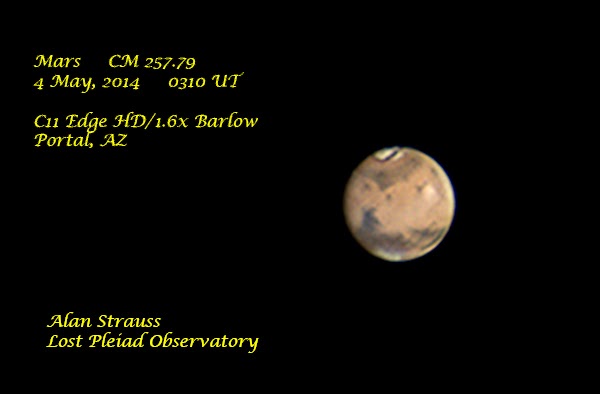
In the Milky Way images below, I was using my new Canon 10-22mm zoom, at the 22mm setting. These are single 30-second exposures and I used a red flashlight to 'paint' Jerry and myself during the exposures. I am in the upper image, Jerry in the lower.


While these images are a bit noisy due to the high ISO, what is notable is the lack of light domes near the horizon. There are now small domes visible from El Paso and Lordsburg that rise perhaps 2 degrees above the horizon in long exposures, but these domes are a bit to the north of this exposure.
Subscribe to:
Posts (Atom)