I spent the better part of this weekend in Denver, Colorado and it seems that while I was gone Tucson went from the humidity of monsoon season to hot and dry. While the weather in Colorado was perfect (to this Arizonan) with daytime temperatures in the low 80's and early afternoon showers, the weather back home is reminding us that our rainy season is all too fleeting. It is hot and dry again, with the hope of some last gasp monsoon activity late in the week. Before long, the sights and sounds of thunderstorms will be gone for another year.
Of course the upside to drying out is the return of the clear skies that make Southern Arizona a mecca for amateur astronomers. As the coffee was brewing this morning I stepped outside and was immediately moved to set up my solar telescope and do some observing of the Sun for the first time in months. The skies were bright blue with no breeze and observing the Sun with my hydrogen alpha telescope confirmed that the atmosphere was fairly steady as well. After a few minutes observing I finished a cup of java and decided to try and image through the telescope. It has been some time since I last attempted this and immediately recognized how out of practice I was. Focusing was difficult, tuning the etalon filter to achieve detail on the laptop screen was challenging, and getting the gain, gamma and exposure times to balance out nicely was nearly a chore. Looking in the mirror I do not see an astrophotographer.
Even my post-processing routine was something of a distant memory. I had taken 30-second videos of the Sun at the full resolution of the ASI120MC sensor (my astronomical video camera) as well as binned 2x2. The best 300 frames (out of about 900) were aligned and stacked in registax with some sharpening and denoising applied as well. First up, the binned image:
Next is the full resolution image and you can see that the atmosphere was impacting the final image more than when binning during capture. The active region left of center was, I think, flaring subtly during the exposure as it seemed to brighten slightly more even after I pulled the camera and put the eyepiece back in. Click the image to enlarge it to full size
So what is the endgame of this sweaty exercise this morning? Well, I am motivated for the first time since June to spend several hours after dark looking through my telescope!
Showing posts with label Hydrogen Alpha. Show all posts
Monday, September 1, 2014
Sunday, April 6, 2014
Spotting a solar prominence and prominent solar spots
Spending this weekend at home, catching up on all the wonderful responsibilities and tasks that accompany being a husband, father and law abiding citizen, finally afforded me some time to enjoy observing the Sun. As much as I enjoy preparing my state and federal taxes I believe I enjoy observing more...and the good news this year is that I do not need to pawn an eyepiece or two to pay a tax bill.
Saturday I spent a bit of time observing the Sun through my 60mm Hydrogen Alpha telescope, and was just starting to take some images when the power went out in our neighborhood. Fortunately, I had already captured an image of a fantastic prominence before the power went out...and it is presented below. I had to blow out the disc in order to expose the prominence, but you can see just how impressive it was. Consider that the Sun is about a million miles in diameter and that this prominence was approximately 15% of the solar diameter in size and it is safe to assume that this tower of plasma was standing at least 150,000 miles high!
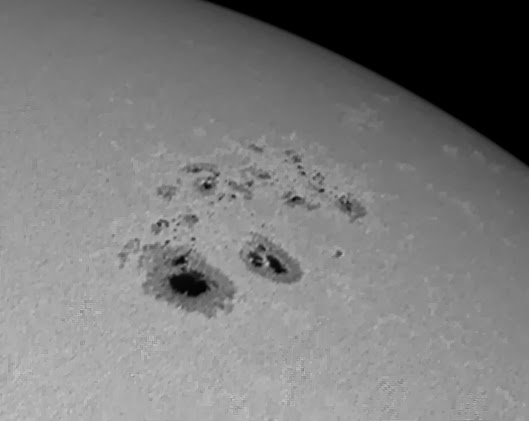
This morning I opened up my observatory and used my 90mm Stellarvue triplet equipped with a Lunt Solar Systems Herschel Prism to observe the Sun in white light. I was rewarded with some steady views that showed several spot regions. Below is a stack of 300 frames taken with my ASI120MC camera, at 9:04 AM local time (1604 UT). Click the image to enlarge it to full size.
For comparison, here is an image from the Solar Dynamics Observatory taken near the same time with the active regions labelled. As you can see, good optics, a decent camera and steady seeing can produce some impressive results!
Friday, January 3, 2014
NOAA Active Region 11944
When it comes to active regions (AR) on the Sun, this one is big...how big? By my estimation, AR11944 is larger than Jupiter. Click on the SDO image and scale at left to enlarge, and remember that the sunspots are contained within a larger region of magnetic activity. This region made it's way around the Sun's eastern limb on New Years Day, and I expect that we will be able to observe this region and it's accompanying spots for approximately two weeks as it transits (the Sun rotates from east to west with a rotational period of approximately 25 days at the equator). Below are two images from this morning, taken through my 90mm Stellarvue triplet and Lunt Solar Systems Herschel Prism. They represent stacks of 750 frames (out of 3000) in average seeing captured with an ASI120MC camera. This region is on the southeast limb of the Sun, but I liked the composition better as presented-

If you have a solar telescope, this is one region worth taking a gander at...and, I suspect this region is large enough to be seen naked eye with the appropriate solar filter to protect one's eyes.
Below is a second image of the region, taken with the addition of a 2x Barlow lens- and I am not sure why, but blogger seems to compress images and much of the solar granulation is blurred, particularly above the spots...but at least the spots survived the blog platform!

Wednesday, January 1, 2014
Happy New Year!
Today marks not only the New Year, but also the fourth anniversary of this blog...and most importantly my 18th wedding anniversary! Life has treated me well and I am quite fortunate to have such a wonderful spouse and son. 18 years has gone by in the blink of an eye, and it seems only yesterday I was eyeing that cute grad student with the southern accent and the smell of eucalyptus in her hair.
It is somewhat of a personal tradition that I try to celebrate all holidays with a little observing and this morning I set up both my hydrogen alpha and white light solar telescopes. There is a fair bit of action on the Sun and I took some images through both telescopes. I began with the white light and took the images below. All images are presented with north up and west to the right.
The seeing was steady enough that in addition to the images straight through the 90mm Stellarvue triplet, I was able to utilize a 2x barlow.
Finally, while the seeing was slowly worsening (as typically happens as the day progresses and the air and ground warm up) I was able to grab an image in hydrogen alpha. I was having a hard time tuning the telescope and it may be time for me to take it in for a "tune up" at Lunt Solar Systems. Again, north is up and west is to the right.
Happy New Year!
Monday, December 16, 2013
ISS Transits the Sun
Earlier this week I received an email alert from calsky.com (a wonderful site for the amateur astronomer!) that the International Space Station (ISS) would transit the face of the Sun as seen from my observatory at 3:29 PM today. Once before, in October of 2011, I observed an ISS transit (see this post) and it was quite a thrill. I was hoping to do it again and this time I was equipped with a camera that would allow me to video the event.
I invited my friend Jon Shallop to accompany me on my misadventure and as the day approached the predicted ground track of the ISS had been refined and shifted about 2-3 miles to the west. This is due to the fact the ISS is continuously dropping in its orbit (they boost it back up occasionally) and also the solar flux can affect it's orbital path. Looking at the map this morning it appeared that the center-line of the transit would run right over the southeast corner of Himmel Park, very close to the University in mid-town at precisely 3:29:29 PM. As the day wore on, heavy cirrus clouds built in the southern sky and as the time approached we were worried about seeing anything at all.
I had set up both a hydrogen alpha and white light telescope and given the thick clouds decided I would scrap the video plan and visually observe the transit. Fortunately, about 10 minutes before the transit the cirrus thinned and I decided to mount the camera to the HA telescope and see if I could record anything. Sure enough, despite the thick cirrus, I was able to capture it! The transit occurred exactly at the predicted time, indicating we were right on the center-line. Below is a single frame from the video, processed a bit to sharpen the details.
The ISS is just above left of center in the image. Of course, I was in a hurry and did not notice that I had the camera binning 2x2...so the resolution is somewhat limited...although with the very poor seeing conditions, it may have been better this way. The uneven illumination is due to passing cloud, and for my first attempt, I am happy with the results.
Saturday, December 14, 2013
Images of the Sun
It has been a few weeks since I had a window of opportunity to image the Sun. I have had a few visual moments the last few weeks but just enough time to take a look and marvel. This morning the Sun was ready for me, sporting several nice active regions which included several photogenic spots. If the atmosphere steadies a bit tomorrow, I may try and take a picture of the individual spots using a barlow lens as they are quite detailed. Below are the white light (top) and hydrogen alpha (bottom) images of the Sun, taken between 11:00 and 11:20 (18:00 and 18:20 UT) this morning. As always, click the images to enlarge them.
Sunday, November 24, 2013
Lifting Prominence
If you have been following the weather here in Tucson, or perhaps watched the roasted Duck that the Arizona Wildcats football team served up yesterday afternoon (Bear Down!), you know that we have had record November rainfall here in the naked pueblo. As the low pressure system loses its local organization and begins to move out we are left with partly cloudy and fairly unstable skies. Still, I set up my 60mm HA solar telescope to take a look at the Sun between clouds this afternoon and was delighted to see some nice limb activity. As active region 11899 departs, it is putting on a farewell show- and the prominence activity on the limb is the result. After a few minutes observing and allowing the telescope to reach thermal equilibrium, I attached the ASI camera and took a 30 second avi of the Sun. Given the lack of stability, I only used 300 frames (out of about 1000) and stacked them to get the image below. It is at the full resolution of the camera and slightly reduced in size for aesthetics. In addition, I took the liberty again of brightening up the prominences in order to show the one that is lifting off. It is slightly over-sharpened, I think, but given the low quality of the original data, no complaints.
And just for fun, here is the same image inverted:
Here is a similar image, binned 2X2, with less attention to the prominences:
And just for fun, here is the same image inverted:
Here is a similar image, binned 2X2, with less attention to the prominences:
Monday, November 11, 2013
Veterans Day Solar Images
The image below was captured at 8:54 AM local time (1554 UT) this morning. Seeing conditions were slightly below average with the limb of the Sun in constant motion. At about 30 frames per second I am able to negate the seeing conditions somewhat, however, compared to the images I captured on November 8th when the seeing was quite good, I am able to appreciate the difference on a day like today. This is a stack of 250 frames out off 1000, binned 2x2, processed in Registax. Using Photoshop I also increased the exposure setting for the prominences on the upper limb of the Sun...it resulted in a cool look although the process did introduce some brightening artifacts on the limb.
The image below was taken at the full resolution of the little ZWO camera, 1280x960. Whenever I try this it seems that the resulting image has a grid pattern that is difficult to remove in processing. In addition, stacking a good number of frames results in artifacts that make the image appear as if it were a completed jigsaw puzzle. Focus was a little off, and it was taken a few minutes earlier than the above image, so perhaps the atmosphere steadied a bit for the later capture. In any event, here you have it-
Friday, November 8, 2013
Solar images in Hydrogen Alpha and White Light
Not a lot of time to spin words today as I am about to head off to work...but I had a bit of time this morning to capture the Sun not only in Hydrogen Alpha, but also in white light. I am pretty happy with the images and am feeling like I make a little bit of progress each time I use the camera. First off, some of the HA images...this first one I shot to try and show off the "filaprom" at the top...it had a 3D look visually.
This next image may be my best effort yet...processing skills limited me far more than the data. Incidentally, the active region near the center of the Sun has been spitting X class flares, including one around 9 PM last night.
For white light, I captured the image through my Stellarvue 90mm triplet apo and a Lunt Herschel Prism, using a polarizing filter. This is my first successful white light image:
Having fun now!
Monday, November 4, 2013
November 4th Sun
Quick capture this morning, trying to be more careful with the etalon tuning and also using a slightly shorter exposure time to freeze out some of the turbulence. Seeing was not quite as good as yesterday but I still ended up with a reasonable image. I think it is about time to start asking solar imagers about the settings that they use in Registax for the wavelet functions...I am having difficulty finding a good balance of sharpening/denoising.
Best thing about this above image is that it can be directly compared to yesterdays image and one can appreciate the changes and rotation of the Sun over 24 hours. Note that I was able to capture some prominence detail along the limb in the right side. To truly bring out the prominences, which are faint, the settings need to be adjusted (e.g. longer exposure, higher gain rate) and the surface detail will wash out. The adventure continues...
Sunday, November 3, 2013
Solar imaging take two
A week has passed since I first tried out my new ASI120MC camera, and I was able to image two targets with the camera over the past 24 hours: Venus yesterday evening, and the Sun this morning. Seeing conditions were variable last night as I attempted to capture Venus. I have a very small window from my observatory where I can actually observe Venus around sunset before it quickly passes behind a tree in my neighbors yard. Venus is inherently a difficult target to image in the evening skies as it is generally not more than 20 degrees above the horizon, and last night there were also clouds rushing in from the west. As I live east of Tucson I am also looking right over the city when I observe to the west...so seeing conditions for evening apparitions of Venus are always a mixed bag. I did manage to create the image below and it was my first attempt at using a cheap 2x Barlow lens with the camera. In order to reach focus I also had to use a mirror star diagonal, which is likely not ideal for imaging. Below is the result of stacking about 150 usable frames (out of 2000) and some processing in Registax.
While I was hoping to do some visual observing last night and ultimately try to image Jupiter, the aforementioned could bands rolled in and we were treated to a long steady rain lasting until near midnight. This morning skies were mostly clear with some passing thin cirrus and as the coffee was brewing I set up my 60mm Lunt HA scope to try and create another solar image. Seeing was fairly steady and other than the passing bands of cirrus I was able to take an avi of approximately 2000 frames. The result is below, following a stack of about 750 frames and some processing in Registax.
In some ways, this image is better than my previous attempt. Clearly (pun intended) the improved seeing conditions helped me to start with better data and more usable frames. Having steady skies also made focusing a bit easier. I also happier with the sharpening and denoising I did using the wavelet functions in Registax, although I could still be more effective with these techniques. The exposure settings were not ideal as some of the active regions are a bit washed out and I also did not have the etalon filter on the telescope tuned as precisely as I would have liked. While I had it tuned for the eyepiece I was using prior to image capture, it seems that it needs to be tuned slightly differently for the camera. This tuning process as well as precise focusing is something that I need to continue to explore if I am to improve the images. If I had to rank the importance of these factors, focusing is probably number one, followed closely by the tuning, with the atmosphere being the third consideration (and the one I have no control over). As I become more fluent in the exposure time, gamma, and gain rate settings, I will be able to compensate slightly for the atmospheric stability being less than perfect.
Subscribe to:
Posts (Atom)