Showing posts with label Planetary Nebula. Show all posts

Sunday, October 14, 2012

Seeing the light in the dark

I just returned from Portal, AZ where I spent two nights with very good friends observing under some of the darkest skies in the western U.S.  I have blogged previously about Portal and what a great place it is to relax by day and observe by night, and this trip was certainly as rewarding as any.  We camp out at one of the premiere observing retreats known to amateur astronomers, the world famous Rancho de Farrar.  The early days of Rancho de Farrar are mostly unknown, however, historians have accepted local legends of it's beginnings...stories that seem to center on bonfires, whiskey, and heavenly bodies.  Speaking of amateur astronomers, below you can see our group of heavenly bodies as dusk settles over the ranch.   From left to right: Chris H., Shak (the 20 inch Dobsonian), Mike W., yours truly, Bill G., and El Jefe of the Ranch, Jerry F.


Folks living in places like Arizona are fortunate in that we often have clear views of the eastern horizon after sunset and can appreciate the beautiful colors of the "Belt of Venus."  The distant horizon and clear dry air in Portal combine to show beautiful colors as night approaches.  The blue color just above the distant hills is the shadow of the Earth being cast on our atmosphere and slowly ascending as the Sun continues to descend below the horizon.  As we say, often seen, rarely noticed!


Last week I acquired a very nice lens for my Canon T2i, a 15-85 mm EF-S.  I had wanted something that I could use to walk around with that was of higher quality than the kit lens, and also something that had a very wide field so that I could try to take some shots of the night sky.  I quickly learned that one of the most difficult parts is focusing the lens on the stars.  Simply turning the focus to infinity results in blurred stars, and there seems to be a sweet spot not quite to infinity.  The images of the milky way are far from perfect, however, I am  happy with them given that they are simply single shots, 25 seconds each with the lens at the 15mm setting...and that these are really my first attempts at this kind of photography from a dark site.

At left is an image of the Milky Way running nearly vertical into the foothills of the Chiricauhua Mountains.  This was taken at ISO 6400.  It is somewhat noisy, yet that is currently my trade off for obtaining the most color in the Milky Way.  Another reason why I need to get back to learning how to use Photoshop.

Below is an image of the Milky Way with a different composition, and I am not sure which I like better...And if you are a faithful reader that is not much into astronomy, I should point out that the reason that Milky Way is so bright in the south, is that we are looking toward the center of our galaxy in this area of the sky.


The image below was taken from a bit further back of the Ranch in order to capture some of gear.  It was also a 25 second exposure, but with an ISO of 3200.


 This next picture is a bit higher up in the sky and shows the Milky Way as it runs through Cygnus and the asterism known as the "Summer Triangle"


Despite all these pictures, I spent quite a bit of time looking through the telescopes that we had assembled within the circled wagons on the ranch:  a 20 inch Dobsonian, two 12 inch Meade SCT's, an 8 inch Celestron orange tube SCT, a TEC 140mm refractor, and a Zeiss 62mm refractor.  Truly, it was an embarrassment of astronomical riches.  And while we all enjoyed the various views, Mike was in and out of the "command center" where he was checking in on the data streaming in from his remote imaging set up.  Soon, I expect he will post a very impressive image of M 33, the Triangulum Galaxy, on his blog.

While he was imaging M 33, we observed it in nearly all of the telescopes on the field, save the 8 inch.  In my own 12 inch SCT I was blown away by details I had previously not seen in this low surface brightness galaxy.  Instead of the usual broad "S" shaped galaxy with two arms and a handful of bright knots, I was able to observe two additional spurs (arms) of the galaxy and more bright HII regions than I had ever seen.  Realizing how transparent the night was I pointed the scope at M 31, the Great Andromeda Galaxy and was again stunned by the detail.  Two dust lanes were easy and the edges of the lanes hinted at a mottled structure.  As I panned around, I was awestruck my M110, a satellite galaxy that is undergoing a merger with Andromeda.  As I pushed the magnification up to about 235X there was clearly mottling to this galaxy, and the bright nucleus was offset from center.  As I continued to observe  I realized that the reason the core seemed offset was that I was detecting an elongation of the galaxy back toward Andromeda.  This "light bridge" was confirmed by both Bill and Jerry.

I have been observing comet 168P/Hergenrother on and off over the past week and wanted to take a look at it from Portal.  I was not disappointed as the comet sported a stubby fan shaped tail- yet with averted vision there was clearly a long stream heading to the SE.  You can see this stream in my sketch at left, although it appeared fainter than in my drawing (obviously).  In addition to the comet, we observed a faint galaxy in the field of view, which Chris identified for us as NGC 7777, a 14th magnitude galaxy.  How dark was it last night?  We were able to detect this galaxy with averted vision in the 62mm Zeiss!  Had we not known it was there it would have been missed, however, with patience we were all able to tease it out of the background.

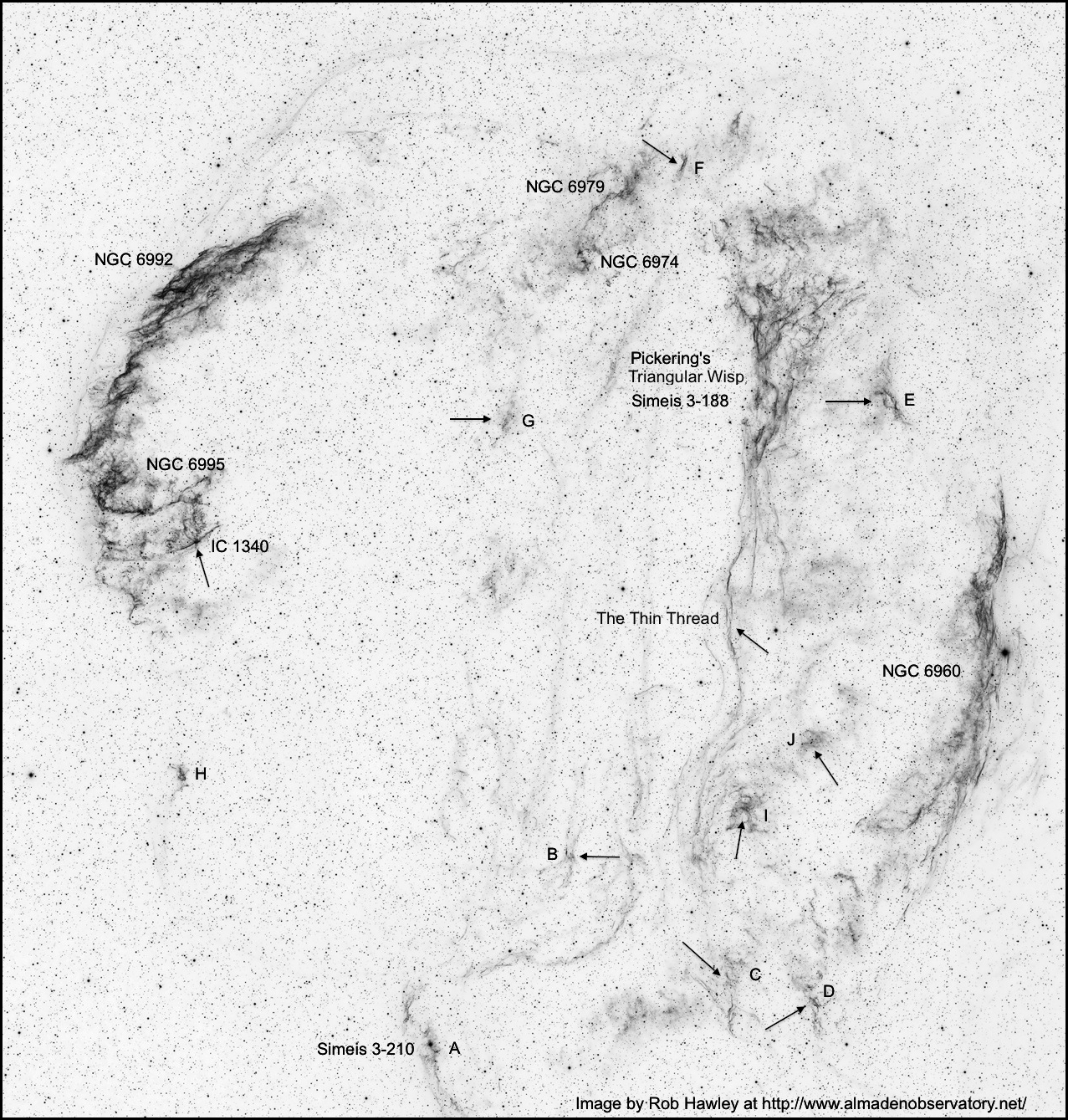
Another target that I had been planning to observe was the Veil Nebula, using my TEC 140 and an OIII filter.  With inspiration from the website of Steve Gottleib and using the chart at right I was able to observe many of the various labelled components.  I started at the "Witch's Broom" NGC 6960 and was able to easily identify the knot labelled 'D'.  I then moved back up to Pickering's Triangle also known as Simeis 3-188 and enjoyed the ethereal structure of this region while training my eye to pick out the fainter regions.  I then panned south and was able to detect the brighter portion of the "Thin Thread" as well as the knots labelled 'J' and 'I'.  I then relocated to the eastern portion of the Veil, NGC 6992 and 6995.  This is my favorite section of the nebula and my most traveled.  I made a point to observe IC 1340 and then located the star that would serve as a marker for knot 'A' which is Simeis 3-210.  This proved to be a little tougher than I expected given the glare from the star, but after careful observation I was able to positively identify the thin wisp of nebulosity.  Again, both Jerry and Bill were able to confirm this observation.

As the night wore on, we observed many targets from the popular Messiers, and double stars to interesting Arp galaxies, and of course Jupiter.  One of the highlights for me was Chris locating Comet 2012 J1 (Catalina) in the 20 inch despite it being close to the "Dob Hole" near the zenith.  This comet is cruising through Pegasus not far from Hergenrother and is approximately magnitude 14.5.  I had attempted this unsuccessfully in the 12 inch SCT.  I spent a few minutes revisiting some planetary nebula that I had observed from Portal two years ago with my buddy Christian (now back in Eurpoe), NGC 246 in Cetus, and IC 5148 in Grus  See this post for sketches of these objects.

Finally, a picture that was hard to take and that I had to mess with in photoshop to try and bring out the subject.  It is an attempt to image the Gegenschien, which is actually sunlight, back-scattered by interplanetary dust.    This soft glow forms opposite the Sun within the zodiacal light band and is only subtly brighter than the sky.  This is a phenomenon only visible under the darkest of skies.


All in all it was another great trip that ended all too quickly.  As great as the skies and observing are, it is the great friends and the unparalleled hospitality of the proprietor of Rancho de Farrar that make the trip.

Sunday, June 17, 2012

Fathers Day Sun (and a few night shots)

Happy Fathers Day to all my friends, family and faithful readers who happen to be dads.  We are a fortunate bunch-  In my case, being a Dad is the greatest thing that could have ever happened in my life.  For some reason, I have for years made a custom of making astronomical observations on holidays and other special occasions.  Perhaps because these dates mark the passage of time in my own life, it seems fitting to spend a few brief moments considering the bigger picture.

Here is the 2012 Fathers Day observation, of the Sun.  Pretty similar to the images I have been capturing lately, although perhaps I achieved a little better focus today.  Click the image to enlarge it.


Yesterday we had our first quasi-monsoon thunderstorm of the season in Tucson, meaning that we about to head into a solid 6-8 weeks of cloudy nights.  The skies did clear last night around 11:00 PM and I went out and played around with my new camera a little more...The atmospheric stability was below average, and these targets (save M 27) are in the glow of Tucson from my observatory location.  Speaking of M 27, I posted an image of it previously but wanted to try again using my OIII filter.  The filter is designed for visual use so does not have as narrow a passband as an OIII imaging filter.  This is likely a good thing in that I am using single shots and not stacking and combining multiple images.  Compared to my previous image you can see that much of the star light has been blocked and more of the nebula is visible.

Click to enlarge
My good friend Jerry wanted me to try and take a picture of M 22, a beautiful globular cluster in the constellation of Sagittarius.  This was a harder image to capture and have appear decent due to the light pollution into which the telescope was pointing.  As a result, I had to alter the contrast a bit more than I have on previous images...still nothing to write home about, but at least Jerry can now label the variable stars that he has been observing visually!  One thing that is interesting to me, is to see the dark lanes in the upper left portion of the cluster.  Tonight, I will look to note these visually

Click to enlarge
Next up was the Swan Nebula, M 17.  Similar issues with light pollution...also, emission nebula such as this emit a significant amount of light in red portions of the spectrum, which cameras like my Canon struggle to capture.  Still, given my status as rank beginner and the lack of any proper filters or integrating of images, this image is interesting.  Note the asteroid moving through the field (this is a 30 second exposure).  I captured this asteroid on three consecutive images of the swan.

Click to enlarge
Finally, because I was in the neighborhood, I took this image of a portion of M 24, the Sagittarius Star Cloud.  Same issues as above with light pollution and me messing around with the brightness and contrast.  I also slightly sharpened these images using a tool called unsharp mask.

Click to enlarge
All of these images were taken using my Canon T2i and Backyard EOS


Friday, June 15, 2012

Astronomical imaging

A week has passed since the Transit of Venus, or I as have affectionately begun to refer to it, the TofV.  While I purchased a new Canon T2i to capture the once in a lifetime event, I have been having a lot of fun with the camera learning how to take digital  pictures of all kinds.   I still have not attempted to learn any processing techniques, but have managed to connect the camera to my TEC 140 and take some more shots, both during the day (solar) and at night.

I should mention that I am also playing with some great software called Backyard EOS which I used to capture all these pictures.  The software seems fairly intuitive considering I have never done any computer controlled imaging before.  You can download a free 30 day fully functional trial, and the lifetime license is only $30.  I will certainly be purchasing the software when my trial expires.  Here are some single shots taken last night from my backyard.  All I have done in terms of processing is to slightly sharpen the images and adjust the contrast and brightness to make the background sky appear more black than it does from my observatory.  Click the images to enlarge them.

M 11 the Wild Duck Cluster
M 27 the Dumbbell Nebula
M 56 a Globular Cluster


Of course, the real reason I purchased the camera was for Solar imaging and I did manage to snap a pretty picture of the Sun this morning at 1407 UT (7:07 MST).  You can see that active region 11504 which has been churning out solar flares over the past day (9 of them at my last check) dominates the southern hemisphere with its large and dark spots.  I am pretty happy with this shot given that once again I am shooting through smoke from a wildfire.  Unfortunately, this wildfire is burning in Reddington Pass, within about a dozen miles of my house....regardless, here is today's sun taken through my TEC 140 and Lunt Herschel Wedge.  1/4000 of a second at ISO 100.


Saturday, November 26, 2011

Herschel 400, the official start

Often when observing at night, I tend to follow a familiar pattern.  I will observe any planets that are in the sky, I make sketches of any available comets, I visit some of my favorite Messier objects, and then I'll pick a constellation and observe some of its deep sky objects until I am ready to head indoors.  Last night was a very dark and clear night at the Lost Pleiad Observatory, and on a lark I said to myself  "self, lets finally, officially, start the Herschell 400."  Now faithful reader, you have been brought in on one of my secrets...I talk to myself.  Why, you ask?  Well, to be honest, I usually agree with myself.

According to Wikipedia, The Herschel 400 are a "subset of William Herschel's original deep sky catalog of 2,500 deep sky objects, selected by Brenda F. Guzman (Branchett), Lydel Guzman, Paul Jones, James Morrison, Peggy Taylor and Sara Saey of the Ancient City Astronomy Club in St. Augustine, Florida, USA circa 1980."  They represent 400 of the brighter deep sky objects cataloged by William Herschel and are all observable from mid-northern latitudes.  I have probably observed well over half of these objects already, but I have done so in a haphazard fashion and being a poor note taker, likely have no record of many of them...and even where records exist in my notes, they are written in a notebook by date of observation and are not collected or organized in any fashion whatsoever.  As a resource, click here for the Herschell 400 catalog arranged by constellation published by the Astronomical League.

Distribution of Herschel 400 objects
Red = Galaxy///Green = Nebula///Yellow = Star Cluster

We just had a fairly wet storm leave the area and temperatures last night were much cooler than they had been over the past few weeks.  I had a feeling that the night could be one of the few at my observatory where dew would actually be a concern.  I pulled the dew shield for my 12 inch SCT out of storage, screwed it on.  After observing Jupiter and taking a look at comet C/2010 G2 (Hill) (ephemerides here), I began to officially observe the Herschel 400.

The darkest and best skies from the Lost Pleiad Observatory are to the North and East and I decided to start my observations in the constellation of Andromeda...that and alphabetically they are first on the list, so it just seemed the right thing to do.  All observations are made at  magnifications of 145X and 234X, with occasional looks at planetary nebula and galaxies at 305X.  While transparency was excellent last night, the seeing 9atmospheric stability) was average to below average...it never really became steady.  Regardless, in order of NGC designation:

NGC 891
Andromeda - The Princess

NGC 205 - Also known as M110 this is a large satellite of the the Great Andromeda Galaxy and at low power shares the view with M31 herself.
NGC 404 - Very close to the orange star Beta Andromeda, commonly called Mirach...sometimes called the Ghost of Mirach.  Moving the star out of the field of view reveals a brighter nucleus and a round galaxy.
NGC 752 - One of only two Herschel 400 objects in Andromeda that I do not recall observing.  An open cluster of stars, pretty, bright and not condensed.  Magnitude 5.7
NGC 7662
NGC 891 - An old favorite.  This is an elusive edge on galaxy that I have observed in almost every telescope of decent aperture I have used.  Dust lane visible with averted vision, quite ethereal.  Sketch above right made with the Mt. Lemmon SkyCenter 32 inch Schulman Telescope
NGC 7662 - The Blue Snowball nebula shows a nice blue color and increasing the magnification reveals the incomplete bright inner ring.  Sketch at left also made with the Schulman 32 inch.
NGC 7688 - The other Herschel 400 object in Andromeda not previously observed.  Another bright open cluster...what else is there to say?


Aries (A good second constellation as it is my "sign"):

NGC 772 - A small 8 x 5 arcminute galaxy which is slightly elongated.  No sign of arms, however, the nucleus is somewhat brighter than outer areas.  Also known as Arp 78.

Cassiopeia - The Queen.

NGC 129 - Open cluster, attractive with many bright stars, probably 30-40 overall.
NGC 136 - A very small, faint, condensed patch of light...averted vision reveals a smattering of elusive pinpoints of light.  Apparently an open cluster, but perhaps I am observing something in the background of the cluster?
NGC 185 - Also known as Caldwell 18, this is a small galaxy that seems slightly disturbed using averted vision.  Also, a touch elongated.
NGC 225 - Another open cluster of bright stars...probably better in binoculars.
NGC 278 - A small round galaxy with a brighter nucleus.  Just a couple arcminutes in diameter.
NGC 381 - One of the nicer open clusters so far with 50 - 70 stars, many of them faint giving the cluster a busy appearance.
NGC 436 - Yet another open cluster, containing many brighter stars with a few multiple stars among them.
NGC 457 - One of my favorite open clusters out there...looks best at low power where it looks like a winged creature.  I like to call it the Owl, but at Halloween call it the Bat...some locals call it the Kachina Dancer.  Whatever the name, it appears to have two bright eyes staring back at the observer while spreading it's wings wide.
NGC 559 - Another open cluster, bright stars, not very impressive.
NGC 637 - Duplicate of the above!  Different stars, same impression in the 12 inch scope...yawn...
NGC 654 - OK, a little better in the eye candy department with twice as many stars as the above two objects and a higher level of condensation.
NGC 659 - Back to basics...maybe 10 cluster members well spread apart.  Where are my (goto) binoculars?
NGC 663 - Now we are talking!  Many faint stars, well condensed, at 145 power this cluster should be more famous.  It has a delicate appearance with a dark lane running the length of the cluster.
NGC 1027 - Another open cluster, typical of others in this constellation.  Bumping the telescope I think I can detect a subtle nebulosity enveloping this cluster...averted imagination?  Maybe...Worth returning to at a truly dark site.
NGC 7789 - Wow!  This is a beautiful cluster with well over 100 stars.  As I continue to observe this cluster it started to appear as if it had a spiral shape to it...maybe time to get some rest.  I took a walk around the yard to get the blood flowing, took a drink of water and came back to the scope.  Sure enough, this cluster has a distinct spiral shape to it...once noticed I can not avoid seeing this obvious pattern.  Favorite Herschel 400 object in Cassiopeia!!
NGC 7790 - What else?  Another open cluster...about 30 stars gathered together...a let down after the previous cluster, but typical of these Cassiopeia clusters.

Cepheus - The King.

NGC 40
NGC 40 - This is a favorite planetary nebula that I have observed and sketched a couple times previously (example at left).  The central star is easily visible in a circular shell of nebulosity with a bright "polar caps".  Also known as Caldwell 2.
NGC 6939 - A well populated open cluster with many chains of stars emanating from its central regions.  Probably upwards of 75 stars.  In a lower power telescope one can observe this pretty cluster together with the galaxy below
NGC 6946 - A small low surface brightness galaxy that is very nearby to the cluster above.  No sign of spiral arms, and only a slight brightening toward toward the nucleus.  Also known as Caldwell 12, The Fireworks Galaxy.
NGC 7142 - Run of the mill open cluster- 20+ stars, fairly bright.
NGC 7160 - Barely an open cluster in the 12 inch scope...not many stars at all, although they are relatively bright ones.
NGC 7380 - A bright cluster embedded within some nebulosity.  From a dark site this would likely be striking.
NGC 7510 - Open cluster (too many of these tonight!) with approximately 30 stars in the cluster.  Relatively bright at magnitude 7.9

Perseus - The Hero.

NGC 651 - Planetary nebula widely known as the Little Dumbbell, M76.  Pushing the power up to 305 reveals the bipolar nature of this nebula with brighter regions at the poles.  Hints of the nebulous looping extensions noted when nudging the scope, although these would likely be invisible if I did not know they are there from previous observations.
NGC 869 and NGC 884 - The famous "Double Cluster" is the only object tonight for which I pulled out the 56mm plossl.  At very low power I can almost appreciate the beauty of these two objects, containing several hundred stars, including some colorful stars near the center of each cluster.
NGC 1023
NGC 1023 - This is a bright elongated galaxy nicely offset by a chain of stars south of the galaxy.  A bright nucleus with some faint extensions make for a sight unique so far tonight.  I took a break from simply observing and sketched this galaxy as seen at right.
NGC 1245- An open cluster, containing a fair number of stars, somewhat condensed with stars of similar brightness.
NGC 1342 - Another open cluster, not much to note, maybe 40 stars.
NGC 1444 - Small and faint cluster of stars, Herschel must have been sleepy by this point!
NGC 1513 - This is an interesting cluster in that it is shaped somewhat like a "U"...it is a bright a large cluster with 30 to 40 stars.
NGC 1528 - This is also an interesting open cluster with dark lanes passing between the lines of stars.
NGC 1545 - Final open cluster of the evening...and not an impressive one by any stretch.  Dominated by two brighter stars.

Well, that is my report on night one of the official Herschel 400 observing run of the Lost Pleiad Observatory.  I may try and get a few more objects in tonight, but am already quite happy with my Thanksgiving weekend start.  40 objects down, 360 to go!  That means that if I average one object per night I should finish in a year...we'll see!


Friday, November 11, 2011

NGC 7008 by eye and camera

Adam Block/Mount Lemmon SkyCenter/University of Arizona
We continue to be completely clouded out here in the Old Pueblo (Tucson), prohibiting any observational astronomy day or night.  At least we are in the bright moon period so I am not missing too much.  Just this week, Adam Block published an image of NGC 7008 that was captured at the Mount Lemmon SkyCenter using the 32 inch Schulman telescope. It is quite a beautiful planetary nebula, with a pair of bright (relatively) colorful stars to the south of the nebula.  Looking at the nebula, I immediately recognized the object as one that I had sketched earlier this year.  At left is the image and below is my sketch.  Together they illustrate the difference between what can be seen with the eye versus a camera.  In both the image and sketch, North is up and West is to the right.  I completed my sketch on the night of July 2nd 2011, using my 12 inch LX200 SCT and a 10mm Pentax XW eyepiece yielding a magnification of 305X.


This nebula resides in the constellation of Cygnus the swan, approximately 2800 light years away.  It was discovered by William Herschel in 1787 and is sometimes known popularly as the "fetus nebula."  This nebula resulted from a brief phase near the end of life of the central star when it was shedding off its outer layers.  This process resulted in a much cooler star, known as a white dwarf.  Incredibly, that single star has created a nebula that is about one light year in diameter!

You can see some of the other examples of the world-class imaging being done at the Mount Lemmon SkyCenter by Adam Block and guests of the programs by visiting this web page.


Sunday, October 23, 2011

Near and Far

I just returned home from a quick two night trip to Portal, Arizona where I had two excellent nights with my good friends Jerry Farrar and Bill Gates.  If you appreciate dark skies and stars, you owe it to yourself to make a visit to this little back country area on the southeast flank of the Chricauhua Mountains.  The weather was extremely cooperative and we had two nights of very low humidity and transparent skies.  While Friday night was excellent by most standards, Saturday night was very nearly perfect.  (For the astronomers among you, Bill commented that his impression was that we were experiencing sub-arcsecond seeing).  In terms of naked eye limiting magnitude at the zenith, I could see stars around magnitude 7.2...while Bill could see fainter.  At left is a picture of the purple light that was filling the western sky shortly after sunset.

HST image of NGC 6751
I observed many targets over two nights, near and far, more than I can recount here without putting you quickly to sleep.  For example, using my 12 inch LX 200 SCT, I observed the central star in the ring nebula at 610 power.  In addition to this easy planetary nebula, I decided to make a tour of some of the planetaries within the constellation of Aquila.  I made a few notes on about a half dozen of them with the most interesting (in other words, something more than a diffuse stellar blip, or an ethereal glow) being NGC 6751 and NGC 6804.  NGC 6751 revealed an easy central star at 381x, and increasing the magnification to 610x brought out the delicate structure, central hollow, and slightly brighter arcs on the perimeter.  NGC 6804 is a large oval shaped nebula with an easy central star and two additional stars superimposed on the nebula.

For some time I had been wanting to make a sketch of the Pleiades star cluster and nebula.  Considering the honored place that this object has in my life (it is after all, the Lost Pleiad Observatory), I was waiting for a trip to Portal where using my TEC 140 APO and a low power eyepiece I could fit the entire cluster into the field of view and see the nebula.  At left is my sketch completed at 0730 UT on October 23rd.  The bright stars of the cluster are very young in stellar terms, only about 100 million years old.  They are approximately 400 light years distant appearing in the constellation of Taurus the Bull.  While I was drawing, I enjoyed memories of camping with my late sister-in-law very near to Portal and looking up at these same stars.


Relatively near to us, almost two astronomical units away (about twice the earth-sun distance), Comet Garradd continues its slow trek through the solar system.  The comet has brightened considerably, and I would estimate it very close to magnitude 7.  Under the dark and steady skies of Portal, the tail was extensive with three main streamers visible, although not nearly as bright as my sketch at right would imply.  My drawing was completed at 0255 UT on October 22nd, at 147x with the 12 inch SCT telescope.  Comet Garradd is currently in Hercules and is an easy target even in a pair of 7 x 50 binoculars.


Finally, something far away...well, extra-galactic anyway.  Guided to the location by Jerry Farrar, I made an observation of Globular Cluster G1 (Mayall II) in the Andromeda Galaxy.  At 2.52 million light years away, this is the brightest cluster in the Andromeda galaxy, and quite possibly the remnant core of a dwarf galaxy that has merged with Andromeda.  What confirms this observation is separating the small 15th magnitude stars that closely attend the cluster.  While not much to look at, it is incredible to consider that using a small telescope we are able to see this object as clearly non-stellar, in another galaxy! Obviously, it is very massive, probably twice the size of Omega Centauri, the largest known globular cluster in the milky way.  It is theorized that there may be a black hole at the center of G1.  I made the sketch below with my 12 inch SCT at a magnification of 381x.  At right is an HST image of the cluster.  This cluster resides approximately 130,000 light years from the core of the Andromeda galaxy.  (If you are interested in hunting it down, it is at RA 00:32:46.8 ~ DEC +39:34:42)

HST image
Click to enlarge


Wednesday, October 13, 2010

New Moon Madness

This past weekend I went down to Portal, AZ to do some new moon observing with my good friend Jerry.  If you have read my previous posts regarding visiting and observing in this area, you already know that the skies are some of, if not THE, darkest and transparent skies in the United States.  We were joined this trip by our friends Bill Gates, Jerry and Debbie Hyman, and Christian Weiss.  In estimating the quality of the skies, we looked to stars of known magnitudes, and each of us was able to detect stars as faint as magnitude 7.  Before I share some of my observing highlights, I do want to mention what a great group we had.

Bill, is the master observer of "things that are not really there" objects.  He is a remarkably skilled observer who spent a fair bit of time hunting down some of the faintest nebulosity you can imagine...these areas are so faint that many of them do not even have catalog designations.  Bill finds them by downloading images from the Palomar Observatory Sky Survey (POSS)  and enhancing them on his computer to the point that he can see these faint clouds of gas.  He then hunts them down in the eyepiece.  Bill is observing objects that in all likelihood have never been observed visually by others...Both because they are virtually unknown, and also due to his incredible eyesight.  It is safe to say that while we use the expression "eagle eyes," eagles refer to themselves as having "Gates eyes."  Bill was able to identify stars as faint as magnitude 7.4 naked eye!  7.2 was the best I could muster...Of course, I was distracted by the bright zodiacal light and the Gegenschein, a phenomenon I had heard of but never seen...

Jerry and Debbie are friends that we have come to know through various "all Arizona" star party events.  They are quite passionate about amateur astronomy and spending time observing with them is always a treat.  I learn a lot from them, and the crisp wide-field views through their binoculars were simply stunning (not to mention the new 8 inch Celestron Edge HD they brought!).

Christian has been visiting Tucson while completing the research for his Masters Thesis in optics.  He is modeling the optics for Giant Magellan Telescope (I hope I have that right Christian!) and soon will return to Switzerland where he will graduate.  Christian is the type of observer who inspires each of us with both his passion and skill.  I know we will all miss him.  It is so refreshing to spend time with a group like this who appreciate observing all types of objects and sharing the experiences with each other.

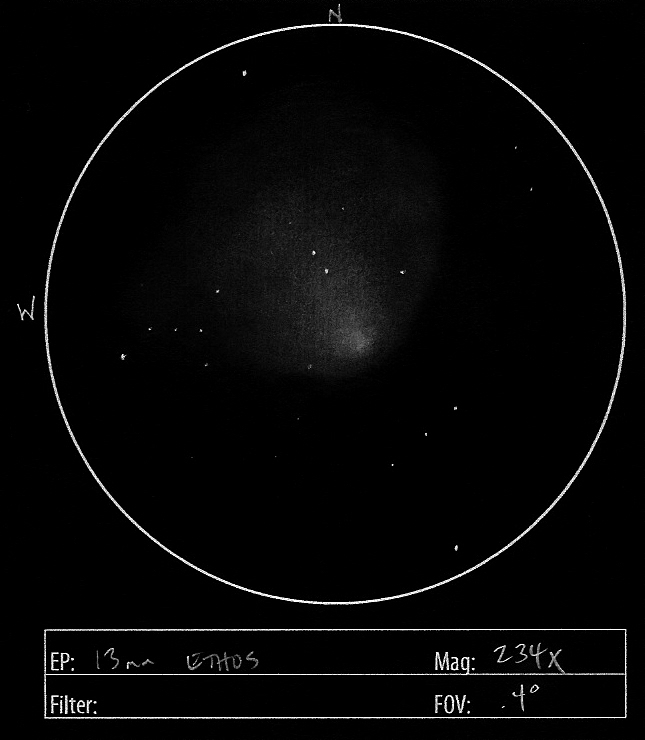
I am only going to post a few of the highlights from my two nights in Portal, beginning with Comet 103P/Hartley.  You can read about this comet that I have been observing over the past month in some of my earlier posts.  What was amazing was that the comet was visible to the naked eye as a fuzzy spot in the constellation of Cassiopeia.  It has brightened considerably and while still diffuse, sports a bright nucleus and extensive coma.  The comet is now appearing to move swiftly, approximately 5.8 arceseconds per minute during the time I was making the sketch...that translates to about 2.5 degrees of sky per day!  The sketch was made on the night of 10-10-2010 through my LX200 12 inch SCT and a 13mm Ethos eyepiece, yielding a magnification of 234X and a field of view of.4 degrees. The comet's distance from the earth was approximately .142 AU, and its distance from the sun was 1.093 AU (one AU = 93 million miles).


With Christian leading the way, I observed several planetary nebulas over the weekend. One of the benefits of having a telescope with 12 inches of aperture is that I can now begin to see subtle detail in these nebula that was not available to me with lesser aperture.  The sketch to the right is of NGC 7009, commonly known as the Saturn nebula, due to the extensions on either side the nebula that resemble Saturn's ring structure.  This nebula is obvious in most scopes at magnitude 8.3 as a small disc of uniform brightness. Magnifying this cluster with a power of 305 reveals the outer halo and extensions.  Careful observation also revealed some subtle darkening toward the center. This nebula is approximately 2900 light years away in the constellation of Aquarius.


To the left is another large but faint planetary that flies through the sky low in the south in the constellation of Grus (the crane).   IC 5148 is large, approximately 2 arc minutes in diameter, yet faint at magnitude 11.  Using a 20mm eyepiece (152X) and an Ultra High Contrast Filter (UHC) the nebula appeared to have a rift running through it, alomst separating it into two distinct objects.  The east half was marginally brighter than the west half, and the entire rim was brighter than the center.  I also observed this object through Christian's 16 inch Dobsonian, and he tells me that this object is actually designated twice in the IC, as object 5148 and 5150.  Either way, this is a very unique planetary and one well worth observing if you can see it from your location.  In Portal, it was perhaps 18 degrees above the horizon.


Finally, I'll share with you a sketch I made of NGC 246, commonly referred to as the Skull Nebula, haunting the constellation of Cetus.  This object was simply stunning from the dark site as it revealed several bright arcs along the perimeter, as well as dark cavities within the nebula itself.  the 12th magnitude central star was easily seen as well as a few other stars superimposed on the nebula.  NGC 246 is large, twice the apparent size of IC 5148 at 4.1 arcminutes in diameter.  It resides approximately 1300 light years away, and is estimated to be about 15,000 years old.

Of course, none of this would be possible without Jerry-  From sharing his property to sharing his food, no one hosts a better star party.  I have been to star parties in Colorado, California, Arizona, and even the vaunted Texas Star Party and can honestly say that there is no better place, and no better host than Jerry.  I have mentioned before that he is my mentor in observing and all the sketches above are due in part to observing and learning from him.  Thanks my friend.

Thursday, September 2, 2010

The Meade LX200 12 inch SCT!

The rumors are true... Introducing the Lost Pleiad Observatory's new Meade LX-200 12 inch Schmidt Cassegrain Telescope.  This telescope is well traveled, having started its career several years ago as a research instrument at the Arkansas Sky Observatories.  When it was retired from research it was sold to a private individual who used it for a few years before deciding to pass it along.  I had been looking for a larger SCT for some time and when I saw this scope advertised, decided to take the plunge.  It has been optimized  through several modifications, such as the two cooling fans which have been installed to circulate filtered air behind the mirror.  This aids the mirror in reaching ambient temperature. The stock focuser bearings have been upgraded to provide very smooth focus with minimal image shift, and the interior of the optical tube has been flocked to eliminate internal reflections and scattering of light.


Above left is the business end of the scope where you can see the the focal length is 3048mm resulting in an F/10 instrument.  The center image shows the cooling fans and on the right you can see the internal flocking.  I have had an opportunity to test the scope out over the past three nights, and without hesitation I can say that it is the best SCT I have owned.  Both my original 8 inch and the 9.25 inch that I have been using were fine performers, yet this scope is in another league.  Certainly the aperture increase is significant, however, planetary images in this scope are sharper than either of my previous SCT's.  In addition, contrast is excellent and the fine detail that I have been able to observe from my backyard has been rewarding. While splitting double stars is the realm of my TEC 140 refractor, this big blue monster has impressed me.

So far I have sketched two objects observing through this instrument.  For my first light sketch (to the right) I decided to attempt M27, the Dumbbell Nebula. This was the first planetary nebula discovered by Messier and is one of the showpiece objects of the summer sky.  This nebula is approximately 20,000 years old, a baby in astronomical time. I observed this nebula with and without my Baader UHC-S filter to bring out some of the nebular extensions.  The magnitude 13.9 central star illuminating the nebula was easily visible as were about 10 other stars within the nebulosity. 
Planetary nebula are fuzzy objects, and typically hold up well to higher levels of magnification than other targets.  I was observing NGC 6818, the "Little Gem" nebula in Sagittarius and decided to pump up the magnification and see if what was a small, circular, light blue fuzz-ball at 234x may reveal structure at 609x!  Typically one would not use magnification that high, but decent seeing combined with excellent optics transformed the nebula from a featureless disc into a nebula reminiscent of M57, the Ring nebula. To the left is an image of this nebula, while below are my sketches of this "Little Gem" at 234x and at 609x.  For reference in the high power sketch, the stars to the NW and SW of the nebula are magnitude 12.5, while the star to the east of the nebula is magnitude 13.5.

Friday, August 13, 2010

SkyNights volunteering and observing report

In an earlier post I mentioned that I have recently been volunteering at the Mount Lemmon SkyCenter, assisting with the SkyNights public observing program on the 24 inch RC Optical Systems Ritchey-Chrétien telescope seen at right  (Photo credit to Adam Block/Mount Lemmon SkyCenter/University of Arizona (Board of Regents)).  Last night the sky center hosted an extended version of the SkyNights program where in addition to the standard educational and viewing program, guests brought lawn chairs and loungers to relax and stretch out under the stars to observe the annual Perseid Meteor shower.  We were very fortunate in that the weather pattern has been holding steady this week, and we were treated to a sky devoid of clouds, with better than average seeing conditions.  The shower certainly displayed several long and colorful meteors for the guests, however, in my opinion the shower was better on Wednesday night and early Thursday morning.  Regardless, all the visitors had a good time.

Another benefit of this extended program was that there was less of a rush to see objects at the telescope for the visitors.  We had more time, and folks were occupied looking for Perseids when not at the eyepiece.  The summer milky way dominates the view right now and guests were treated to most of the showpiece objects of the summer sky. They observed the Lagoon Nebula, the Swan Nebula, globular clusters M22 and M13 (the great Hercules Cluster), the Dumbbell, Veil and Ring nebula, as well as open clusters such as the Wild Duck and the Butterfly.  Of course, everyone was awed by the king of planets, Jupiter.  As the night wore on, most of the guests departed and a few very interested folks remained.  These folks were interested in seeing some of what the 24 inch RCOS could do, so we took a look at some advanced observing targets.

We aimed the scope at the ring nebula and using a 17mm Nagler eyepiece (297x) we attempted see the magnitude 15.7 central star.  Sure enough, with careful observation, 3 of the 4 of us spotted the star with averted vision!  This was quite exciting as I had never seen this star before.  Given the patience and ultimate success demonstrated by these guests, I then slewed the scope to M33, the Triangulum galaxy (image at left).  This galaxy is a very large  face on spiral galaxy, but has a very low surface brightness.  Using a 31mm Nagler eyepiece (153x) the galaxy filled the field of view.  Looking through the eyepiece I was able to detect the spiral structure of the galaxy as well as 5 of the brighter star forming regions in the arms.  If I had been alone and had time to study the galaxy I am sure I could have seen much more, but I was mostly looking for features quickly so that I could assist the visitors in observing the galaxy.  All 3 guests were able to enjoy the detailed view.  Since they were appreciating this more advanced look through the telescope we spent some time looking at other deep space targets.  I can not remember all of them, but we were treated to fantastically detailed views of NGC 6888, the Crescent nebula;  a picturesque view of NGC 7331 and the 4 accompanying galaxies that comprise the "deerlick" group; dust lanes in the Andromeda galaxy, and amazingly, structure in NGC 7662 the "Blue Snowball" nebula!

When the last guests departed I went back to NGC 7662 to make a sketch of what I was seeing.  This is a fine example of a planetary nebula and at 297x displayed a striking aquamarine color.  It is very large, about the same apparent size as Jupiter.  Most shocking to me was that there was a bright arc within the nebula itself as well as a bright knot in the southern portion of the outer halo.  This nebula is about 5000 light years away in the constellation Andromeda.  Here is my sketch as well as an image of the nebula:


My colleague Mike Terenzoni who was leading the program suggested we look at NGC 891, an edge on galaxy in Andromeda.  I had observed this galaxy before in my 9.25 inch SCT and it was always an attractive but faint target.  We slewed the scope over, inserted the 31mm Nagler, and the view about knocked my socks off.  What was always a faint smudge to me, was a bright and beautiful edge-on galaxy with a dust lane that bisected its entire length.  Most often when observing dust lanes one sees subtle differences in contrast that take experience, patience and averted vision to see.  Not so tonight!  This dust lane was dark and readily visible with direct vision.  The galaxy is brighter toward the core, and below is my sketch as well as an image.


We had a few minutes left and decided to take a look at Jupiter one last time.  Mike had a new Tiffen FL-D filter that we attached to the 31mm Nagler to improve contrast- and it worked splendidly.  While the seeing conditions had dropped to about average, we were still treated to a pleasing view of Jupiter that now featured the great red spot traversing across the disc.  There was no way that I could capture the details that we observed in a sketch, but I decided to give it a try.  Typically, Jupiter sports two dark cloud belts, named the north and south equatorial bands.  For the last couple months, the south equatorial band has vanished (this is very uncommon, happening most recently almost 20 years ago), although there are some indications that it may be reforming.  There is a dark band of material immediately south of the great red spot, and the spot itself is clearly sitting in a hollow.  The north equatorial band remains quite dark yet does show some disturbance toward the preceding limb of the planet.  Below are my sketch (completed at 0723 UT 8/13/2010), as well as an image posted on the internet from a little while after my sketch.  You can see that I need some practice in terms of getting the features into a more accurate latitude, but I am pleased with this attempt.


 All in all, it was a very fun evening, and if you have read this far I hope that you will sign up for one of the SkyNights programs...