Showing posts with label Sunspots. Show all posts

Tuesday, May 10, 2016

Transit of Mercury

Yesterday saw the planet Mercury transit the face of the Sun from our unique perspective here on earth.  Slightly more common than a Venus transit which will not happen again in our lifetimes (see this post and this one as well), Mercury transits the Sun 12 or 13 times each century, always in May or November.  The apparent size of Mercury is rather small against the Sun, approximately 1/5 that of Venus.

We had a few programs running simultaneously yesterday for the transit-  up at the summit of Mount Lemmon the SkyCenter hosted a special program for visitors, and we also conducted an outreach event for students at Canyon View Elementary school.  The Sky School was hosting a group of 5th graders from Canyon View at our mountain based program, where I was operating the telescopes.  I set up at the Babad Do'Ag pullout approximately 2.5 miles up the Catalina Highway where we begin our Sky School programs with an exploration of the concept of a Sky Island.  Mercury began its transit prior to local sunrise and the transit is approximately a 7 hour event. I was all set by 5:30 AM and enjoyed watching the shadow profile of the Santa Catalina Mountains slowly creep across the Tucson basin as the Sun rose.  At left is the Coronado 90mm Hydrogen Alpha telescope we used for visual observation, as well as my 90mm Stellarvue triplet, 2x barlow and Canon 6D that I used to take pictures of the transit.  (Many folks ask about utility of the pink foam...it is simply to shade my camera in the Sun!)

Here are a few of the excited 5th graders observing the transit, I enjoyed the amazement of the student in the grey and red shirt exclaiming "It's so small!!"


I took a large number of images (approximately every 10 minutes until it was over) and processing them will require some time.  I did process one from near mid-transit and it is presented below.  As always, click the image to enlarge it and if your browser automatically re-sizes images you may need to click it again.


So there you have it- a fun and science filled day sharing the wonders of our Solar System with a group of our future scientists and leaders!


Saturday, January 3, 2015

Solar flashback and why I am not an astrophotographer

One reason I am not a serious astrophotographer: Patience.

I enjoy taking some casual images of bright targets such as the Sun, moon, or a planet but I rely heavily on being able to process these images in a quick and efficient fashion.  I do not have the motivation or desire to spend a lot of time learning the ins and outs of varied software packages to create astronomical images of the highest quality.  Many call my approach to obtaining a nice image "lucky imaging."  At left is a single shot of the Sun taken back on October 23rd when we had the largest sunspot in 24 years near the center of the Solar disc.  On the same day I made a video (AVI) recording of the Sun using my ASI120MC astronomical video camera in the hopes of stacking multiple frames to achieve a sharp, high resolution image.  Below is the AVI file as captured.


This is where the story takes a long break.  Back in the fall I broke down (and nearly went broke...emotionally and economically...) and purchased a new laptop.  I had a very nice 5 year old laptop that was still humming along quite well, yet technology has improved dramatically and doing a lot more work on the go I wanted something a bit lighter than the old 5+ pound beast.  I did my research, moved through periods of analysis-paralysis, wavered on what features I was looking for, and ended up with a Samsung Ativ Book 9 plus.  It is a very nice laptop and I only have two issues that remain.  One is Windows 8.1 which I can't do anything about, and the other is that the display has a resolution of  3200 x 1800 pixels, in a 13-inch class screen.  While this produces stunningly sharp images and can be useful in processing photos, it is somewhat of an annoyance in that several software programs do not always display properly and one can end up with text that is so small as to render it unreadable even with reading (magnifiers) glasses!  There are work arounds and settings that can be tweaked and for the most part things can be set effectively.

Two specific examples that are driving me nuts are Registax 6 and Adobe Camera Raw, both of which I use in the image processing I do.  Registax is used to align and stack multiple frames from AVI recordings (of say the Sun) and is just not displaying properly or working properly on the new laptop.  I have been fighting it since the fall and as a result have not been able to process a single AVI file.  I have known this day was coming but I finally decided to try another program and this morning downloaded and made a first attempt using a freeware program called Autostakkert2!  It seems to work fine, but does not contain the wavelet sharpening tools that Registax does.  Fortunately that functionality of Registax is still usable.  I Also will try a program called Avistack to see which I like better.

Adobe is particularly frustrating in that I was able to get Photoshop to display in a small but reasonable fashion, yet when opening a raw file the window does not display at the proper settings. See the image below and compare the text (not the title bar, but the controls) in the raw window to the application window in the background.


In any event, back to the AVI file I captured back on October 23rd.  Using Autostakkert2! this morning, I did stack and align the best 50% of the frames (out of about 1000) and then use the wavelet filters in Registax to create an image.  While not perfect, you can immediately see it is sharper than the single shot at the top of the post.  I think I can do better as I learn to use AutoStakkert2! (or Avistack) but at least I am back in business with AVI files.  Jupiter season is here, we have a bright comet in the sky, and stacking images is a must to capture these sights!


Sunday, April 6, 2014

Spotting a solar prominence and prominent solar spots

Spending this weekend at home, catching up on all the wonderful responsibilities and tasks that accompany being a husband, father and law abiding citizen, finally afforded me some time to enjoy observing the Sun.  As much as I enjoy preparing my state and federal taxes I believe I enjoy observing more...and the good news this year is that I do not need to pawn an eyepiece or two to pay a tax bill.

Saturday I spent a bit of time observing the Sun through my 60mm Hydrogen Alpha telescope, and was just starting to take some images when the power went out in our neighborhood.  Fortunately, I had already captured an image of a fantastic prominence before the power went out...and it is presented below.  I had to blow out the disc in order to expose the prominence, but you can see just how impressive it was.  Consider that the Sun is about a million miles in diameter and that this prominence was approximately 15% of the solar diameter in size and it is safe to assume that this tower of plasma was standing at least 150,000 miles high!


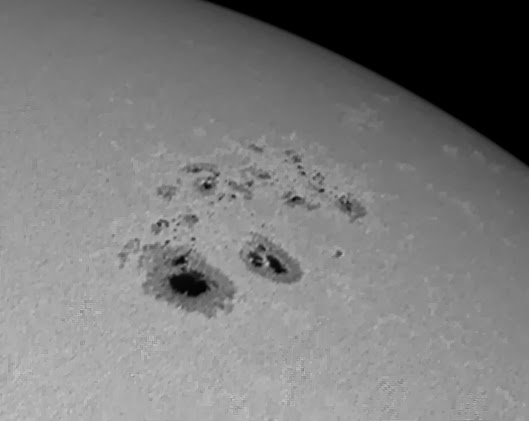
This morning I opened up my observatory and used my 90mm Stellarvue triplet equipped with a Lunt Solar Systems Herschel Prism to observe the Sun in white light.  I was rewarded with some steady views that showed several spot regions.  Below is a stack of 300 frames taken with my ASI120MC camera, at 9:04 AM local time (1604 UT).  Click the image to enlarge it to full size.


For comparison, here is an image from the Solar Dynamics Observatory taken near the same time with the active regions labelled.  As you can see, good optics, a decent camera and steady seeing can produce some impressive results!


Wednesday, January 8, 2014

Active region 1944

The last few days have seen some remarkable images of the sunspots contained within active region 11944 that are making their way across the face of the Sun.  While I had taken a couple images late last week (posted here), I wanted to revisit the area this morning during a break from work.  Working at home this morning allowed me to run out and take a look at this region once again.  Seeing was a little above average with some some thin cirrus that are heralding an arriving cold front (maybe I should say a 'cooler front' in light of what our east coast brothers are experiencing this week).

All images were taken through my Stellarvue 90mm triplet and  Lunt Solar Systems Herschel Prism.  First, a whole disc image using my Canon T2i and a 2x Barlow lens- it is a single frame...click to enlarge.
Next, is a stack of 500/1000 frames captured with my ASI120MC video camera.  This comparison to the above image shows the benefit of stacking multiple images to obtain a higher and sharper level of detail than can be achieved in a single shot as above.  Again, click to enlarge.


Finally, an image of the same region using the ASI120MC and a 2x barlow.  This active region is massive, and with a proper solar filter can be seen without optical aid...it is perhaps the most impressive spot region I have seen in several years.  Click to enlarge.


Friday, January 3, 2014

NOAA Active Region 11944

When it comes to active regions (AR) on the Sun, this one is big...how big?  By my estimation, AR11944 is larger than Jupiter.  Click on the SDO image and scale at left to enlarge, and remember that the sunspots are contained within a larger region of magnetic activity.  This region made it's way around the Sun's eastern limb on New Years Day, and I expect that we will be able to observe this region and it's accompanying spots for approximately two weeks as it transits (the Sun rotates from east to west with a rotational period of approximately 25 days at the equator).  Below are two images from this morning, taken through my 90mm Stellarvue triplet and Lunt Solar Systems Herschel Prism.  They represent stacks of 750 frames (out of 3000) in average seeing captured with an ASI120MC camera.  This region is on the southeast limb of the Sun, but I liked the composition better as presented-


Below is a second image of the region, taken with the addition of a 2x Barlow lens- and I am not sure why, but blogger seems to compress images and much of the solar granulation is blurred, particularly above the spots...but at least the spots survived the blog platform!


If you have a solar telescope, this is one region worth taking a gander at...and, I suspect this region is large enough to be seen naked eye with the appropriate solar filter to protect one's eyes.


Wednesday, January 1, 2014

Happy New Year!

Today marks not only the New Year, but also the fourth anniversary of this blog...and most importantly my 18th wedding anniversary!  Life has treated me well and I am quite fortunate to have such a wonderful spouse and son.  18 years has gone by in the blink of an eye, and it seems only yesterday I was eyeing that cute grad student with the southern accent and the smell of eucalyptus in her hair.

It is somewhat of a personal tradition that I try to celebrate all holidays with a little observing and this morning I set up both my hydrogen alpha and white light solar telescopes.  There is a fair bit of action on the Sun and I took some images through both telescopes.  I began with the white light and took the images below.  All images are presented with north up and west to the right.


The seeing was steady enough that in addition to the images straight through the 90mm Stellarvue triplet, I was able to utilize a 2x barlow.


Finally, while the seeing was slowly worsening (as typically happens as the day progresses and the air and ground warm up) I was able to grab an image in hydrogen alpha.  I was having a hard time tuning the telescope and it may be time for me to take it in for a "tune up" at Lunt Solar Systems.  Again, north is up and west is to the right.


Happy New Year!

Saturday, December 28, 2013

Sunspotting

The weather the past few days has been frustrating here at my observatory...very clear skies day and night, with winds gusting on and off to 20 mph.  I am off work this week, and with lots of dark time I have been looking forward to spending some serious observing time with my new (to me) C 11 Edge HD (News Flash!!).  Even though I have already first lighted the telescope, the winds have been driving me crazy!
 
The winds died down, finally, very early this morning and when I went outside to check on conditions for Solar observing saw that high cirrus were beginning to form as a predicted front moves in.  As many observers know, sometimes a very thin layer of cirrus clouds can provide favorable observing conditions for bright targets such as the Sun (or Jupiter)-  I set up my Stellarvue 90mm triplet with Lunt Herschel Prism and sure enough the views of the Sun were quite stable.  While there is virtually no activity in the northern hemisphere, the southern hemisphere had numerous spots stretching in a band within 15 degrees of the equator.  At left is a white light image from the Solar Dynamics Observatory taken this morning.  Clicking on the image will bring it up full size and includes the NOAA active region numbers within which the current sunspots exist.  In addition, there is a scale at lower right to provide a sense of the size of spots relative to the Earth and Jupiter.

Below, is an image I took this morning using my ASI120MC camera.  It is a stack of about 600 individual frames from an avi of 1200.  Considering this was taken through a layer of cirrus, the results are quite nice and compare favorably to the SDO image.  North is up, and west is to the right.  Click the image to enlarge.


Wednesday, December 25, 2013

Post-solstice KPNO sunset

The previous post detailed an annual trip to photograph the Sun setting behind Kitt Peak National Observatory as seen from the Catalina Highway.  As this alignment occurs 3 days prior to the Winter solstice (while the Sun is trekking southward), there is a second opportunity to observe the alignment approximately 3 days following solstice as the Sun is once again passing the same point on the horizon (while trekking northward).

Approximately 10 folks came out yesterday to take pictures of the Kitt Peak ridge line and observatories silhouetted by the Sun. Once again, I was taking pictures of the Sun using my Canon T2i through my Stellarvue 90mm triplet refractor with a Lunt Solar Systems Herschel Prism and a 2x Barlow lens.  This results in a focal ratio of approximately f/14.  Overall, the atmosphere was far less stable than the attempt last week which made focusing quite difficult.  At left is an image of the Sun about 20 minutes prior to sunset.  You can see there are some very nice spots on the disc and compared to the later images below how quickly the seeing (atmospheric stability) would continue to deteriorate.

As last time, here are two images of the Sun as it set behind the National Observatory.  The building that is on the left of the ridge line that appears as a "7" on its side, is the McMath-Pierce Solar Telescope.  At far right on the summit is the Mayall 4-meter Telescope.  Click the images to enlarge them to full size.


In addition to the generally poor seeing there was a thick inversion layer that was forming in the valley as temperatures quickly dropped around sunset.  It was easy to see this layer from our vantage point as it developed.  This resulted in a large amount of atmospheric dispersion and some amazing colors of the final bits of the setting Sun.  Below is an image of the nearly set Sun which shows the green rim as well as some blue-


Finally, here is an image at full resolution of the camera of the last fraction of a second of sunset-  The atmospheric dispersion shows colors from orange/yellow at the bottom to blue at the top!  None of this was visible to the eye, as expected, but I was surprised to see this amount of color in the image-  It is not much to look at due to the lack of context in the picture, however, knowing this is the Sun makes it impressive (to me anyway!)


Happy holidays!


Saturday, December 14, 2013

Images of the Sun

It has been a few weeks since I had a window of opportunity to image the Sun.  I have had a few visual moments the last few weeks but just enough time to take a look and marvel.  This morning the Sun was ready for me, sporting several nice active regions which included several photogenic spots.  If the atmosphere steadies a bit tomorrow, I may try and take a picture of the individual spots using a barlow lens as they are quite detailed.  Below are the white light (top) and hydrogen alpha (bottom) images of the Sun, taken between 11:00 and 11:20 (18:00 and 18:20 UT)  this morning.  As always, click the images to enlarge them.


Venus Transit re-processed

Over Thanksgiving week I was leading a public observing program at the Mount Lemmon SkyCenter and one of the guests asked me what were my most memorable observations.  It was a question that motivated me to think about all of the wonderful times I have spent with friends and colleagues enjoying time at the eyepiece.  I hope to actually write up a blog post where I attempt to answer that question, and included in the answer will be observing the 2012 Transit of Venus.

Guest observing sunset - note the sun projecting on his eye
I observed the transit from the summit of Mount Lemmon with my colleague Adam Block and somewhere in the neighborhood of 100 guests that attended our special Transit of Venus program.  We had multiple telescopes set up, including some brought by visitors themselves, through which we observed the event.  I had purchased my first DSLR (ever!) the week of the Transit in the hopes that I would be able to take some pictures through my telescope.  I posted those images on the blog shortly after the transit, and to say I was lucky is an understatement.  I had very little understanding of how the camera worked, and practiced with the camera and telescope for just a couple days leading up to the Transit.  You can read about the adventure and see the original images on this post from June of 2012. About a month after the Transit I made an attempt to process my best raw image of second contact and was fairly satisfied with the results at the time. That post and image can be found here.

As I have been playing around with solar imaging a little bit this year, I have gained more experience in processing the images that I take.  While I was previously using the freeware program GIMP, I am now using using Adobe Photoshop and have been able to identify a few techniques to improve my images.  Below, is my latest attempt to bring out the best of my image of second contact-  I am quite happy with the result!  Click on it to enlarge.


Sunday, November 17, 2013

Solar improvements

This weekend is the 2nd annual Arizona Science and Astronomy Expo at the TCC.  This event which features speakers and vendors from around the world is essentially a playground for amateur astronomers. The Mount Lemmon SkyCenter has a booth and after spending the morning publicizing our activities I spent the afternoon networking with vendors and visiting with old friends.  At left is my colleague Dr. Maria Perreira and I in our booth preparing for the expo opening.


While a boy can dream (see the beautiful TEC 180 on an Italian Mount at right), one of the accessories that I have had my eye on for some time was a side-by-side dovetail system which would allow me to use two telescopes at once.  This is very useful in solar outreach as I can set up both my hydrogen alpha and white light telescopes at the same time.  In addition, it would allow me to mount both my 12 inch SCT and small 90mm refractor at the same time for night use.  I spoke with Anthony Davoli from ADM Accessories, who had been set up next to us last year and after some deliberation took the plunge on a very nice system.  Not only does it allow for side-by-side mounting, but one of the saddles is adjustable in altitude and azimuth allowing for precise alignment between instruments.  I spent some time figuring out how to balance this set up and was able to successfully utilize both solar telescopes this morning.


Of course, I also spent some time taking some pictures of the Sun through both telescopes.  Seeing conditions were about average and the Sun is putting on quite a show right now.  One of the next items I would like to find is a reducer of some sort that would allow me to fit the entire solar disc on the chip of the ASI120MC camera.

First up, the white light...click the images to enlarge them to full size.


The image below was taken at the camera's full resolution (the one above was binned 2x2) and you can see that it suffered a bit from the atmosphere.  However, it does show the very large spot quite well, including some detail within the umbra.


Next, the Hydrogen Alpha...The image is binned 2x2 and I played around with brightness and contrast of the prominences to try and bring them out a little.  These are features that are much fainter than the Solar disc and I am impressed that the camera is capturing them at all with the settings I am using to capture the hydrogen alpha detail in the chromosphere.  Again, click the image for full size.


Sunday, November 10, 2013

November 10th Sun

Clouds are coming fast this morning at the Lost Pleiad Observatory.  Fortunately one of the benefits of having things set up semi-permanently is that mount, telescope, and camera are ready to go at a moments notice...just like I used to be.  After last nights marathon observing session which lasted until nearly 3 AM I had a bit late of a start for solar observing, however, seeing conditions still seemed slightly above average.  Generally, I find that the best atmospheric conditions for observing the Sun are between 90 and 120 minutes after Sunrise.  Some days the window lasts a bit longer, but it rarely starts earlier due to the low Sun angle.

The two images below were taken through my 90mm Stellarvue f/6.3 triplet with  Lunt Solar Systems Herschel Prism and a polarizing filter.  Naturally, the camera is the same one I have been playing with, the ASI120MC.  The images were taken without regard for the directional orientation of the Sun.  If you imagine the Sun as a clock face, South is actually at about 10 O'clock; however, I like the composition better with the spots at an angle and the large group at the upper right.  The midpoint of the exposure was at 11:05 AM MST (1805 UT).


The large spot group at upper right is NOAA Active Region (AR) 11890 which has been spewing out very strong X-class flares over the past few days.  Often individuals want to know the size of spots relative to the Earth- and in fact we could line up about 110 Earths across the approximately 1 million mile solar diameter.  So clearly the large spot within 11890 is much larger than the Earth.  In fact, AR 11893 which is the home of the second largest current spot group at lower left also contains a spot that is much larger than the Earth.  These spots (while still quite hot) are relatively cooler regions in the solar atmosphere which is why they appear darker.  They are areas of intense magnetic activity, however, and the sheer size of 11890 is an indication to keep an eye out for flaring activity.  The image below was taken with a 2x barlow lens immediately after the above image, at 11:13 MST (1813 UT).  Both of these images are stacks of approximately 500 of 1500 individual frames processed in the freeware program Registax and adjusted a little in Photoshop.  I am pretty unhappy with the processing, but that is what staying up late will do to me the next morning....


Friday, November 8, 2013

Solar images in Hydrogen Alpha and White Light

Not a lot of time to spin words today as I am about to head off to work...but I had a bit of time this morning to capture the Sun not only in Hydrogen Alpha, but also in white light.  I am pretty happy with the images and am feeling like I make a little bit of progress each time I use the camera.  First off, some of the HA images...this first one I shot to try and show off the "filaprom" at the top...it had a 3D look visually.


This next image may be my best effort yet...processing skills limited me far more than the data.  Incidentally, the active region near the center of the Sun has been spitting X class flares, including one around 9 PM last night.


For white light, I captured the image through my Stellarvue 90mm triplet apo and a Lunt Herschel Prism, using a polarizing filter.  This is my first successful white light image:


Having fun now!


Sunday, May 12, 2013

Mothers Day Sun

Happy Mother's Day to all the moms out there, especially the ones for whom I am about to prepare brunch: My favorite super saucy spouse - Beth; and of course our own Mom's Lynne and Wanda.

I awoke this morning much earlier than the family and set up my Stellarvue 90mm refractor to observe the Sun in white light. Seeing was quite good with only a gentle breeze and numerous spots.  I brewed some coffee, grabbed my pencil and clipboard and headed out to make a sketch of the Mothers Day Sun...and much to my surprise in the 15 minutes I was inside the gentle breeze had become 10-15 mph gusts!  Needless to say, this made sketching difficult.  Below is my sketch completed at 1500 UT (8:00 Am MST).


At the time of my sketch, the Sun was at an altitude of 31 degrees and an azimuth of 87 degrees.  We are in Carrington rotation 2136, and the Official NOAA sunspot number for today is 145.

Friday, May 3, 2013

Naked eye sunspots

If you live in the Tucson area you know that the extremely high winds of the past couple days have resulted in a quite a layer of dust here in Tucson, and last night I observed Sunset from the summit of Mt. Lemmon through the layer of heavy dust in the valley below.  I was up at the Mount Lemmon SkyCenter conducting an evening observing program for a group of local 6th graders, and due to the thick dust we were able to observe a naked eye spot group on the Sun as it set, without optical aid.   It is surprising to some, but the earliest written records of sunspot observations come from Chinese astronomers who would view spots through fog or dust at Sunrise or Sunset...as long ago as 800 BC!

I recently purchased a canon 24-105mm F4 lens, and took the images below with this lens on my Canon T2i.  This is what the Sun looked like setting in the dust...click to enlarge:


Below is a crop of the Sun at full resolution.  Click it to enlarge it to full size (you may have to click it twice if your browser automatically re-sizes images) and you can see the spot group on the upper left that the students noticed.


Finally, I captured this image of one of the students looking at Jupiter through the 20-inch Jamieson Telescope.  It was a 1 second exposure, ISO 400, at the 24mm setting, handheld...As you can see, I am pretty happy with this new lens.  It focuses quickly and accurately and the color rendition is beautiful.


Saturday, April 27, 2013

Saturday sunspots

Somehow, a month has gone by since my last post on the blog-  I think that may be a record for inactivity, but it is inversely proportional to my own level of activity.  As it happens between two jobs I have worked every single day in April except the 22nd!  Mostly this is due to extremely successful efforts at developing the UA Sky School, which is a new facet of the Mount Lemmon Sky Center where I serve as Director.  I'll have to write more later about the Sky School, but essentially we are delivering 2-5 day immersive residential science inquiry programs to area schools.  We have a draft website which will be live in the coming week (it may or may not work now, as we are still installing the security certificate) that you can visit at skyschool.arizona.edu

I am heading up the mountain today as we have Safford Magnet School coming up for an overnight program; so this morning I wanted to take a look at the Sun and get an idea of what was going on.  Later I will do a short lesson on solar astronomy for the students where they will create sunspots with magnets and iron filings, as well as observe the Sun in white light and hydrogen alpha solar telescopes.  I was pleasantly surprised to see a fair amount of activity, and I took a quick picture through my Stellarvue 90mm triplet refractor, and Lunt Solar Systems Herschel Prism, using my Canon T2i.  I acquired the image using the software program Backyard EOS, however, I was using a non-tracking mount so it was a bit of a challenge to center the Sun in the field of view and fire off an image.  Below I am pasting two images, one labelled with the active region numbers and one not.  North is up in both images, and East is to the right.  Click the images to enlarge them to full size.


The image was taken at 1533 UT this morning (8:33 Am MST) with the Sun at an altitude of 35 degrees. You can see that there are a couple active regions with spots that have not yet received official numbers from the NOAA.  For example, there is a large spot just rounding the east limb in the southern hemisphere that will likely be designated 1732.  There is another dark spot between regions 1729 and 1730 that also may receive a designation.  Interestingly, I was not able to observe any spots in region 1729.