Showing posts with label C11 Edge HD. Show all posts

Monday, May 12, 2014

Portal, AZ dark skies and good times

Milky Way over Chiricauhuas
My good friend Jerry and I have been planing to go down to Portal, AZ and do some serious deep sky observing around the new moon since about the new year...and finally, after three attempts to head down were thwarted by bad weather, we did make it down at the beginning of this month.  We spent three glorious nights with observing friends extraordinaire Mike Wiles and Chris Hanrahan (AKA ServoChris) under dark and steady skies.

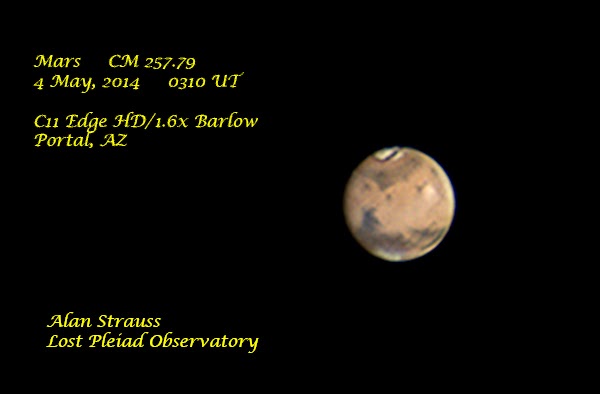
Slowly this blog is turning to more photos than text and I guess that is a factor of being so busy with work.  When I have free time I spend it with family or in my own observatory and do not take much time to write the blog these days.  In fact, I am about to head out to Mount Lemmon for a UA Sky School trip and need to finish up this brief post quickly.  Below I present three images from the Portal trip...one taken of Mars through my 11-inch Celestron Edge HD, and two of the milky way rising.


First, Mars:
In the Milky Way images below, I was using my new Canon 10-22mm zoom, at the 22mm setting.  These are single 30-second exposures and I used a red flashlight to 'paint' Jerry and myself during the exposures.  I am in the upper image, Jerry in the lower.


While these images are a bit noisy due to the high ISO, what is notable is the lack of light domes near the horizon. There are now small domes visible from El Paso and Lordsburg that rise perhaps 2 degrees above the horizon in long exposures, but these domes are a bit to the north of this exposure.


Friday, April 4, 2014

A little Mars love

Between working many days and nights and generally poor skies on my days off, there have not been many opportunities for me in the past few weeks to get out and practice observing or imaging Mars in my backyard.  Last night was the rare night where skies were clear and I was at home with some time to observe.  Both seeing and transparency were slightly below average, but this photon deprived boy was not about to complain.

I opened up the roof and spent some time observing mars through my C11 between about 9:00 and 9:30 local time (0400 and 0430 UT).  The north polar cap has noticeably diminished in size over the past month as the Martian spring advances and there is a darker collar on the southern edge of the cap.  There continues to be very bright limb haze.  I had a hard time noting many dark features, likely due to Mars still hanging low in the east during my early observation.  I was able to identify Terra Cimmeria in the south, but that was about it.  While the image would no doubt be better with Mars higher in the sky, I was not about to stay up until midnight as I was looking forward to sleeping in my own bed for the first time in a few nights.

Below is an image I took using my ASI120MC camera, and it represents a stack of about 200 frames out of 2500, taken through the C11 and a 1.6x barlow lens.  You can see the north polar cap as well as the thin dark collar below it.  The wider, dark area south of the polar cap is Utopia Panitia.  At the south of the planets disc, the darkest feature facing us is Terra Cimmerium.  The bright spot near the limb on the right is Olympus Mons, and you can see the haze on the limb.


For comparison, here is a simulated image from calsky.com of mars at about the same time:


Currently, Mars is visual magnitude -1.40 with a true distance of 0.6286784 AU (94048948 km) from Earth.  In light time, it is 0h 05m 13.71s distant.  Hopefully as Mars come to opposition next week, I'll have more opportunities to take some images of the other side of the planet as well.

Wednesday, March 12, 2014

Mars approaches!

No, this is not a blog post to let you know that Mars will pass closer to Earth than at any point in the history of our solar system in early April.  You can find that story circulating on the internet as it does approximately every two years as Mars approaches opposition.  This year, Mars will be at opposition on April 8th and will have an apparent diameter of approximately 15" (arcseconds).  Currently, Mars is .73 astronomical units from Earth and is 96.7% illuminated with an apparent diameter of 12.74"

A few months ago I purchased my first astronomical camera in order to learn to take planetary images in a run up to this Mars apparition.  Mars has always been my favorite planet to observe visually and I want to be able to capture some nice images as well.  Two nights ago I was out observing and imaging Jupiter and was impressed with how steady the seeing conditions were.  Below is an image of Jupiter I captured with my 11" Celestron Edge SCT and a 1.8x barlow lens.
As the seeing conditions were so favorable I decided to stay up far too late and try my hand at my first image of Mars.  I will not go into detail about the trials and tribulations of the process, but keep in mind that Mars is much smaller in apparent size than Jupiter, that its details are quite subtle, and the seeing conditions had deteriorated quite a bit by 1 AM.  I was not able to use the Barlow lens to increase the image scale so the picture below is straight through the C11.
All in all I am happy with the first effort.  I pushed the processing a little too hard but may go back and try again if I have some time.  Of note, you can see clouds in the Olympus Mons region on the right side! Olympus Mons is the largest volcano in our solar system and these are likely orographic clouds.  For comparison, below is a simulated image from the website calsky.com.


Tuesday, February 18, 2014

Jupiter February 17th

Last night was the first clear night in several for us here in Tucson and I spent a few hours observing.  In addition to some typical targets, I observed the Supernova in M82 and was pleasantly surprised to see that it has dimmed only slightly.  It was still easily visible even in my 90mm refractor.  Using the 11 inch SCT, it seemed to have a slight yellow cast to it!?!

Of course, I also took an image of Jupiter under average seeing conditions-  and to my surprise, there is a very interesting feature on the "boring side" of the planet...a disturbance that is nearly as large as the great red spot and is also a shade of red.  It is more stretched than typical storms, and it will be interesting to obsreve how this region changes and how long it persists.  The image below was taken through my 11 inch Celestron Edge HD SCT with an ASI120MC camera...it is approximately 250 frames aligned and stacked in Registax with some tweaks in Photoshop.


Wednesday, February 12, 2014

Jupiter and Io's shadow

To my surprise tonight, Io was making a transit of Jupiter about the time I started observing tonight.  Naturally, I used the experience to practice taking an image, despite the fact that my telescope was not acclimated to ambient temperature...and the result is below.  It is a stack of approximately 400 frames.  Seeing conditions were slightly above average, and certainly good enough for my level of processing skill!


Sunday, February 9, 2014

Copernicus

After a solid week of rather cloudy skies we had somewhat clear skies this evening over the Lost Pleiad Observatory.  While there were some passing cirrus, it was a very comfortable night to open up the roof and let the telescopes do what they do best- collect photons.  Tonights target for the little ASI120MC camera was the lunar crater Copernicus. This is a crater well known to most amateur astronomers as it dominates the Earth facing side of the moon and has a very large and bright set of rays extending from it.  The image below is a stack of about 500 frames aligned and stacked in Registax, with some additional sharpening in Photoshop.  It was taken through my Celestron 11 inch Edge HD SCT.


While this is certainly a reasonable image given my skill and the average seeing conditions, I can not look at any lunar images without thinking about the amazing images generated by NASA's Lunar Reconnaissance Orbiter (LRO). The images below are the central peak region of Copernicus and give you an idea of just how impressive the images from LRO are.  Make sure and click the images to enlarge them to full size!


If you want to read more about these images and see others, check out this blog post from the LRO camera. If you have not had enough (and how could you?!?) watch the video below...and turn up the speakers to listen to the narration.

Monday, January 27, 2014

Jupiter, Io and a shadow transit

Arriving home from work tonight under partly cloudy skies, I did not even bother to open the observatory roof.  This turned out to provide good karma as my poor planning led to skies that were crystal clear at 9 PM.  While the transparency (clarity of the atmosphere) was reasonable for observing Jupiter, the seeing (atmospheric stability) went from average to poor rather quickly between 9 and 10 PM.  This was unfortunate as tonight was a transit of the Galilean moon Io and its shadow.  Regardless of sky conditions, being the faithful amateur astronomer that I am, I took several videos through my 11-inch Celestron Edge HD SCT and my ASI120MC camera in order to stack the frames and create an image of the event.

First up, is a stack of 2 images, each of which itself represented a stack of approximately the best 450 frames out of a 60 second video.  That is Io's shadow cruising through the south equatorial band.  Just think, if you were on Jupiter standing in the shadow you would be seeing a solar eclipse!
Seeing had deteriorated significantly by the midpoint of the transit, and the image below is a stack of three images, each of which was a stack of only 90-120 frames each from a 30 second video.  Compared to the above image the details are far less clear.  Io's shadow is nearly on the center of the disc, and the Great Red Spot has come around onto the face.
Next up is the image I was after.  You can see that the Great Red Spot has rotated onto the face (less than an hour after the previous image), Io's shadow has moved further along, and on the limb of Jupiter the moon itself is now visible!  Despite the obviously poorer seeing conditions, I ended up with a salvageable picture, and the process gives me confidence that with better conditions I may be able to capture some nice transit images.


Thursday, January 23, 2014

Jovian improvements

My faithful readers (you two know who you are) have seen that I have been learning to take planetary images of Jupiter and Venus these last few months.  I do not have the patience required to get into serious deep-space astrophotgraphy, but the planets are bright targets whose ever changing appearances make for constant photo opportunities, and require less investment of time and money.  My hope is to develop some skill at imaging Jupiter so that I can successfully image Mars in a way that will reveal some of the Martian detail.  Mars holds a special place for me as an observer in that it rewards patience.  It is often quite small and the details are subtle...so I hope to achieve a level of skill and confidence with the camera and techniques as the current Mars apparition unfolds.

Alas, I digress (again, those of you who know me...)...with all the excitement of the supernova in M82, I have not gotten around to posting what is my best Jupiter image to date.  Below is an image captured through my Celestron 11" Edge HD SCT using the ASI120MC camera on Tuesday night.  I can say that I am making progress and soon, I will be ready get to work on Mars.  The moon closest to Jupiter is Io, and the one near the right edge is Europa.


Wednesday, January 22, 2014

Supernova in M82!

Word has spread quickly of the likely Type Ia supernova in nearby galaxy M82 (The cigar Galaxy).  Surely news will continue to flow about this event as professional and amateur astronomers around the world turn telescopes, eyes and cameras toward the galaxy to observe the Supernova.  M82 is only 12 million light years away, which is fairly close as galaxies go.

In an absolutely amazing coincidence, two nights ago I was taking an image of Jupiter and after I finished I decided to take my first look at this galaxy this season.  I was very tired, but as I observed it in my 11-inch SCT I noticed a star in the central portion of the galaxy and thought to myself that I did not recall that star.  Typically I would not know the star patterns around galaxies but it happens that I have observed this galaxy more than perhaps any other galaxy.  You can see my sketch and report on this galaxy in a post I made back in February of 2010.  I even have a wonderful image of it hanging in my office on canvas.  My reaction two nights ago was that somehow I had never noticed this faint star before, and my thought was that as seeing conditions were very good, my new 11 inch telescope was delivering a fine image.  Imagine my surprise today when I heard that there was in fact a supernova!  So in my own way, I feel like I discovered it without any prior knowledge...if only I had put 2 and 2 together!

The best part of the story is that when I called my good friend and astronomy mentor Jerry Farrar today to let him know there was a supernova, his cut me off to exclaim "You are kidding!  I saw that two nights ago!"  He did not know either and described to me its exact location...so we are both reveling in our own independent "discovery" of this transient event.

Tonight I wanted to take a picture of the supernova and that meant I had to attempt my first image of a galaxy.  I used my Canon T2i and the software BackyardEOS attached to my 11 inch Celestron Edge SCT.  Now that I have a little experience stacking images of Jupiter, I took a sequence of 10 images of 15 seconds each at ISO 1600.  I aligned and stacked the images and with a little processing in photoshop ended up with the image below.  It is far from an inspirational image, yet it is really exciting for me to get this result...and of course, it shows the supernova (marked by the red lines)!


Thursday, January 16, 2014

Jupiter's 'boring side'

Everyone loves the GRS (Great Red Spot); a giant storm that has persisted in the Jovian atmosphere since before the time a telescope was first pointed at Jupiter by Galileo.  Tonight, the GRS was somewhere on the side of Jupiter facing away from Earth and I imaged what astronomers jokingly refer to it's boring side.  The picture below is a stack of 3 images, each of which was itself a stack of between 250 and 400 individual frames, all taken within about 90 seconds of each other.  Jupiter rotates so quickly (a day on Jupiter is approximately 9 hours!) that if I were to spend more time taking video, the resulting stacked image would be blurred from Jupiter's rotation.  There is software to deal with this 'de-rotation' issue in processing, but I am still too far back on the learning curve to deal with that.  This is, I think, my best image of Jupiter to date.

Picture taken through my Celestron 11" Edge HD, using an ASI120MC camera

Tuesday, January 14, 2014

Jupiter, Io and Europa

Not a lot of time for words this morning, which for those of you that know me, is a good thing.  Below is an image of Jupiter I took last night at about 9:15 PM MST (0415 UT, 1.14.14).  To the right of Jupiter are the moons Io (top) and Europa (bottom).


Image was taken through my C11 Edge with an ASI120MC color camera.  Seeing was average and I came a little closer on focus and collimation.  It may be time for a Bahtinov mask to achieve focus, and studying some real processing techniques.  Image is a stack of about 450 frames.