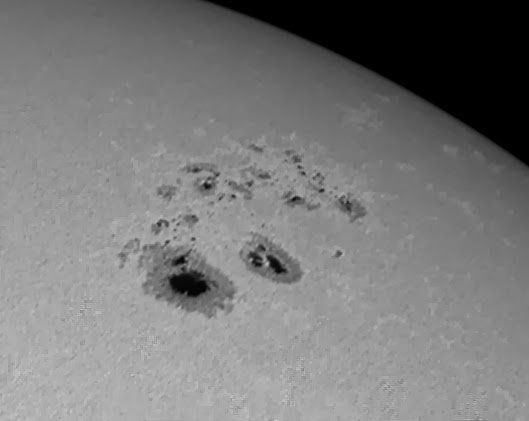
Showing posts with label SV90T. Show all posts

Wednesday, January 31, 2018

Super Blue Lunar Eclipse

Living here in the USA, things have been a bit surreal over the past year.  As the Great Orange One (GOO) that occupies the office reserved for President has done his best to divide our citizenry and alienate us from the rest of the conscious world, it is sometimes difficult to remain optimistic about our future.  Fortunately, there are events that remind us of our place in the universe; and despite the deep divisions that are being cultivated by the GOO, there are greater forces at work that serve to unite us here on Earth.  There is something about seeing the solar system in motion in a way that we do not witness frequently, that seems to recharge my desire to make the world a better place.

Early this morning we were treated to a widely publicized total Lunar Eclipse.  This eclipse occurred on the second full moon within a calendar month (a "Blue" moon), and also at the time of perigee, when the moon is at the closest point in its elliptical orbit around the Earth (the "Super" moon).  The occurrence of a "Super Blue Lunar Eclipse" is indeed rare, with the last one occurring in 1866, one hundred and fifty two years ago! I observed the eclipse from work, (The Mount Lemmon SkyCenter) where we were providing a live stream of the eclipse for NASA.

The image at left was taken with my Canon 6D and a 70-200mm lens set to 100mm, just before sunrise.  You can see the eclipsed moon hanging in the dawn sky with Picacho peak in the distance at lower right (along with I-10 traffic just in front of it).


Below is a collage of some of the images I captured during the eclipse, using my Canon 6D and my Stellarvue 90mm refractor.  Remember to click to enlarge (perhaps twice if your browser automatically resizes images to fit the window)
So you missed the eclipse and are wondering when the next lunar eclipse is here in AZ? The next eclipse in Tucson will be on January 20, 2019 starting at 7:36 PM local time.

Finally, my friend Roger who observed and photographed the eclipse with me, had a little fun with my image above...


Tuesday, May 10, 2016

Transit of Mercury

Yesterday saw the planet Mercury transit the face of the Sun from our unique perspective here on earth.  Slightly more common than a Venus transit which will not happen again in our lifetimes (see this post and this one as well), Mercury transits the Sun 12 or 13 times each century, always in May or November.  The apparent size of Mercury is rather small against the Sun, approximately 1/5 that of Venus.

We had a few programs running simultaneously yesterday for the transit-  up at the summit of Mount Lemmon the SkyCenter hosted a special program for visitors, and we also conducted an outreach event for students at Canyon View Elementary school.  The Sky School was hosting a group of 5th graders from Canyon View at our mountain based program, where I was operating the telescopes.  I set up at the Babad Do'Ag pullout approximately 2.5 miles up the Catalina Highway where we begin our Sky School programs with an exploration of the concept of a Sky Island.  Mercury began its transit prior to local sunrise and the transit is approximately a 7 hour event. I was all set by 5:30 AM and enjoyed watching the shadow profile of the Santa Catalina Mountains slowly creep across the Tucson basin as the Sun rose.  At left is the Coronado 90mm Hydrogen Alpha telescope we used for visual observation, as well as my 90mm Stellarvue triplet, 2x barlow and Canon 6D that I used to take pictures of the transit.  (Many folks ask about utility of the pink foam...it is simply to shade my camera in the Sun!)

Here are a few of the excited 5th graders observing the transit, I enjoyed the amazement of the student in the grey and red shirt exclaiming "It's so small!!"


I took a large number of images (approximately every 10 minutes until it was over) and processing them will require some time.  I did process one from near mid-transit and it is presented below.  As always, click the image to enlarge it and if your browser automatically re-sizes images you may need to click it again.


So there you have it- a fun and science filled day sharing the wonders of our Solar System with a group of our future scientists and leaders!


Monday, October 27, 2014

Partial Solar Eclipse

Last Thursday we witnessed a partial solar eclipse of the Sun- and for some reason this particular eclipse did not grab the attention of the media the way that the past few have.  It seemed that there were far more stories in the popular media for the lunar eclipse a couple weeks ago than for this event, despite the lunar eclipse happening in the middle of the night and the solar eclipse happening in mid-afternoon.  I was up at the Mount Lemmon SkyCenter with my colleagues (we streamed the eclipse live) and took the opportunity to take some images of the eclipse of my own.

I was using my Stellarvue 90mm triplet refractor with a Lunt Solar Systems Herschel Prism and my Canon T2i.  All the images were taken at 1/4000 of a second, ISO 100 and were shot in raw format.  I was shooting at a very high shutter speed in order to try and minimize the effects of atmospheric turbulence in my images.  I later used photoshop to increase the exposure value and stretch the contrast of the images.  Overall, the seeing conditions ranged from good to spectacular during the first part of the eclipse, but as mid-eclipse approached the conditions deteriorated slightly.  Below are a few of the best images that I captured, and as always, click to enlarge.

Start of Eclipse

Sharpest of my images, quite happy with this one!

Near greatest eclipse

A nice view after maximum eclipse, atmosphere not as stable

EDIT: The large sunspot region on the face of the Sun during the eclipse, Active Region 12192, has produced (as of yesterday) 9 X-class flares and is obviously quite large.  "How large" you are wondering?...well the blog of the SDO mission has published an interesting post comparing AR 12192 to previous spots.  If you look at the graph they provide you will see that this is the largest spot region (by area) in the past two solar cycles!  They report that it is the 33rd largest on record, and within the top .01% of all spots.  Pretty impressive stuff!

We were rather lucky to have this spot during the eclipse, and even luckier that it was in the Sun's southern hemisphere and not eclipsed by the moon, making for some pretty pictures.  Looking forward to the August 2017 Total Eclipse!

Tuesday, April 15, 2014

Total Lunar Eclipse

The full report and images will come later, but I wanted to quickly share one of the images I took during last nights total lunar eclipse.  I captured a couple hundred images through my 90mm Stellarvue triplet refractor and 1.6x Barlow lens using my Canon T2i, and they are all in RAW format...so when I have the time to go through them I hope to perhaps make a time-lapse of the eclipse, or at least share some of the nicer shots.  For now, enjoy this image taken at 12:54:54 local time (0754 UT on April 15th).  Click the image to enlarge.


Sunday, April 6, 2014

Spotting a solar prominence and prominent solar spots

Spending this weekend at home, catching up on all the wonderful responsibilities and tasks that accompany being a husband, father and law abiding citizen, finally afforded me some time to enjoy observing the Sun.  As much as I enjoy preparing my state and federal taxes I believe I enjoy observing more...and the good news this year is that I do not need to pawn an eyepiece or two to pay a tax bill.

Saturday I spent a bit of time observing the Sun through my 60mm Hydrogen Alpha telescope, and was just starting to take some images when the power went out in our neighborhood.  Fortunately, I had already captured an image of a fantastic prominence before the power went out...and it is presented below.  I had to blow out the disc in order to expose the prominence, but you can see just how impressive it was.  Consider that the Sun is about a million miles in diameter and that this prominence was approximately 15% of the solar diameter in size and it is safe to assume that this tower of plasma was standing at least 150,000 miles high!


This morning I opened up my observatory and used my 90mm Stellarvue triplet equipped with a Lunt Solar Systems Herschel Prism to observe the Sun in white light.  I was rewarded with some steady views that showed several spot regions.  Below is a stack of 300 frames taken with my ASI120MC camera, at 9:04 AM local time (1604 UT).  Click the image to enlarge it to full size.


For comparison, here is an image from the Solar Dynamics Observatory taken near the same time with the active regions labelled.  As you can see, good optics, a decent camera and steady seeing can produce some impressive results!


Sunday, January 19, 2014

Jupiter meets the Stellarvue

Recently, I mounted my 90mm Stellarvue triplet in a side by side configuration with my Celestron 11-inch Edge HD SCT.  This has turned out to be an exceptional set up combining the high powered views the C11 can deliver, with a small telescope that can provide the wider context.  While the Stellarvue is by any definition a small telescope,  it excels at wide field views of the Milky Way as well as views of extended objects such as the Great Andromeda galaxy or the Pleiades.  It is also useful for observations of Jupiter and Saturn as among planets these two have enough angular diameter to reveal details.  Last night seeing conditions were better than they had been in some weeks and observing Jupiter revealed a great bit of detail in both telescopes.  I wondered how an image through the Stellarvue would compare to the C11 and so took my first ever image of Jupiter through my Stellarvue 90mm Triplet.  I was surprised at the level of detail, given the small aperture.

The image below is a stack of about 600 frames taken using a 2x barlow and my ASI120MC camera.  The Great Red Spot is actually in the southern equatorial band on Jupiter, but the composition was much nicer placing south up in the image.  Io is the moon at far left and Ganymede at far right.


Wednesday, January 8, 2014

Active region 1944

The last few days have seen some remarkable images of the sunspots contained within active region 11944 that are making their way across the face of the Sun.  While I had taken a couple images late last week (posted here), I wanted to revisit the area this morning during a break from work.  Working at home this morning allowed me to run out and take a look at this region once again.  Seeing was a little above average with some some thin cirrus that are heralding an arriving cold front (maybe I should say a 'cooler front' in light of what our east coast brothers are experiencing this week).

All images were taken through my Stellarvue 90mm triplet and  Lunt Solar Systems Herschel Prism.  First, a whole disc image using my Canon T2i and a 2x Barlow lens- it is a single frame...click to enlarge.
Next, is a stack of 500/1000 frames captured with my ASI120MC video camera.  This comparison to the above image shows the benefit of stacking multiple images to obtain a higher and sharper level of detail than can be achieved in a single shot as above.  Again, click to enlarge.


Finally, an image of the same region using the ASI120MC and a 2x barlow.  This active region is massive, and with a proper solar filter can be seen without optical aid...it is perhaps the most impressive spot region I have seen in several years.  Click to enlarge.


Friday, January 3, 2014

NOAA Active Region 11944

When it comes to active regions (AR) on the Sun, this one is big...how big?  By my estimation, AR11944 is larger than Jupiter.  Click on the SDO image and scale at left to enlarge, and remember that the sunspots are contained within a larger region of magnetic activity.  This region made it's way around the Sun's eastern limb on New Years Day, and I expect that we will be able to observe this region and it's accompanying spots for approximately two weeks as it transits (the Sun rotates from east to west with a rotational period of approximately 25 days at the equator).  Below are two images from this morning, taken through my 90mm Stellarvue triplet and Lunt Solar Systems Herschel Prism.  They represent stacks of 750 frames (out of 3000) in average seeing captured with an ASI120MC camera.  This region is on the southeast limb of the Sun, but I liked the composition better as presented-


Below is a second image of the region, taken with the addition of a 2x Barlow lens- and I am not sure why, but blogger seems to compress images and much of the solar granulation is blurred, particularly above the spots...but at least the spots survived the blog platform!


If you have a solar telescope, this is one region worth taking a gander at...and, I suspect this region is large enough to be seen naked eye with the appropriate solar filter to protect one's eyes.


Wednesday, January 1, 2014

Happy New Year!

Today marks not only the New Year, but also the fourth anniversary of this blog...and most importantly my 18th wedding anniversary!  Life has treated me well and I am quite fortunate to have such a wonderful spouse and son.  18 years has gone by in the blink of an eye, and it seems only yesterday I was eyeing that cute grad student with the southern accent and the smell of eucalyptus in her hair.

It is somewhat of a personal tradition that I try to celebrate all holidays with a little observing and this morning I set up both my hydrogen alpha and white light solar telescopes.  There is a fair bit of action on the Sun and I took some images through both telescopes.  I began with the white light and took the images below.  All images are presented with north up and west to the right.


The seeing was steady enough that in addition to the images straight through the 90mm Stellarvue triplet, I was able to utilize a 2x barlow.


Finally, while the seeing was slowly worsening (as typically happens as the day progresses and the air and ground warm up) I was able to grab an image in hydrogen alpha.  I was having a hard time tuning the telescope and it may be time for me to take it in for a "tune up" at Lunt Solar Systems.  Again, north is up and west is to the right.


Happy New Year!

Saturday, December 28, 2013

Sunspotting

The weather the past few days has been frustrating here at my observatory...very clear skies day and night, with winds gusting on and off to 20 mph.  I am off work this week, and with lots of dark time I have been looking forward to spending some serious observing time with my new (to me) C 11 Edge HD (News Flash!!).  Even though I have already first lighted the telescope, the winds have been driving me crazy!
 
The winds died down, finally, very early this morning and when I went outside to check on conditions for Solar observing saw that high cirrus were beginning to form as a predicted front moves in.  As many observers know, sometimes a very thin layer of cirrus clouds can provide favorable observing conditions for bright targets such as the Sun (or Jupiter)-  I set up my Stellarvue 90mm triplet with Lunt Herschel Prism and sure enough the views of the Sun were quite stable.  While there is virtually no activity in the northern hemisphere, the southern hemisphere had numerous spots stretching in a band within 15 degrees of the equator.  At left is a white light image from the Solar Dynamics Observatory taken this morning.  Clicking on the image will bring it up full size and includes the NOAA active region numbers within which the current sunspots exist.  In addition, there is a scale at lower right to provide a sense of the size of spots relative to the Earth and Jupiter.

Below, is an image I took this morning using my ASI120MC camera.  It is a stack of about 600 individual frames from an avi of 1200.  Considering this was taken through a layer of cirrus, the results are quite nice and compare favorably to the SDO image.  North is up, and west is to the right.  Click the image to enlarge.


Wednesday, December 25, 2013

KPNO Sunset timelapse

Inspired by several time lapse videos that I have seen of astronomical events, (including this one by Dean Ketelsen made last week) I pieced together my version of the sunset which silhouetted Kitt Peak National Observatory yesterday evening.  See my previous post for more details...and it will look better if you watch it on YouTube and change the setting to 1080 HD...


Post-solstice KPNO sunset

The previous post detailed an annual trip to photograph the Sun setting behind Kitt Peak National Observatory as seen from the Catalina Highway.  As this alignment occurs 3 days prior to the Winter solstice (while the Sun is trekking southward), there is a second opportunity to observe the alignment approximately 3 days following solstice as the Sun is once again passing the same point on the horizon (while trekking northward).

Approximately 10 folks came out yesterday to take pictures of the Kitt Peak ridge line and observatories silhouetted by the Sun. Once again, I was taking pictures of the Sun using my Canon T2i through my Stellarvue 90mm triplet refractor with a Lunt Solar Systems Herschel Prism and a 2x Barlow lens.  This results in a focal ratio of approximately f/14.  Overall, the atmosphere was far less stable than the attempt last week which made focusing quite difficult.  At left is an image of the Sun about 20 minutes prior to sunset.  You can see there are some very nice spots on the disc and compared to the later images below how quickly the seeing (atmospheric stability) would continue to deteriorate.

As last time, here are two images of the Sun as it set behind the National Observatory.  The building that is on the left of the ridge line that appears as a "7" on its side, is the McMath-Pierce Solar Telescope.  At far right on the summit is the Mayall 4-meter Telescope.  Click the images to enlarge them to full size.


In addition to the generally poor seeing there was a thick inversion layer that was forming in the valley as temperatures quickly dropped around sunset.  It was easy to see this layer from our vantage point as it developed.  This resulted in a large amount of atmospheric dispersion and some amazing colors of the final bits of the setting Sun.  Below is an image of the nearly set Sun which shows the green rim as well as some blue-


Finally, here is an image at full resolution of the camera of the last fraction of a second of sunset-  The atmospheric dispersion shows colors from orange/yellow at the bottom to blue at the top!  None of this was visible to the eye, as expected, but I was surprised to see this amount of color in the image-  It is not much to look at due to the lack of context in the picture, however, knowing this is the Sun makes it impressive (to me anyway!)


Happy holidays!


Tuesday, December 17, 2013

Sunset behind Kitt Peak National Observatory

Click to enlarge
This marks year two that I have participated in a small winter tradition among a few local amateur astronomers-  That is taking pictures of the Sun setting behind Kitt Peak National Observatory, as seen from the Mount Lemmon highway.  I posted a few pictures from last year, exactly one year ago today.  Dean Ketelsen is the originator and organizer of this annual tradition and he is also the inspiration for the start of this blog!  You can see him at left, in the image at left, as we prepared for the sunset.  Also in the image are Dean's colleague Roger, his wife Melinda, and my good friend Jon.  It is due in small part to Dean that I am posting this report within a couple hours of our trip...he threw down the gauntlet as his parting words this evening were that he was looking forward to a blog post- so Dean, here you are!

I had planned to take an image every ten seconds and then make a time lapse-  I set up a tracking mount along with my Stellarvue 90mm triplet refractor, a Lunt Herschel Prism, and my Canon T2i with a 2x Barlow lens.  As the Sun dipped toward the horizon I made sure everything was set-  and sadly, I forgot to turn off the tracking!  So instead of the telescope remaining fixed on the summit observatories, it continued to track on the sun as the observatories slowly drifted up out of the field of view!  Regardless I ended up with a few nice images which I present here.  As you can see we had a large number of clouds drifting through and it made for some very photogenic moments.

First up, are two images of the Sun as it was descending behind Kitt Peak.  As always, click them to enlarge to full size and if your browse automatically resizes images, you may need to click them again.

 
Next, I was delighted to discover when going through my pictures that I captured the Green Rim!  Many have heard of the elusive "Green Flash" which is actually a distortion of the Sun's green rim.  The short explanation for this is that our atmosphere acts similarly to a prism as the Sunlight moves through it toward us, and the suns light is refracted and spreads out much like in a rainbow.   While you may expect the rim to be blue, similar to the rainbow, our atmosphere scatters much of the blue light and we are left with the upper limb of the Sun appearing greenish.  When most of the Sun is below the horizon and it is no longer overwhelmingly bright, we can often see this green rim with the magnification supplied by binoculars or a telescope.


Finally, once I pulled the camera from the telescope, I put a 24-105 zoom lens on with a polarizing filter and took the image below at the 105mm setting.  It was 1/500 of a second at f/4.

This was so fun, I may try again on the 24th.  In case you are wondering how we could have a second opportunity to find the Sun setting in the same place on the horizon within a week...we are approaching the winter solstice in approximately 3 days.  At solstice, the Sun reaches its most southerly point in our sky and then begins its trek northward...so about 3 days after solstice it will again be setting behind KPNO.


Saturday, December 14, 2013

Images of the Sun

It has been a few weeks since I had a window of opportunity to image the Sun.  I have had a few visual moments the last few weeks but just enough time to take a look and marvel.  This morning the Sun was ready for me, sporting several nice active regions which included several photogenic spots.  If the atmosphere steadies a bit tomorrow, I may try and take a picture of the individual spots using a barlow lens as they are quite detailed.  Below are the white light (top) and hydrogen alpha (bottom) images of the Sun, taken between 11:00 and 11:20 (18:00 and 18:20 UT)  this morning.  As always, click the images to enlarge them.


Sunday, November 17, 2013

Solar improvements

This weekend is the 2nd annual Arizona Science and Astronomy Expo at the TCC.  This event which features speakers and vendors from around the world is essentially a playground for amateur astronomers. The Mount Lemmon SkyCenter has a booth and after spending the morning publicizing our activities I spent the afternoon networking with vendors and visiting with old friends.  At left is my colleague Dr. Maria Perreira and I in our booth preparing for the expo opening.


While a boy can dream (see the beautiful TEC 180 on an Italian Mount at right), one of the accessories that I have had my eye on for some time was a side-by-side dovetail system which would allow me to use two telescopes at once.  This is very useful in solar outreach as I can set up both my hydrogen alpha and white light telescopes at the same time.  In addition, it would allow me to mount both my 12 inch SCT and small 90mm refractor at the same time for night use.  I spoke with Anthony Davoli from ADM Accessories, who had been set up next to us last year and after some deliberation took the plunge on a very nice system.  Not only does it allow for side-by-side mounting, but one of the saddles is adjustable in altitude and azimuth allowing for precise alignment between instruments.  I spent some time figuring out how to balance this set up and was able to successfully utilize both solar telescopes this morning.


Of course, I also spent some time taking some pictures of the Sun through both telescopes.  Seeing conditions were about average and the Sun is putting on quite a show right now.  One of the next items I would like to find is a reducer of some sort that would allow me to fit the entire solar disc on the chip of the ASI120MC camera.

First up, the white light...click the images to enlarge them to full size.


The image below was taken at the camera's full resolution (the one above was binned 2x2) and you can see that it suffered a bit from the atmosphere.  However, it does show the very large spot quite well, including some detail within the umbra.


Next, the Hydrogen Alpha...The image is binned 2x2 and I played around with brightness and contrast of the prominences to try and bring them out a little.  These are features that are much fainter than the Solar disc and I am impressed that the camera is capturing them at all with the settings I am using to capture the hydrogen alpha detail in the chromosphere.  Again, click the image for full size.


Sunday, November 10, 2013

November 10th Sun

Clouds are coming fast this morning at the Lost Pleiad Observatory.  Fortunately one of the benefits of having things set up semi-permanently is that mount, telescope, and camera are ready to go at a moments notice...just like I used to be.  After last nights marathon observing session which lasted until nearly 3 AM I had a bit late of a start for solar observing, however, seeing conditions still seemed slightly above average.  Generally, I find that the best atmospheric conditions for observing the Sun are between 90 and 120 minutes after Sunrise.  Some days the window lasts a bit longer, but it rarely starts earlier due to the low Sun angle.

The two images below were taken through my 90mm Stellarvue f/6.3 triplet with  Lunt Solar Systems Herschel Prism and a polarizing filter.  Naturally, the camera is the same one I have been playing with, the ASI120MC.  The images were taken without regard for the directional orientation of the Sun.  If you imagine the Sun as a clock face, South is actually at about 10 O'clock; however, I like the composition better with the spots at an angle and the large group at the upper right.  The midpoint of the exposure was at 11:05 AM MST (1805 UT).


The large spot group at upper right is NOAA Active Region (AR) 11890 which has been spewing out very strong X-class flares over the past few days.  Often individuals want to know the size of spots relative to the Earth- and in fact we could line up about 110 Earths across the approximately 1 million mile solar diameter.  So clearly the large spot within 11890 is much larger than the Earth.  In fact, AR 11893 which is the home of the second largest current spot group at lower left also contains a spot that is much larger than the Earth.  These spots (while still quite hot) are relatively cooler regions in the solar atmosphere which is why they appear darker.  They are areas of intense magnetic activity, however, and the sheer size of 11890 is an indication to keep an eye out for flaring activity.  The image below was taken with a 2x barlow lens immediately after the above image, at 11:13 MST (1813 UT).  Both of these images are stacks of approximately 500 of 1500 individual frames processed in the freeware program Registax and adjusted a little in Photoshop.  I am pretty unhappy with the processing, but that is what staying up late will do to me the next morning....