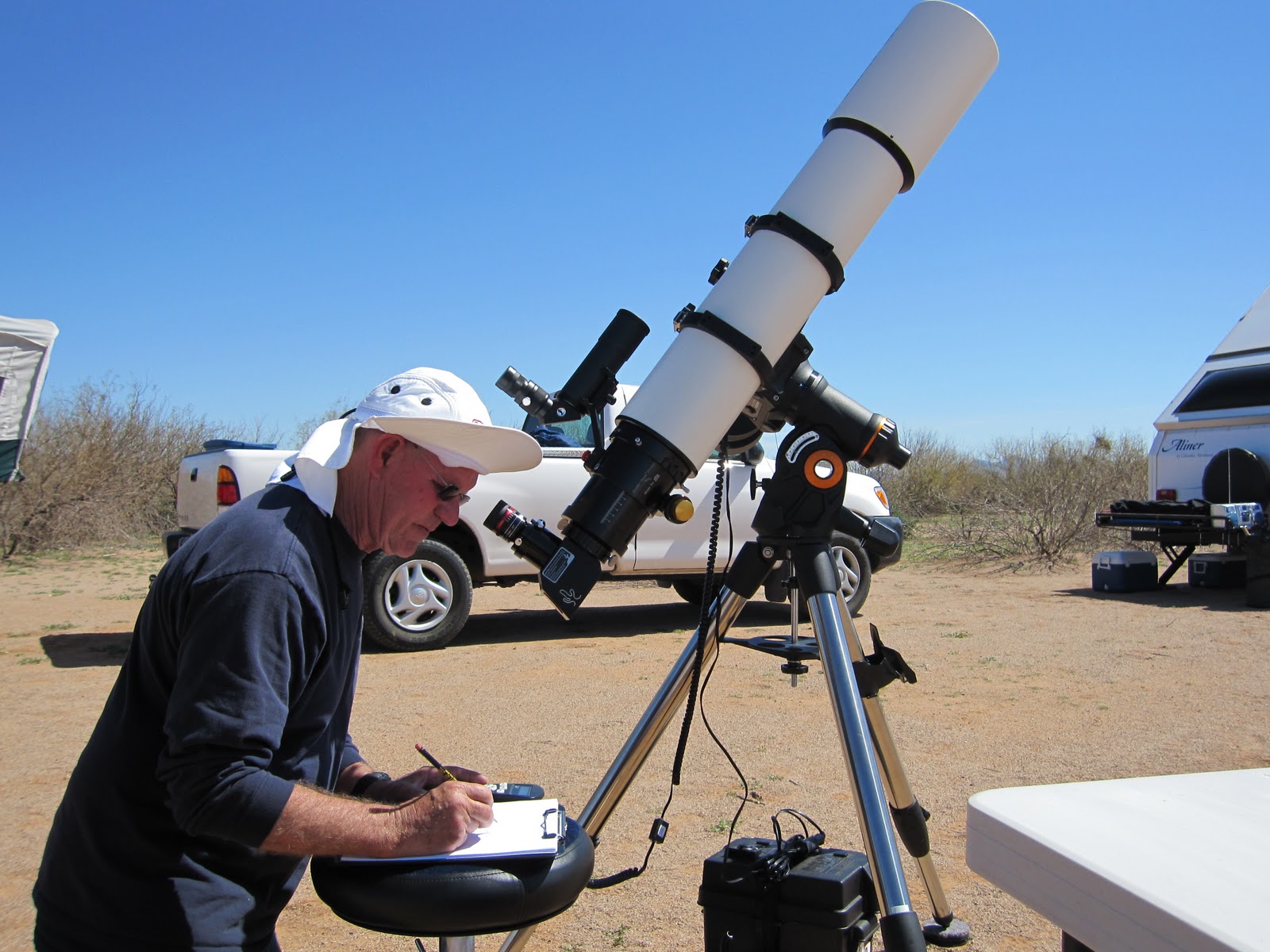
The Astronomy Sketch of the Day website is in the same vein as the very famous Astronomy Picture of the Day website. Amateur astronomers from around the world submit sketches that they have made while observing and each day one is selected as the sketch of the day. Certainly in this age of astrophotography, there are many fewer individuals sketching at the eyepiece than taking photos. Nevertheless, I was quite tickled that my sketch was featured. As they say, every dog has his day!
Friday, August 6, 2010
Astronomy Sketch of the Day
There is not a lot of observing going on this week as the monsoon weather pattern does its thing...which is fill the sky with dark clouds, blow around a lot of dust, and then sprinkle just enough that your car is a mess from the blown dust. I did awake today to a nice astronomical surprise, however, in that my sketch of the sun in hydrogen alpha from July 31st was featured as the August 5th Astronomy Sketch of the Day! (Follow the link!)
The Astronomy Sketch of the Day website is in the same vein as the very famous Astronomy Picture of the Day website. Amateur astronomers from around the world submit sketches that they have made while observing and each day one is selected as the sketch of the day. Certainly in this age of astrophotography, there are many fewer individuals sketching at the eyepiece than taking photos. Nevertheless, I was quite tickled that my sketch was featured. As they say, every dog has his day!
The music is playing on this award ceremony, but before I am kicked off stage, I want to thank my good friend Jerry Farrar who is my mentor when it comes to sketching and observing the sun; truth be told, he is my mentor in quite a few aspects of visual amateur astronomy.
The Astronomy Sketch of the Day website is in the same vein as the very famous Astronomy Picture of the Day website. Amateur astronomers from around the world submit sketches that they have made while observing and each day one is selected as the sketch of the day. Certainly in this age of astrophotography, there are many fewer individuals sketching at the eyepiece than taking photos. Nevertheless, I was quite tickled that my sketch was featured. As they say, every dog has his day!
Tuesday, August 3, 2010
The William Optics 28mm UWAN
I tend to get a little stir crazy during the summer monsoon as far as astronomy goes- I am spoiled living in the desert southwest with many clear dry nights. So when a few weeks go by with no opportunity for night time observing I turn to other aspects of my hobby (addiction) for entertainment. Having already cleaned the observatory a few times (you could eat off the floor) and having already installed a nice new shelf from Target to hold some of my books and stuff, I made an impulse buy and acquired a used William Optics 28mm UWAN eyepiece. I had heard good things about it from other TEC 140 users so when I saw one for sale on Astromart I asked myself "Do I need this eyepiece?" I quickly answered myself saying "Self....No. No. A thousand times, no. You already have a very nice 31mm Baader eyepiece" A few hours later I had made the deal and it would soon be shipped.
After a week of cloudy nights, the weather gods took pity on me, and the past two nights proved to be fantastically clear with very good seeing and no moonlight until after midnight. I used the opportunity to test this new eyepiece extensively in my TEC 140 and what follows are my subjective observations and experiences using this eyepiece.
I decided to compare this eyepiece to my Baader 31mm Hyperion Ashperic which is obviously similar in terms of the power it delivers in the scope. The picture to the left gives you an idea of the relative size of the monster in comparison to the Baader 31mm, and a can of Pepsi...keep in mind that these eyepieces both have 2 inch barrels, so you can see how physically massive the 28mm UWAN is. Before I provide you with my subjective impressions, I'll give you some of the objective information as taken from the respective companies, as well as some of the exit pupil, power, and field of view calculations for the scopes I own.
Eyepiece William Optics 28mm UWAN Baader Planetarium 31mm Hyperion Aspheric
Manufacturer info William Optics Baader Planetarium
Price Retail/Used $339/$250 $189/$150
Eye Relief 18mm stated 18mm stated
Weight 1000 grams (2lbs. 3 oz.) 390 grams (13.8 oz.)
Apparent F.O.V. 82 degrees 72 degrees
Using TEC 140 (f/7)
Exit pupil 4mm 4.5mm
Magnification 35X 31X
True field of view 2.3 degrees 2.3 degrees
So now that we have the objective data out of the way, how did the eyepiece perform for me? My conclusion first...Overall, I am quite satisfied with the 28mm UWAN, and will be selling the Baader 31mm. The Baader is a very, very good eyepiece for the money, however, the 28mm UWAN does most everything just a little better. You can see from the data that these eyepieces are very close in both magnification delivered, exit pupil and field of view- so the differences that I am about to describe are my subjective experiences using the eyepiece.
Prior to explaining why I preferred the views in the UWAN, there are some ergonomic issues worth noting in the event you are considering one or the other of these eyepieces. First, is the aforementioned weight. The Baader weighs less than a pound, and is remarkably light for an eyepiece with a 72 degree apparent field of view. The 28mm UWAN is over 2 pounds and will impact your telescopes balance. Second, while the stated eye relief is 18mm for both eyepieces, the experience using them is quite different. To the right is an image of the eye lenses and you can see that the UWAN eye lens is slightly smaller and you may be able to tell that it is recessed into the eyepiece top. When using the 28mm UWAN, it does not feel like one has 18mm of eye relief. In fact, to see the field stop, I have to place my eye almost all the way to the housing. This is not an issue for me as the lens itself is recessed and my eyelashes do not touch. I also find myself tilting my head slightly to get the best position to see the entire field. The UWAN has a very smooth twist up eye-cup, however, I can not use this as if it is up at all I can not see the entire field of view. The Baader 31mm is very comfortable to use and the eye relief measurement seems accurate. For public outreach the Baader 31mm would be a better choice on its ergonomic characteristics alone.
On to the views, and the reasons why I prefer the 28mm UWAN. I observed several types of objects with both eyepieces- nebula including M8, M17 and NGC 7000; planetary nebula including M57, M27, and the young, small NGC 7027 in Cygnus; Globular clusters including M22, M13, M20, M5, and NGC 7006 in Delphinus; The Veil supernova remnant NGC 6992; and the galaxy NGC 7331 in Pegasus. Observations of faint nebula were made both unfiltered and with my Baader planetarium UHC-S filter.
I'll present my findings in descending order of the perceived difference. In other words, I'll address sharpness first as I felt this was the greatest difference in the views...sky background will be second as I felt this was the second greatest difference. Last will be color as I felt there was no difference in eyepieces.
First, the Baader 31mm is very sharp on axis, however, stars in the outer 25% of the field of view increasingly look like little flares as they approach the edge. The 28mm UWAN on the other hand was sharp all they way past 90% of the field of view. Even the outer 10% of the field was not nearly as distorted as in the Baader. In terms of sharpness, the 28mm UWAN clearly had the edge (pun intended).
The second thing I noticed when using these eyepieces was that the 28mm UWAN revealed a darker sky background. I was surprised by this given that the eyepieces are so close in focal length. This was an obvious and marked difference between the eyepieces. Had I not perhaps been unconsciously biased to look at sharpness first, the sky background may have struck me immediately.
Third, and I hate to use such a subjective construct, was faint detail. When observing star clusters, there were not any stars that I noticed in one eyepiece that I could not see in the other. That being said, there were faint stars that were easier to see in the 28mm UWAN...easier than the magnification difference alone would dictate. I do not know if it is related to sky background, coating differences, or anything for that matter. Contrast is a touchy subject when discussing eyepieces and I am trying to avoid using that term...but faint detail was easier to see in the 28mm UWAN. Nebula in particular were brighter and faint extensions were more readily seen in the 28mm UWAN. This was most noticeable when observing NGC 6992, the eastern portion of the veil. Also, the lagoon nebula (M8) revealed more structure in the UWAN. To the left is a sketch I made of M8 using the UWAN 28mm and the Baader UHC-S filter.
Finally, I looked for differences in how the eyepieces rendered star colors. With fainter stars within clusters I could not tell a difference between eyepieces. I did point at the bright and colorful double Albireo and could not detect a color difference between eyepieces on this bright pair either.
In conclusion, the William Optics 28mm UWAN is an excellent eyepiece for use in an f/7 refractor. It is significantly more money than the Baader 31mm, but in my opinion, the views are worth the difference. The Baader is more comfortable to use for a beginner or a member of the public at an outreach event, however, for the experienced amateur, the UWAN does manage to quickly get out of the way and let one observe. Unless something is radically different in my f/10 SCT, look for the Baader Hyperion on the used market soon.
Saturday, July 31, 2010
Monsoon madness
Fifteen hours ago we were in the midst of the best rainstorm we've had all year. We received about 2.25 inches of rain over two hours. This morning I was out observing the sun and it was so hot and humid I had to shower when finished. Now, we are about to get drenched with another very heavy downpour. For those of you who appreciate the desert (or Tucson...and I know you are out there somewhere), the normally dry Tanque Verde creek was flowing at 12 feet over night, and the Santa Cruz was at 15 feet and rising still this morning!
As mentioned, I was out observing during a brief window of sun this morning. I completed the sketch at 1628 UT (9:28 MST) using my Lunt Solar systems 60mm Hydrogen Alpha (Ha) telescope. The sun was a bit more active than yesterday with the sunspot in Active Region 11092 continuing to grow and darken. There is also a small bit of plage associated with a thin filament to the east of the spot. I assume it is part of the same active region, as it has persisted for a few days. Many limb prominences are present, as well as the two dark, snaking filaments slithering their way across the northern hemisphere. When I made the sketch, the sun was approximately 45 degrees above the eastern horizon and many high cirrus clouds were passing through the area. With the relative humidity around 60%, the seeing was rather mushy and it was hard to note fine details in the prominences.
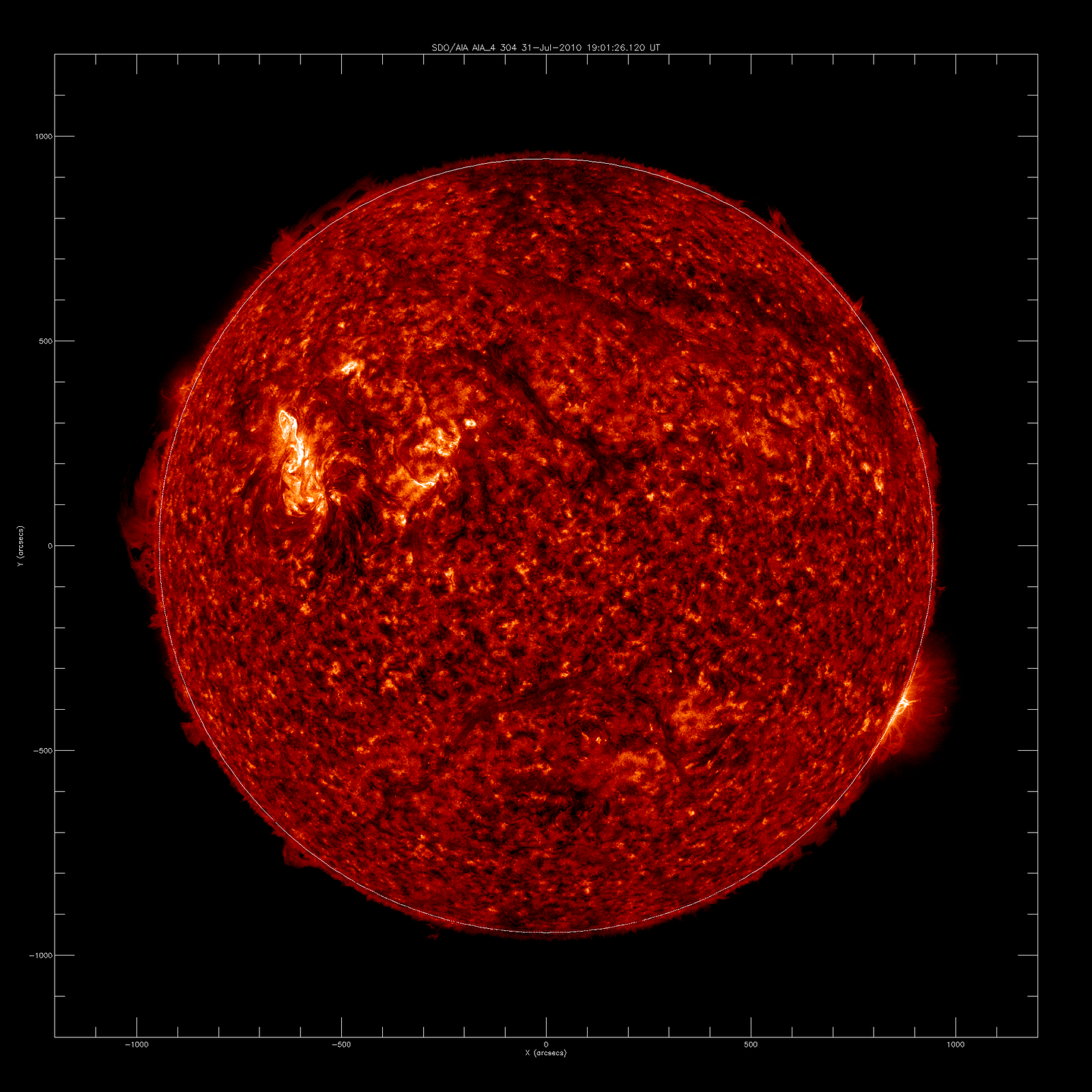
I regularly share my observations on the Cloudy Nights Solar Observing Forum where many other observers from around the world also share their observations, sketches and images. P-M Hedén is a Swedish observer and photographer who maintains an excellent blog (for those of you fluent in Swedish!). He posted the image to the right on Cloudy Nights this morning. In his image east is to the left (my sketch has east to the right). Be sure and click on the image for the high resolution version. The images below are from the SolarMonitor.org website, and the Solar Dynamics Observatory and are both Ha images from today as well.
Finally, for those of you who know the story behind the Lost Pleiad Observatory, today would have been our Lost Pleiad, Laura's 39th birthday. We miss you.
As mentioned, I was out observing during a brief window of sun this morning. I completed the sketch at 1628 UT (9:28 MST) using my Lunt Solar systems 60mm Hydrogen Alpha (Ha) telescope. The sun was a bit more active than yesterday with the sunspot in Active Region 11092 continuing to grow and darken. There is also a small bit of plage associated with a thin filament to the east of the spot. I assume it is part of the same active region, as it has persisted for a few days. Many limb prominences are present, as well as the two dark, snaking filaments slithering their way across the northern hemisphere. When I made the sketch, the sun was approximately 45 degrees above the eastern horizon and many high cirrus clouds were passing through the area. With the relative humidity around 60%, the seeing was rather mushy and it was hard to note fine details in the prominences.I regularly share my observations on the Cloudy Nights Solar Observing Forum where many other observers from around the world also share their observations, sketches and images. P-M Hedén is a Swedish observer and photographer who maintains an excellent blog (for those of you fluent in Swedish!). He posted the image to the right on Cloudy Nights this morning. In his image east is to the left (my sketch has east to the right). Be sure and click on the image for the high resolution version. The images below are from the SolarMonitor.org website, and the Solar Dynamics Observatory and are both Ha images from today as well.
![]() |
| SolarMonitor.org |
![]() |
| Solar Dynamics Observatory |
Finally, for those of you who know the story behind the Lost Pleiad Observatory, today would have been our Lost Pleiad, Laura's 39th birthday. We miss you.
Thursday, July 29, 2010
Solar observations
Having a few days between returning from vacation (see the previous posts) and my return to work, I have had a chance to get back to some regular solar observing. The days are quite humid right now and the window to observe is quite brief. The overnight cloud cover seems to disappear about 8:00 AM and by 10:00 the atmosphere is already revving up for some afternoon showers. Or so we hope...
I observed the sun in hydrogen alpha both yesterday and today and was able to make sketches both days. You will see that the activity is very similar from yesterday to today, with the features moving a bit to the west from one day to the next. (Note that my North and West compass points are estimations, and not actual measurements).
Jim Ferreira of Livermore, CA took this impressive photo sequence of an eruptive prominence just before sunset yesterday. Click on the image for the full size! Jim is an accomplished astrophotographer and I would recommend you visit his website by clicking on his name above. He uses Stellarvue telescopes for much of his work, which is the same company that produced my 90mm triplet refractor and two of my previous scopes.
I observed the sun in hydrogen alpha both yesterday and today and was able to make sketches both days. You will see that the activity is very similar from yesterday to today, with the features moving a bit to the west from one day to the next. (Note that my North and West compass points are estimations, and not actual measurements).
![]() |
| July 28, 2010 ~ 1720 UT |
![]() |
| July 29, 2010 ~ 1540 UT |
Active Region (AR) 11089 is decaying as it approaches the southwestern limb, but we are fortunate to have AR 11092 coming around in the northeast. In fact, this region was just numbered today. Within 11092, a strong sunspot has developed, although observing in hydrogen alpha does not show the spot with any detail. There are many dark fibrils within and around the region and hopefully it will develop further. While there are a few dark filaments in the northern hemisphere, there is a surprising lack of prominences on the limb. The Picture to the right is from the Solar Dynamics Observatory's Atmospheric Imaging Assembly which is now posting real time solar data. The picture is reversed est to west from my sketches. In it, you can see the active regions and some of the filament structure that I observed in hydrogen alpha.
Jim Ferreira of Livermore, CA took this impressive photo sequence of an eruptive prominence just before sunset yesterday. Click on the image for the full size! Jim is an accomplished astrophotographer and I would recommend you visit his website by clicking on his name above. He uses Stellarvue telescopes for much of his work, which is the same company that produced my 90mm triplet refractor and two of my previous scopes.Tuesday, July 27, 2010
Thunder Ridge Star Party ~ Observing Report
During my trip to Colorado, I once again attended the Thunder Ridge Star Party (TRSP) hosted by my friend Phil Good. The TRSP-IV was held July 9 - 11 at Phil's ranch property, at approximately 9000' overlooking Eleven Mile State Park. The location is excellent for a star party given its elevation, clear southern horizon, and weather. While storms often roll through in the summer afternoons and evenings, the skies often clear quickly after sunset. Some of us who attended TRSP-III last year, are also aware of the kindred native spirits that frequent the ridge...
...The area was a fruitful hunting ground for our ancestors, and evidence remains today on Thunder Ridge. A walk around the ridge will reveal signs of circles where ancient fires burned within teepees. Careful hunting will reward one with fragments of worked stone and an occasional arrowhead. During TRSP-III, several of us had left our tripods and/or scopes set up from one night to the next. During the intervening afternoon, a very strong, rogue gust of wind lifted every piece of equipment and threw them several feet. Miraculously, nothing was damaged...not a mount, not a scope, not even Phil's brand new TEC 180mm Flourite refractor, "Uncle Milt," sitting atop its mount. Clearly, the ancients were amateur astronomers and made sure to protect our gear.
This year, the skies were quite good on Friday night. By dark, I would estimate the seeing at 4/5 with occasional moments of 4.5/5. The transparency was near perfect, and while just a guess, I would estimate that the NELM at zenith was approximately 7. Frank Nadell (I think) had a sky quality meter and perhaps he can chime in with a more accurate figure. I had brought along my TEC-140 APO on my DM-6, as well as many charts and a lengthy observing list. I observed many objects over two nights, and below I'll overview the highlights.
First up was Pluto. I had observed all the planets except Pluto, when the International Astronomical Union (IAU) stepped in and demoted Pluto to the status of "Dwarf Planet." How this happened and why makes for interesting reading, and Universe Today sums it up nicely. Despite the arrogance of the IAU, I was still intent on seeing the little guy. To be honest, I was not sure that I would be able to pull it in with the 140mm of aperture, but I was bound and determined to give it the old college try. Circumstances during the TRSP were just right for a serious run at this faint speck, not only due to the dark skies but also due to the fact that Pluto was passing Barnard 92, a dark nebula. This would make its identification much simpler in that there were no stars to confuse it with, even though it is passing through the heart of the milky way in Sagittarius. To the left is the star chart from the July Sky and Telescope that I used to locate the star field and hunt for the object Pluto, formerly known as a planet. I inserted a 5mm Pentax XW (196X) and began to look for Pluto. After about 10 minutes I glimpsed a faint speck with averted vision. I looked away and looked back and there it was again. It was very difficult to hold in my sight, and I realized that the best way to confirm what I was seeing was to get a look through Franks 12 inch Dob. A few minutes later (and after getting my brain over the up-down reversal of the image in the dob) and I had confirmed that the tiny speck was indeed there! Back at the TEC 140 and little Pluto was still extremely difficult to hold in view. At a visual magnitude of 14, this was quite a catch in the TEC 140! Pluto was approximately 30.88 AU distant, which equates to about 257 light minutes!
After the hard work observing Pluto, I was ready for some easier targets. I inserted a 20mm Nagler (49X) and headed over to NGC 6514, the Trifid Nebula, M20. The view was dramatic. Not only were the dust lanes obvious, but the definition on the edges of the lanes was jaw dropping. There was a definite structure to the lanes...I had never seen the nebula as well. Indeed, even the blue reflection nebulosity alongside the Trifid (to the right in the image) was clearly visible in the eyepiece. This was quite a treat and a testament to the skies.
At this point, I had not even considered my observing list, so I spent the rest of the first evening observing many of the other famous Messier objects in the summer sky such as globular clusters M13 and M22, The Swan Nebula (M17), and the great Andromeda Galaxy, M31. I observed at least a dozen other globular clusters in and around the Sagittarius teapot that I found simply by panning the scope around. The wide-field views were so breathtaking that I was not concerned with getting out the atlas to identify the objects.
I was beginning to get sleepy but decided that since I had visited Pluto earlier (and Saturn before it set), I should finish up the other outer planets that were now in the sky...namely Uranus, Neptune and Jupiter. The seeing was deteriorating and Jupiter was difficult at high power. We were treated to a view of a moon transit, although I do not recall which moon it was. At about 2:30 AM it was time to hit the sack.
Day two dawned bright and clear and after a good brunch in nearby Hartsel, we (Ian, my niece Cierra, and I) joined Frank and his son Henry on a day trip to find some good bouldering near the 11 mile reservoir. We had fun scrambling around, eating ice cream, and taking in the views before heading back to Phil's famous "surf-n-turf" BBQ and a second night of observing.
The weather was not shaping up to be as good as the previous night with heavy cloud cover blanketing the area throughout dinner...yet, as often happens at Thunder Ridge, the skies completely cleared within an hour after sunset. Despite seeing conditions that were just average, I still had an observing list of deep sky objects that I wanted to make some headway on. Fortunately, deep sky targets do not suffer from atmospheric turbulence at the level of planets or close double stars. Faint fuzzy objects, remain faint fuzzy objects in most conditions. I had compiled a list of objects from Sue French's columns in the June and July issues of Sky and Telescope magazine. She is an excellent observer and her columns are chock full of information and observing ideas. In fact, they are my favorite feature of the magazine. Following are highlights from my notes from night two:
NGC 6210 - The Turtle Nebula in Hercules. At 3600 light years this planetary nebula is a smooth elliptical shaped nebula with an extremely faint halo.
NGC 6400 - Open cluster in Scorpius. An approximately 9th magnitude cluster with many faint stars ranging from magnitude 10 to 12. A little lost in the background. Distance of 3100 light years.
NGC 6441 - Globular cluster in Scorpius. This one looks familiar as I visited it last night! It sits alongside the golden star G Scorpii. It is small and difficult to resolve but makes an attractive pairing with 'G'. Interestingly, this is one of only four known globular clusters that houses a planetary nebula...and no, I did not see the planetary!
NGC 6302 - The Bug Nebula in Scorpius. Sometimes called the butterfly nebula. This is a small planetary nebula sporting a fairly bright core with extensions that are faint yet quite long. Distance is 2000 light years.
NGC 6281 - Open cluster in Scorpius. Best at low power, this is a run of the mill open cluster. Better looking in the finder scope!
NGC 6569 & NGC 6558- Globular Clusters in Sagittarius. At 49X (20mm Nagler), these clusters fit in the same field of view in the TEC 140. Surrounded by many stars, these clusters appear to float in the froth of themilk shake, I mean milky way...just seeing if you are still paying attention! Both of these clusters can be partially resolved at high power.
NGC 6624 - Globular Cluster in Sagittarius. Very nice at both low and high power. At low power there is a long chain of about 12 magnitude 10 stars that form a line running right into the clusters northern side. At high power the cluster displays a bright condensed nucleus and is partially resolved.
NGC 6652 - Globular Cluster in Sagittarius. This cluster is parked about 1 degree from M69 and shares the low power field of view. It is a nice paring and a fitting way to end the second night!
All in all, this was the best TRSP I have attended- not only was the observing first rate, but the company was as well! I got to see some old friends like Jim and Jeannette, Frank and Henry, and Benton, but I made some new ones like Scott, Rebekah and Aaron; Patricia; and Darren and and his dad Burton who drove from Canada. For those of you who don't know, my trip to Colorado each year is a father-son trip that I do with Ian, and it was great to see Darren and his dad on a father-son trip. I hope that when Ian is in his 40's he still wants to travel with me. As always, Phil is the ultimate host...it would not happen without him...who knows maybe I'll have a report on TRSP-V next July...
| Which of these Bison is different? |
This year, the skies were quite good on Friday night. By dark, I would estimate the seeing at 4/5 with occasional moments of 4.5/5. The transparency was near perfect, and while just a guess, I would estimate that the NELM at zenith was approximately 7. Frank Nadell (I think) had a sky quality meter and perhaps he can chime in with a more accurate figure. I had brought along my TEC-140 APO on my DM-6, as well as many charts and a lengthy observing list. I observed many objects over two nights, and below I'll overview the highlights.
First up was Pluto. I had observed all the planets except Pluto, when the International Astronomical Union (IAU) stepped in and demoted Pluto to the status of "Dwarf Planet." How this happened and why makes for interesting reading, and Universe Today sums it up nicely. Despite the arrogance of the IAU, I was still intent on seeing the little guy. To be honest, I was not sure that I would be able to pull it in with the 140mm of aperture, but I was bound and determined to give it the old college try. Circumstances during the TRSP were just right for a serious run at this faint speck, not only due to the dark skies but also due to the fact that Pluto was passing Barnard 92, a dark nebula. This would make its identification much simpler in that there were no stars to confuse it with, even though it is passing through the heart of the milky way in Sagittarius. To the left is the star chart from the July Sky and Telescope that I used to locate the star field and hunt for the object Pluto, formerly known as a planet. I inserted a 5mm Pentax XW (196X) and began to look for Pluto. After about 10 minutes I glimpsed a faint speck with averted vision. I looked away and looked back and there it was again. It was very difficult to hold in my sight, and I realized that the best way to confirm what I was seeing was to get a look through Franks 12 inch Dob. A few minutes later (and after getting my brain over the up-down reversal of the image in the dob) and I had confirmed that the tiny speck was indeed there! Back at the TEC 140 and little Pluto was still extremely difficult to hold in view. At a visual magnitude of 14, this was quite a catch in the TEC 140! Pluto was approximately 30.88 AU distant, which equates to about 257 light minutes!
After the hard work observing Pluto, I was ready for some easier targets. I inserted a 20mm Nagler (49X) and headed over to NGC 6514, the Trifid Nebula, M20. The view was dramatic. Not only were the dust lanes obvious, but the definition on the edges of the lanes was jaw dropping. There was a definite structure to the lanes...I had never seen the nebula as well. Indeed, even the blue reflection nebulosity alongside the Trifid (to the right in the image) was clearly visible in the eyepiece. This was quite a treat and a testament to the skies.
At this point, I had not even considered my observing list, so I spent the rest of the first evening observing many of the other famous Messier objects in the summer sky such as globular clusters M13 and M22, The Swan Nebula (M17), and the great Andromeda Galaxy, M31. I observed at least a dozen other globular clusters in and around the Sagittarius teapot that I found simply by panning the scope around. The wide-field views were so breathtaking that I was not concerned with getting out the atlas to identify the objects.
I was beginning to get sleepy but decided that since I had visited Pluto earlier (and Saturn before it set), I should finish up the other outer planets that were now in the sky...namely Uranus, Neptune and Jupiter. The seeing was deteriorating and Jupiter was difficult at high power. We were treated to a view of a moon transit, although I do not recall which moon it was. At about 2:30 AM it was time to hit the sack.
Day two dawned bright and clear and after a good brunch in nearby Hartsel, we (Ian, my niece Cierra, and I) joined Frank and his son Henry on a day trip to find some good bouldering near the 11 mile reservoir. We had fun scrambling around, eating ice cream, and taking in the views before heading back to Phil's famous "surf-n-turf" BBQ and a second night of observing.
The weather was not shaping up to be as good as the previous night with heavy cloud cover blanketing the area throughout dinner...yet, as often happens at Thunder Ridge, the skies completely cleared within an hour after sunset. Despite seeing conditions that were just average, I still had an observing list of deep sky objects that I wanted to make some headway on. Fortunately, deep sky targets do not suffer from atmospheric turbulence at the level of planets or close double stars. Faint fuzzy objects, remain faint fuzzy objects in most conditions. I had compiled a list of objects from Sue French's columns in the June and July issues of Sky and Telescope magazine. She is an excellent observer and her columns are chock full of information and observing ideas. In fact, they are my favorite feature of the magazine. Following are highlights from my notes from night two:
NGC 6210 - The Turtle Nebula in Hercules. At 3600 light years this planetary nebula is a smooth elliptical shaped nebula with an extremely faint halo.
NGC 6400 - Open cluster in Scorpius. An approximately 9th magnitude cluster with many faint stars ranging from magnitude 10 to 12. A little lost in the background. Distance of 3100 light years.
NGC 6441 - Globular cluster in Scorpius. This one looks familiar as I visited it last night! It sits alongside the golden star G Scorpii. It is small and difficult to resolve but makes an attractive pairing with 'G'. Interestingly, this is one of only four known globular clusters that houses a planetary nebula...and no, I did not see the planetary!
NGC 6302 - The Bug Nebula in Scorpius. Sometimes called the butterfly nebula. This is a small planetary nebula sporting a fairly bright core with extensions that are faint yet quite long. Distance is 2000 light years.
NGC 6281 - Open cluster in Scorpius. Best at low power, this is a run of the mill open cluster. Better looking in the finder scope!
NGC 6569 & NGC 6558- Globular Clusters in Sagittarius. At 49X (20mm Nagler), these clusters fit in the same field of view in the TEC 140. Surrounded by many stars, these clusters appear to float in the froth of the
NGC 6624 - Globular Cluster in Sagittarius. Very nice at both low and high power. At low power there is a long chain of about 12 magnitude 10 stars that form a line running right into the clusters northern side. At high power the cluster displays a bright condensed nucleus and is partially resolved.
NGC 6652 - Globular Cluster in Sagittarius. This cluster is parked about 1 degree from M69 and shares the low power field of view. It is a nice paring and a fitting way to end the second night!
| Darren and Burton |
| Scott, Benton, Darren |
| Phil, Patricia, and...Darren! |
Monday, July 26, 2010
Back in the Old Pueblo ~ Summer 2010
As July winds down, Ian and I have returned from our annual summer camping trip to Colorado. This year we we were fortunate to have Cierra, my niece and Ian's cousin, along on our adventure. There is a slideshow at the bottom of this post that takes you through about a hundred photos from our two week trip.
We began the trip by attending the Thunder Ridge Star Party, near Eleven Mile State Park, in Park County, Colorado. This is a small star party attended by a group of astronomers that met through the Yahoo Stellarvue Users Group. While there were many Stellarvue scopes present, I had brought along my TEC 140 as well as my Lunt Solar Systems 60mm Hydrogen Alpha scope. I will detail my observations from the star party in the next post. The pictures below are of the kids at 11 mile reservoir, as well as some Bison in the area (and see if you can tell which Bison is different from the others!)
Following the star party, we headed a bit south to Cutty's RV Resort. Ian really likes Cutty's as it is a very pretty camp spot on Hayden Creek in Coaldale, CO. I like it as it gives me a chance to re-charge the pop-up tent trailer battery and do some laundry! This location also served as our jumping off point for a very pretty afternoon trail ride along the base of Mt. Princeton. With Ian riding Toy, Cierra riding Echo, and me chilling on Dan, we experienced phenomenal views of Mt. Princeton and the chalk cliffs.
Next stop was the Pine Cove Campground on Lake Dillon near Frisco, CO. This campsite served as base camp for canoeing, motor boating and hiking two 14,000+ foot peaks! Last year Ian and I hiked Mount Democrat (14,148 ft) and this year we returned to the Mosquito Range to attempt both Mount Cameron (14,238 ft) and Mount Lincoln (14,286 ft). Climbing 14'ers is serious business and the kids were really impressive as we summited both peaks! These peaks are reached from the Kite Lake trailhead near the town of Alma, CO, and Mount Lincoln is the 8th highest peak in CO. Next year we are going to return to this area and attempt the "Decalibron" which is a loop trail that takes one to the summits of Mount Democrat, Mount Cameron, Mount Lincoln and Mount Bross...not for the faint of heart!
Of course, while the assault on the 14'ers was fun, the kids really liked being on the water. We went canoeing around some of the islands in the Dillon Reservoir and saw an osprey nest. We also went motor boating one day and the kids really enjoyed bouncing around the waves which were being whipped up by afternoon winds. There are worse ways to spend one's days...

Following these activities, we drove over to Utah and camped with my best friend from childhood Blake, and his daughter Samantha on the west fork of Huntington Creek in the Manti-La Sal National Forest of Utah. This area was quite beautiful with towering spruce trees and the creek just outside the tent. It was great to catch up with Blake and watch the kids play in the water. After a couple days camping we headed north to Salt Lake to get 'citified' and spend more time with Blake, Samantha, and his spouse Holly. Despite the many things to be done in SLC, Ian and Cierra really enjoyed just hanging out at the house and feeding the chickens! All in all we had a great visit with them...unfortunately we had to head back to Tucson as work and school are rapidly approaching!
We began the trip by attending the Thunder Ridge Star Party, near Eleven Mile State Park, in Park County, Colorado. This is a small star party attended by a group of astronomers that met through the Yahoo Stellarvue Users Group. While there were many Stellarvue scopes present, I had brought along my TEC 140 as well as my Lunt Solar Systems 60mm Hydrogen Alpha scope. I will detail my observations from the star party in the next post. The pictures below are of the kids at 11 mile reservoir, as well as some Bison in the area (and see if you can tell which Bison is different from the others!)
Following the star party, we headed a bit south to Cutty's RV Resort. Ian really likes Cutty's as it is a very pretty camp spot on Hayden Creek in Coaldale, CO. I like it as it gives me a chance to re-charge the pop-up tent trailer battery and do some laundry! This location also served as our jumping off point for a very pretty afternoon trail ride along the base of Mt. Princeton. With Ian riding Toy, Cierra riding Echo, and me chilling on Dan, we experienced phenomenal views of Mt. Princeton and the chalk cliffs.
| Mt. Lincoln Summit! |
| Mt. Cameron Summit! |
Of course, while the assault on the 14'ers was fun, the kids really liked being on the water. We went canoeing around some of the islands in the Dillon Reservoir and saw an osprey nest. We also went motor boating one day and the kids really enjoyed bouncing around the waves which were being whipped up by afternoon winds. There are worse ways to spend one's days...
Monday, July 19, 2010
Where am I?
Just a quick note for the few of you that read the blog....I am still around and still doing some astronomy! I have been travelling the country since late June visiting family in North Carolina (see previous post), camping and attending the Thunder Ridge Star party in Colorado, as well as camping and visiting a childhood friend in Utah. I have my scopes with me, and upon my return to Tucson at the end of July I will post a full report of the trip and astronomical observations...and I will get back to the Lost Pleiad Observatory Blog's regularly scheduled programming. Until then- Stay thirsty my friends!
Subscribe to:
Posts (Atom)