Click to enlarge
Friday, September 16, 2011
Spotapalooza - A festival of sunspots!
I am working remotely from my home office today, which provided me an opportunity to grab a quick peek at the Sun while eating some lunch. I did not have enough time to make a hydrogen alpha sketch, but the white light view of the Sun revealed as many spots as I can remember seeing in several years. It is a downright spotapalooza! A festival of sunspots! As it is mid-day, the atmospheric seeing conditions are a bit unsteady and it is difficult to tell how many small spots are in the larger regions. Regardless, there are too many to accurately sketch them all while eating a sandwich and stressing out about job related nonsense. Below is my sketch from 1840 UT, and a comparison image from the Solar Dynamics Observatory taken at 1824 UT. I completed my sketch using my TEC 140mm APO and a Lunt Solar Systems Herschel Prism.
Sunday, September 11, 2011
80 degree(!) Solar observation
The last two nights have brought some remarkable thunderstorm activity to the Lost Pleiad Observatory. While I do not have a rain gauge, those in the vicinity would suggest that we received around 1.5 inches of rain last night. That may not sound like a lot to many of you, but consider that our annual rainfall total this year was less than 10 inches. There were several funnel clouds spotted last night around the Tucson valley along with unconfirmed reports of a tornado touching down. The low pressure system that is causing these storms remains in place over Los Angeles and more storms are likely tonight...which means that the atmosphere remains fairly unstable.
I made an observation of the Sun this morning, and while the atmospheric stability was only fair, it was wonderful to be sitting at the scope under my towel without a continuous stream of sweat pouring off my body. I had forgotten what 80 degrees feels like! The sketch below was completed at 8:44 AM MST (1544 UT) with my Lunt Solar Systems 60mm Hydrogen Alpha telescope. To the right is an image from Big Bear Solar Observatory captured 5 minutes after my sketch at 1549 UT.
Click to enlarge
There are four numbered active regions visible (to me) on the face, as well as what appears to be a developing region near the east limb on the equator. The most impressive region is 11289 which sports some very large and dark spots, as well as a long snaking region of plage trailing to the east. Consider that it would take about 110 Earths lined up to cross the diameter of the Sun, and you can see that these spots are larger than our own planet!
Departing region 11283 on the west limb was also showing some bright plage this morning as well as a few associated prominences. This region was difficult to observe due to the atmospheric turbulence making the solar limb appear as if it were under water. Both regions 11287 and 11290 appear weak, although my lack of observations this past week leave me unable to determine if these regions are decaying. 11287 does appear to have a spot.
Monday, September 5, 2011
Supernova 2011fe
![]() |
| Click to enlarge |
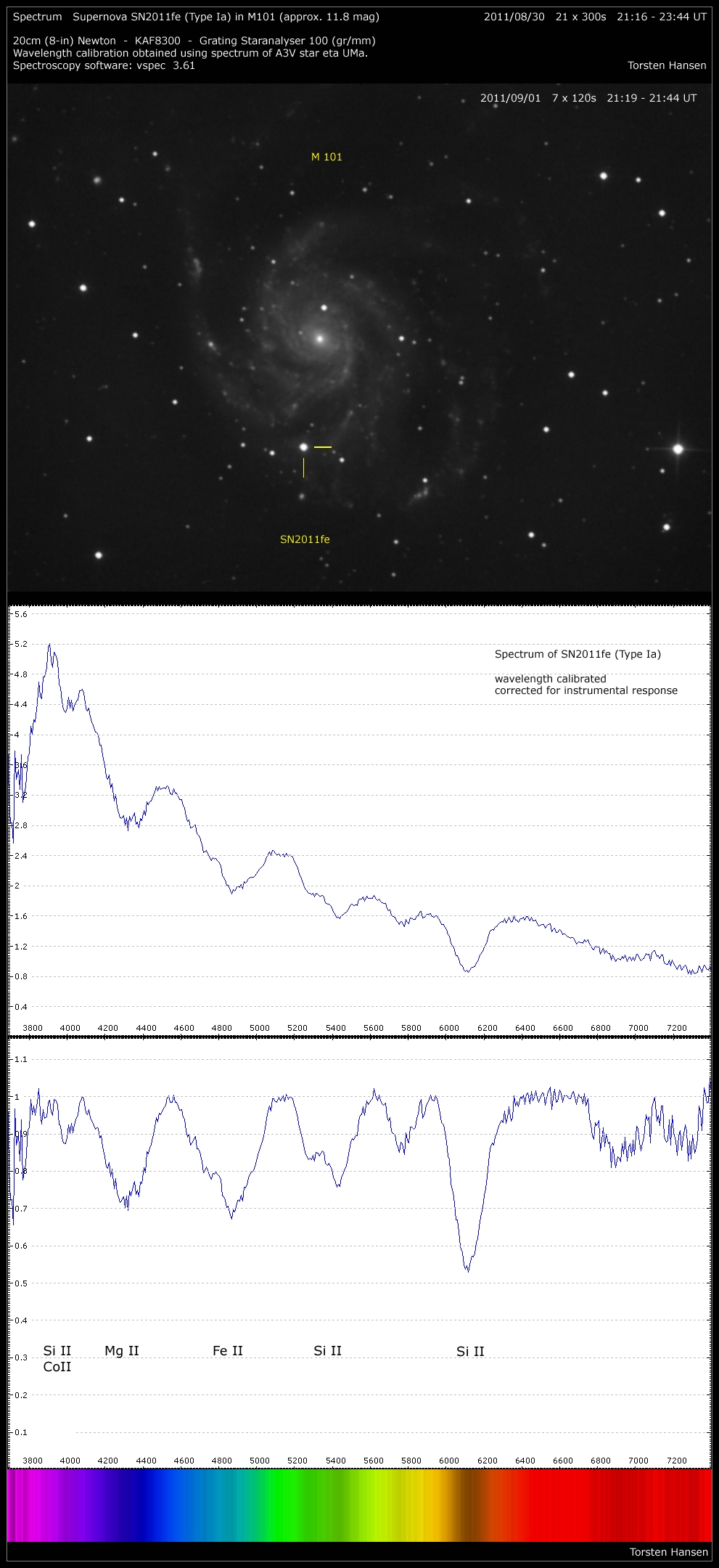
The good news is that the supernova is extremely bright, and easy to identify. It is approximately magnitude 10 and was the brightest object in the field of view. North is at the up in my sketch, with east to the right. In observing the supernova, we were using the 32 inch Schulman telescope and a 21mm Ethos eyepiece, resulting in a magnification of approximately 271X, and a field of view of .4 degrees. The easiest way to identify this supernova is to look for the star just northeast of the nucleus. The supernova is exactly opposite this star, to the southwest, between two bright stars in the field of view. Torsten Hansen has imaged the supernova as well as analyzed it's spectrum, which is the image at right. Spectral analysis is the means by which astronomers are able to study the composition of a star. In addition, astronomers can glean information on the temperature and velocity of the object, particularly whether the object is moving toward us (blue shifted) or away (red shifted). Supernova like 2011fe are further useful to astronomers as they can help to more precisely measure the distance to the host galaxy.For further information on supernova in general, visit this wikipedia page. This is an informative video from the astronomer who first noted the supernova:
Sunday, September 4, 2011
Hot, Hot, Hot
Quite the day for solar observing today, with crystal clear skies and slightly lower humidity than we have had these last several weeks. I completed a sketch of the Sun in hydrogen alpha this morning at 9:42 local time (1642 UT). Skies were quite steady and I was able to see much more detail within each active region than I could possibly capture in a sketch . Active region 11280, which is on the extreme northwest limb, was producing a spectacular prominence that was changing so rapidly that it appeared different each time I looked back to it while sketching other areas. Next to my sketch below is an image from the Big Bear Solar Observatory taken at 1650 UT, just minutes after my sketch.
Update- Andy Devely in the UK maintains The Solar Explorer website which I highly recommend you visit. He posted the animation below of the spectacular prominence erupting from AR 11280 during the time I made my sketch:
Click the images to enlarge them
Update- Andy Devely in the UK maintains The Solar Explorer website which I highly recommend you visit. He posted the animation below of the spectacular prominence erupting from AR 11280 during the time I made my sketch:
Sunday, August 28, 2011
Comet Garradd
As a follow up to the previous post on white light observing with the 4 inch f/11 achromat, I observed and sketched Comet C/2009 P1 Garradd tonight. There was a bit of dust and smoke in the atmosphere all day and I think that the transparency was impacted tonight. Contrast in the scope is excellent, and I do believe that I was seeing a broad and faint tail extending in an easterly direction from the nucleus.
Sketch was completed at 0325 UT under average skies, using a 10mm Pentax XW (110X). The comet has an estimated magnitude of 8.1
![]() |
| Click to enlarge |
Sunspots in white light ~ 28 August, 2011
Recently I acquired a longer focal length achromat, an Astro-telescopes 102mm f/11 refractor. It is a fairly inexpensive telescope given the quality of the objective lens and I intend to write up a review of it soon. While I have not yet used it enough to complete a quality write up, I did want to evaluate it during white light observation of the Sun. To observe the Sun in white light I use a Lunt Solar Systems Herschel Prism, along with a zoom eyepiece and a polarizing filter that allows me to quickly zoom in and out on individual spots, facula and granulation as the seeing permits. Below are a couple of photographs of the telescope mounted in my observatory this morning.
While a longer review of the scope will follow soon enough (forecast for tonight is CLEAR!!), I was extremely happy with the performance of this telescope. The view of the sun is slightly off-white as compared to my TEC 140mm APO, however, the chromatic aberration (de-focused purple light) that I have noticed at night was much less obvious in this solar configuration. Perhaps it was the steady atmosphere, perhaps it has something to with the solar prism and polarizing filter- either way the view was exquisite. This scope will likely become my main instrument for white light observation of the sun. It provides almost as much detail as the TEC 140, yet it is much lighter and there is something comforting about not having the TEC pointing at the sun for extended periods of time.
The sketch at left was completed this morning at 1527 UT, under steady skies. There was a slight amount of high level cirrus that may have lent itself to the impressive image. You can see that spot region 11279 contains two very dark spots and three small spots surrounded by a large penumbra. Just outside this group to the east are 4 small spots. Region 11277 contains two large spots within an oval penumbra. Spot region 11275 near the Sun's meridian contains 4 very small spots. In addition to the numbered regions, there is a large group of spots that have rotated into view on the southeast limb. This region has extensive facula that can bee seen within the limb darkening. Similarly, there is some bright facula on the northwest limb where region 11271 is rotating out of view.
While a longer review of the scope will follow soon enough (forecast for tonight is CLEAR!!), I was extremely happy with the performance of this telescope. The view of the sun is slightly off-white as compared to my TEC 140mm APO, however, the chromatic aberration (de-focused purple light) that I have noticed at night was much less obvious in this solar configuration. Perhaps it was the steady atmosphere, perhaps it has something to with the solar prism and polarizing filter- either way the view was exquisite. This scope will likely become my main instrument for white light observation of the sun. It provides almost as much detail as the TEC 140, yet it is much lighter and there is something comforting about not having the TEC pointing at the sun for extended periods of time.
![]() |
| Click to enlarge |
Saturday, August 27, 2011
Solar Sketch August 27, 2011
The predicted high temperature for today at the Lost Pleiad Observatory is 108 Degrees F, and we are well on our way with temperatures hovering at 101 at 12:45 PM. If we hit this temperature, it will be four of the last seven days that we have tied or broken the record high temperature for a given date. The nice part about this, is that we still have a monsoon moisture pattern in the vicinity and the daily heating jump starts some serious thunderstorms that bring relief...if one is lucky enough to be in the storm's path. Speaking of storm paths, a shout out to those family and friends on the east coast who are getting hit by hurricane Irene. Take cover, and bring your scopes indoors!
This morning I observed the sun and made a sketch of several of the numbered active regions facing the earth. The atmosphere was not great as I had to make the sketch early (7:30-7:55 MST) and the image at the eyepiece was not as steady as I would have liked. Typically, the best window to observe the sun is right around 2 to 3 hours after sunrise. In addition, the transparency was average due, I think, to high levels of humidity.
Below left is my sketch of the sun at 1455 UT, and Below right is an image from the solar observatory at Mauna Loa, Hawaii, part of the National Solar Observatory. The Mauna Loa image is from about 4 hours following my observation.
This morning I observed the sun and made a sketch of several of the numbered active regions facing the earth. The atmosphere was not great as I had to make the sketch early (7:30-7:55 MST) and the image at the eyepiece was not as steady as I would have liked. Typically, the best window to observe the sun is right around 2 to 3 hours after sunrise. In addition, the transparency was average due, I think, to high levels of humidity.
Below left is my sketch of the sun at 1455 UT, and Below right is an image from the solar observatory at Mauna Loa, Hawaii, part of the National Solar Observatory. The Mauna Loa image is from about 4 hours following my observation.
Subscribe to:
Posts (Atom)