I was super busy yesterday as I was leading a program at the
Mount Lemmon SkyCenter, yet early in the day I was hearing reports of a strong flare and coronal mass ejection emanating from a new active region on the Sun. As I did not really have time to set up my solar telescopes I did look on the
Solar Dynamics Observatory webpage and discovered that the "latest" image, at left, was indeed spectacular. The in progress coronal mass ejection was coming off of the northeast limb of the Sun. As it turns out, this ejection was associated with an M class flare- quite a powerful event. Be sure to
click the image to enlarge it.
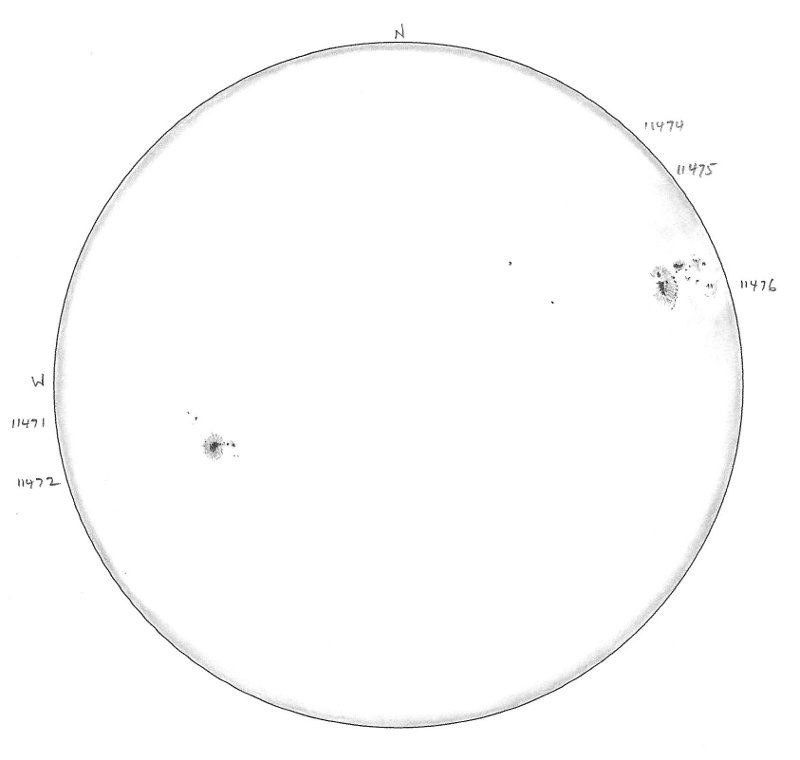
This morning, I set up both my hydrogen alpha and white light solar telescopes to check out the Sun. While impressive in hydrogen alpha, the newly emerging region on the northeast limb is incredibly complex as seen in my white light sketch below. I made the sketch at a magnification of approximately 50X, and the new region 11476 is sporting some dozen spots. While this region is stealing the show, there are four other regions with spots as seen in the sketch. Regions 11474, and 11475 in the northeast each contain one dark spot. Region 11471 in the southwest contains 2 spots, and region 11472 contains a very large spot as well as 5 trailing spots.

Sketch completed at 1640 UT
Carrington rotation No. 2123
Solar Diameter: 31' 42"
Solar altitude: 51 degrees
Solar Azimuth: 104 degrees
Click the sketch to enlarge it
 Occasionally I have posted about my dear spouse and son on the blog, and I have had a couple folks ask about the "Others" in our family...so without too much fanfare, I give you Cosmo, our mutt. He is also affectionately known as Mo-Mo after my nephew Evan first called him that as he was learning to speak (Evan, not Cosmo), and also occasionally as Cosmonaut, Mo-Mo Jones, or when misbehaving - knucklehead. cosmo is 8 years old and is finally, maybe, done with the puppy years!?!
 The other male member of the clan is Spike, our desert tortoise. We adopted Spike about 7 years ago when I was actually wanting a goat (think milk, cheese and free weed control)...I got to discussing my desire to adopt a goat with a woman at the dog park who indicated she needed to find a home for her tortoise as she was relocating to northern climes. Well, this was all Beth and Ian needed to hear and my goat plans went by the wayside. Spike is a pretty cool character and other than hanging out, well, he pretty much hangs out. He is somewhere in his mid 40's which is early middle age. A toroise like Spike can live to around 100!