Wednesday, June 20, 2012

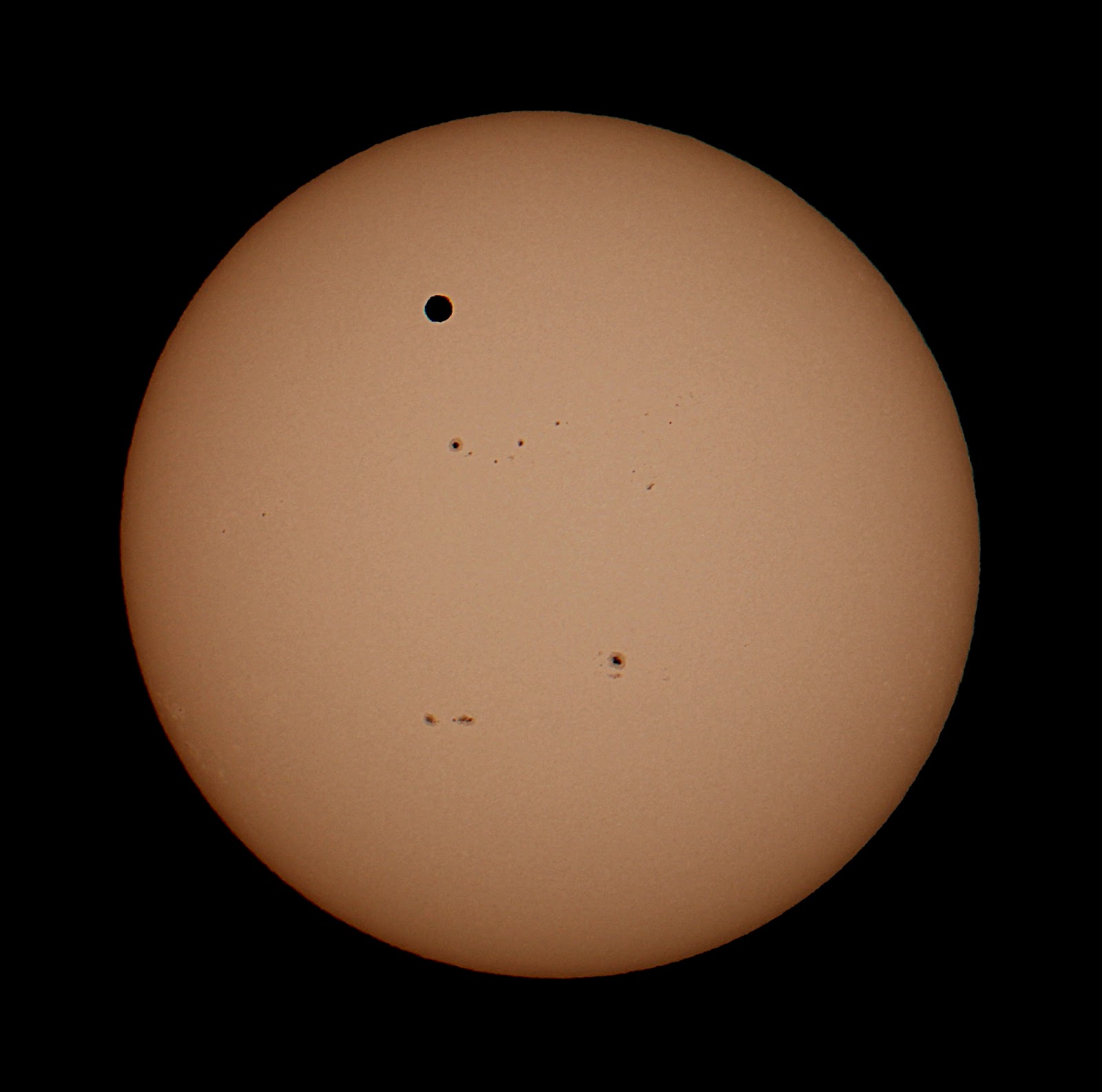
White light image 20 June

Last day of experimenting with white light imaging for a little while as my schedule will prevent me from doing any early morning soalr obsrving for a couple weeks.  This image was taken this morning at 7:59 AM MST (1459 UT) through my TEC 140 with a Lunt Herschel Prism, and a neutral density filter (13% transmission).

It was taken at 1/2500 of a second with an ISO of 800...I slightly sharpened the image and increased the contrast.  I am discovering that with this set-up this may be a compromise to hint at granulation while showing the best sunspot detail.  Everyone I talk to says to increase the focal length and use video to capture and then integrate the best frames.  I am sure this is ideal, but I am also fairly sure that my interest is not great enough (yet) for the expense of money or time.  I am pretty happy with the images so far.

Click to enlarge


Tuesday, June 19, 2012

Solar imaging experiment

I wanted to try out a little filtration when taking images of the Sun, as I was having to capture images at 1/4000 of a second which is the fastest my canon T2i will allow.  While spots have been sharp, I suspected that being able use a slower shutter speed may allow me to capture a little more of the granulation in the photosphere...so yesterday I picked up an Orion 2-inch moon filter (13% transmission) to attach between my Herschel Prism and the camera.  This morning I went out before heading to work and snapped off several pictures.

I was using the program Backyard EOS, so was able to establish up front what settings I wanted for a series of 20 exposures before running inside the house to continue getting ready for work...the slowest shutter speed I set was 1/800 of a second...turns out, I should have tried a few perhaps even slower.  I'll try that tomorrow.

Below are two images fro this morning that I believe show the granulation a little better.  The first is 1/800 of a second, and the second image is 1/1000 of a second, both at ISO 100.  I am partial to the 1/800 of a second exposure as it is inherently brighter, which is why I am wondering if a slightly slower shutter speed would still allow me to capture some granulation and provide a brighter image.  Anyway, here are the pictures and I would love some feedback.

Click the images to enlarge


Sunday, June 17, 2012

Fathers Day Sun (and a few night shots)

Happy Fathers Day to all my friends, family and faithful readers who happen to be dads.  We are a fortunate bunch-  In my case, being a Dad is the greatest thing that could have ever happened in my life.  For some reason, I have for years made a custom of making astronomical observations on holidays and other special occasions.  Perhaps because these dates mark the passage of time in my own life, it seems fitting to spend a few brief moments considering the bigger picture.

Here is the 2012 Fathers Day observation, of the Sun.  Pretty similar to the images I have been capturing lately, although perhaps I achieved a little better focus today.  Click the image to enlarge it.


Yesterday we had our first quasi-monsoon thunderstorm of the season in Tucson, meaning that we about to head into a solid 6-8 weeks of cloudy nights.  The skies did clear last night around 11:00 PM and I went out and played around with my new camera a little more...The atmospheric stability was below average, and these targets (save M 27) are in the glow of Tucson from my observatory location.  Speaking of M 27, I posted an image of it previously but wanted to try again using my OIII filter.  The filter is designed for visual use so does not have as narrow a passband as an OIII imaging filter.  This is likely a good thing in that I am using single shots and not stacking and combining multiple images.  Compared to my previous image you can see that much of the star light has been blocked and more of the nebula is visible.

Click to enlarge
My good friend Jerry wanted me to try and take a picture of M 22, a beautiful globular cluster in the constellation of Sagittarius.  This was a harder image to capture and have appear decent due to the light pollution into which the telescope was pointing.  As a result, I had to alter the contrast a bit more than I have on previous images...still nothing to write home about, but at least Jerry can now label the variable stars that he has been observing visually!  One thing that is interesting to me, is to see the dark lanes in the upper left portion of the cluster.  Tonight, I will look to note these visually

Click to enlarge
Next up was the Swan Nebula, M 17.  Similar issues with light pollution...also, emission nebula such as this emit a significant amount of light in red portions of the spectrum, which cameras like my Canon struggle to capture.  Still, given my status as rank beginner and the lack of any proper filters or integrating of images, this image is interesting.  Note the asteroid moving through the field (this is a 30 second exposure).  I captured this asteroid on three consecutive images of the swan.

Click to enlarge
Finally, because I was in the neighborhood, I took this image of a portion of M 24, the Sagittarius Star Cloud.  Same issues as above with light pollution and me messing around with the brightness and contrast.  I also slightly sharpened these images using a tool called unsharp mask.

Click to enlarge
All of these images were taken using my Canon T2i and Backyard EOS


Friday, June 15, 2012

Astronomical imaging

A week has passed since the Transit of Venus, or I as have affectionately begun to refer to it, the TofV.  While I purchased a new Canon T2i to capture the once in a lifetime event, I have been having a lot of fun with the camera learning how to take digital  pictures of all kinds.   I still have not attempted to learn any processing techniques, but have managed to connect the camera to my TEC 140 and take some more shots, both during the day (solar) and at night.

I should mention that I am also playing with some great software called Backyard EOS which I used to capture all these pictures.  The software seems fairly intuitive considering I have never done any computer controlled imaging before.  You can download a free 30 day fully functional trial, and the lifetime license is only $30.  I will certainly be purchasing the software when my trial expires.  Here are some single shots taken last night from my backyard.  All I have done in terms of processing is to slightly sharpen the images and adjust the contrast and brightness to make the background sky appear more black than it does from my observatory.  Click the images to enlarge them.

M 11 the Wild Duck Cluster
M 27 the Dumbbell Nebula
M 56 a Globular Cluster


Of course, the real reason I purchased the camera was for Solar imaging and I did manage to snap a pretty picture of the Sun this morning at 1407 UT (7:07 MST).  You can see that active region 11504 which has been churning out solar flares over the past day (9 of them at my last check) dominates the southern hemisphere with its large and dark spots.  I am pretty happy with this shot given that once again I am shooting through smoke from a wildfire.  Unfortunately, this wildfire is burning in Reddington Pass, within about a dozen miles of my house....regardless, here is today's sun taken through my TEC 140 and Lunt Herschel Wedge.  1/4000 of a second at ISO 100.


Saturday, June 9, 2012

Mass Transit

Even if you are completely saturated with images of the 2012 Transit of Venus, you must watch the video below created by NASA.  The video is from the Solar Dynamic Observatory, and defies description.  The Transit was a moving event (pun intended) to watch in person, and this video montage captures the grandeur of the event in breathtaking fashion.

Adjust the settings to HD, turn up your speaker volume and prepare to be entranced.


It is worthwhile to keep in mind that SDO only began science operations a little over two years ago!  In other words, three years ago no human had ever been able to observe the dynamic behavior of a star the way that we can now...up close, in high definition, in so many varied wavelengths of light.  I can not begin to image the technology that will exist for the next Transit of Venus in 2117.


Friday, June 8, 2012

2012 Transit of Venus

Unless you have been living under a rock, you know that this past Tuesday Venus transited across the face of the Sun...see the previous few posts.  While it has only been three days, it feels like I am the last person on Earth to get my pictures posted.  I have seen some incredible images taken by observers around the world, and  there is no way that my images can compare.  Of course, I just purchased my camera and began my foray into the world of astrophotography last week!

Click to enlarge
We hosted about 30 individuals at a special Transit program at the Mount Lemmon SkyCenter and we simultaneously provided a live web stream of the Transit.  The stream was available on our You Tube channel and our website.  While we do not yet have numbers directly from You Tube, we had over 30,000  folks check out the stream via our website!  Despite having to attend to our guests and the live stream, I did manage to run over to my TEC 140 and snap some pictures every now and then.  I took a few hundred images and ended up with just a handful of decent ones.  At left is a nice image of the Sun early in the day that I took to make sure everything was set and working.

It's funny how much my inexperience came into play.  Taking a sharp image of the Sun as above, about 90 minutes after sunrise while leisurely drinking a cup of coffee is relatively easy.  There is hardly any breeze and the atmosphere is quite stable.  Life is good.  Fast forward to the Transit- While minding my real responsibilities and trying to entertain guest, capturing the Transit photos took on a life of its own.  In addition to being rushed and distracted, the atmosphere at 3 PM is anything but calm as it is the hottest part of the day here in Tucson.  In addition to the atmospheric instability, I was set up on the summit ridge of Mt. Lemmon and experiencing fairly continuous breezes and gusts of wind in the 10-12 mph range.  I had also installed a foam shield on my telescope to keep my camera shaded and did not realize but the shield was acting like a sail keeping the telescope shaking subtly all the time.  Of course, I also forgot to engage the mirror lock up function on the camera, although I suspect with the wind it would not have mattered.  Finally, I had never practiced at sunset and had no idea about useful shutter speeds or ISO settings as the light from the Sun was being extinguished.  All in all, given my inexperience and the atmospheric challenges I am quite happy with the few usable images I ended up with.

Click on images to enlarge them:


First Contact (upper right)
in-progress now


My favorite image, Second Contact!


The Transit continues...the images get darker as the Sun was moving toward the horizon.  Click the images to enlarge:


And of course, the obligatory shot of the Venus transiting the setting Sun, terribly distorted by the atmosphere!


I think it appropriate to close this post, not with my words, but with words from the journal of Jerimiah Horrox, who first predicted and observed the Transit of Venus in 1693.  In describing his colleagues experience he wrote:

"he eagerly betook himself to his observations, and happily saw the most agreeable of all sights, Venus just entered upon the Sun.  He was so ravished with this most pleasing contemplation, that he stood for some time viewing it leisurely, as it were; and, from an excess of joy, could scarce prevail upon himself to trust his won senses.  For we astronomers have a certain womanish disposition, distractedly delighted with the light and trifling circumstances, which hardly make the least impression upon the rest of mankind...


...For what youth, such as we are, would not fondly admire Venus in conjunction with the Sun, what youth would not dwell with rapture upon the fair and beautiful face of a lady, whose charms derive an additional grace from her fortune?"

Monday, June 4, 2012

Sun Spot Shot June 4th

One thing about having an observatory is that there is no set up required to look through the telescope...so this morning I was able to head outside, open the roof, attach the camera, fire off 20 shots and be back indoors within about 20 minutes.  I managed to grab a couple shots with the Canon T2i in moments of decent seeing and here is one of them...taken with the TEC 140 and Lunt Herschel Prism...click for full size:
Click to enlarge to full size

Compare to the image from the Solar Dynamics Observatory (I know, they are reversed left to right...)