It has been a busy and fun summer and I have gotten out of the occasional habit of posting to this blog. In the last two months I have taken trips to the Grand Canyon, North Carolina, San Francisco and am headed to Denver next week. Sometimes life is just too entertaining to take the time to sit and update the cyber world as to my movements. Besides, it keeps my mother guessing. So once again rather than write much I'll share a few pictures with more to follow.
Taken in May from the geology vista pullout on the Catalina Highway is this shot of the Milky Way over the light dome from Tucson. We were out hoping to observe a newly identified meteor shower (the Cameleopardalids) and while the shower did not pan out, I did laugh at this shot of the Milky Way which actually hatched my plan to get out of a ticket should the Sherriff stop...."well officer, I thought it meant no parking in the Milky Way?"
Hopefully you have seen the time lapse of the Milky Way that I posted previously from the Grand Canyon North Rim Star Party in June, and this is a shot that shows you the veranda which sreved as our home base for the week...clearly, the best place to be on Earth in June.
This summer in Tucson provides few opportunities for astronomical observations...even when it is not raining we are frequently clouded out. The picture below was taken at my house of some very dirty looking clouds. I am starting to focus a little more on becoming a better photographer and taking pictures of these clouds was rather challenging, and the result is not too bad.
That's all for this post...next up will be a few pictures from Mount Lemmon.
Friday, August 15, 2014
Monday, June 30, 2014
Milky Way Time-lapse
I just returned from spending 8 nights supporting the 2014 Grand Canyon Star Party as a volunteer at the north rim lodge and visitors center. It was a fantastic time doing astronomical outreach with great friends. While I have barely had a chance to unpack, I did spend a few minutes tonight stitching together 285 frames I shot of the Milky Way into a 30 second time-lapse. Each frame was a 25 second exposure with my canon T2i and 10-22mm zoom lens at the 10mm setting. I do hope to write a trip report and share some of the photos here on my blog, but for now enjoy the video below. I recommend clicking 'play' and then on the settings icon on the right and selecting full HD as the video will default to a lower resolution.
Tuesday, June 10, 2014
Dirty Science
As I prepare to head up to Mount Lemmon for one of the last UA Sky School activities of the school year, I wanted to share a video piece that was very recently produced by UA News in which I talk extensively (imagine that) about the Sky School. And for the record, I actually do have more hair than appears in the video! If you would like to see many images of schools participating in our programs, I suggest (with a shudder) checking out our UA Sky School facebook page.
Monday, May 12, 2014
Portal, AZ dark skies and good times
![]() |
| Milky Way over Chiricauhuas |
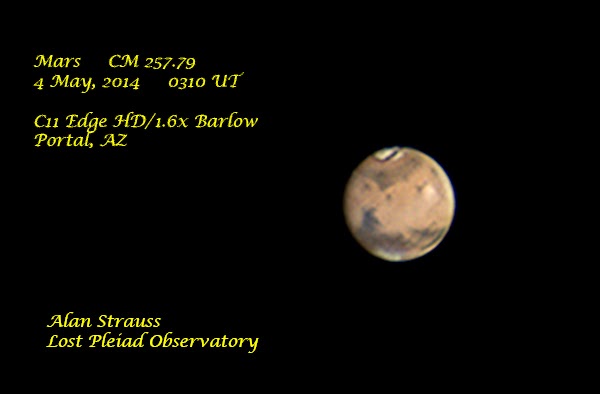
Slowly this blog is turning to more photos than text and I guess that is a factor of being so busy with work. When I have free time I spend it with family or in my own observatory and do not take much time to write the blog these days. In fact, I am about to head out to Mount Lemmon for a UA Sky School trip and need to finish up this brief post quickly. Below I present three images from the Portal trip...one taken of Mars through my 11-inch Celestron Edge HD, and two of the milky way rising.
First, Mars:
In the Milky Way images below, I was using my new Canon 10-22mm zoom, at the 22mm setting. These are single 30-second exposures and I used a red flashlight to 'paint' Jerry and myself during the exposures. I am in the upper image, Jerry in the lower.
While these images are a bit noisy due to the high ISO, what is notable is the lack of light domes near the horizon. There are now small domes visible from El Paso and Lordsburg that rise perhaps 2 degrees above the horizon in long exposures, but these domes are a bit to the north of this exposure.
Tuesday, April 15, 2014
Total Lunar Eclipse
The full report and images will come later, but I wanted to quickly share one of the images I took during last nights total lunar eclipse. I captured a couple hundred images through my 90mm Stellarvue triplet refractor and 1.6x Barlow lens using my Canon T2i, and they are all in RAW format...so when I have the time to go through them I hope to perhaps make a time-lapse of the eclipse, or at least share some of the nicer shots. For now, enjoy this image taken at 12:54:54 local time (0754 UT on April 15th). Click the image to enlarge.
Sunday, April 6, 2014
Spotting a solar prominence and prominent solar spots
Spending this weekend at home, catching up on all the wonderful responsibilities and tasks that accompany being a husband, father and law abiding citizen, finally afforded me some time to enjoy observing the Sun. As much as I enjoy preparing my state and federal taxes I believe I enjoy observing more...and the good news this year is that I do not need to pawn an eyepiece or two to pay a tax bill.
Saturday I spent a bit of time observing the Sun through my 60mm Hydrogen Alpha telescope, and was just starting to take some images when the power went out in our neighborhood. Fortunately, I had already captured an image of a fantastic prominence before the power went out...and it is presented below. I had to blow out the disc in order to expose the prominence, but you can see just how impressive it was. Consider that the Sun is about a million miles in diameter and that this prominence was approximately 15% of the solar diameter in size and it is safe to assume that this tower of plasma was standing at least 150,000 miles high!
This morning I opened up my observatory and used my 90mm Stellarvue triplet equipped with a Lunt Solar Systems Herschel Prism to observe the Sun in white light. I was rewarded with some steady views that showed several spot regions. Below is a stack of 300 frames taken with my ASI120MC camera, at 9:04 AM local time (1604 UT). Click the image to enlarge it to full size.
For comparison, here is an image from the Solar Dynamics Observatory taken near the same time with the active regions labelled. As you can see, good optics, a decent camera and steady seeing can produce some impressive results!
Saturday I spent a bit of time observing the Sun through my 60mm Hydrogen Alpha telescope, and was just starting to take some images when the power went out in our neighborhood. Fortunately, I had already captured an image of a fantastic prominence before the power went out...and it is presented below. I had to blow out the disc in order to expose the prominence, but you can see just how impressive it was. Consider that the Sun is about a million miles in diameter and that this prominence was approximately 15% of the solar diameter in size and it is safe to assume that this tower of plasma was standing at least 150,000 miles high!
This morning I opened up my observatory and used my 90mm Stellarvue triplet equipped with a Lunt Solar Systems Herschel Prism to observe the Sun in white light. I was rewarded with some steady views that showed several spot regions. Below is a stack of 300 frames taken with my ASI120MC camera, at 9:04 AM local time (1604 UT). Click the image to enlarge it to full size.
For comparison, here is an image from the Solar Dynamics Observatory taken near the same time with the active regions labelled. As you can see, good optics, a decent camera and steady seeing can produce some impressive results!
Friday, April 4, 2014
A little Mars love
Between working many days and nights and generally poor skies on my days off, there have not been many opportunities for me in the past few weeks to get out and practice observing or imaging Mars in my backyard. Last night was the rare night where skies were clear and I was at home with some time to observe. Both seeing and transparency were slightly below average, but this photon deprived boy was not about to complain.
I opened up the roof and spent some time observing mars through my C11 between about 9:00 and 9:30 local time (0400 and 0430 UT). The north polar cap has noticeably diminished in size over the past month as the Martian spring advances and there is a darker collar on the southern edge of the cap. There continues to be very bright limb haze. I had a hard time noting many dark features, likely due to Mars still hanging low in the east during my early observation. I was able to identify Terra Cimmeria in the south, but that was about it. While the image would no doubt be better with Mars higher in the sky, I was not about to stay up until midnight as I was looking forward to sleeping in my own bed for the first time in a few nights.
Below is an image I took using my ASI120MC camera, and it represents a stack of about 200 frames out of 2500, taken through the C11 and a 1.6x barlow lens. You can see the north polar cap as well as the thin dark collar below it. The wider, dark area south of the polar cap is Utopia Panitia. At the south of the planets disc, the darkest feature facing us is Terra Cimmerium. The bright spot near the limb on the right is Olympus Mons, and you can see the haze on the limb.
For comparison, here is a simulated image from calsky.com of mars at about the same time:
Currently, Mars is visual magnitude -1.40 with a true distance of 0.6286784 AU (94048948 km) from Earth. In light time, it is 0h 05m 13.71s distant. Hopefully as Mars come to opposition next week, I'll have more opportunities to take some images of the other side of the planet as well.
I opened up the roof and spent some time observing mars through my C11 between about 9:00 and 9:30 local time (0400 and 0430 UT). The north polar cap has noticeably diminished in size over the past month as the Martian spring advances and there is a darker collar on the southern edge of the cap. There continues to be very bright limb haze. I had a hard time noting many dark features, likely due to Mars still hanging low in the east during my early observation. I was able to identify Terra Cimmeria in the south, but that was about it. While the image would no doubt be better with Mars higher in the sky, I was not about to stay up until midnight as I was looking forward to sleeping in my own bed for the first time in a few nights.
Below is an image I took using my ASI120MC camera, and it represents a stack of about 200 frames out of 2500, taken through the C11 and a 1.6x barlow lens. You can see the north polar cap as well as the thin dark collar below it. The wider, dark area south of the polar cap is Utopia Panitia. At the south of the planets disc, the darkest feature facing us is Terra Cimmerium. The bright spot near the limb on the right is Olympus Mons, and you can see the haze on the limb.
For comparison, here is a simulated image from calsky.com of mars at about the same time:
Currently, Mars is visual magnitude -1.40 with a true distance of 0.6286784 AU (94048948 km) from Earth. In light time, it is 0h 05m 13.71s distant. Hopefully as Mars come to opposition next week, I'll have more opportunities to take some images of the other side of the planet as well.
Subscribe to:
Posts (Atom)