 |
| 2004 Transit |
I believe it is safe to day I've boarded the A train (Alan train) to H-E- double hockey sticks...(this is a family friendly blog, no cursing!). I am so excited for the Venus Transit that will occur on Tuesday that I decided I was going to attempt to image the event. After all, this is the last Transit of Venus that will occur in my lifetime and the only previous one in 2004 was not visible from the west coast of the US. The next Transit is in December of 2117 at which point I, along with everyone else alive today will have been reduced back to stardust.
This decision to take images of the Transit of Venus was made about 7 days in advance....i.e. last Tuesday. The "problem," if you will, is that in all my years as an amateur astronomer I have been strictly a visual observer. Sure, I look at many astrophotos every day, but take one!?! I leave that to the experts like my colleague
Adam Block at the Mount Lemmon SkyCenter. Back in the veyr late 1990's and until about 2001 I had an old Ricoh 35mm film camera that I used to snap some occasional shots of the Sun through my trusty C8...however, the difficulties of getting decent focus and the expense of developing rolls of film for one or two good shots quickly turned me off. I simply enjoyed using the old peepers and making a sketch. Skip ahead a dozen years and along comes the Transit of Venus. Impulsively on Wednesday, I purchased my ticket on the A-Train and am now traveling the road to...
I decided to take the plunge and purchase a Canon T2i DSLR camera. I went with Canon for a few reasons. One is that when I graduated college (shortly after the invention of the wheel) I purchased a then brand new first generation EOS Rebel 35mm film camera. I backpacked through Mexico and took countless other trips with that camera and it really delivered excellent images. Secondly, the astrophotographers that I know and trust who own DSLR cameras utilize Canon. Finally, although I have not yet downloaded or tested it, there is a software program called
BackyardEOS that has been developed by an astrophotographer that is not only economical ($30) but well regarded among amateurs like myself. Below are pictures of the Canon T2i for those of you wondering what it looks like.
Just so one can appreciate my timeliness in preparing for this event, I purchased the camera on Wednesday afternoon and then hightailed to
Starizona in order to purchase a T ring and adapter so that I could couple the camera to my telescope. Wednesday night I read key parts of the manual and did a little internet research on some recommended settings for imaging the Sun. Thursday morning I awoke an hour early to set up my white light solar telescope and take some practice shots. Using my 102mm f/11achromatic refractor and my Lunt Solar Systems Herschel Prism I quickly ran into my first problem...I could not achieve focus. With no time to consider alternatives, I packed up and went to work. Thinking through things later that night, I decided that I really should use my TEC 140 apochromatic refractor to capture this historic event as it is a precision telescope. Why would I purchase such a nice camera and then consider using a cheap lens? Further, the TEC 140 is shorter at f/7 and has a feathertouch focuser which is designed for imaging!

Faithfully on Friday morning I again got up an hour early and tried to reach focus....Success! I spent about 30 minutes trying different exposures and then hustled off to work. I had a lot to get done in the morning and then had to drive a couple hours north to Phoenix to give a talk at the
Saguaro Astronomy Club monthly meeting. The meeting ended at 10 PM and I was home in bed by 12:30 AM. Thank goodness my dear spouse runs faithfully several times per week...not only does it give me a heavenly body to observe (remember, family friendly) but she runs shortly after sunrise and as a result I was awake at 0700 this morning to try again.
Below, I give you a single shot taken at 1/4000 of a second, ISO 100, at 8:15 AM MST (1515UT) through the TEC 140 and Lunt Herschel Prism. The only processing done here was to reduce the image scale (which I cut about in half) and to slightly sharpen the image. The color (hopefully) comes from the fact that there is a layer of smoke in the sky from the Gila fire across the New Mexico border. This is the largest wildfire in NM history and the smoke has been filling our skies for days. You can see in the image that I know nothing about processing yet. Make sure to click on the image and enlarge it to full size.
 |
| Click to enlarge |
You can see in the image that I captured the visible sunspot groups as well as some extensive facula surrounding the spot groups near the limb. Overall I am quite happy with this first attempt, and my plan is to capture many raw images of the Transit of Venus on Tuesday and then I can take my time and learn how to process them after the fact.

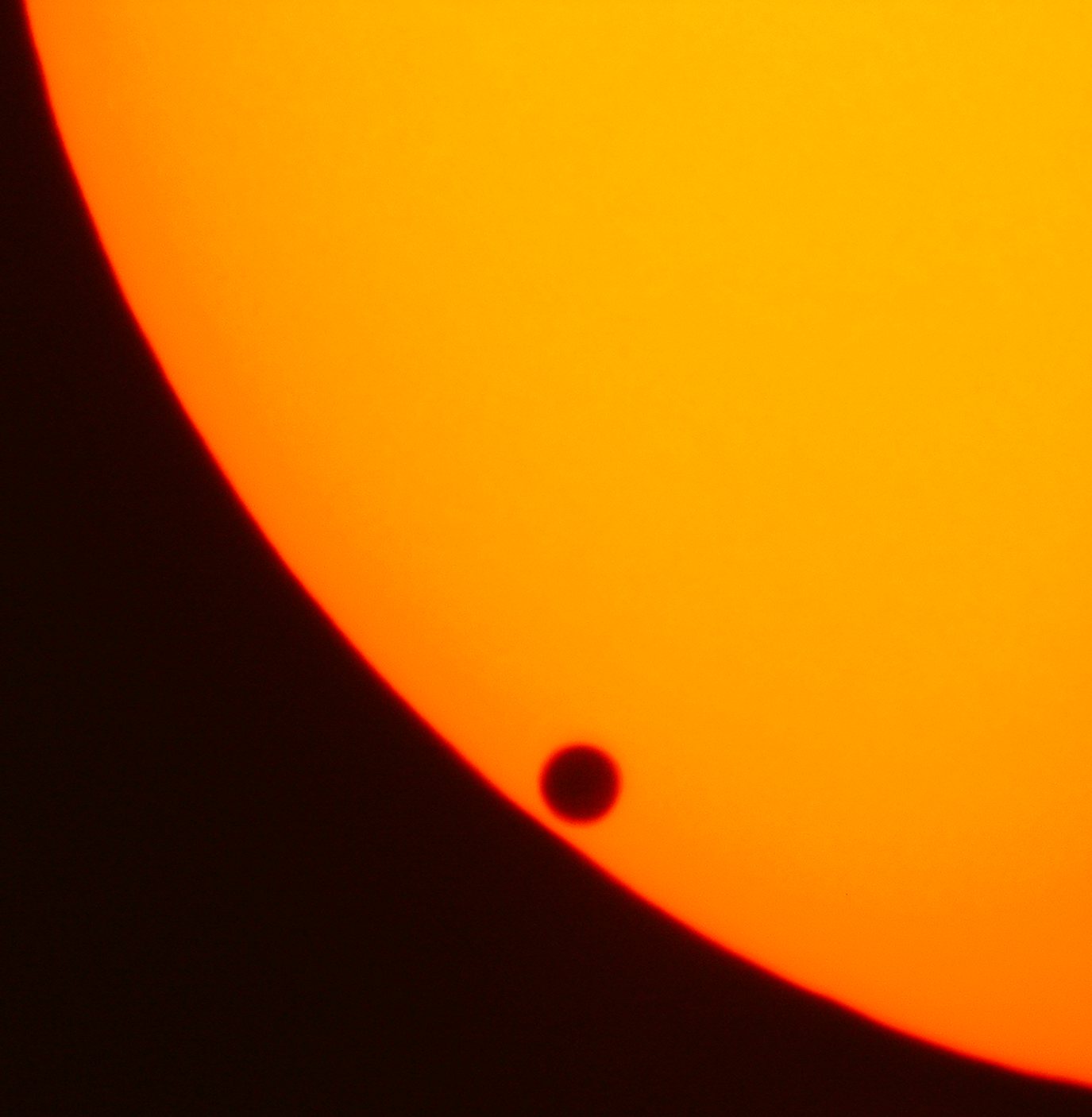


 Unless you are nocturnal, you no doubt realize that yesterday many folks on Earth were treated to a very spectacular Annular Solar Eclipse. The reason that this eclipse was annular (coming from the Latin, annulus, meaning ring) is that the moon was at it's furthest point from earth in its elliptical orbit when it passed between us and the Sun. This was a very beautiful event to witness from start to finish, and I was fortunate to be working with my colleague Adam Block as we conducted a very special eclipse program at the Mount Lemmon SkyCenter. We set up multiple telescopes providing guests views in both white light and hydrogen alpha, as well as providing everyone with specialized eclipse viewers. While we had about 80 individuals on top of Mount Lemmon viewing the eclipse, we had literally thousands who watched a live stream of the eclipse over the internet. We will do this again for the Transit of Venus on June 5th, and if you would like the web address, drop me an email. I took the image at left near the time of greatest eclipse (6:38 PM local MST).
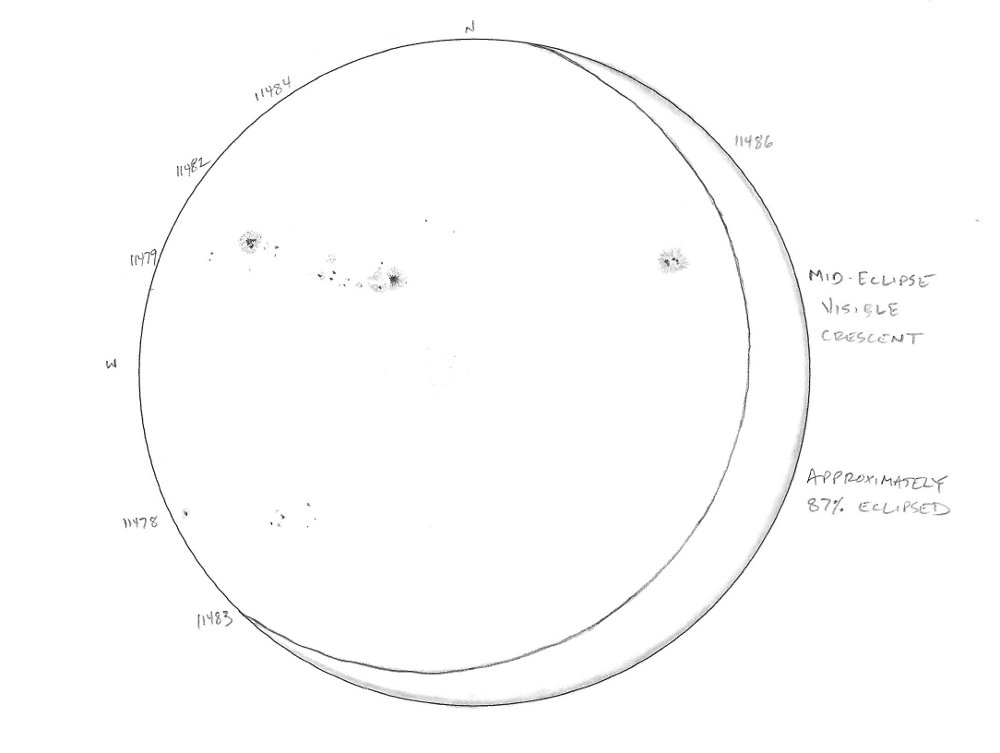 I made a white light sketch of the Sun prior to the eclipse to note the days spots, and then drew in the approximate maximum eclipse. I was quite busy keeping an eye on our live feed as well as entertaining guests, so my sketch is truly an approximation as I lost track of which part of the Sun's disc was not eclipsed. You can see in the sketch that we experienced about 87% of the Sun, including all the sunspots eclipsed by the moon. Click the sketch to enlarge it.


