Sunday, March 27, 2011

Solar sketches March 27th

Hydrogen Alpha 1550 UT
For those of you that follow the sun regularly, you know that it is ramping up in activity.  With the increasing activity, it is beginning to take longer and longer for me to make solar sketches...this means that I am sacrificing some of the fine detail available at the eyepiece in an effort to capture all the varying regions and features.  I was able to make two sketches this morning under very steady and transparent skies.

There are 8 active regions (AR's) on the face of the sun right now, as detailed in the sketch at left.  Of the regions, AR 11176 is the largest and most dynamic.  It sports a plethora fine detail as well as several dark filaments that wind throughout.  There are several spots visible in hydrogen alpha, along with some moderately bright plage.  AR 11178 in the SE is small, yet also reveals a couple spots.  Of the regions in the southern hemisphere, 11181 is the brightest, and it too shows a single dark spot.  In the northern hemisphere, both 11177 and 1180 are moderately bright, with 11180 being more complex.  This region contains some very dark filaments as well as a single spot.  11179 is unremarkable.  Finally, there is an AR that has rotated into view in the northeast near the equator that is fairly bright with a leading spot.

White Light 1625 UT
White light views of the sun provide the most detailed views of sunspots, and the sketch to the right reveals many spots in all of the active regions on the east half of the sun's disc.  While AR 11176 is the most complex as it was in hydrogen alpha, the as of yet unnumbered region in the northeast contains at least a half dozen spots.  As this region is still very close to the limb, it is a bit difficult to ascertain it's true extent.  The white light sketch was made with my TEC 140 refractor and a Lunt Solar Systems Herschel Wedge.

Wednesday, March 16, 2011

March 19th Perigee Full Moon

It's true and not an internet hoax...the full Moon of March 19th will be the biggest since 1983!  Approximately 14% larger and 30% brighter!  Check out the explanation video from NASA.

Sunday, March 13, 2011

Solar report March 13th

Time to get back to posting!  I've been terribly busy between my day job, working at the Mount Lemmon SkyCenter, the start of little league season, and a torn MCL in my left knee!  That last bit was the result of a ski accident on Valentines day in Brighton, Utah...nothing that a bit of physical therapy and time shouldn't fix...

I was finally able to set up my telescopes on the sun this morning and take a look at what is undoubtedly the most activity I have observed since I started observing the sun with my own scopes.  The past two weekends have presented terrible sky conditions, and even yesterday I was clouded out.  Whatever this solar cycle turns out to be, it is fun to see El Sol ramping up in activity.  I made two sketches this morning, first one in white light and about an hour later I made one in Hydrogen Alpha.  The white light sketch below was completed at 1550 UT (8:50 AM MST) using my TEC 140 APO and a Lunt Solar Systems Herschel Wedge, under nearly perfect seeing conditions.  No atmospheric turbulence was noted, and I was able to utilize magnifications approaching 200X.  There are numerous spots in both active regions (AR) 11166 and 11169.  In addition to these regions which are approaching the western limb, there are 5 spots noted in AR 11172, and three spots noted in the northern hemisphere right on the central meridian.  These three spots correspond to plage noted in my hydrogen alpha observation further down.  To the right of my sketch, is an image from the Solar Dynamics Observatory taken at 1600 UT, just 10 minutes after my sketch.  Note that it is reversed east-west from my sketch.


I then grabbed a second cup of coffee and started in on an observation and sketch of the sun in hydrogen alpha.  The seeing was beginning to get back to average, but the sun was still a sight for sore eyes that had not observed the Sun since February 24th.  The sketch was completed at 1657 UT (9:57 AM MST) using my Lunt Solar Systems 60mm pressure tuned hydrogen alpha telescope.  As mentioned there is a bit of plage on the central meridian that corresponds in location to the three spots noted above.  This area is not yet designated an active region but will no doubt be AR 11173 shortly.  AR's 11166 and 11169 are quite bright and contain several spots as well as many fibrils.  11171 is quite large in the southern hemisphere with a long dark filament snaking through.  This region was not noted in white light, yet appears as the largest region in hydrogen alpha.  Near the east limb AR 11172 displays weak plage and some short dark filaments within.  To the right of my sketch is another image from the Solar Dynamics Observatory taken at 1654 UT, during the time I was drawing.  Again, the image is reversed east-west from my sketch.


Thursday, February 24, 2011

The Great Orion Nebula


Without a doubt almost any observer will tell you that the Great Orion Nebula is the finest deep sky object in the northern hemisphere.  Riding high in the winter and spring, I take a glance at this showpiece just about every time I am in the observatory.  It is so detailed and rich that I have been hesitant to attempt to sketch it...however, I finally decided to give it a try.

While I have done most of my sketching with HB graphite pencils on plain white paper, I have been experimenting utilizing Strathmore Black Artagain paper with Generals White Charcoal Pencils (558)...at left is the sketch that I completed this evening with my LX-200 12 inch SCT and 28mm UWAN eyepiece (108X). It does not do justice to the nebula, but it certainly is good practice with these new materials.


What does this nebula look like in color?  Below is an image taken from the Mount Lemmon SkyCenter through our new Televue NP127is.  The image gives a significantly wider, lower power field of view...and it represents 3 hours of exposure time.
Copyright Adam Block/Mount Lemmon SkyCenter/University of Arizona

Sunday, January 30, 2011

Making solar sketches

January 30th, 2011
I have received a few emails and messages from folks over the past year asking about how I make my sketches of the sun, so I thought I would write up a small post showing my (lack of) technique.   First, I must provide credit to my good friend, observing partner, and mentor in all things astronomical Jerry Farrar.  Jerry is truly a master at sketching and he is the one that taught me the method that I will overview below.

My goal in sketching is twofold.  First and foremost sketching makes me a better observer.  Whether at night or during the day, I spend more time observing faint and fine details when I am trying to re-create them on paper.  Second, and less important to me, is to keep a record of my solar observations.  As  a result of my priorities, I do not fret over the exact positioning of details although I do try and maintain the size and perspective as they appear in the eyepiece.

I begin by printing out a blank solar observing form that has been made publicly available by sketch artist Jeremy Perez, who maintains the Belt of Venus website.  I then use a graphite HB pencil to shade in the entire disc.  Do not worry at this point about uneven shading, as the rest of the process will even out the Chromospheric network that I try to represent.  Below are the first two steps in the process:
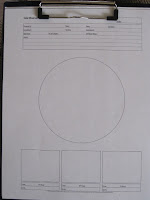

The next step takes awhile, and I have actually gotten in the habit of preparing these solar discs ahead of time. By doing these ahead of time, I can get right to observing and sketching the Sun when my schedule and the weather cooperate.  I sharpen my pencil and then add a layer of random squiggly (technical term) lines over the entire solar disc.  I am careful not to draw circles or straight lines, as inevitably these show through in the final product...and what I am after is a  randomness to the look of the disc.  Once I have filled the entire disc with squiggles, I take a blending stump and using small circles, rub the drawing to blend both layers of graphite that I have applied.  I do try and blend the disc to a somewhat even appearance so that I do not end up with areas that are markedly darker or lighter than others.  The idea is that when I am done, the squiggly lines still show through a bit and the disc resembles the hydrogen alpha view of the sun without any features.


At this point I am done, if preparing ahead of time, as this discs are ready for use in making a solar sketch.  Prior to drawing in any details such as active regions, filaments and prominences, I spend about 10-20 minutes observing the sun to get the overall picture of the disc, noting what details are present and where they are.  I also adjust the tuning of the etalon filter in my scope to bring out some of the features that are best observed on the blue and red wings of the hydrogen alpha band.  Once I have seen what I believe can be seen that day, I use an eraser to mark the locations of plage and active regions.  I erase an area that is slightly larger than the actual region, so that I can then fill in the edges, creating a more realistic look and shape.  Once I have these regions erased into the sketch, I use them as markers to locate filaments and prominences around the disc.  After I have drawn in these these other features, I return to the plage areas and spend some time filling in spots, filaments, fibrils, whatever I can.  Typically I see much more detail than I can record, however, I try to finish my sketch feeling like I captured the significant details. I will often use a mechanical pencil to draw some of the faint magnet field field lines that surround the plage areas.


There you have it, the secrets of a solar sketching hack revealed!  Feel free to drop me a note with any questions...


Saturday, January 29, 2011

Happy Birthday Son Sun observation

Invitation to 1st Birthday!
Busy day today, but nothing compared to 12 years ago...on January 29th 1999, Ian finally arrived!  I say finally as he had been trying to come for almost 6 weeks and it was all Beth could do to keep his restless little behind in the womb while she remained on bed rest at Tucson Medical Center.  It has been a fun filled 12 years and each year seems to get better and better.  We started our day today with player evaluations for little league Majors division, and Ian did great in both fielding and pitching evaluations.   While I'll help out coaching soon enough, I spent the 3 hours this morning leaning over the outfield fence, sipping my coffee and appreciating how lucky I am to have such a wonderful son.  We already have memories to last a lifetime and I am increasingly proud of the young man he is becoming. Ian woke early this morning and quickly reminded us that it is only 4 years until he receives his drivers license.  Wow...I am sure it will feel like tomorrow.


As we get ready to have the family over to celebrate, I slipped outside to make an observation of the Sun on my son's birthday.  overall, it remains fairly quiet, with a few small active regions (AR) and small prominences.  You can see below in my sketch that AR 11150 in the southeast is the largest and brightest of the regions.  It appears to have at least one small spot and contains many magnetic field lines.  AR 11151 near the west limb is fairly small and appears to be deteriorating.  In the northeast, there is an extremely bright prominence accompanied by a bright plage region that may be heralding an AR coming around the limb.  My sketch was completed at 1921 UT (12:21 MST) using my Lunt 60mm Hydrogen Alpha Solar Telescope.

Saturday, January 22, 2011

Eruptive prominence!

This morning's observation of the sun was quite a treat.  Not only are there two attractive Active Regions (AR) near the center of the Sun's face, but there was a massive eruptive prominence on the northwestern limb.  My sketch below does not do justice to the brightness and detail of the prominence, but it does give you an idea of the size.  For reference, the prominence is likely at least 10-12 earth diameters high! ( It would take about 110 earths lined up to cross the diameter of the Sun).


The sketch was completed at 1625 UT (9:25 MST) under very steady skies.  During the time of the sketch, the prominence was changing rapidly- every time I would look at it after drawing in one of the active region details it had evolved.  I drew the prominence first and by the time I finished the drawing, the prominence looked entirely different. Below are images (reversed left to right from my drawing) from the Solar Dynamics Observatory in hydrogen alpha and white light.  The white light image shows the sunspots associated with the two AR's. Due to some delay in data, the images are from several hours prior to my sketch.